Rod Bantjes, “Fabritius_Box.html,” last modified, 2 September, 2024 (https://people.stfx.ca/rbantjes/).
Fabritius Pantheon
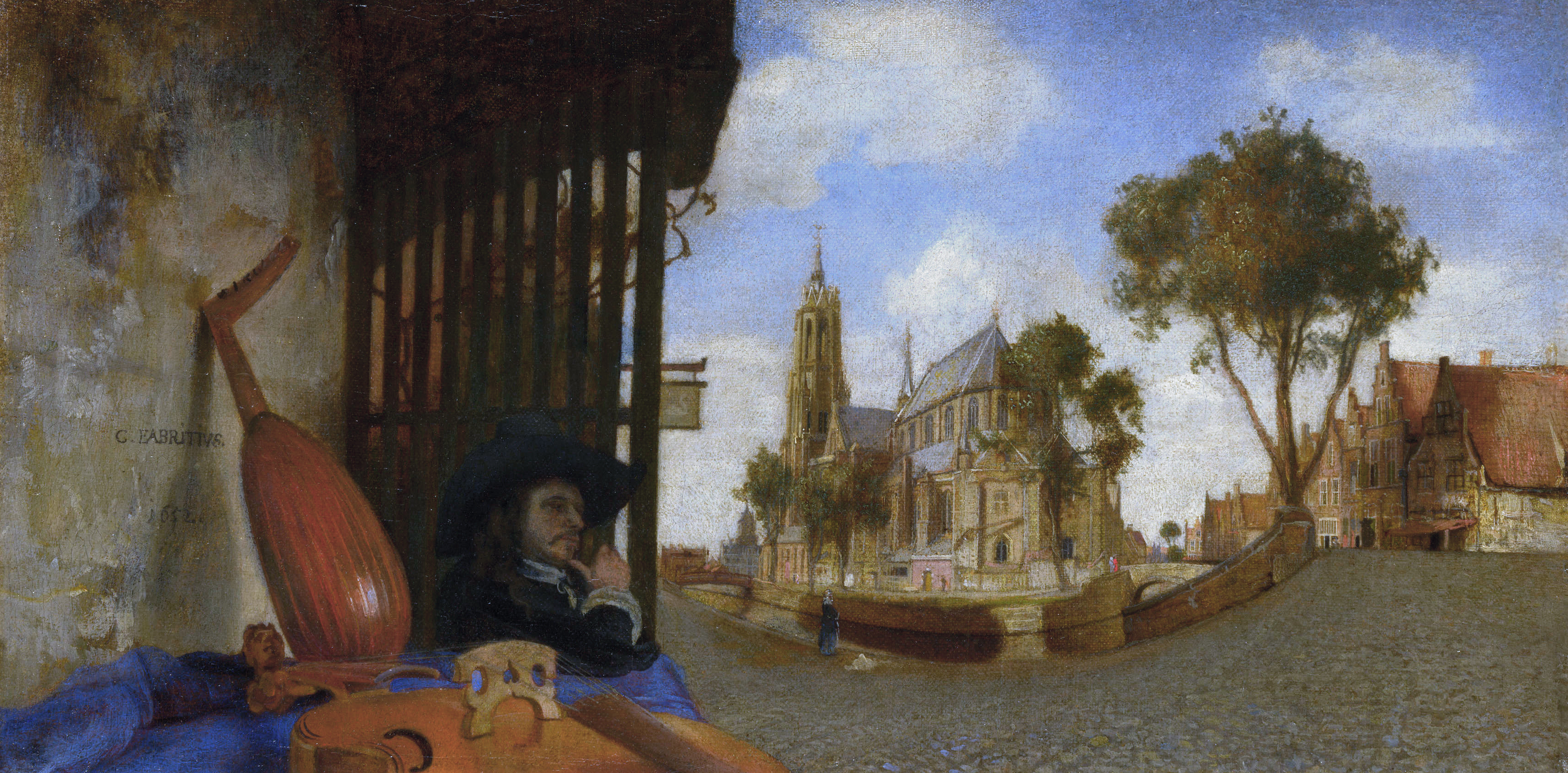 |
Figure 1 – Fabritius, 1652, A View in Delft |
1. The Wide-Angle View
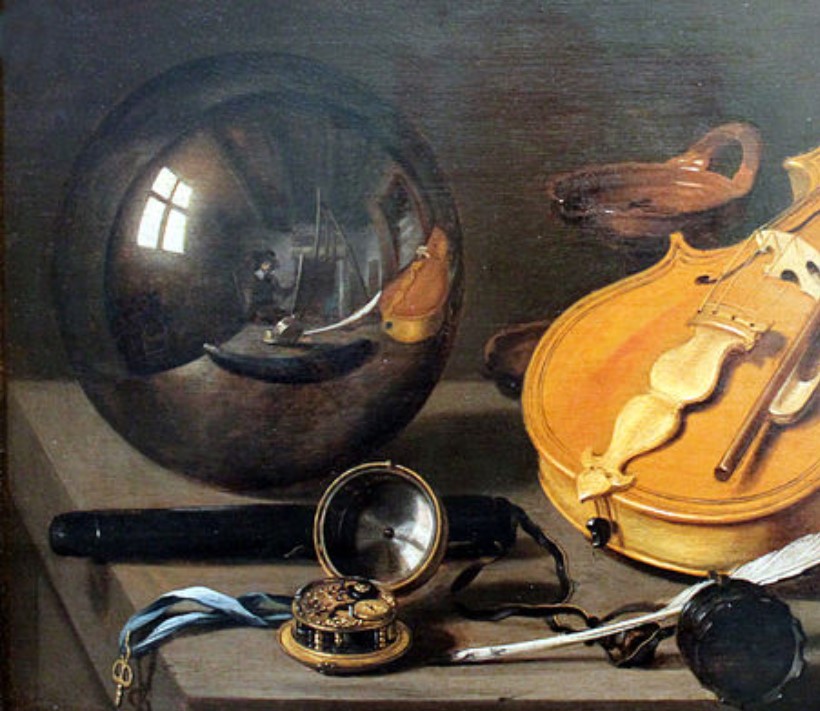 |
Figure 2 – Claesz, 1630s, Vanitas Still Life [detail] |
Dutch artists of the 17th century were interested in the wide surround of space that we experience but which conventional painting could not depict. Two devices had been invented to assist in evoking the all-round view. One was a convex mirror which Claesz uses in Figure 2. These reflect the world outside the frame of the painting and you can see them everywhere in art from this period – even in mundane reflective surfaces like wine-glasses and grapes.
The other device was a rotating camera obscura invented by Kepler in 1620. I am currently building one and will report on it soon. It functions very like the panorama feature of your smartphone camera. Fabritius's View in Delft always looked to me as though it had been made with such a device. Others disagree.[1]
What most scholars do agree on is that the painting was once displayed on a curved surface inside a viewing-box. So I decided to build such a box and make it so that the curvature could be changed between the tight curve that Liedke prefers and the wide curve that makes sense if the painting were made with the aid of a rotating camera obscura.
2. Making the Box
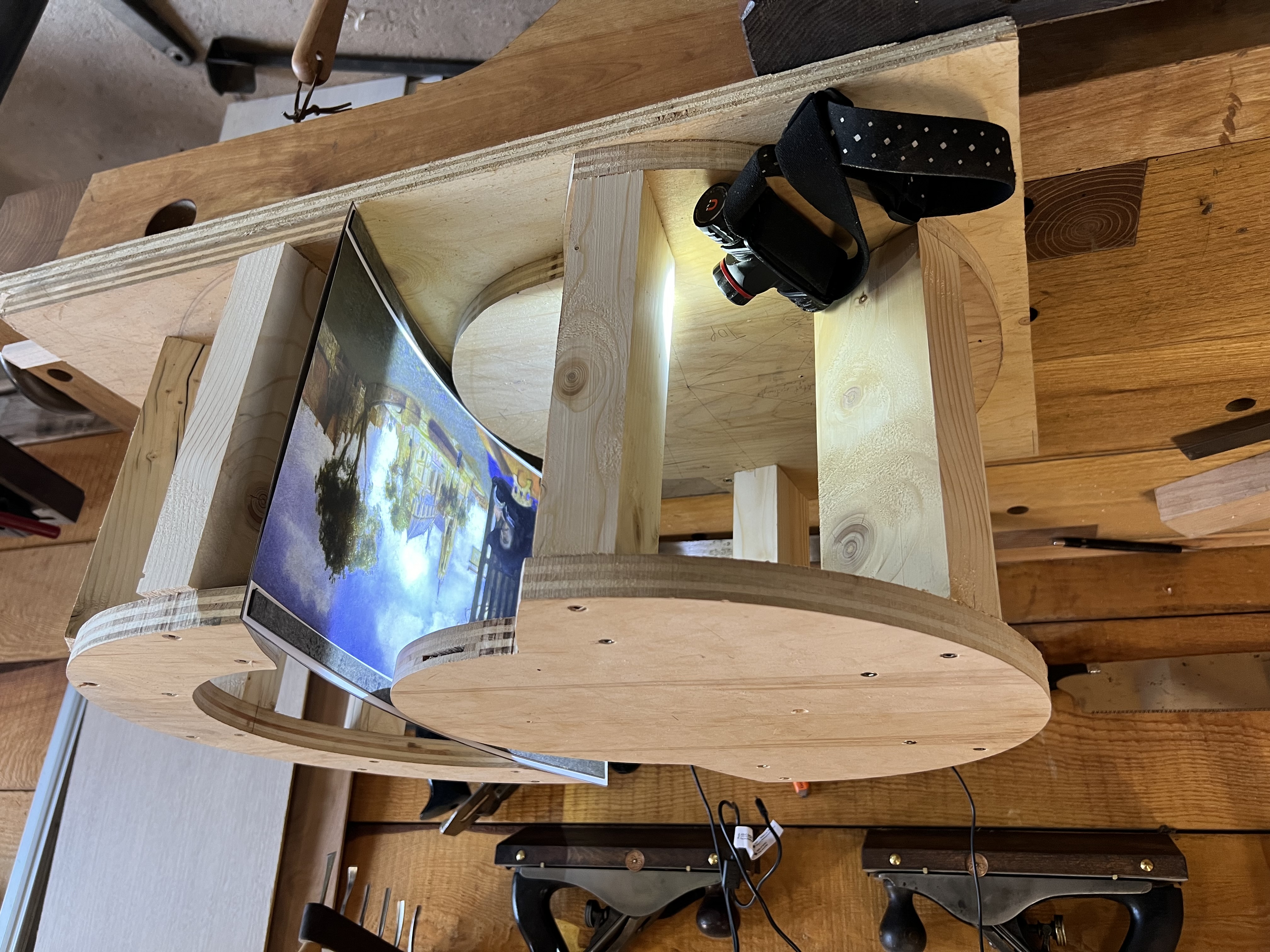 |
Figure 3 – "First Draft" of the box |
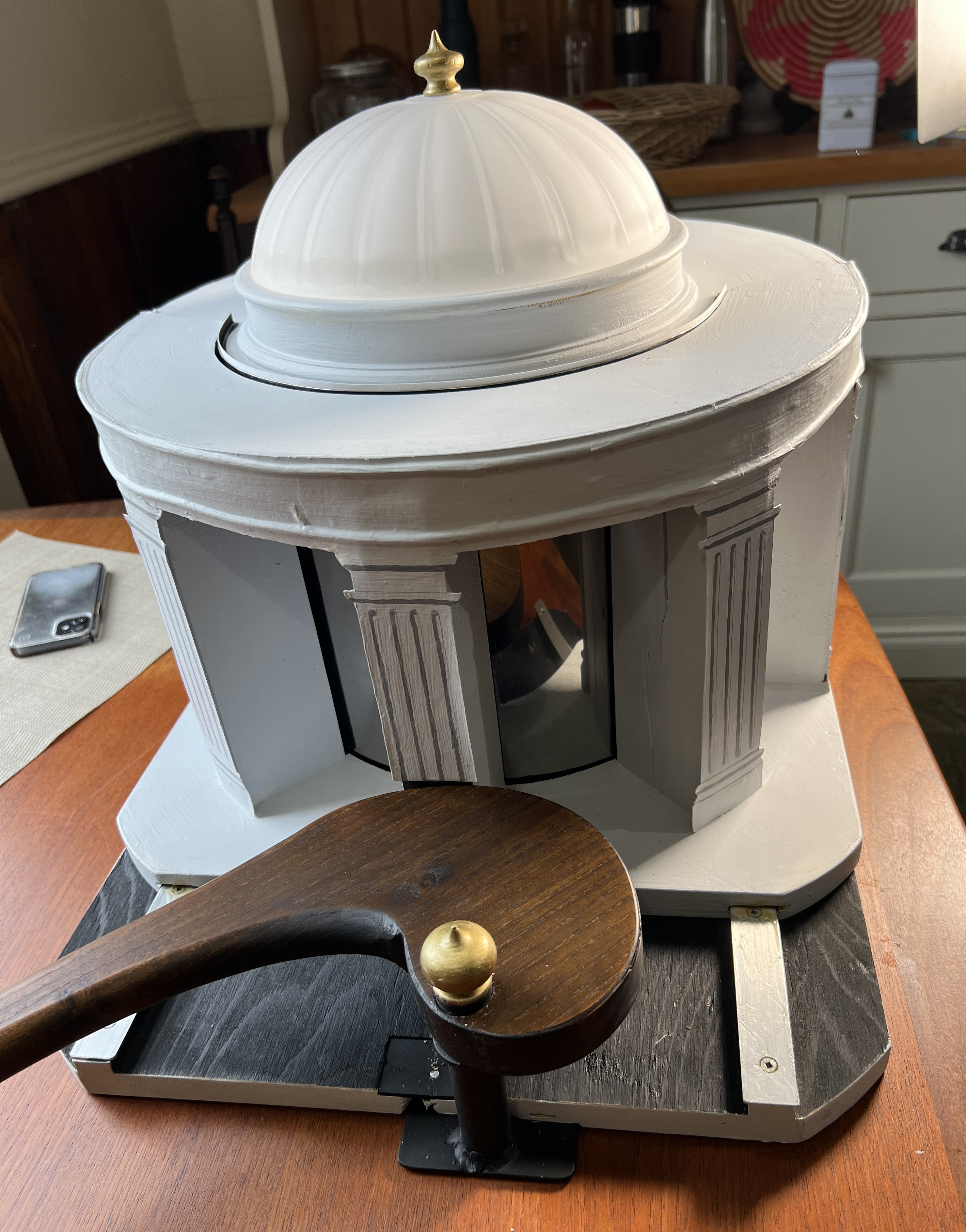 |
Figure 5 – Cam Mechanism |
| Here the box is closed and the image is exhibited on the tight curve favoured by Liedke. |
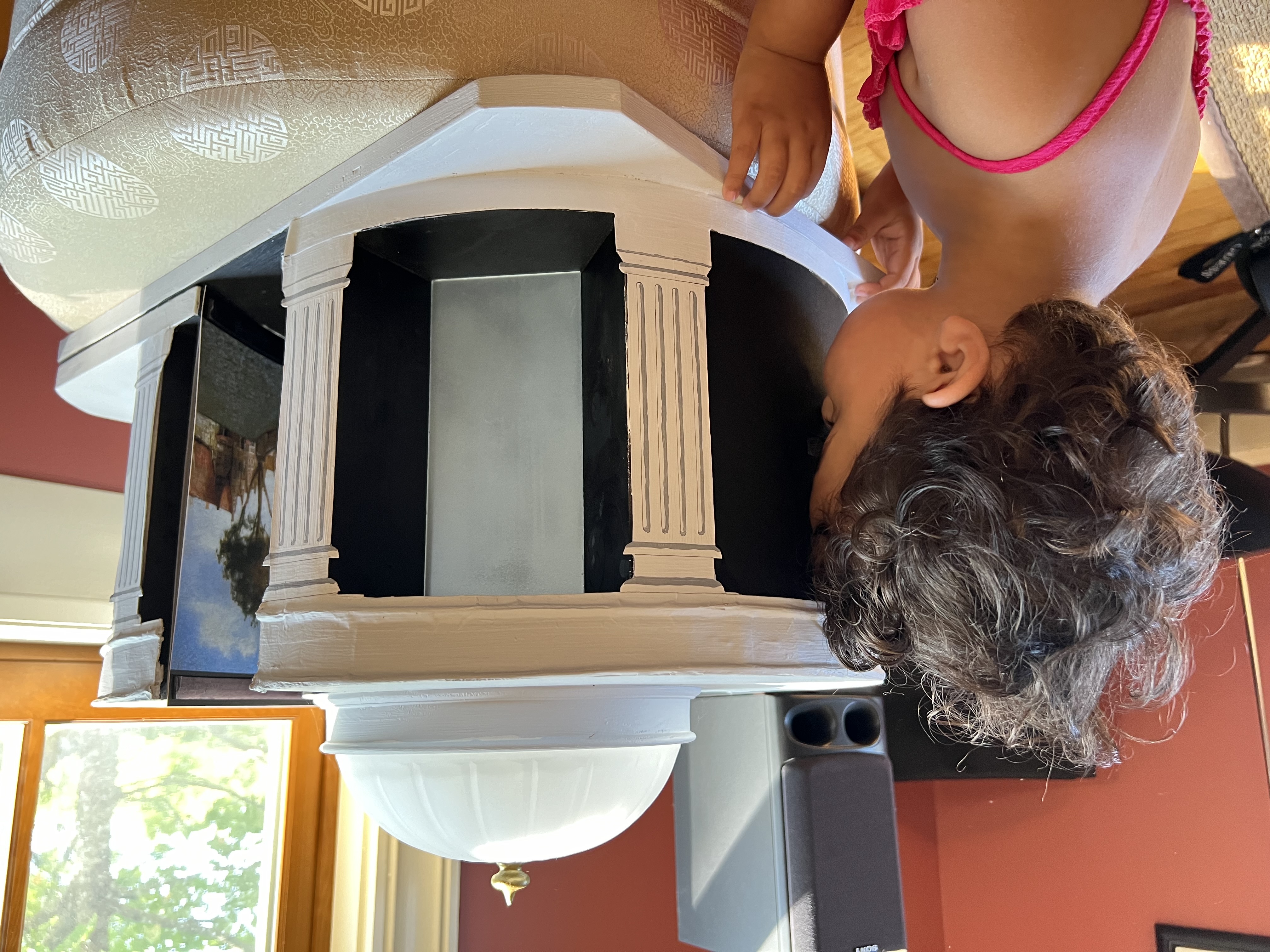 |
Figure 4 – Finished Box |
| Little Mersa understood immediately how it worked without invitation or instruction. |
When I make devices, I like to start with a "first draft" (Figure 3) to test the design. My plan was to attach the image to a spring steel backing with magnets. I wasn't sure if I could press it into a tight curve and back with enough force and without the steel weakening and losing its flex. Also, sometimes I am not sure if the final optical effect is worth a lot of effort to make something of beauty. So I used old scraps of spruce and plywood which I consider to be inferior woods, since I didn't want to use up my precious stock of hardwoods.
However, since it did work, and some people thought it already looked quite good, I decided to take a new direction. Instead of realism (little columns turned on the lathe) and quality materials (hardwoods and brass finials) I went with fakery (illusionistic columns and tacky gold-painted finials) and cheap materials. I thought I would try papier maché which I hadn't used since I was a kid. The effect was toy-like and playfully theatrical (Figure 4).
I wanted a circular shape since the device is about circularity in vision. When it started to take on a Pantheon-like look, I added a translucent dome (actually an inverted light-shade) to complete the effect. When the box is closed, the image is quite dark, so the dome helps to illuminate it. Since this was to be shown at a panorama conference, I was also thinking of the circularity and lighting effects of those 19th-century devices.
I was initially going to move the two parts of the box together and apart using a brass crank-and-screw mechanism. However, my experience with the Optical Theatre taught me that that was too slow. Instead I designed a huge lever-and-cam system (Figure 5). It operates in one long sweep and makes a satisfying crunching sound as though the illusionistic space is being crushed into new configurations.
3. The Results
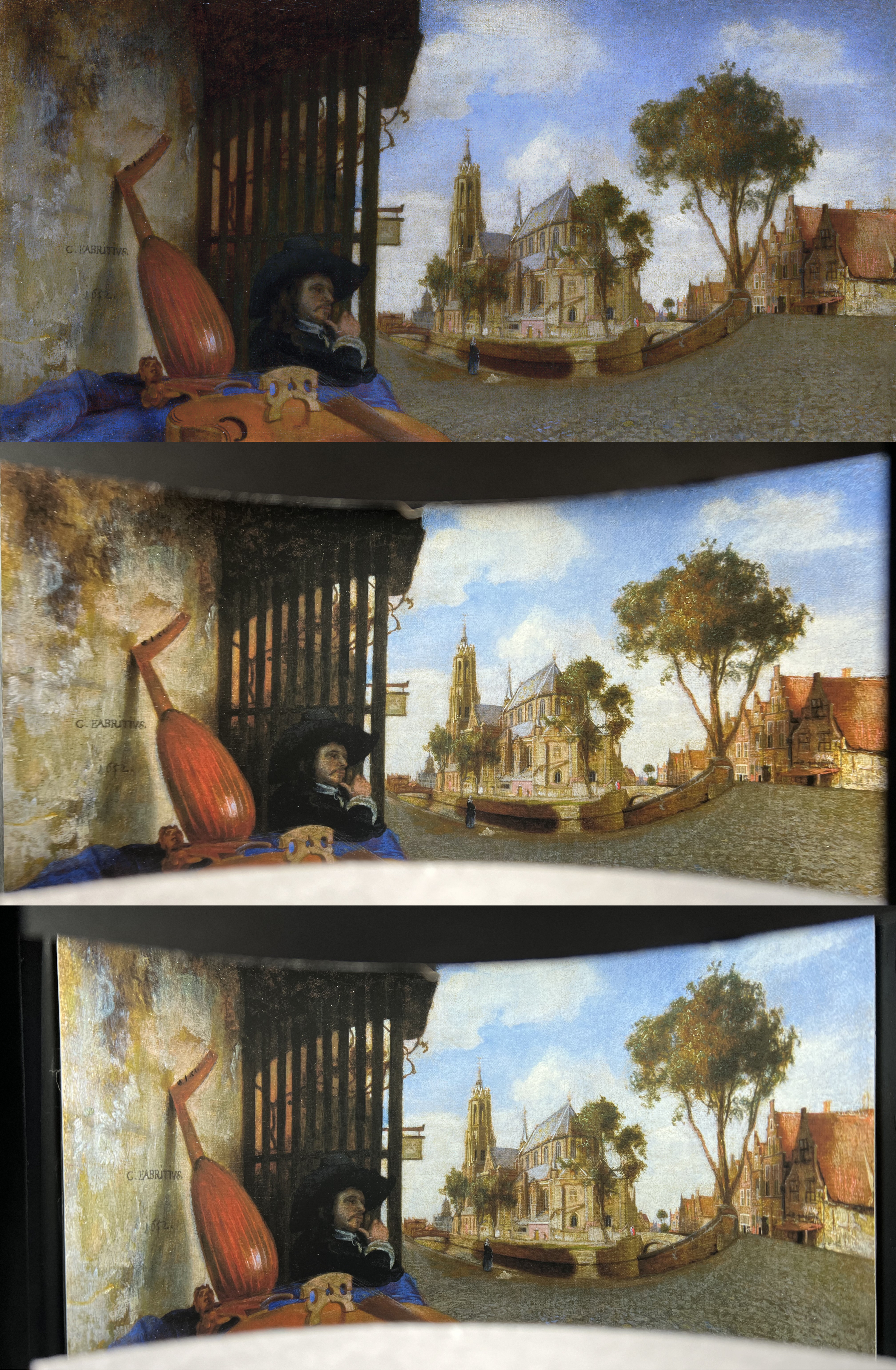 |
Figure 6 – A View in Delft in Different Curvatures |
| Top – Flat; Middle – Circular Curve; Bottom – Tight Curve |
It is impossible to represent here what you experience when you look into the box. The digital images in Figure 6 re-flatten all three images. By contrast, the exhibition-box enhances the impression of a spatial surround. The iPhone lens captures the whole image in a glance, while in the device you have to scan from side to side as you would when surveying the actual scene.
This active approach to vision I think is what Fabritius intended. That is, if I am right that he used a rotating camera obscura. As the camera turns, the artist records a small segment of the image on a roll of paper. When he moves the camera, he scrolls the paper accordingly and records the next slice of image. The paper-roll is like a memory-device on which the full panorama is recorded even as we look at only one slice at a time. The process mimics how we actually see wide-angle views. I suspect Fabritius wanted to reproduce it in how he exhibited his panoramic painting.
 |
Figure 7 – Lute |
The question is: which of the three versions of the painting is best? The flattened images can help us to determine which is least distorted. It is hard to judge because we do not know what the actual scene looked like in 1652. We see a roadway behind which is a canal (that no longer exists). The road bends away to the right as it goes over a small bridge. This corner was very tight, tighter than 90°. I would say that it is impossible to judge which of the three images captures the curve of that corner exactly.
Liedke places great weight on the foreshortened shapes of the two musical instruments: a lute leaning up against the wall, and a viola da gamba lying on a blue cloth on the table. The neck of the viola da gamba, with a carved human head in place of a fiddlehead scroll, is more foreshortened and appears to lean back more the greater the curve. Despite Liedke's assertions, I find it difficult to assess which of the three versions is more correct. The lute however seems to me stretched out too long and thin in the tight curve favoured by Liedke. The circular curve gives it a more full-bodied shape that one expects in a lute (see Figure 7).
Liedke suggests that the sun and shadows are another good clue. The sun is located out of sight above the awning of the instrument seller's stall. The most telling shadows are those cast by the lute as it leans against the plaster wall and by the large tree against the building facades behind it. If the sun were a large lightbulb located just above the seller's stall, it would make sense that it would cast shadows in two different directions as it seems to do in the first of the three images. However, it is not a lightbulb, so these shadows are oddly cast.
If you bend the image around, that brings the lines between the objects and the shadows they cast more into parallel. So says Liedke. But notice that in his version of the curved painting (the bottom one in Figure 6), the shadows still seem to be cast in different directions. They might seem more consistent if you look round the circle of the painting in sequence. Looking left you see the lute shadow and turning round and looking to the right you see the tree shadow. In the turning of your eye you understand at some level that you are shifting the orientation of the whole scene, and in this shift parallel lines will change orientation.
In the end, I think the strange shadows weigh in favour of my view that this is an all-round view to be perceived in motion. And that view weighs in favour of Fabritius having used a rotating camera obscura. And, if a rotating camera obscura were used to make the image, a circular curve would be the only way to exhibit it without distortion.
4. Lingering Doubts
You have to look into the box to fully appreciate this, but the tight curve makes it feel much more like you are inside the instrument seller's stall looking out onto the street. The way the wall wraps around you at the left is particularly convincing. So I have some hesitation about my initial conclusion and need to consider further the implications of Liedke's hypothesis that a tight curve is correct.
Liedke thinks Fabritus intended this device to be like other Dutch perspective boxes that were common in this period. Perspective boxes project perspectivally correct images on oddly angled surfaces. They look right only when viewed from the correct point of sight constrained by a peephole. Fabritius' would be the only known box where the projection surface was curved. This feature makes it more like perspectival images projected on the vaulted ceilings of churches, like those made famous by Andrea Pozzo in the late 17th century.
How would Fabritius have created the correct projection? I am not an expert on this, but I suspect it would be far more complicated than using a rotating camera obscura. He would have to start with an image (he could not do it from the scene as he might with a rotating camera obscura). That would be a wide-angle projection (Liedke thinks as much as 90°) with significant perspective distortion at the edges (and for this reason probably best rendered with the help of a perspective device such as a fixed sight and grid). Then he would overlay a square grid on the image and project a distorted grid onto the final canvas – either physically using threads or by geometric calculation. Finally he would have to transfer the contents of each grid square to its distorted counterpart. Not only does this procedure seem unnecessarily difficult, but the rationale seems lacking. Since it is a wide-angle view, why not use known technologies for producing wide-angle views (i.e. the rotating camera obscura)?
Thinking about why my panoramic curve did not have the same surround effect as Liedke's, I finally realized the problem. Sadly, it meant I had to abandon this pretty Pantheon-like box and build a new one.
Footnotes:
[1] Liedtke, Walter A. 1976. "The 'View in Delft' by Carel Fabritius." Burlington Magazine 118(875):61-73.