Rod Bantjes, “RB-07_Zog_Folding.html,” created 4 July, 2025; last modified, 7 July, 2025 (https://people.stfx.ca/rbantjes/).
Folding Zograscope
Rod Bantjes Collection #RB-07
French late 18th century
Open at full height:
Folded:
Lens: ⌀=7.3 cm, ƒ=33 cm
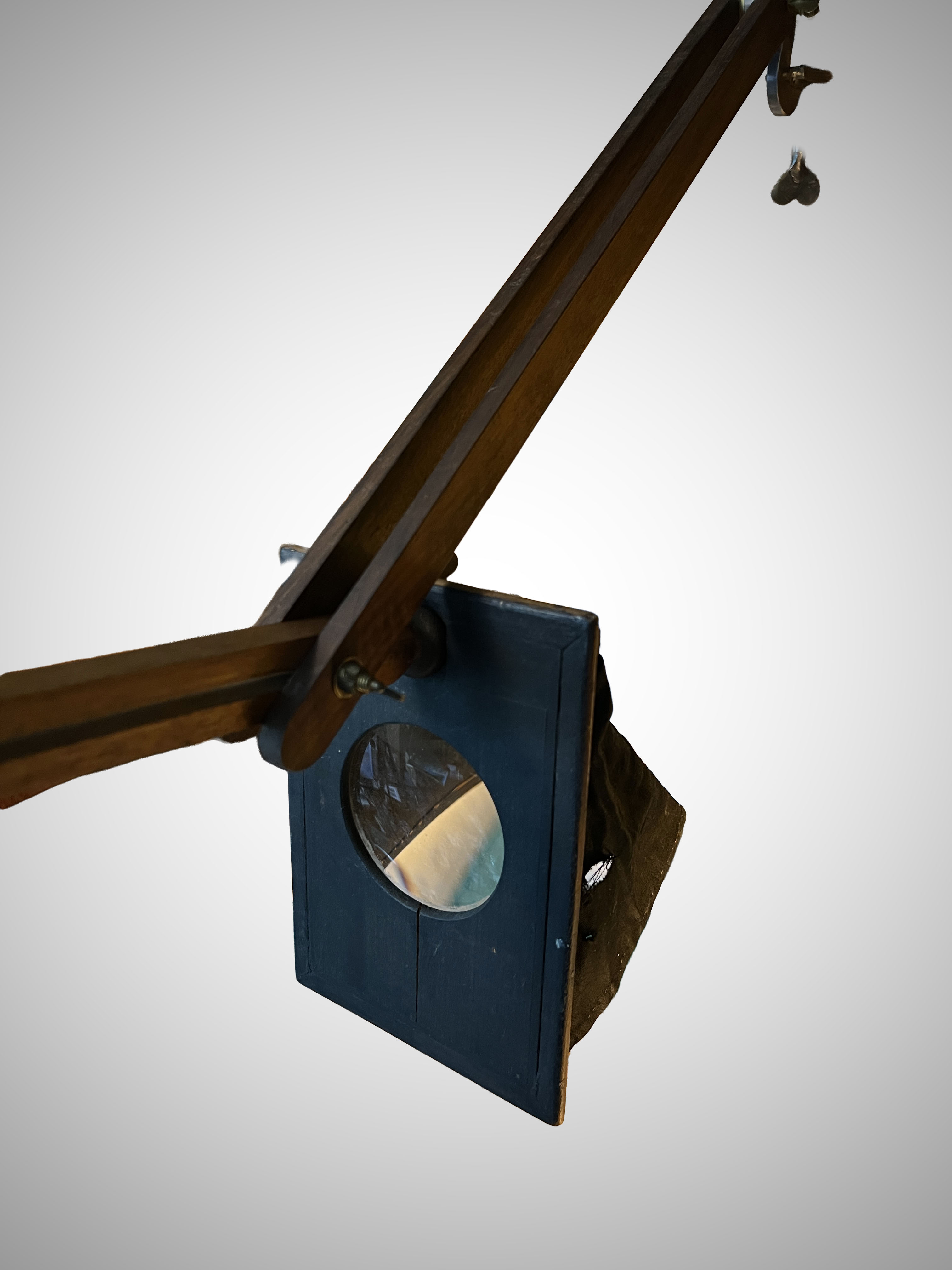 |
Figure RB-07.1 –Folding Zograscope |
| The unique design is to have it suspended from above. |
This is a folding zograscope of unique design.
I have never seen or heard of a zograscope designed this way. The lens-mirror assembly is suspended from a two-part folding arm at the end of which is a clamp. The original clamp was missing and it came with a crudely-fashioned replacement too narrow to attach to anything and probably too weak to hold. The original design aesthetics is rather straight-edged with the exception of decorative wing-nuts. My clamp takes inspiration from the wing-nuts.
I had to tinker for some time before deciding how it was meant to be set up. The main difficulty is that the first arm-segment attaches rigidly from the front of the lens. That is where one's head is supposed to be for viewing. There is no configuration where the arm does no get in the way to some degree. The arm should have been attached at the back of the lens-mirror assembly, but design/construction details make it clear that it was not intended to work that way. With the first arm-section coming out the front, it would be possible to clamp the second arm-section to the edge of a table or desk, but that would be exactly where your head needs to be to see through the lens. Clamping from the edge of a shelf (Figure RB-07.1) works, but the geometry of the arm is a bit awkward still. It seems designed to position the lens-mirror assembly under the shelf above rather than out on the desktop (as I have it in Figure RB-07.1).
In addition to the folding design without a pedestal, another clever innovation is the collapsible hood around the mirror. This hood helps to mask out visual distractions when one views the image. The lens is unusually small (7.3 cm in diameter) for and 18th-century zograscope and it has an unusually short focal length (33 cm). Zograscopes and optical boxes were thought to work best when the image was a focal length's distance from the lens. However, at this distance the viewing width is only 23 cm, too small for most vues d'optique (37-44 cm). Might it have been designed for smaller prints?