 |
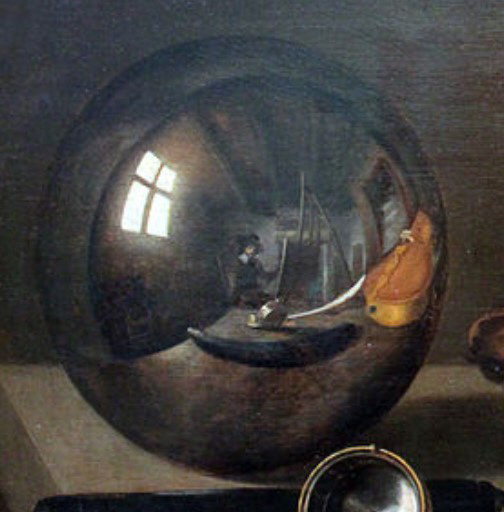
Figure HP.3 – Curvilinear Projection in a Polished Sphere
Source: Pieter Claesz, ca. 1630, Vanitas, oil on wood, 36 x 59 cm, Germanisches Nationalmuseum [detail]. .
Note how the reflected image encompasses an almost complete surround of space.
Claesz's Reflections on Representation
In the following analysis of the painting I consider the visual evidence that Claesz is reflecting on the complex problem of how we perceive the world as a surround of space. Some may find the writing heavy going, but I hope insightful.
Stoichita reads this painting in the context of his Foucaultian distinction between the paradigm of the “enquiring eye” and that of the “methodical eye.” The former relates to a theory of signification that is inter-textual (see The Order of Things) and evident in the Renaissance notion of the ‘cabinet of curiosities.’ (Stoichita does a nice analysis of paintings of collected paintings within galleries as instances of cabinets of curiosities.) The origin of the paradigm of the methodical eye he locates with Descartes, in particular Descartes’ Optics in which he raises the problem of how we see vision. Stoichita makes much of Descartes engraving of the observer looking at the back of the curved retina of an actual organic eye (the embodied camera obscura). He also notes Descartes use of the metaphor of painting – the image is painted on the retina. The methodical eye gets caught in a self-referential trap. For while, in order to verify the accuracy, the right-constructedness of the sense datum on the retina, we try, we nonetheless cannot see seeing. Ego (the observer), cogito (the process of observation) and res (the world observed) are never co-present to an observer.[xxx]
So, Stoichita is interested in self-referential painting in which the painter (metaphorically of the retinal image) is paradoxically the subject of the process of painting. In other words, these paintings are meditations of the problematic of observing observation. Like Foucault, he thinks Velasquez’s Las Meninas (1656) is interesting in this regard, but more interesting (and he is correct in this) are the works of Clara Peters and Pieter Claesz. His reading of Claesz’s Vanitas is limited by his failure to see how much Claesz is engaging with contemporary problems in optics and the physiology of vision as well as epistemology. Stoichita starts by underlining the vanitas theme (probably rightly). In addition to the reflecting sphere (an insertion of a “‘microcosm’ into the pictorial image, following the principle of ‘containing-contained’) and the skull,
| there are other objects between these two that intimate the passing of time (timepiece, extinguished lamp), the fragility of existence (cracked walnut, glass, quill), or the arts (violin and once again the quill). The actual orb in which we see the artist at his easel -as well as the reflection of some of the objects in the foreground (watch, violin, quill) -is a symbol of the vanity of things and the fragility of the world. By bringing the artist into the work, it is also thematizing the vanity of the artistic act.[xxx] |
The orb is also a motif for seeing. On its curved surface, like the curved surface of the retina, the whole scene is ‘painted.’ There is evidence in the writings of Hookgeeste and the work of other painters in Claesz’s milieu that the physiology of the curved retina, the rotating eye and head and consequently the experience of the wide-angle view were of interest to them. The orb or convex mirror that appears in many paintings of this milieu is a way of exploring this way of seeing. Clearly this ‘eye’ sees in the round in ways that is more encompassing and more revealing than the linear perspective projection that frames it. The visible orthogonals in the costruzione legittima view (along the left side of the table) point to a vanishing point off the painted surface to the left and therefore to an observer position that is ‘outside the frame’ as it were. The vanishing point in the curved ‘retina’ is within both the circular frame of the orb and the encompassing frame of the canvas. The curved orthogonals, if they can be called that in this curvilinear projection, embrace everything within the conventional projection, plus the ceiling, three additional walls and the artist with his easel.
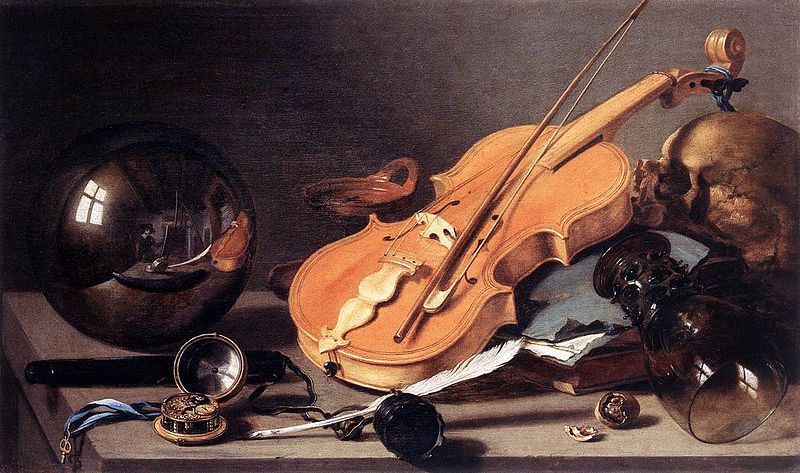 |
Figure HP.3 –Vanitas |
| Source: Pieter Claesz, ca. 1630, Vanitas, oil on wood, 36 x 59 cm, Germanisches Nationalmuseum. |
Insofar as the orb is wholly within the rectangular frame of the canvas, the curved projection is contained within the conventional projection. However, paradoxically, since the curved projection encompasses the whole space of the conventional projection and locates it [the space it frames, plus its frame] within a larger space, the conventional projection becomes a limited special case of the curved. Curvilinear projection better reflects the experience of being-in-the-room that the painter would have had facing his easel. But on the canvas it looks distorted. Within Claesz’s exploration of the similarities, there is perhaps a visual statement of the problematic difference between painting and seeing. The image is ‘painted’ (in light) on the curved retina (the orb), or the retinal record of a curving arc of a moving eye or head, but always painted (in oils on the actual surface before us) on a flat surface. The flattening of a curved surface, as mapmakers know, always creates distortions. But interestingly, what we see in this projection (in the orb) of the process of painting is the (painted) painter painting (in oils) on a curved surface (that is, the image of the canvas in the orb is curved).
Berkeley had already argued that seeing space involved time.[xxx] Certainly the idea of the curvatures produced by movement (quote Houckgeeste) involves time in the delineation of the curve.[xxx] The temporality of seeing raises another paradox in the painting of the process of the painter painting the painting we are looking at. He is painting an unfinished painting and we are looking at a painting complete in every detail (although interestingly our experiential ‘reading’ of it may be never complete). He is long gone from the position that he surely occupied in front of this very painting, yet here we are in his place. The indexes of time – the watch, the light that is out, the skull with empty eye sockets – may refer to this temporal instability. To make sense of the work we are caught in a kind of ‘chronic historesis’ moving from the living eye of the painter (back in time to the work-in-progress) on the left, forward in time to the painter as he surely is now on the right. But if we are to re-enter the logic of the work we step back into the subject position of the painter painting painting or observing observation (which is certainly what we are doing now), so the seeing subject is again animated, we move back to the left, back in time to before the paint was dry, before the observation was complete and so on. As we do so, our eyes scan back and forth, ritually re-enacting seeing as a temporal process of construction.
It is significant that time is signalled by a light gone out. Because light functions as a kind of triangulation of the spatial ‘truth’ of this scene and its interlinked representations. The source of light is a window on the wall to the observer’s left which can be seen reflected in the orb. All of the objects in the scene are marked with subtle and precise indexes of their location in that unitary light that pervades both the scene (in costruzione legittima) and the scene beyond the scene (in curvilinear projection). The upturned goblet reflects the window in its inner and outer glass surfaces in a way that defines the volume of the glass, its relation in space to the window and the spatial location of the window. This spatial positioning is corroborated in the polished lid of the watch where again you can see the mullioned window reflected. Its report is cross-referenced with the orb since the watch-lid’s back is reflected in the orb and on its reflected back is the reflection of the window again – such that the geodesic spatial indexes in the orb are again calibrated with indexes of rectilinear, metric space. These calibrations leave no doubt that the distorted reflection in the orb is of a square, not a curved window. All of the other objects orient themselves to that square window by the direction and precise angles of their shadows. We can see by all these indicators, plus the tiny image of the easel in the orb that the light that illuminates the scene comes from the left of the table. (However, the easel is turned 45º counter-clockwise to the table so that there is a non-equivalence between the light that bathes the painted surface and the light that bathes the scene.) So the skull’s eye is turned toward the light, but is empty, dark and in shadow (with the lamp, this is a second ‘light’ gone out). Claesz has departed the scene, so the reflection on observation here is not solitary self-reflection, but rather a collaboration between Claesz, his construct, and the living viewer. His physical construct, an externalization of internal processes of vision, perception and thought, is intriguing enough to stimulate speech and writing (the quill pen and the book?) within a community of observers and thinkers (myself and the reader of this page included).
In Claesz’s treatment of light, optics goes a long way toward minimizing, if not cancelling out the philosophical mise en abyme that this work interrogates. Certainly as an individual self-reflexive exercise it is not possible to see seeing (to observe observation, to paint painting). But the collective exercise of anatomizing the machinery that enables us to see – the physiological eye and the artificial models of it such as the camera obscura and the convex mirror, plus the laws of optics, of the transmission, refraction and reflection of light – enable us to model it very closely. This modelling of the mechanisms of sight was one of Descartes projects, and one which modern critics routinely suppress. The mise en abyme may be about painting, and representation generally, as an inescapable inter-text, its system of signs referring only ever to other systems of signs. However, if it is an inter-text it is an inter-text between two representation systems that are normally taken to be incommensurable. Light here seems to offer a kind of universal translation linking across time different logics of representation: costruzione legittima, or the regime of rectilinear, a-temporal, fixed-point projections of space, and the organic eye and its participation in the temporally extended and curvilinear projection of space.
End-notes
[xxx] Stoichita, Victor Ieronim, The Self-Aware Image: An Insight into Early Modern Meta-Painting, Cambridge Studies in New Art History and Criticism, (Cambridge: Cambridge University Press, 1997), 198 ff..
[xxx] The Self-Aware Image, 223.
[xxx] Berkeley, George, An Essay Towards a New Theory of Vision, 2nd ed. (Dublin: Aaron Rhames for Jeremy Pepyat, 1709)..
[xxx] text of footnote.
[xxx] text of footnote.
[xxx] text of footnote.