 |
 |
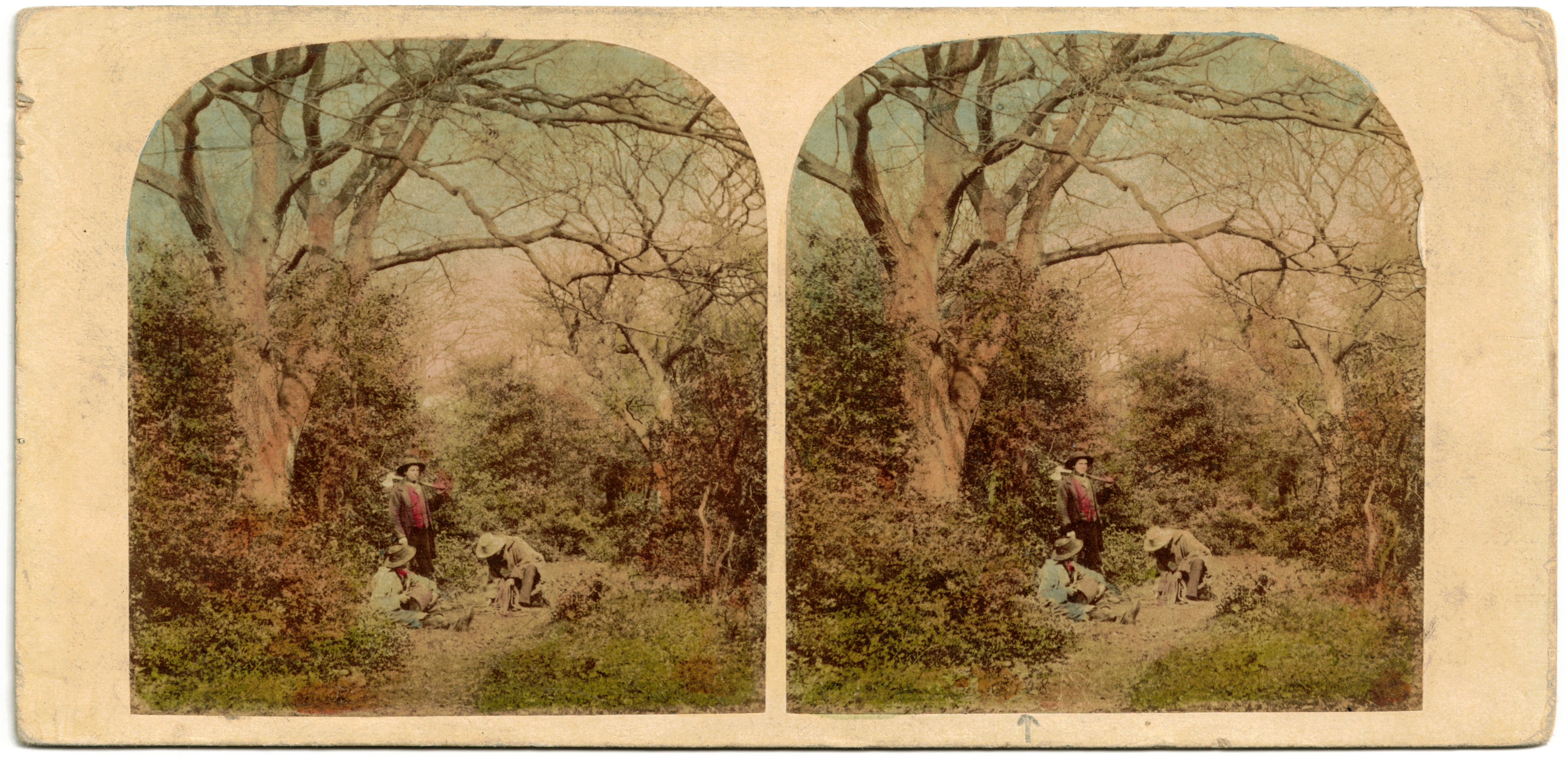
UUKG0128 – William Grundy (1850-1859) '[Three woodcutters in a forest].' Hand-tinted albumen prints.
William Gilpin (1724 - 1804) was the English authority on picturesque landscape painting. A young artist like Grundy would certainly have read Observations on the River Wye (1782) and might have read Remarks on Forest Scenery (1790) where Gilpin describes the kind of “close forest scene” we see depicted here.
Gilpin writes, “The great beauty of these close forest scenes arise from the openings and recesses, which we find among them.” (p.213) Here Grundy focuses on what Gilpin calls “the happiest of all circumstances, a winding road [which runs] ..along the wood.” (p.214) Herman van Swanevelt (1603 – 1655) and Anthonie Waterloo (ca.1610-1690) are for Gilpin the exemplars of artists who “delighted in these close forest scenes” (p.214)
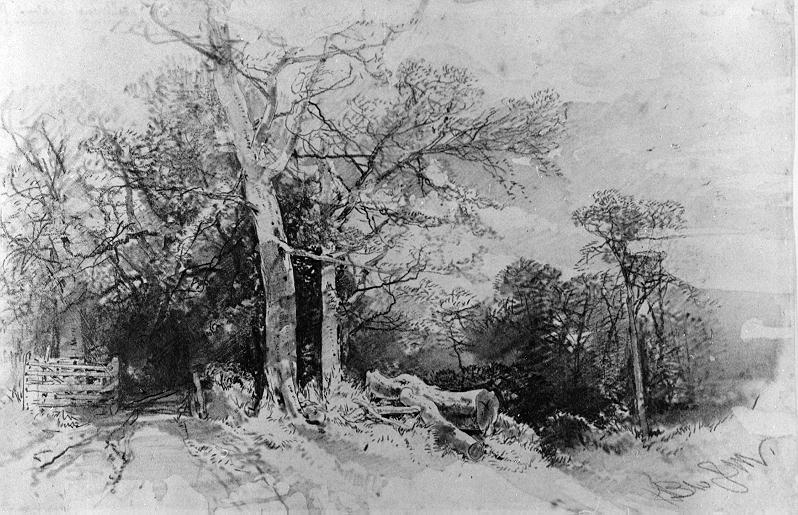
Grundy was wealthy and collected art by many contemporary painters including Henry Bright (1810 - 1873) whose work I have reproduced on the right. It is as though the two artists are looking for the same aesthetic feeling – the stately tree overarching intimate forest openings.
 |
 |
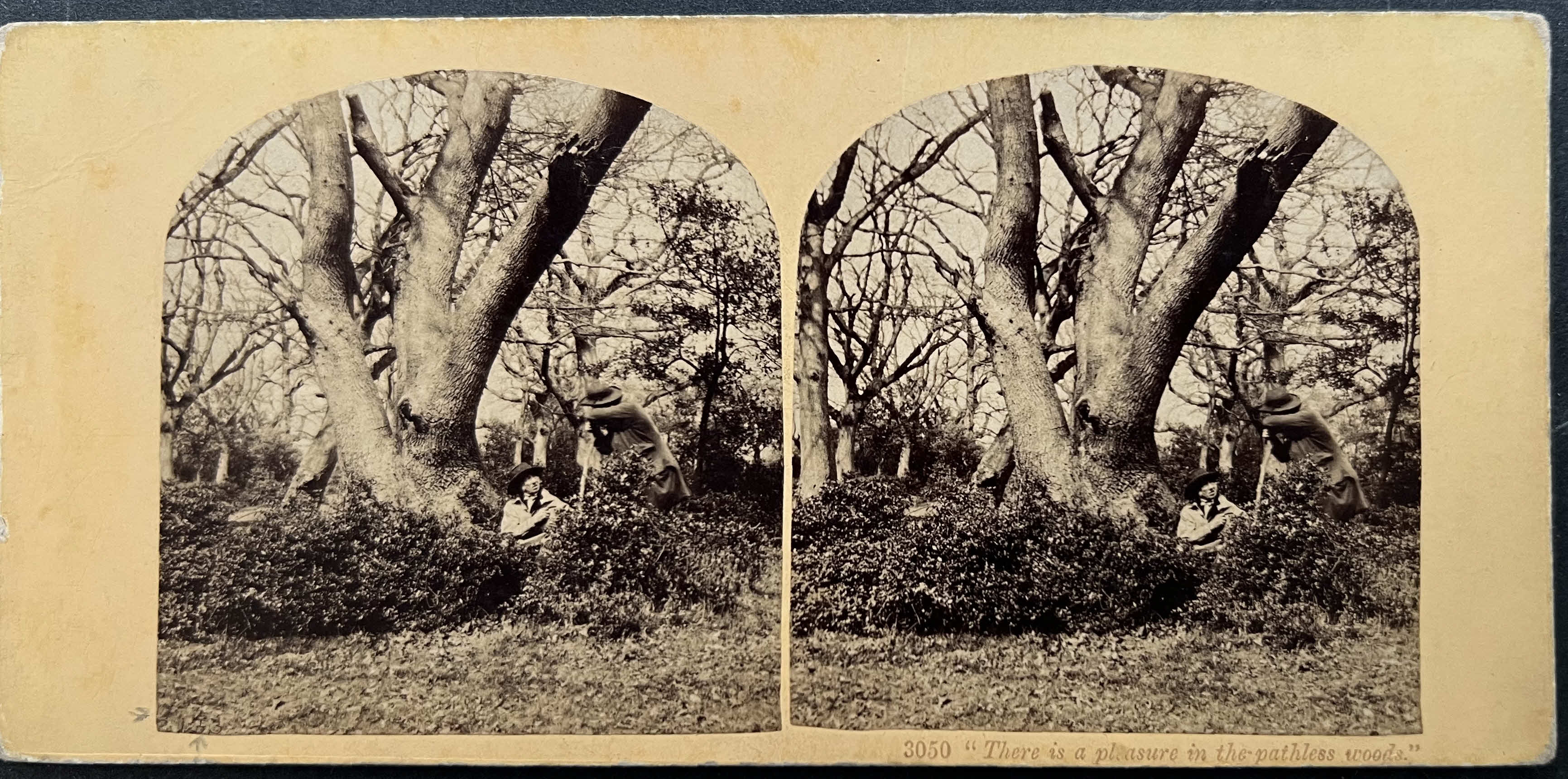
UKG0133 – William Grundy (1850-1859) 'There is a Pleasure in the Pathless Woods.' Albumen prints.
Besides the two men chatting, the focus of this image is the trunk of a single tree, centred and in the foreground. As Gilpin points out “…a tree in full perfection, as a grand object to grace a foreground, is rarely seen.” While not as grand as the individual trees that Gilpin discusses in Book I, Sect VI of Remarks on Forest Scenery (Vol. 1), it is old enough to anchor the present to a distant past, which Gilpin acknowledges is one of the cultural meanings of such trees.
In this connection he mentions a great oak at Magdalen College, Oxford that was reputed to be a sapling “when Alfred the Great founded the university.” (p.135). Grundy’s tree anchors and draws his viewers back well before their industrial present, and draws us with them back over an even longer span of time, over the nightmares of the 20th century and over the headlong rush of the 19th century towards them.
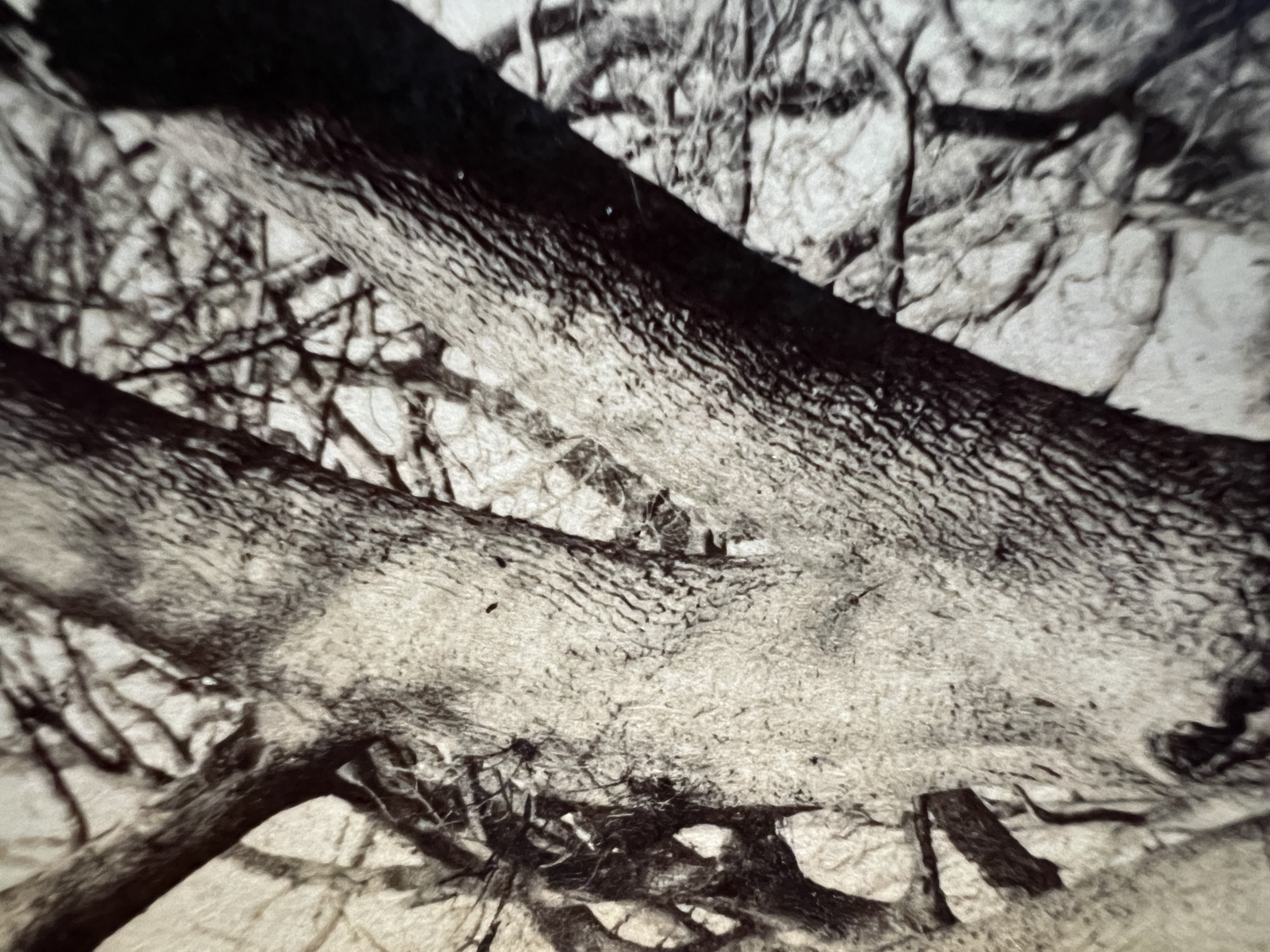
In the enlarged detail of this stereoview on the right, you can better appreciate the sensuous beauty that Grundy finds in his images of trees.
 |
 |
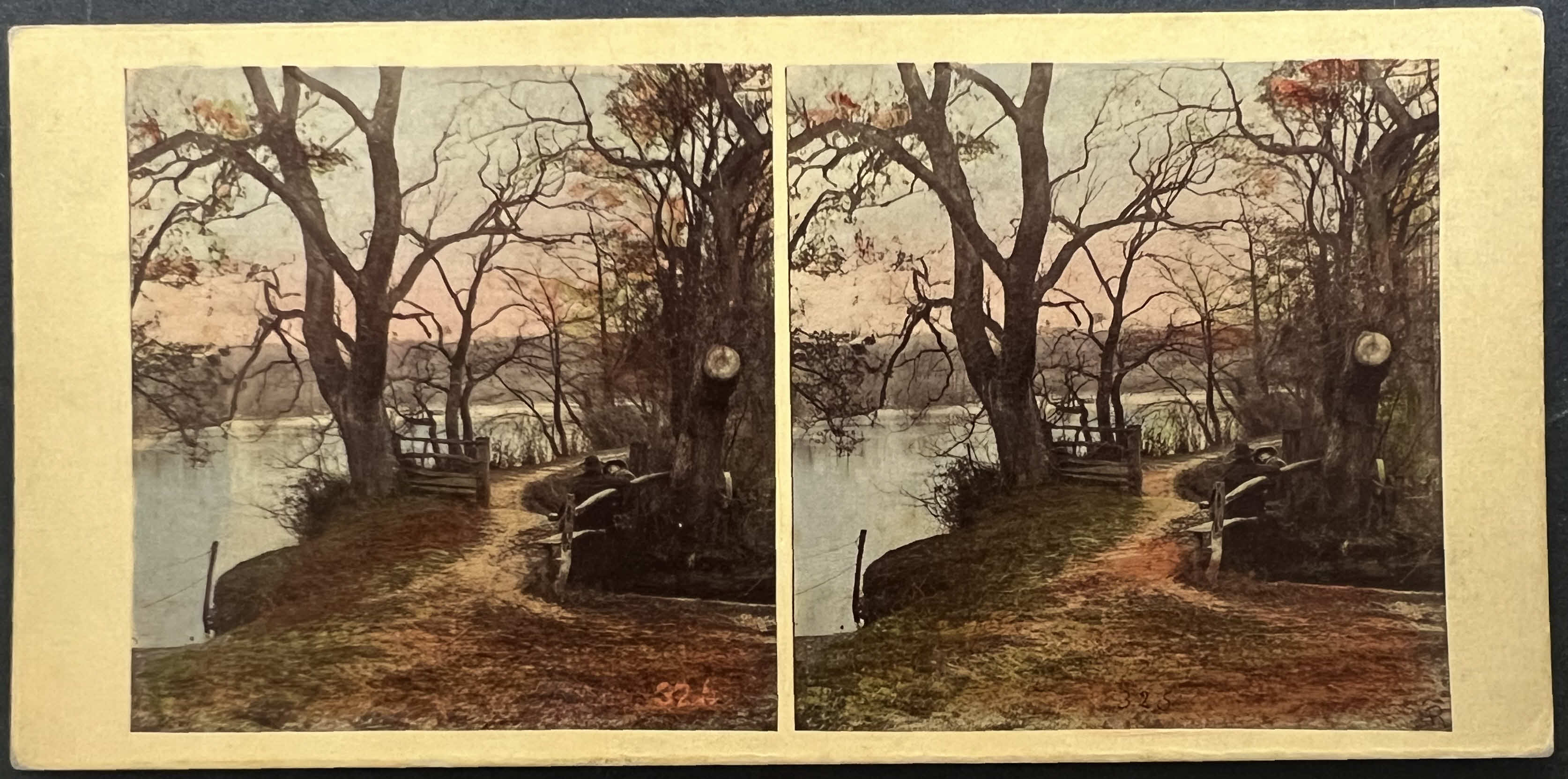
UKG0325 – William Grundy (-1859) '[Path Along the River].' Hand-tinted albumen prints.
This is a good example of a view where the structure of the composition changes in 3D. In the flat, there is a strong symmetry between the upward and outward branching structure of the main tree and the foreground path as it passes through the gate and past the bench. This symmetry unfolds on a pivot turning from the base of the rail fence and rotating its forms parallel to the picture plane. In 3D the main structure is the curve of the river that pivots on the second great tree between the seated men and the grindstone. Its deeply carved groove is marked by the screen of trees whose branches define the sweep of the bank and reach out behind to open an envelope of space over the water. Neither structure contradicts the other so the overall feeling is of lazy clockwise motions in sweet balance.
The branches are mostly bare and the tinting is in fall colours. Still the colour values are pre-Constable with the foreground grass ranging from brown to dull olive and subdued with not colour in the background except the characteristic Grundy wash across the sky of late evening blue and peach. Similarly the whole is in a minor key of brightness with no stark whites or solid shadows.
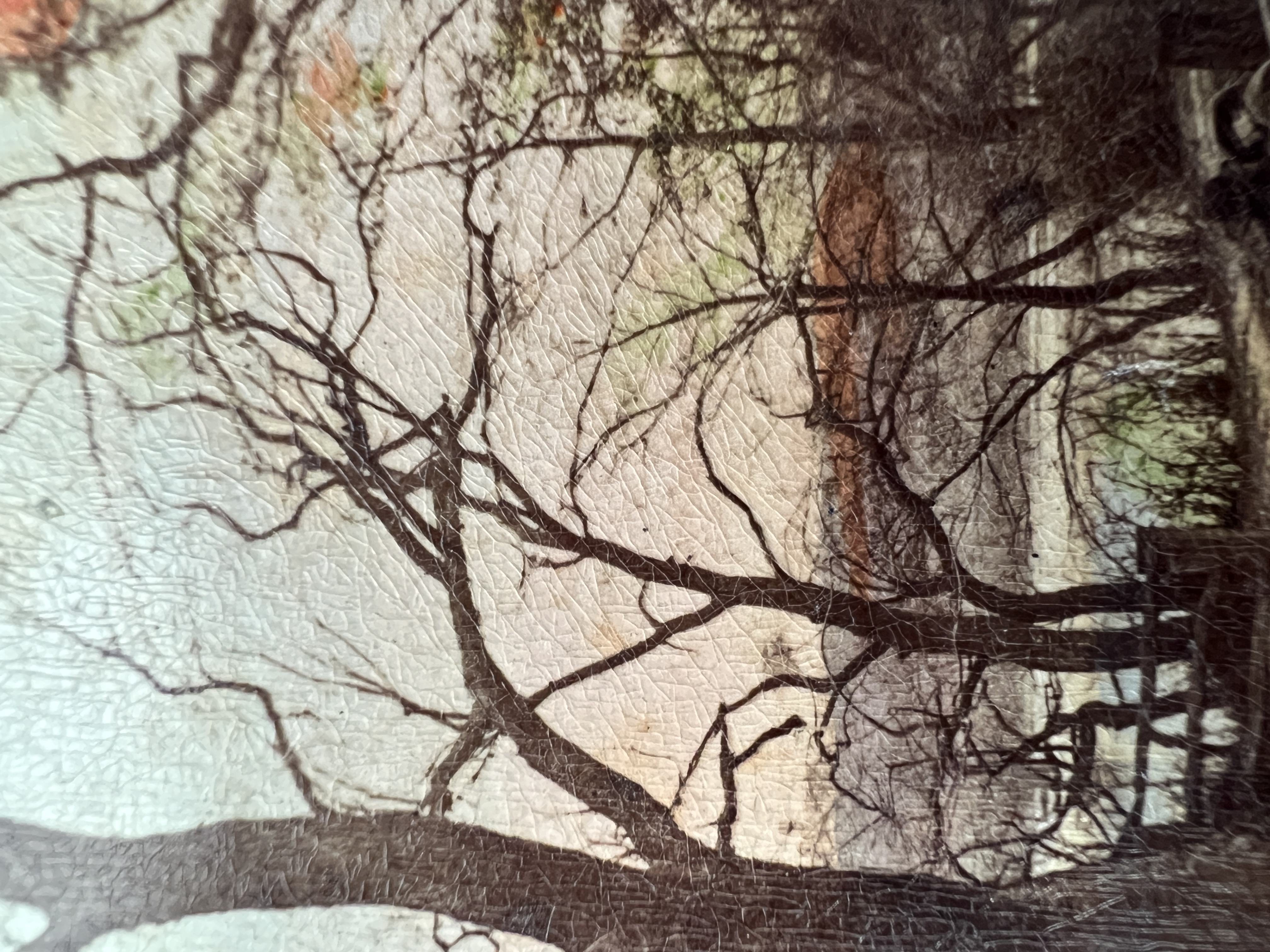
On the right is a detail. Open it in a separate tab to see it properly. You can get a sense of the painterly feel of these images when enlarged in the stereoscope. The paint surface is evident in the cracks in the albumen as though it were an old master done in oils – at times it feels like a painting, at times it breaks through to pure open space.
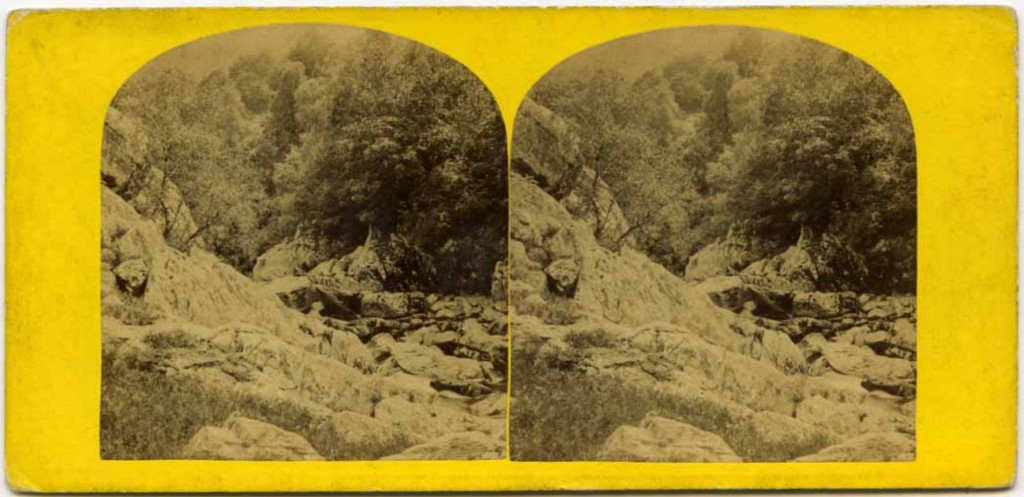 |
UKG0433 – William Grundy (-) '[Rocky Sided River Gorge -- Wales?].' Albumen prints.
Grundy has composed a subtle meditation on interlocking depths that weave right, left, right as they recede around the final coulisse toward the origin of the stream. The initial statement is a high foreground coulisse, too bright and too close for the painted picturesque. Behind two strong coulisses the ‘stage’ is, contrary to Gilpin’s prescription, shaded relative to the cool bright foreground and distance. Here chiaroscuro helps to model the boulders and particularly the foliage that rises above them. The background is located at distance stereoscopically by a bright overhanging tree (transparent screen) but also by aerial perspective – a subtle loss of contrast and clarity.
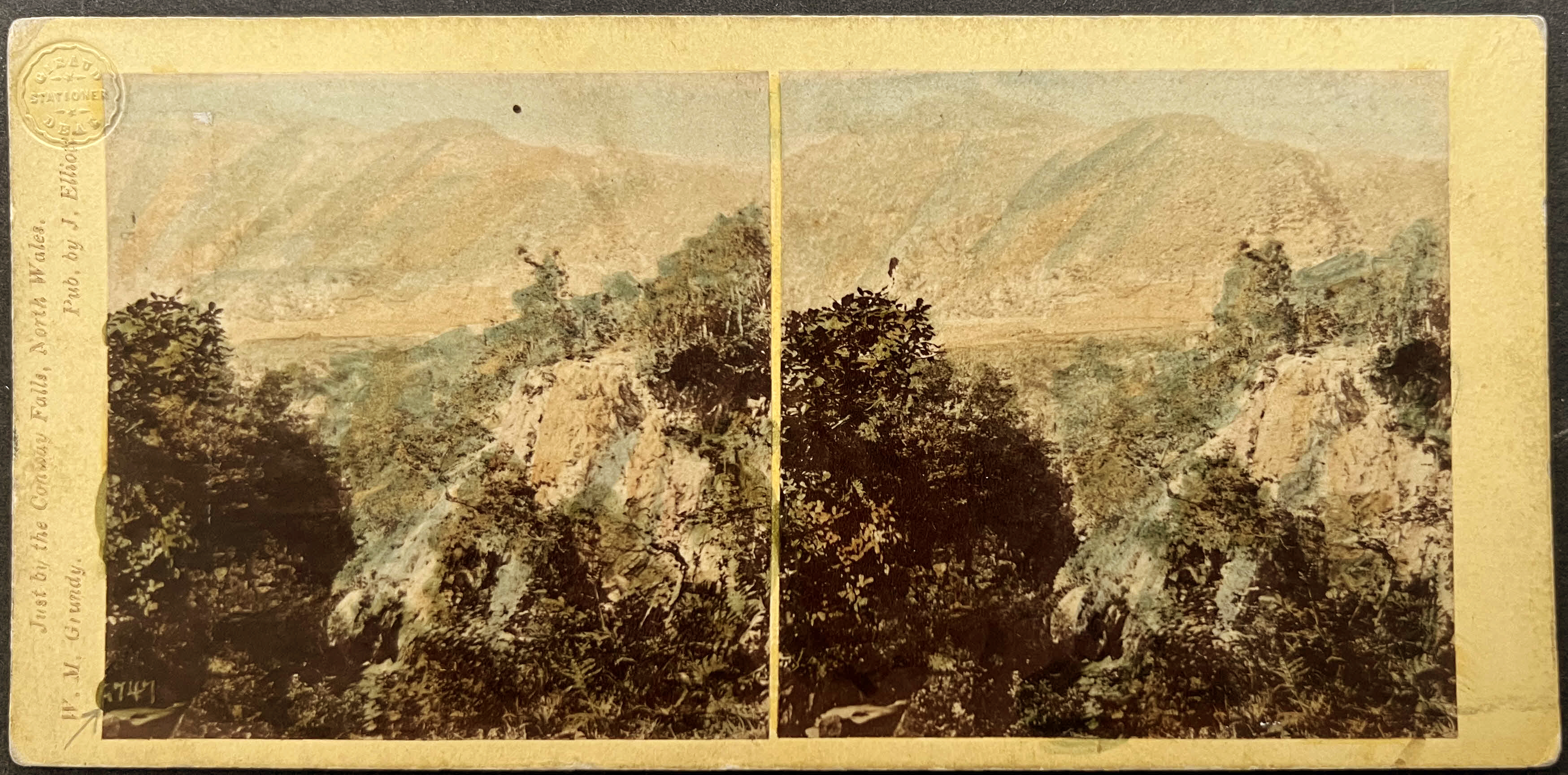 |
UKG0747 – William Grundy (-) 'Just by the Conway Falls, North Wales.' Hand-tinted albumen prints.
Two painterly styles vie with one another in this view. The far and middle distance is rendered in the yellow ochres and washed-out greens reminiscent of landscapes of the south of France or Spain. Particularly in the middle ground the brushstrokes are evident, as much artist’s signatures as effects signified. The signatures do not correspond left to right, so their interaction, when the view is sutured, generates surface instability. The brush strokes are not as precise and faceted as Cézanne’s, but in the colour palette and in the shallow spatiality there is a hint of Cézanne’s way of seeing. This is the first style.
The second is the strong chiaroscuro, which together with stereoscopic tropes, carves out a deep foreground space. A series of overlapping groundrows starting from the right edge define a steep descent. A branch coulisse at the left defines the open volume above, below which is a plunge into obscure depths, framed by the bright sunlit opposite bank and hazy distance.
The effect is paradoxical, as though the eyes excavate deep into the surface of lower half of the view and merely tap at the albumen surface of the backdrop meant to indicate distance.
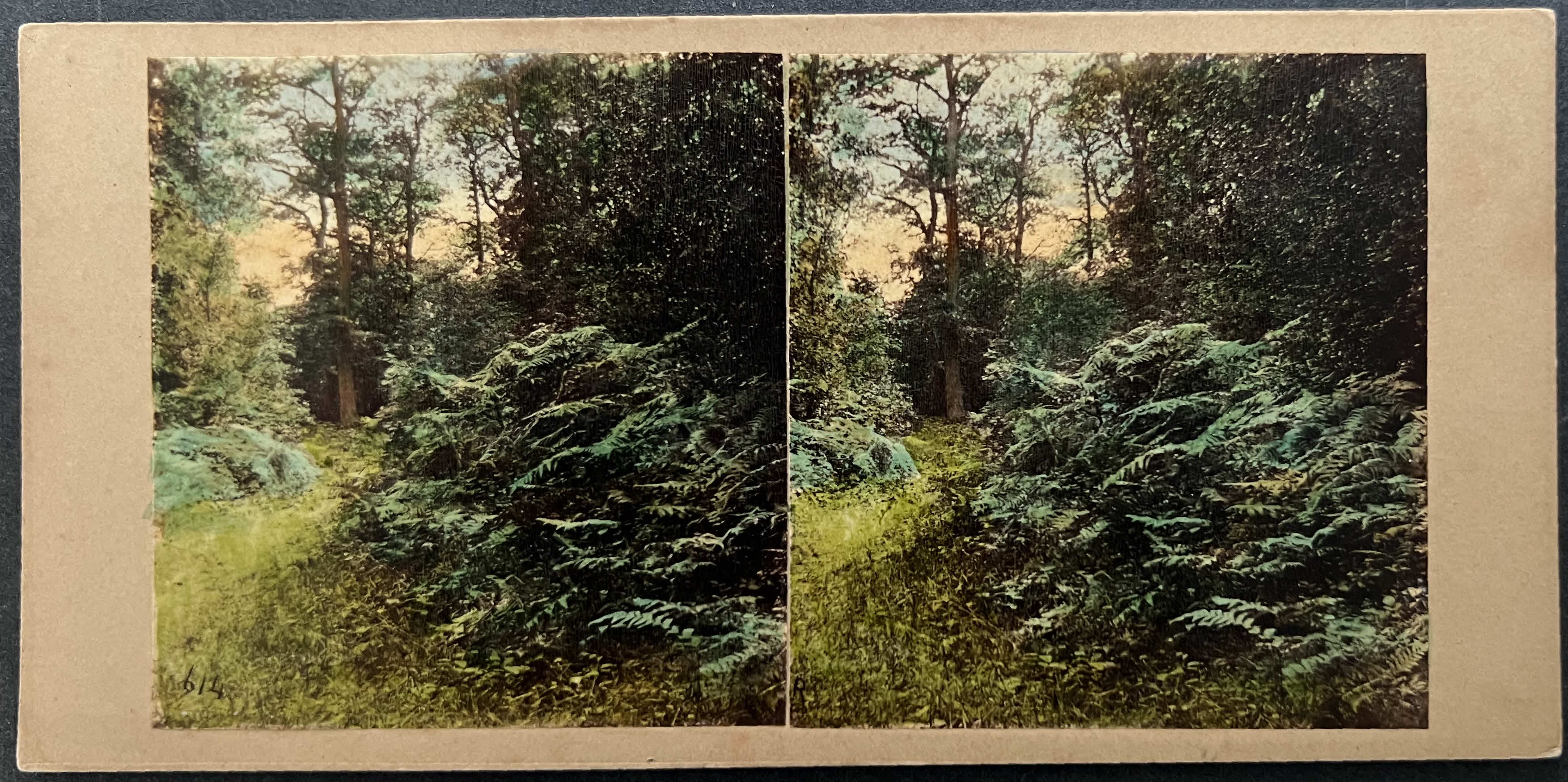 |
UKG0614 – William Grundy (1850-1859) 'In Sutton Coldfield Park.' Hand-tinted albumen prints.
Grundy’s composition here departs from Gilpin’s prescriptions in two ways. The mass of ferns claims too dominant a position. For Gilpin (1790) these “humble plants” should play a subordinate role connecting clumps of trees and forest openings: by “filling up the interstices,” they “mass and connect the whole.” (p.218) “These, however rude, we only wish to remove, when they straggle too far from the clumps, with which they are connected, and appear as spots in the area, or middle spaces between different combinations.” (218)
While Gilpin considers the fern the most picturesque of the humble plants, Grundy’s fern is clearly a “spot in the area.” It is not picturesque when “spread in quantities,” but only “where it is sparingly, and judiciously introduced.” (219) The fern is also too close: in two steps its fronds would be brushing against the viewer’s legs. This foreground would be in front of the picture plane in any of the examples of “close forest scenes” that Gilpin mentions.
Only in the stereoview could a mass in this position, instead of obscuring the area, hint at its openness through to the left and around to the back of the fern. Viewed through the stereoscope the fern does perform a linking function (in this case between embodied viewer and area), but in the new vocabulary of before-around-and-behind unavailable to Gilpin. In other ways the view is conventionally picturesque with a dark foreground and illuminated area (albeit unconventionally small) in the close middle distance.
 |
 |
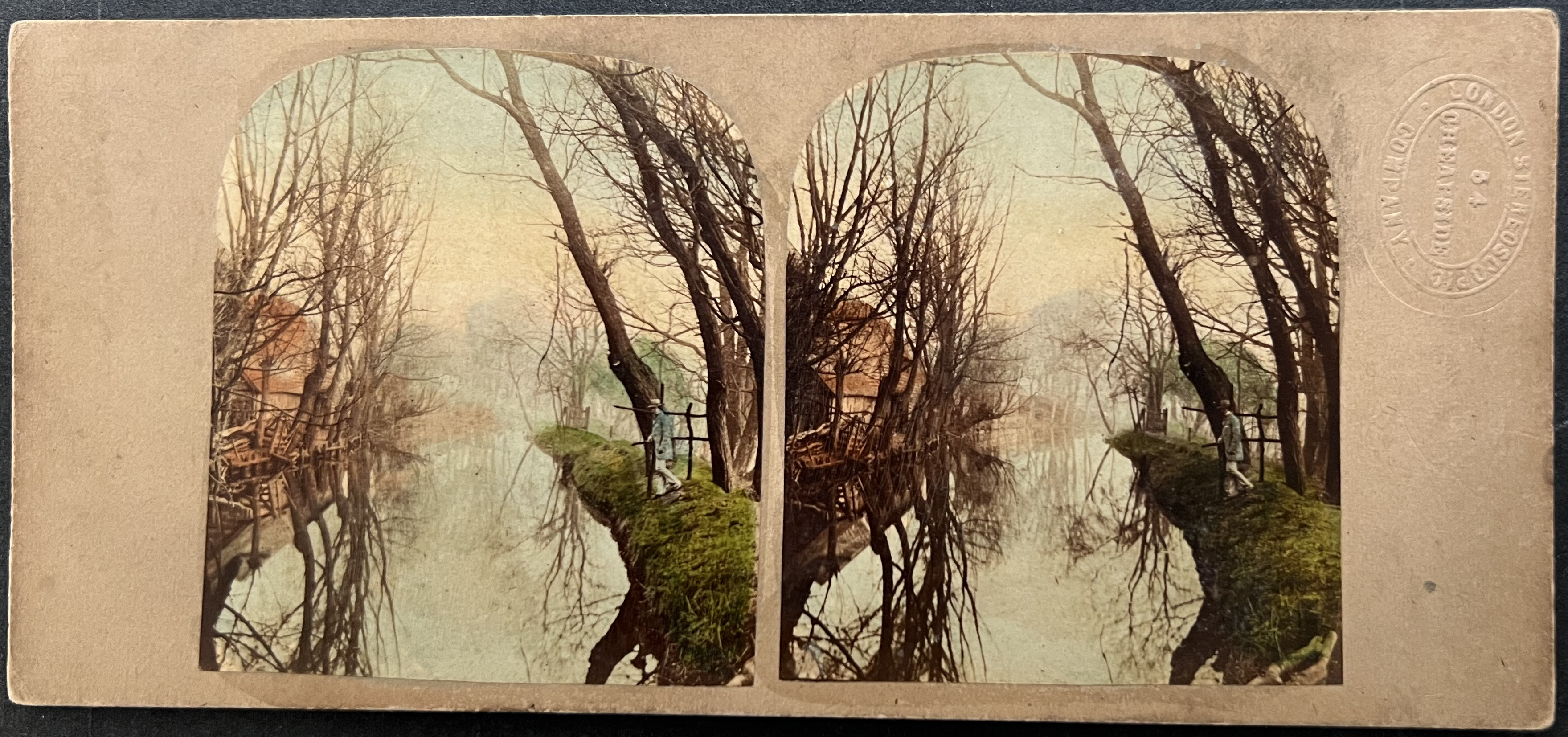
UKG0U001t – William Grundy? (-) '[Canal in Spring].' Hand-tinted albumen prints.
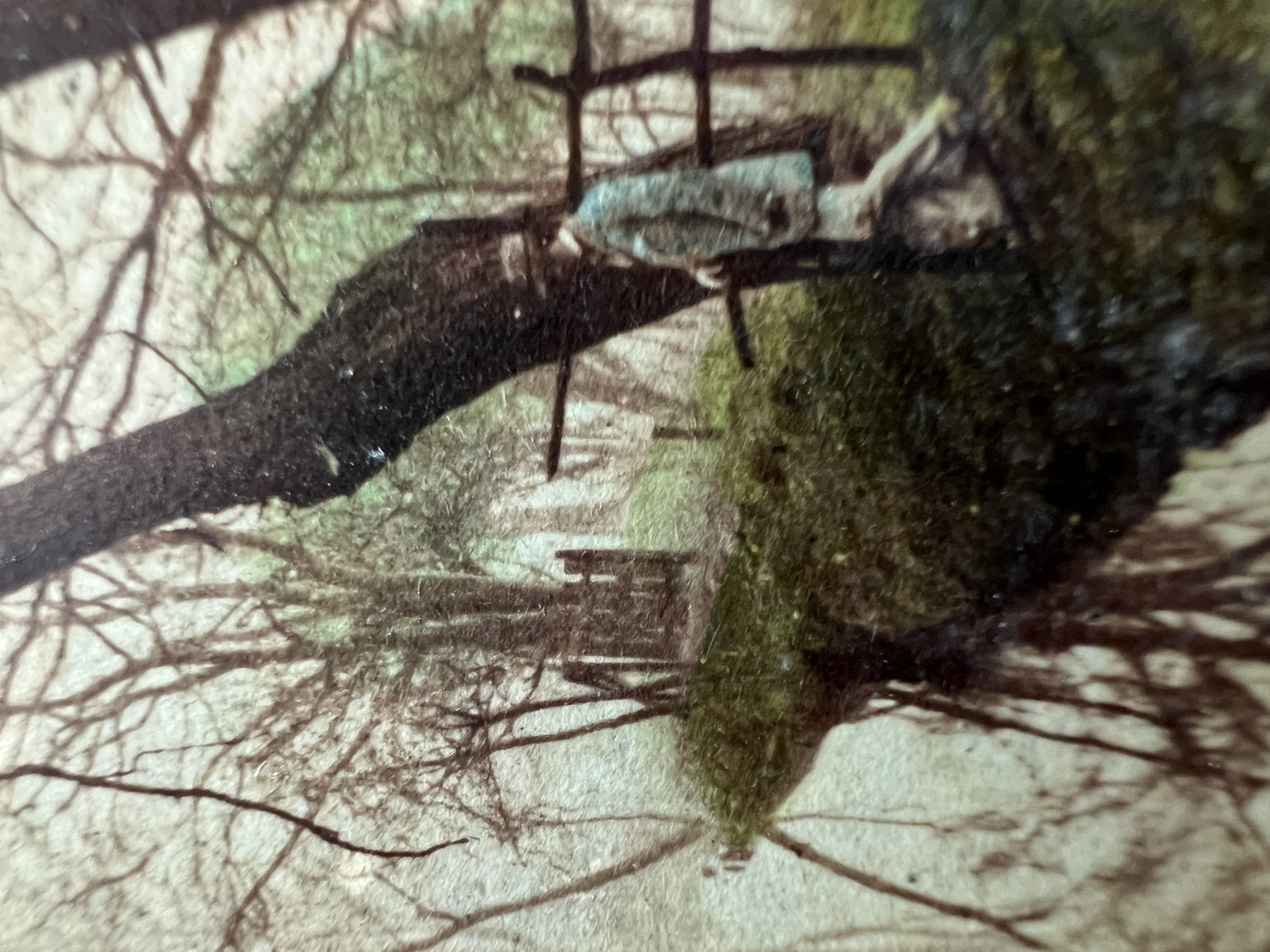
I have included another detail (on the right) to give an idea of the painterly feel of these stereographs. Right-click on it and "Open Image in New Tab" to get the full view (in fact it is best to do that with all of these images).
Grundy loved reflections in water and many of his images have these almost perfect mirror images below the surface of the water. Here the viewer seems to hover over empty space below.
 |
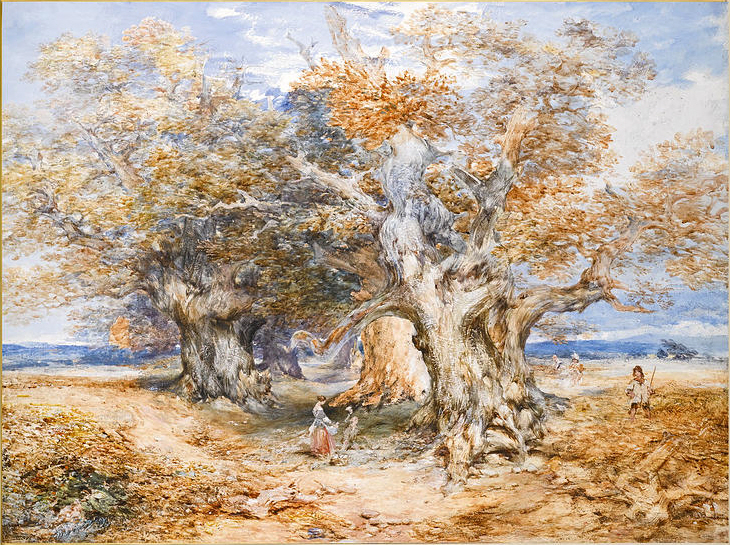 |
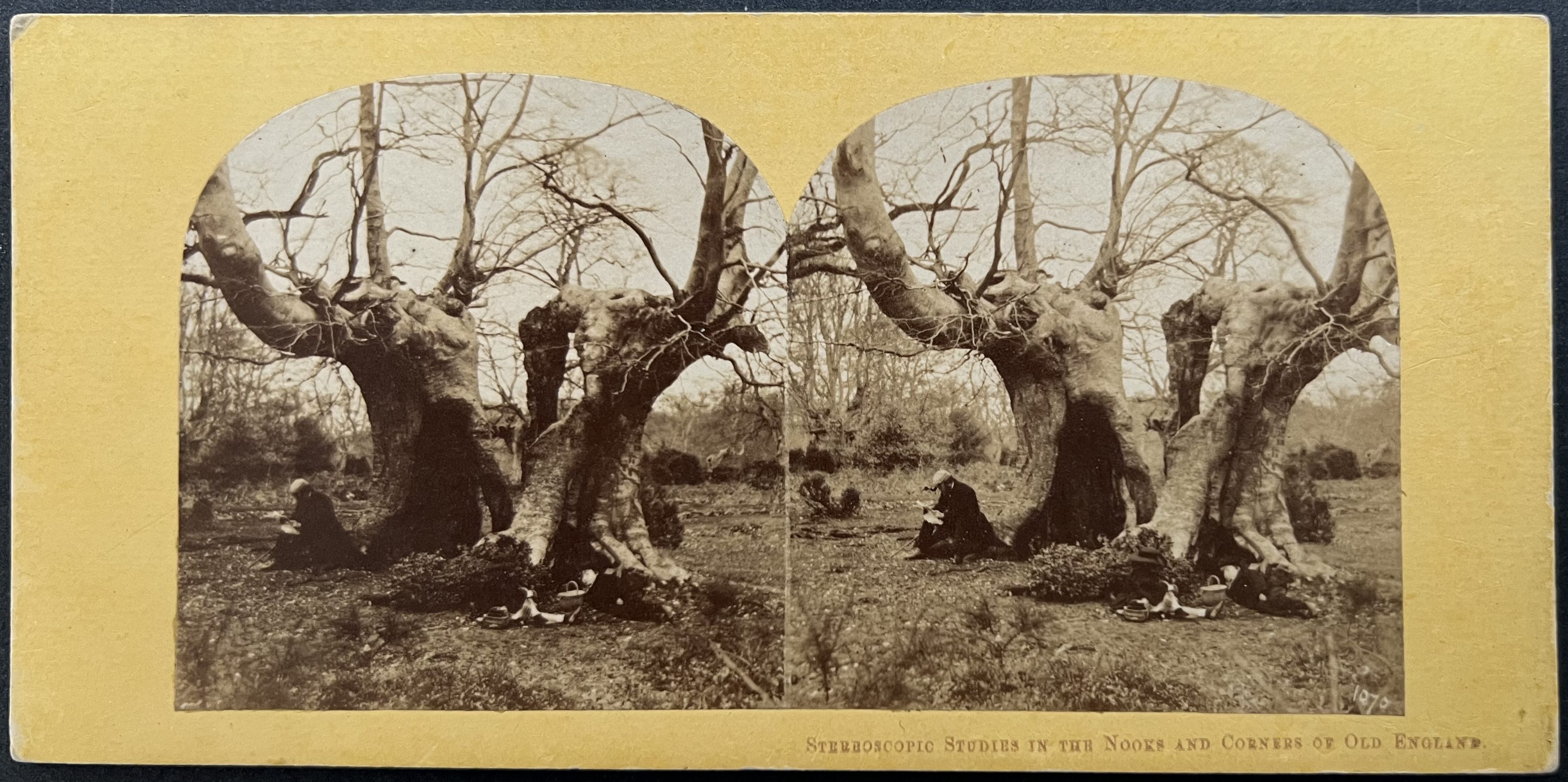
UKG1070 – William Grundy? (1850-1859) '[Under a Beech],' Stereoscopic Studies in the Nooks and Corners of Old England. Albumen prints.
George Cattermole (1800-1868) was an artist in Grundy's personal collection. I have reproduced his painting On the borders of Sherwood Forest (watercolor 76 x 101 cm) on the right. You can see the common interest in great trees. See also Grundy's 'There is a Pleasure in the Pathless Woods.'