Rod Bantjes, “EXBD-69331_Water-Mill.html,” created 5 August, 2025; last modified, 5 August, 2025 (https://people.stfx.ca/rbantjes/).
Water Mill Viewing-Box
Bill Douglas Cinema Museum[*] #69331
Swiss, Early 19th
Dimensions: H=20.8 cm; W=17.5 cm; D=11.7 cm
Peephole: ⌀=2.5 cm; no lens (missing?)
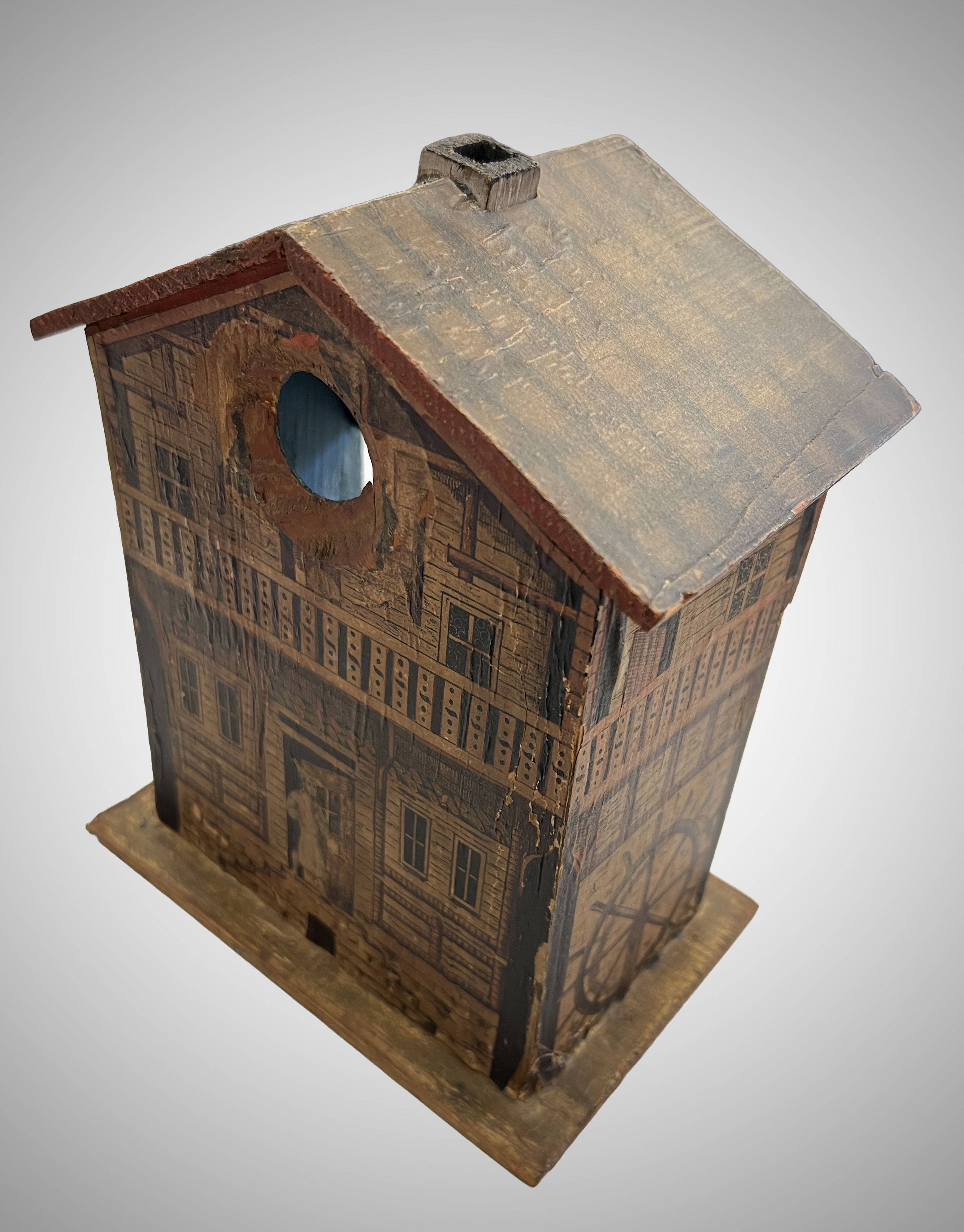 |
Figure 693331.1 –Water Mill Viewing-Box |
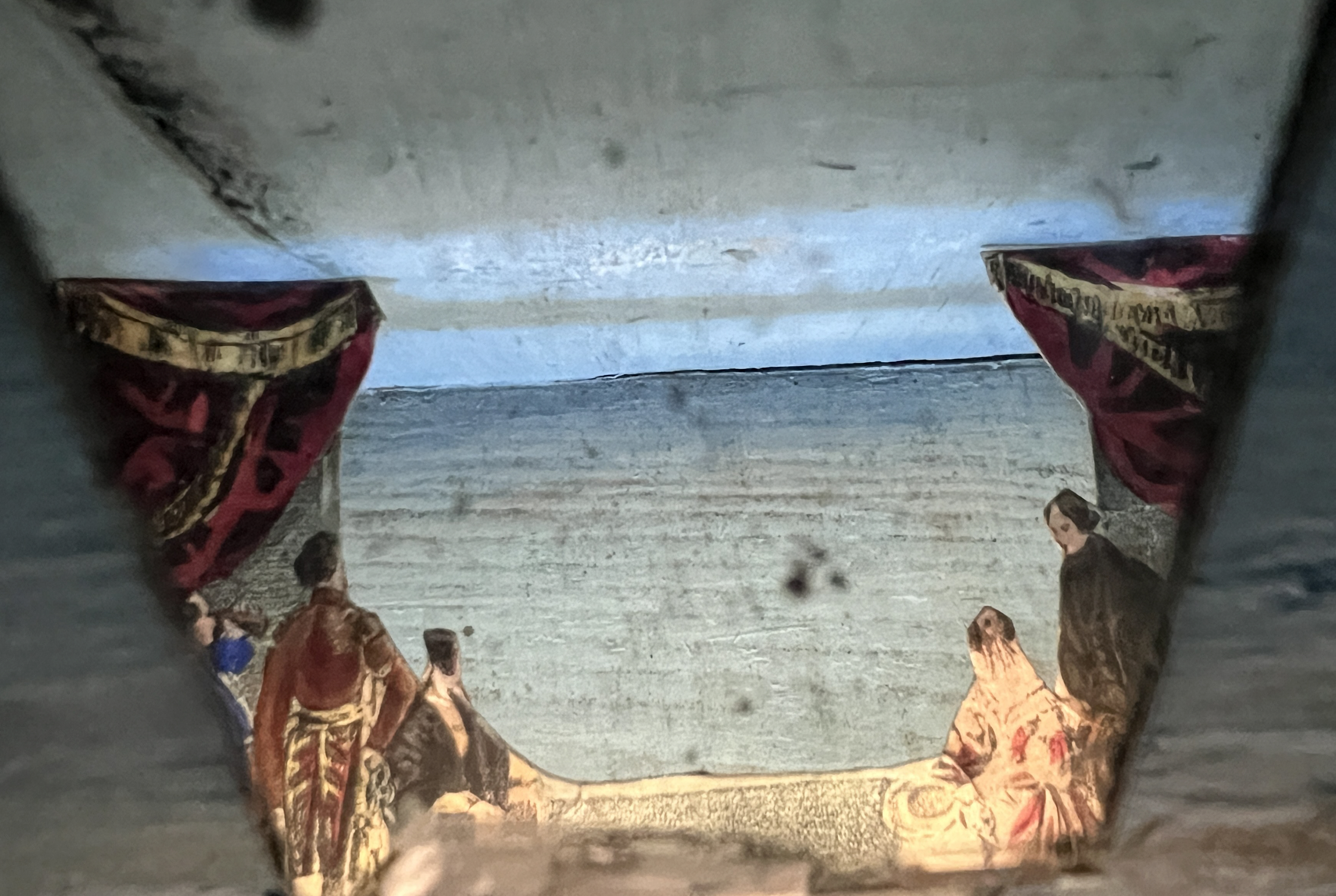 |
Figure Figure 693331.2 –Inner Coulisse |
| The idea is that we are in a box in the theatre or opera gazing down at the scene below. |
This is a peepshow with a single peephole and diagonal mirror, possibly Swiss from the early 19th century. It is an example of an "optical machine " and is included in the Optical Machine Taxonomy
The charming little box takes the form of a water mill as indicated by litho prints pasted to its four sides. The depiction of an overhanging upper story and decorative wood detailing suggest Swiss design. The miller emerges from the front door smoking pipe of distinctly Swiss style (see Figure 693331.4).
When one peeps into the aperture one is transported from a rural Swiss scene to theatre box amid distinguished company from which one views distant scenes on the “stage” beyond. The theatre box and its occupants are represented by a coulisse in front of and framing the scene beyond. The Bill Douglas Museum has one of these scenes – a stark litho of the Italian city of Livorno (Cat no. 70120) (see Figure 693331.3). It is numbered “3” and presumably others could be obtained for the box and interchanged.
The edges of peep hole have been crudely carved away probably by the user rather than the manufacturer. Such boxes typically had a biconvex lens in the peephole whose purpose was to slightly enhance the 3D effect of the image. Perhaps the child who owned the box thought it would be more amusing to use the lens as a burning-glass.
This form of diagonal mirror box, with the fancifully papered exterior and single coulisse representing a theatre-box audience, may have been from an Austrian workshop. I have documented three other examples (GST-373, GST-374, GST-375). (There is also one in the Werner Nekes collection in Cologne that I did not have time to examine.) A further distinguishing feature is that the interiors are all painted in a light blue. Optical box interiors are more typically painted matte black to minimize light reflection and visual distraction.
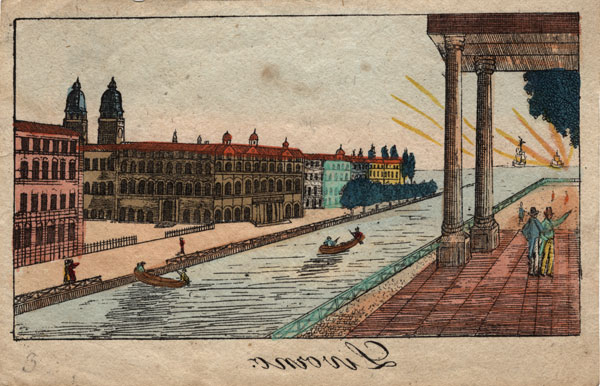 |
Figure 693331.3 –View of Livorno |
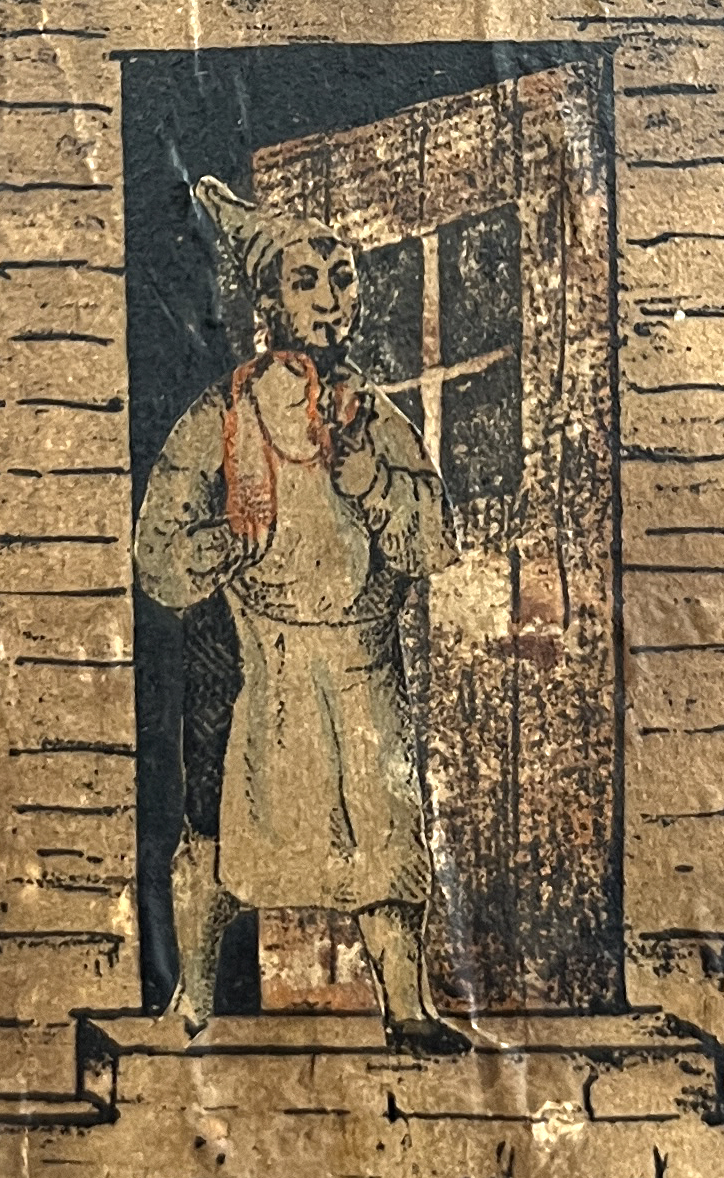 |
Figure Figure 693331.4 –The Miller |
Footnotes:
[*] I would like to thank the Bill Douglas Museum for a stipend that supported my research there and the staff of the museum for their generous assistance..