Rod Bantjes, “EXBD-69417_Paper_Theatre.html,” created 10 September, 2025; last modified, 10 September, 2025 (https://people.stfx.ca/rbantjes/).
Paper Theatre
Bill Douglas Cinema Museum[1] #EXBD-69417
English, 1851
Dimensions: H=16 cm, W=17 cm, D=2 cm (collapsed) D=ca. 50 (extended)
No lens
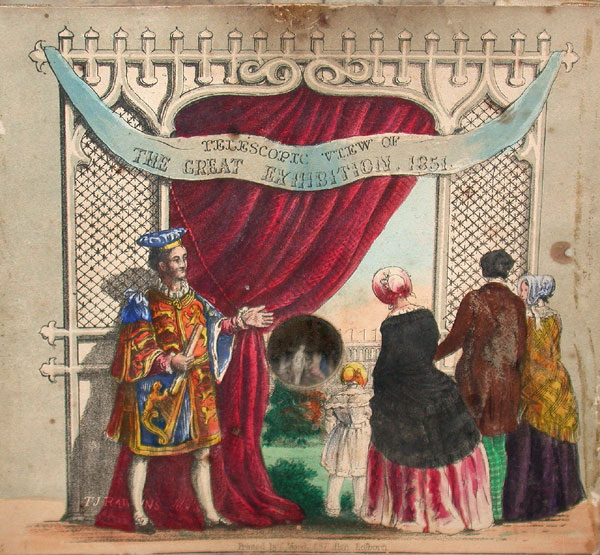 |
Figure 69417.1 –Paper Theatre |
| Photo © Rod Bantjes. |
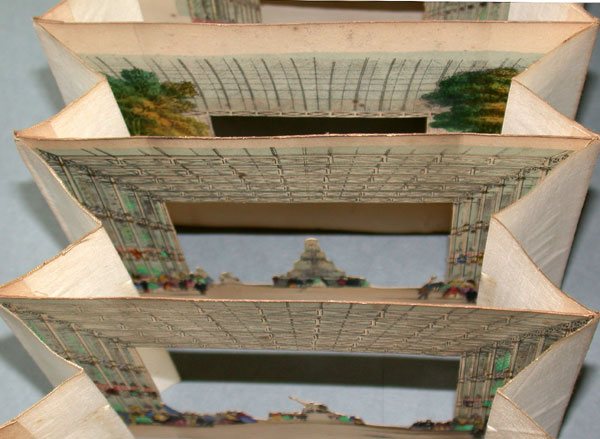 |
Figure 69417.2 –Pleats Connecting Coulisses |
| Photo © Rod Bantjes. |
This is a folding theatre maquette with a peephole through which one views multiple paper coulisses showing the Great Exhibition of London, 1851. The peephole lacks a lens so it cannot be considered an "optical machine ," but is included in the Optical Machine Taxonomy as an outlier.
This version of paper theatre, with the pleated folds and an aperture for peeping, was first developed in Vienna in 1825 by Heinrich Friedrich Müller. He printed the images first as etchings, but soon shifted to lithographs.[2] Paper theatres became popular in Germany where they were called faltperspektive, in England, where they were known as "telescopic views" and France where they became known as vues dépliantes à perspective.[3]
They are part of a proliferation of paper ephemera in what we are calling the Lithograph Era (1820-1854). Dispensing with the wooden box and using cheap lithographs, they were significantly lighter and less expensive that the kulissentheaters of the 18th century that they were modelled on.
Their loose structure made paper theatres a bit floppy. They could be stabilized on a hard surface such as a table. There were other techniques as well. Hyde shows an image of a little girl holding hers with the accordion pleats hanging down so that she could peep into it from above.[4]
English toy theatres made of wood with paper scenes also became popular at this time. These included cutout figures of actors that allowed children to participate in the making of the drama in ways that the kulissentheater and paper theatre did not.[5]
These new visual-theatrical toys were in competition with the optical machine. They were part of a changing cultural context that stimulated a proliferation of new optical machine designs in the early 19th century. The optical machine's direct answer to the toy theatre is the folding diagonal-mirror theatre.
Footnotes
[1] I would like to thank the Bill Douglas Museum for a stipend that supported my research there and the staff of the museum for their generous assistance..
[2] Hyde, Ralph, Paper Peepshows: The Jacqueline & Jonathan Gestetner Collection (Woodbridge: Acc Art Books, 2015) 10-11.
[3] There were other terms used, such as "optiques" and "pocket panoramas" that are vague and misleading. I have mentioned only those that are describe their object somewhat accurately and unambiguously. I am reserving the word "Telescopic Theatre" for paper theatres with lenses, since they share two key features with telescopes: they are collapsible and have a lens.
[5] Paper Peepshows, 70.
[4] Speaight, George, The History of the English Toy Theatre (London: Studio Vista 1969).