Rod Bantjes, “vanderheyden_device.html,” last modified, 22 August, 2024 (https://people.stfx.ca/rbantjes/).
The van der Heyden Device: Perspective Painting as a Peep-Show
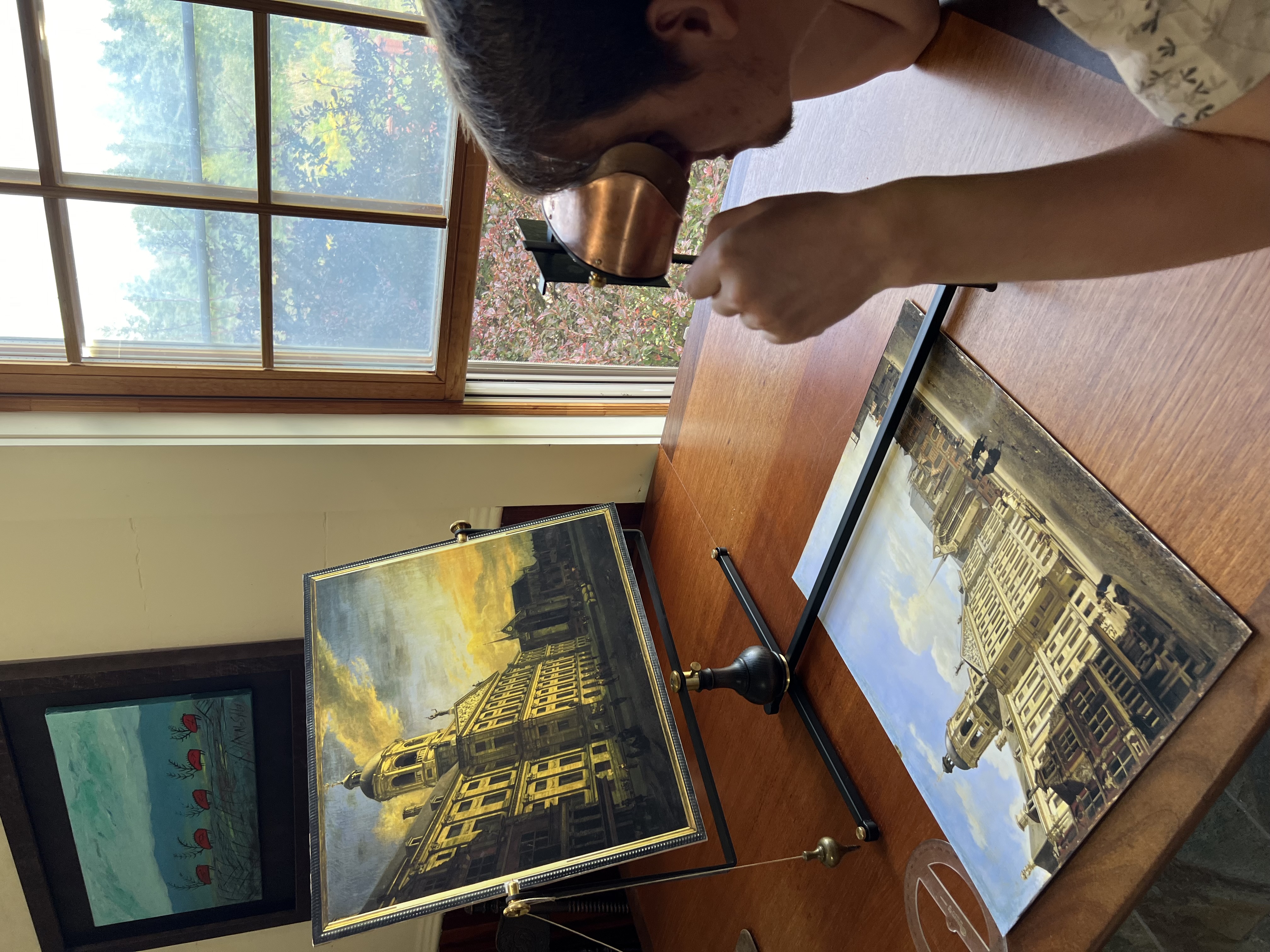 |
Figure 1 – van der Heyden Device |
| In the device: Van der Heyden, Stadhuis in Amsterdam 1667 (anamorphic) |
| On the table: Van der Heyden, Stadhuis in Amsterdam 1665 (conventional) |
1. The Viewing Device
Jan van der Heyden, in 1667, painted the municipal building or Stadhuis in Amsterdam in distorted perspective. He meant it to be viewed with a special viewing apparatus designed to correct the distortion. As soon as I learned of this and that the apparatus had been removed and lost, I wanted to try to re-create it. That is what you see in Figure 1, with my student David Eliot, trying it out.
The device is like Brunelleschi's peep-show, which I also re-constructed. I am sympathetic to this idea that what we take to be "normal" perspective painting is always a peep-show, and I am interested when artists have acknowledged it (and why others, including presumably whoever removed van der Heyden's device, have denied it).
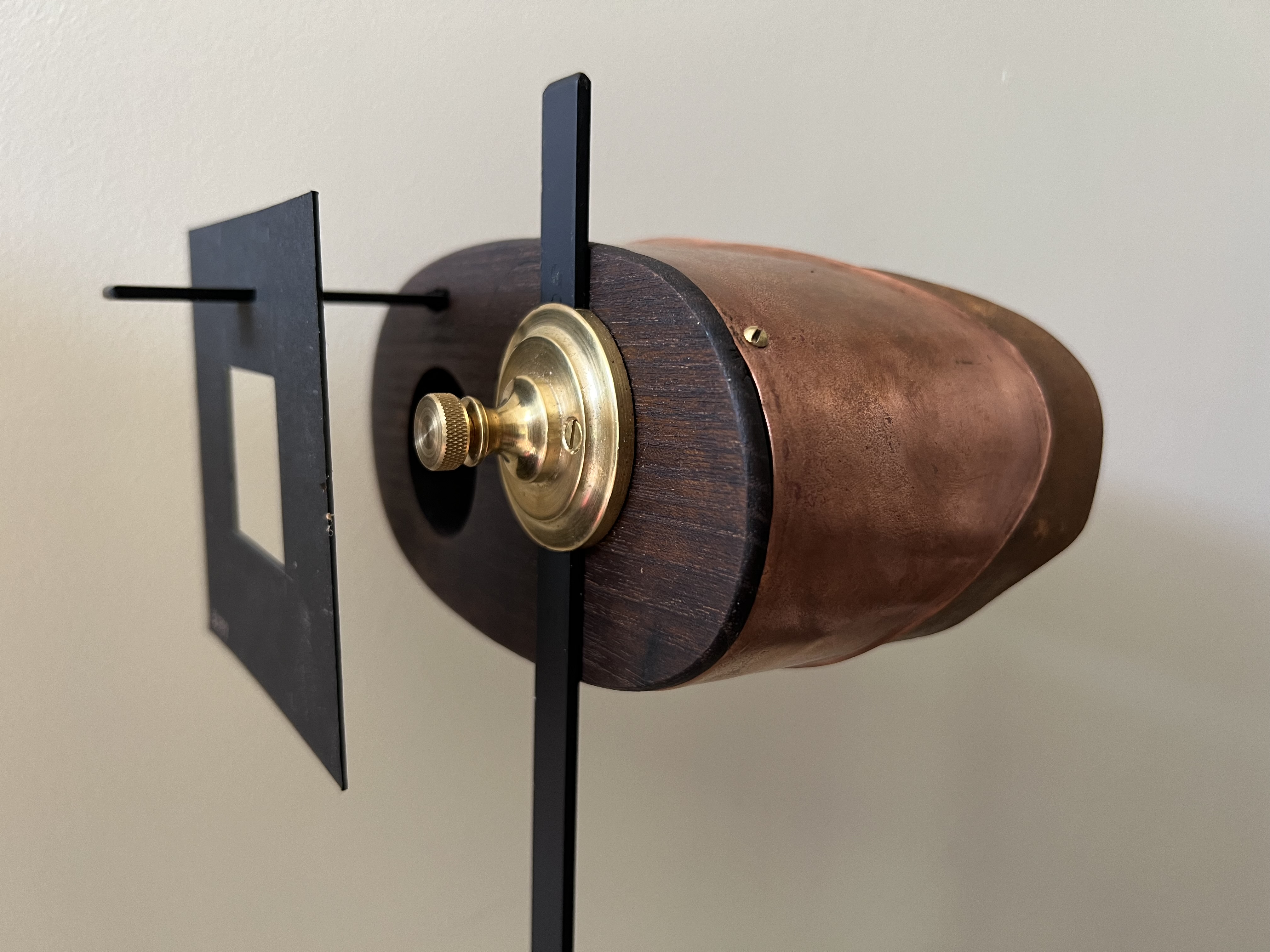 |
Figure 2 – Eye-Piece |
| The brass knob is to adjust the height |
The geometry of perspective works perfectly if we assume that we see from a single, mathematical point. Constructing the eye-piece for this device (Figure 2) helped me to think about just how artificial that idea is. You might think that a 1/4 inch hole would serve as a peep-hole – but at that size you can't actually see the whole painting. The eye has to swivel to take in the whole view. Here what I have done is create a leather-lined hood (modelled on a Holmes stereoscope but with only one eye) that constrains the head and the location from which the eye swivels. I have heightened its "steam-punk" qualities to indicate what a strange mediation of seeing it is.
The distance between the eye-piece and painting is adjustable, as is the height of the eye-piece. I normally place this sort of setup on a rail atop a tripod, but I have become tired of carrying heavy tripods around the world, so this time I designed a table-top version.
The viewer can adjust the angle of the painting to find what seems to them the most un-distorted position. As you can see, David finds it best tilted back and turned clockwise (i.e. the same as viewing from below and from the right side). However, it is hard to be precise about this, since we have learned, from looking at thousands of pictures from every conceivable angle, to tolerate a huge amount of perspective distortion. Note that in the photograph of the reproductions of the paintings (Figure 1) we are looking at two versions of the scene from very oblique angles, but we have no trouble making sense of the space that they depict.
Van der Heyden painted two versions of the Stadhuis and the square in which it is situated. The first (1665) is conventional in the sense that it follows the advice given by treatises of perspective to stand back from architectural scenes to keep the angle of view narrow and thereby minimize perspective distortions. The second (1667) follows the geometry of perspective, but from a vantage point too close to the building so that anamorphic distortion becomes evident.
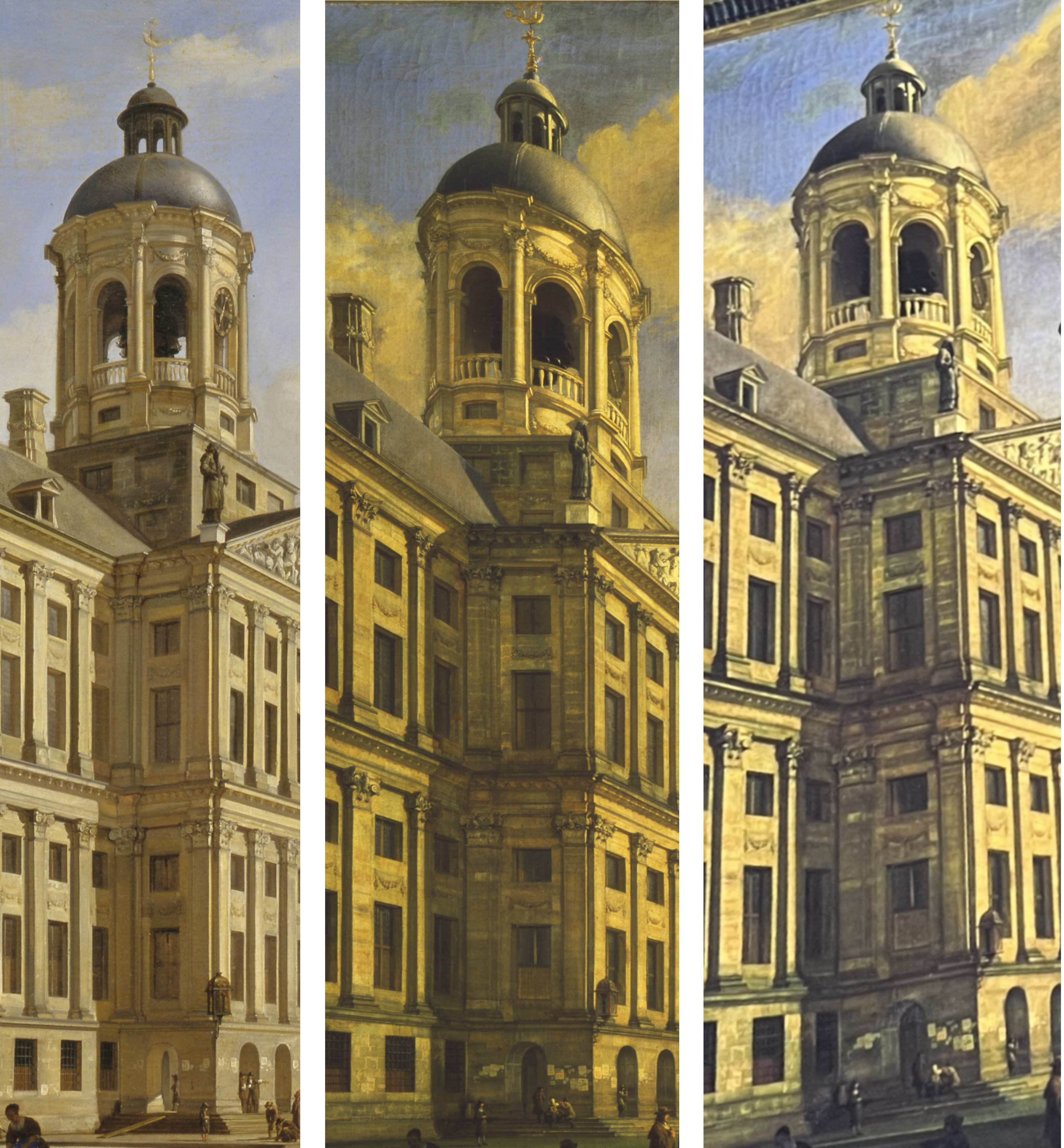 |
Figure 3 – Distortion Comparison |
| Left: Stadhuis 1665 (conventional) |
| Middle: Stadhuis 1667 (anamorphic) |
| Right: Stadhuis 1667, rectified |
2. Looking Up
Circular forms tend to betray perspective distortion most readily. You can see it in the dome (Figure 3) and the arches that make up the circular support of the dome.
The floor of the cupola is tilted away from us more dramatically in the 1667 version. That is because we are closer to the building than in the 1665 version and are having to look up. The Amsterdam town hall was was once the tallest secular building in Europe and its height posed a problem for artists who wanted to represent the full facade. Gérard Lairesse suggested, in 1738, that artists could use a convex mirror, a device which gives a wide-angle view and captures the height of the building as well as the full breadth of the square where it is located (as in Figure 5).
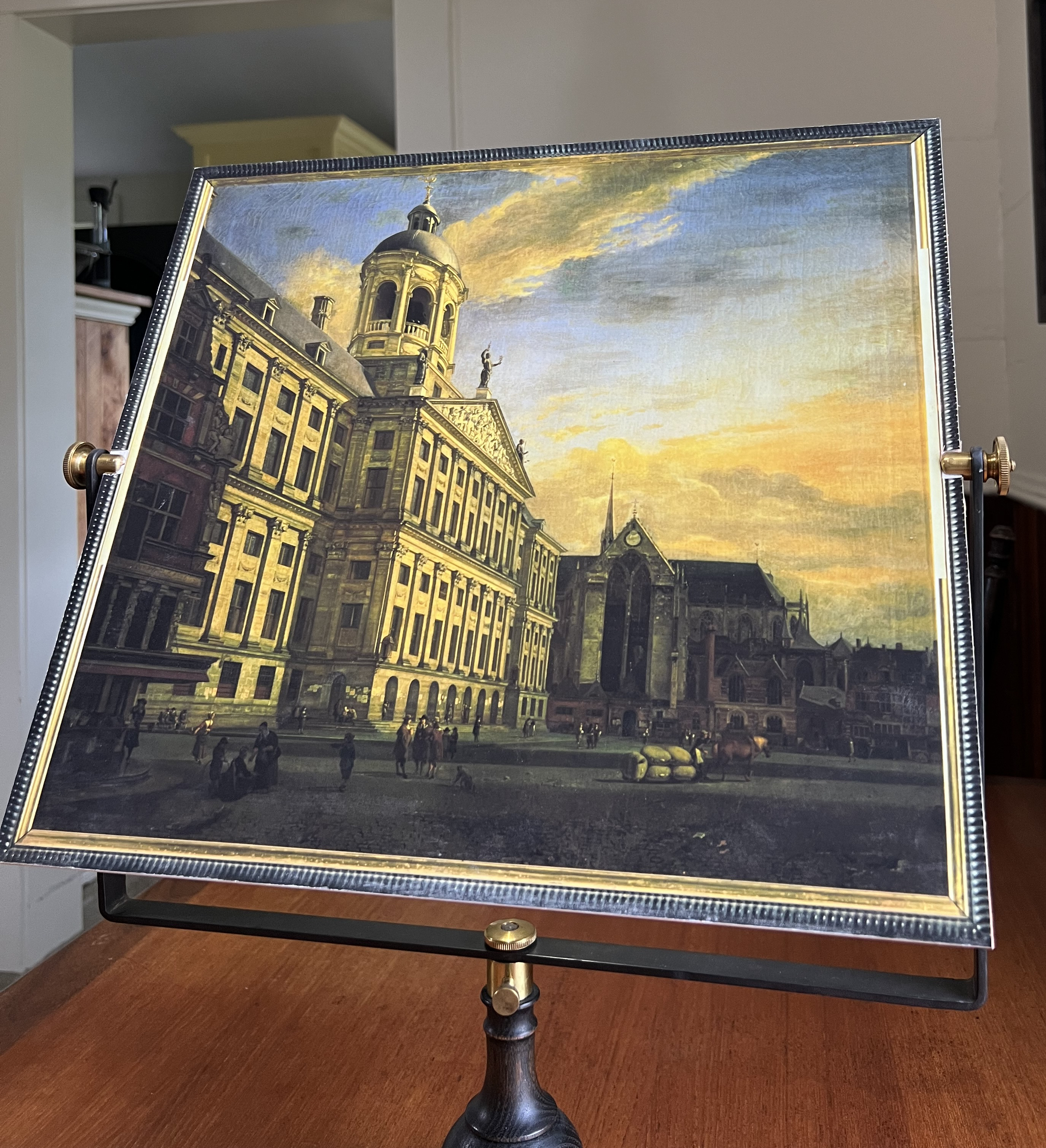 |
Figure 4 – From the Eye-Piece |
| iPhone view from the location and orientation of the eyepiece |
Van der Heyden has painted as though we were looking up. One way that he could have done that would have been to have tilted the "plane of delineation" back. In so doing he would have ignored the advice of every treatise on perspective to date. Viewers and theorists alike were offended by the way that the vertical lines of buildings would appear to converge upwards. The strange thing about this objection is that perspective always renders parallel lines as converging in one direction or another towards "vanishing points." Why did converging verticals seem distorted when converging horizontal lines seemed "natural?" (I try to answer that question in my paper "Vertical Perspective Does Not Exist" which you can find among my publications.)
By affixing a viewing device at the lower left-hand corner, van der Heyden was effectively tilting the plane of the painting rather than the plane of delineation. By this means he reintroduces the offending upward converging vertical lines (see figure 4). However, they are deniable, because they are not recorded on the canvas. The eye sees them, just as it does when looking up at an actual building. But it is one of the many curiosities of our consciousness of seeing, that many can fail to see what the retina records (again, see "Vertical Perspective" for evidence of this).
3. A Wide-Angle View
The cupola on the right in Figure 3 is a detail from the photograph in Figure 4. It has simply been cropped and rotated. To my eye it is the least distorted of the three, even though in Figure 4 the tower and the whole building lean precariously to the right. Think of the building as positioned off to the left in a wide-angle view. The centre of that view would be near the old church in the background. Imagine that the rest of the view has been cropped away. We could expect that a building on the absent right side of the view would lean dramatically to the left. We are accustomed to this sort of symmetry in leaning buildings from having seen many photographs of skyscrapers taken with the camera tilted up.
Conventional perspective failed to do justice to the expansive sense of space that this great open square evoked. The maker of the copper-plate engraving in figure 5 has bent the perspective rules in an effort to capture a wide-angle view. Instead of a single plane of delineation (that van der Heyden adhered to in both his versions) the artist has used multiple planes of delineation in a sweep from left to right that he/she has stitched together. The principle is the same as when you make a panorama with your mobile phone. This approach eliminates obvious anamorphosis, but as you will know from your own panoramas, it bends the scene and turns straight lines on the ground into curves. Here those curves are eliminated so that the image looks like an example of rigorous single-point perspective. This is what I have called "hybrid projection" and I explain it more fully in the paper "Hybrid Projection, Machinic Exhibition and the Eighteenth-Century Critique of Vision."
The engraving in Figure 5 is known as a vue d'optique and was designed for a lensed peepshow like my Optical Theatre, about which I will have more to say later.
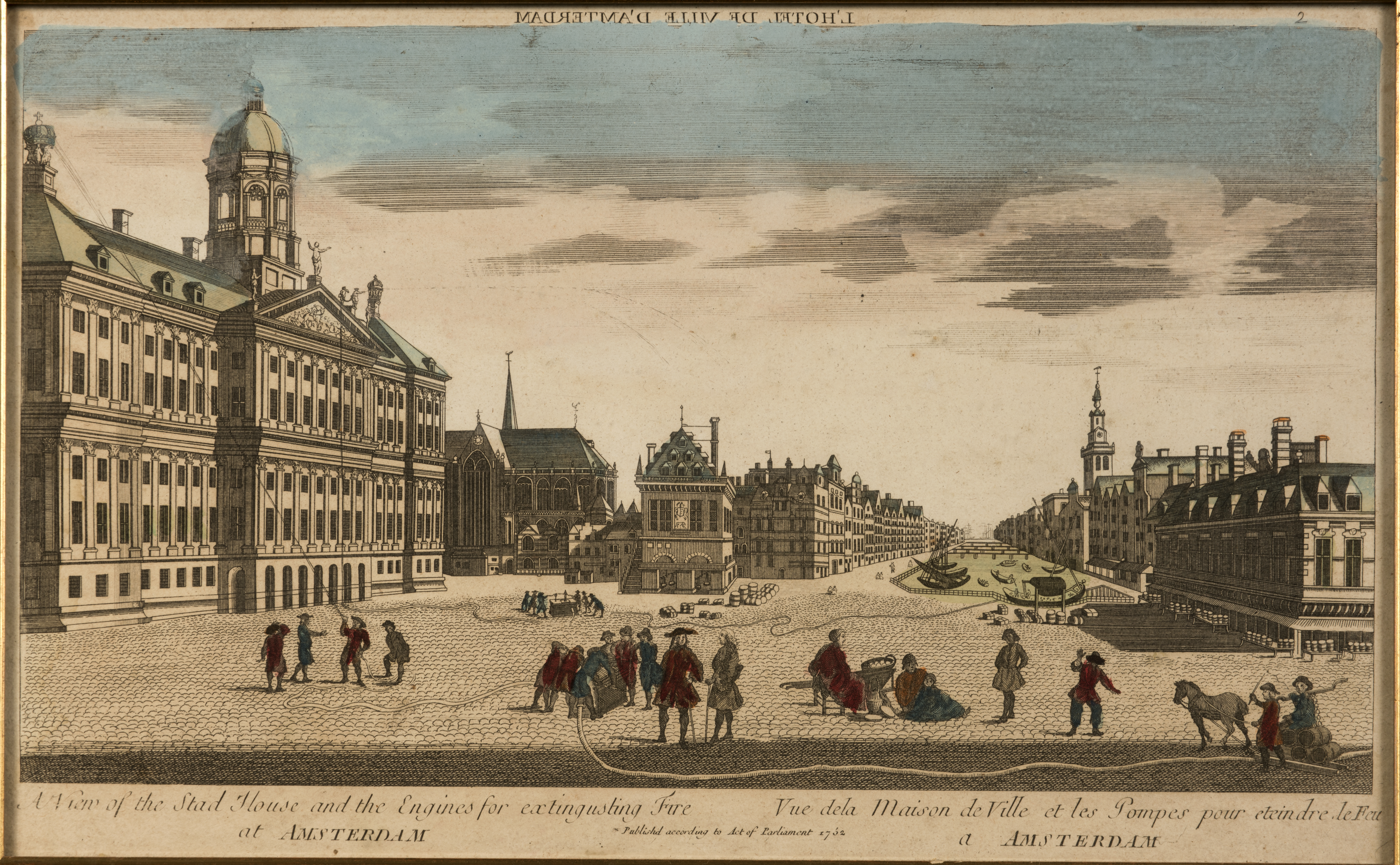 |
Figure 5 – A View of the Stad House, 1762, copperplate engraving, 24.5 x 39.2 cm. |
| This is a wide-angle "hybrid projection" |
4. Enhanced Illusion
This apparatus also strongly enhances the illusion that you are looking out into an open square in Amsterdam rather than looking at an image of that space. I fitted the eye-piece with a square mask (Figure 2) that can be adjusted so that it blocks from view everything but the image. The reality of my apparatus, the table it sits on, and the room in which it is located retire from consciousness and the mind can relish the illusory space that van der Heyden has invoked. The reduction to a single-eye view eliminates binocular cues that would betray that the image-surface is only a few inches from the eye. The tilting away of that surface seems also to make it harder to interpret as a surface. The single eye can read depth through changes in focus, but here the slight variations in distance of the tilted image correspond roughly to the gradient of distance in the purported scene.