Rod Bantjes, “AP-19-3347_Mondo_Nuovo.html,” created 9 June, 2025; last modified, 21 June, 2025 (https://people.stfx.ca/rbantjes/).
Mondo Nuovo (Italian Peepshow)
La Cinémathèque française #AP-19-3347
Italian c.1792
Box dimensions: H=86 cm, W=95 cm, D=125 cm
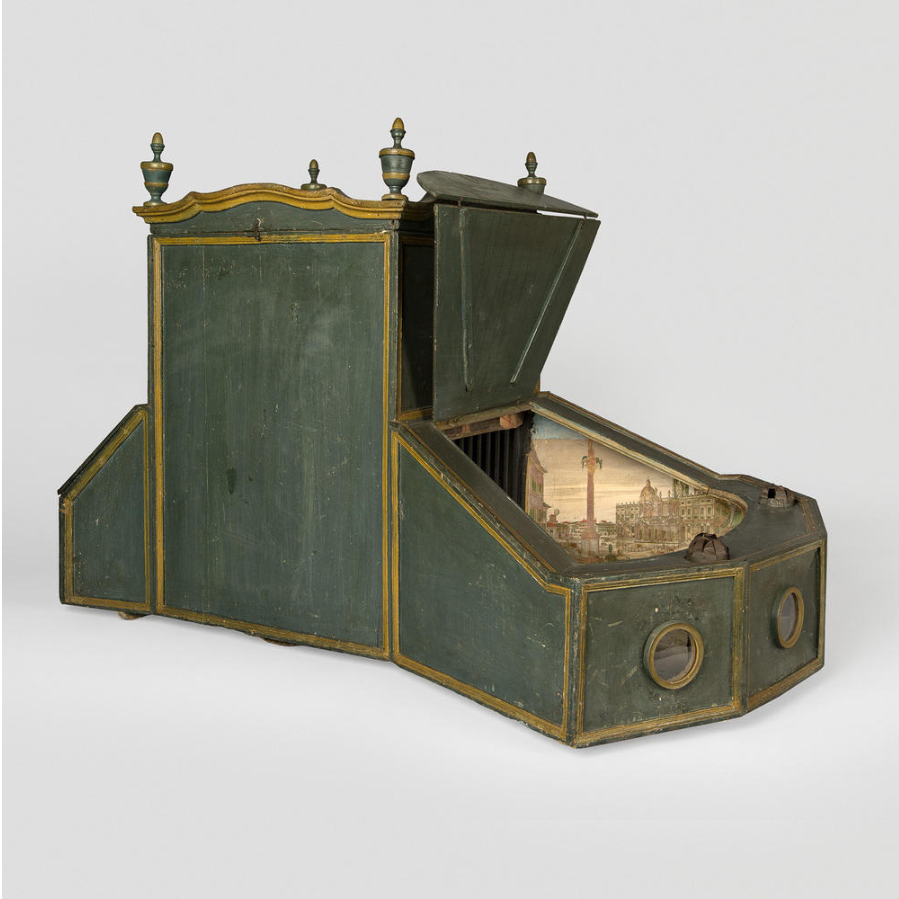 |
Figure 69056.1 – Mondo Nuovo |
| Front view. Note the lenses on the lower right and the raised flap to direct light to the front of the view.
Photo credit: Stéphane Dabrowski, Cinémathèque française |
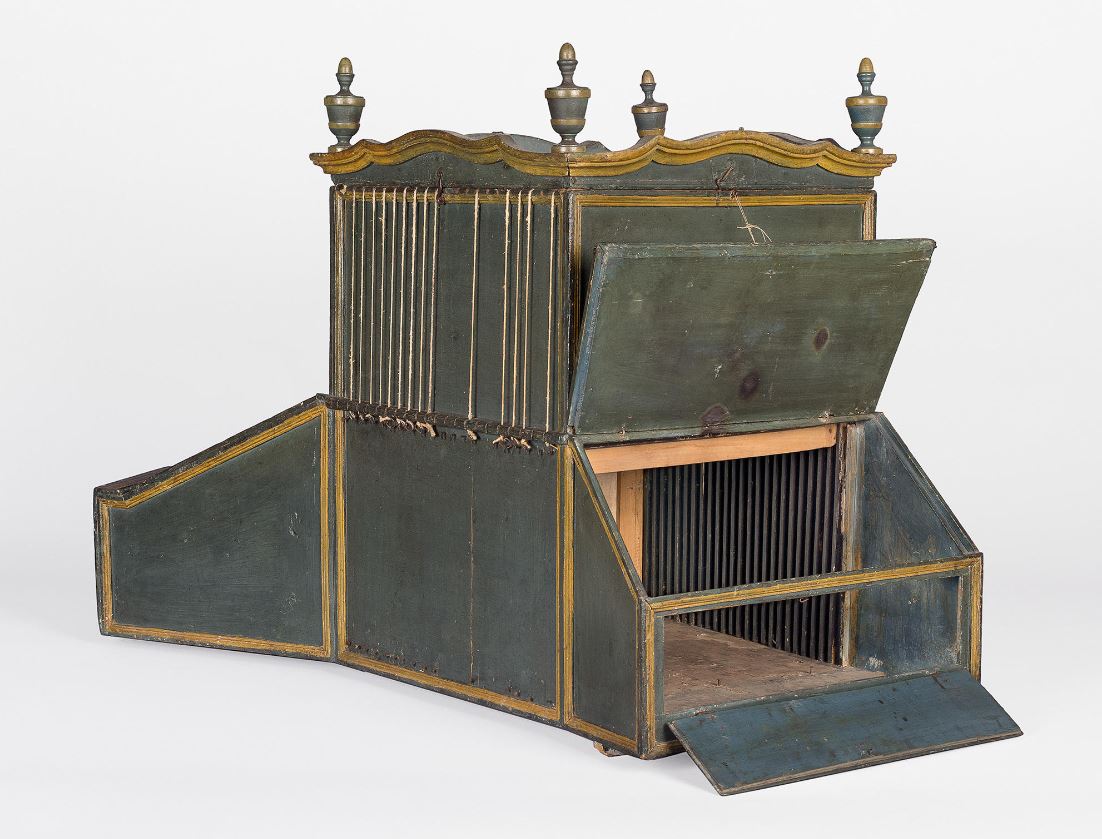 |
Figure 69056.2 – Mondo Nuovo |
| View from the back. The strings on the side of the flytower can be released to lower images into the viewing area. Through the open back you can see the slots that guide the descending 'stage flats.' Two separate flaps can be opened or closed to control back-illumination.
Photo credit: Stéphane Dabrowski, Cinémathèque française |
This is a travelling show-box with four viewing lenses. It is an "optical machine " intended for public performances and is included in the Optical Machine Taxonomy as a member of the genus Mondo Niovo (which you can consult for a general discussion of this category of optical device).
Use:
It has shoulder straps so that it could be carried on a person's back – a heavy burden given its size and tortuous if the showperson were carrying it from town to town. Period engravings often depict showmen as disabled soldiers – presumably unfit for better employment.[1] They would stop in places where people gathered – a market or fair for example – set their box upon a folding stand and charge a penny for a peep. Contemporary engravings depict children as their chief audience, all gathered around eager for a look.[2]
Construction:
This box is 'home-made,' perhaps by the showman himself, and is styled to invoke the splendour of an Italian opera house. It is made of softwood, perhaps pine, with turned ornaments and highlights in gold paint. The 'vestibule' between the lenses and the 'proscenium arch' of the opera stage is decorated on the floor with floral wallpaper and on the two sides with engravings of urban spaces.
Because of the abuse they must have suffered from being carried about in all weather and because of their 'vulgar' status, few of these boxes have survived. We know from the many engravings of them that they came in different styles and designs. This Mondo Nuovo is an example of an Italian style. However, each was unique and reflected the tastes or abilities of the itinerant showman who made it or commissioned its construction.
Theatrical Elements:
Like a real opera house, this box has a 'flytower' that holds up to 22 scenes that can be lowered in to the viewing area by strings. You can see the grooves for the descending 'stage flats' in figure 69056.2. You can also see the strings and their anchor-points in figure 69056.2. Francois Binetruy, in whose collection it once was, shows the box with a perspective image, or vue d'optique, of an opera house stage seen from over the heads of the audience and flanked on both sides by private boxes. This was a very popular image for optical boxes throughout the 18th and 19th centuries. We can imagine that, once the 'stage is set,' and audience members at their peepholes feel they are in the theatrical world of imagination, the showman pulls the strings to make this view vanish and reveal scenes from other worlds.
Lighting Technology:
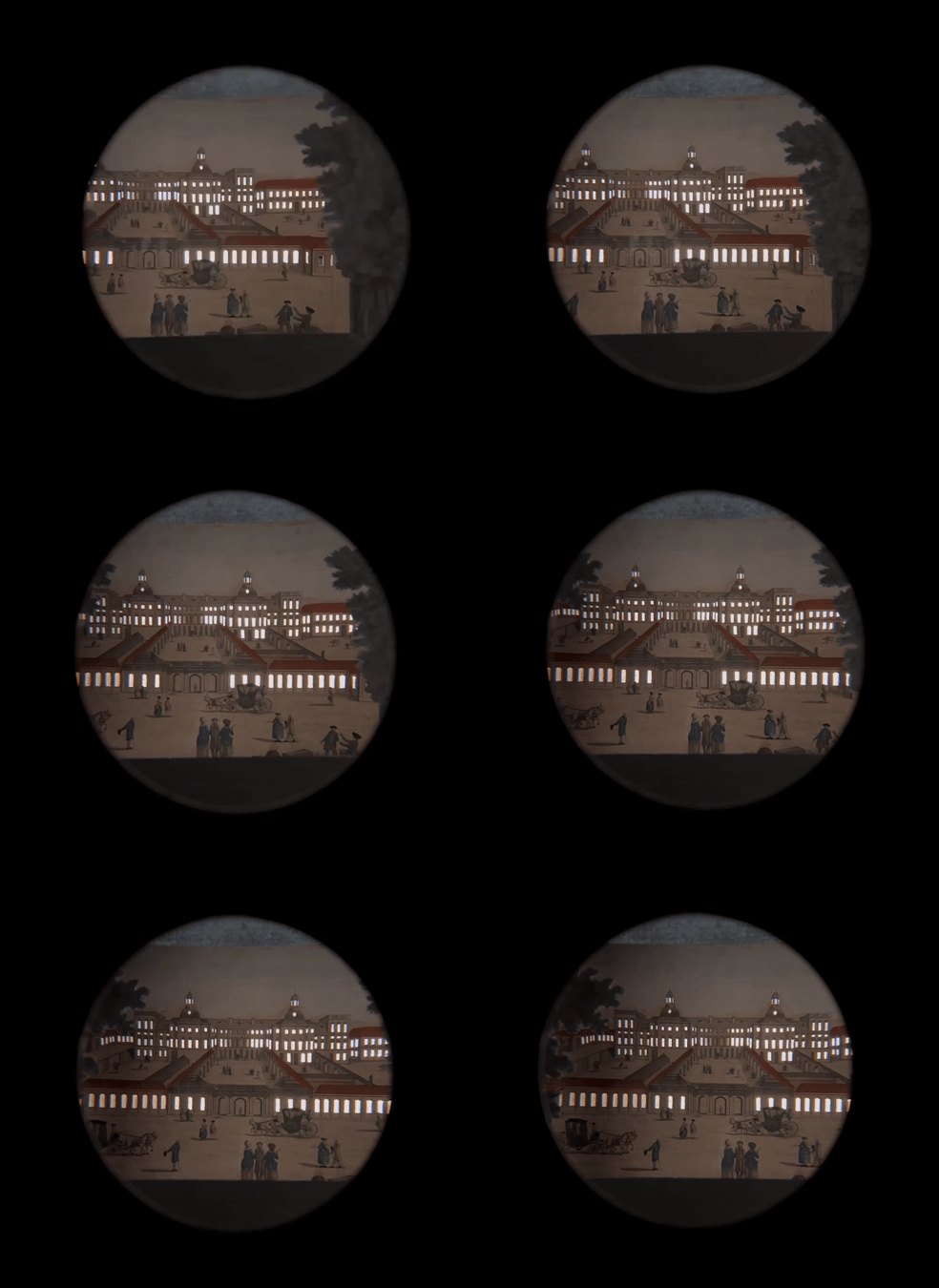 |
Figure 69056.3 –Illuminated Vue d'Optique |
| This is a view through the lens of an optical theatre I built.
Gif image © Rod Bantjes, 2025. |
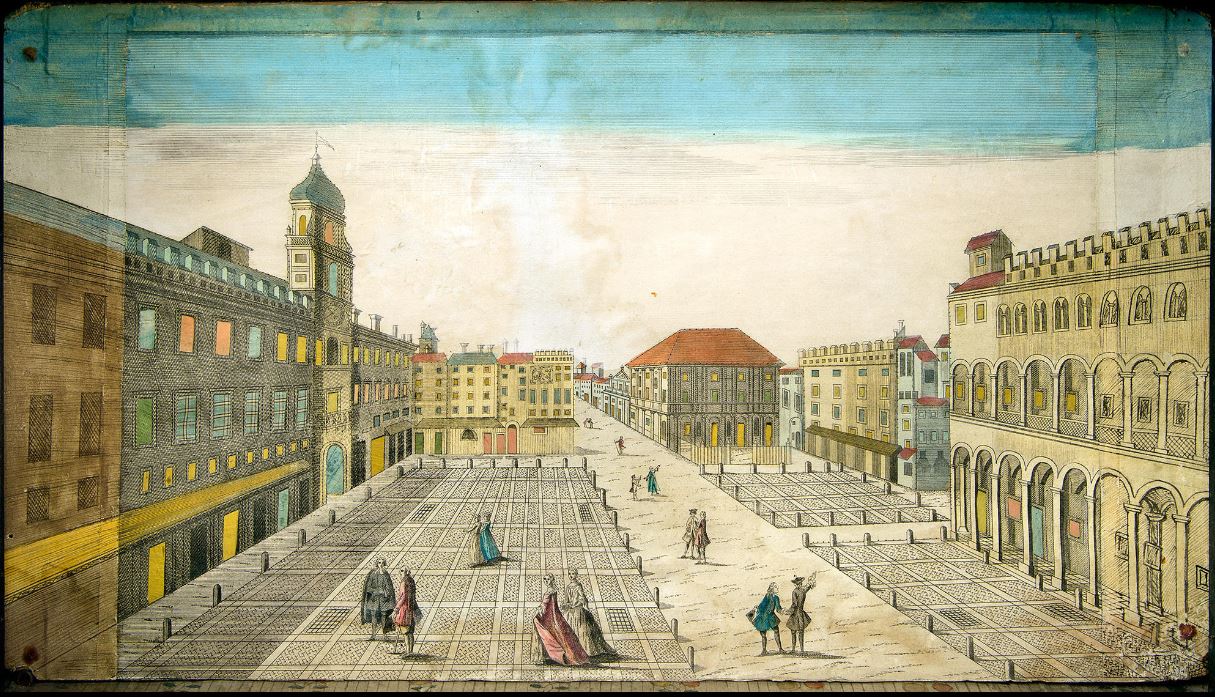 |
Figure 69056.4 –Mondo Nuovo Vue d'Optique |
| The original print is approximately 43 cm in width; the hand-drawn additions (on the left and right edges) extend it to about 52 cm.
Photo credit: Stéphane Dabrowski, Cinémathèque française |
Illumination is controlled by front and back flaps. The flap over the 'vestibule' casts light onto the front of the vues d'optique (figure 69056.1), and the flaps at the back cast light on the back of the views (figure 69056.2). These two sources of light could be varied to transform a scene from day to night – magically transporting the viewers in time. Figure 69056.3 shows an animation of a back-lit night scene. The windows have been cut out and a thin tissue pasted over them to simulate glowing interiour lights. You can see in figure 69056.4 that coloured paper has been used for added effect.
This box also was also equipped with candle-holders inside the vestibule near the lenses. You can see two tin exhaust-vents located above the candles in figure 69056.2. Their presence suggests that the box was sometimes used indoors where, in the 18th century, lighting was poor.
Customized Vues d'Optique:
The images for these 18th-century boxes were commercially printed, hand-tinted copper-plate engravings known as vues d'optique.[5] They were of more-or-less standard size – 37 to 44 cm in width. This showman has opted for a grand 'stage' for which the standard views are too small. So, he has glued hand-drawn additions to the prints to make them more 'panoramic' (figure 69056.4). He has also modified this print for lighting effects when back-illuminated. The 18th-century author William Hooper published directions for how to pierce, illuminate and even animate these optical prints.[3] Surviving prints show additional effects like hidden figures that appear in windows at night. [4]
Footnotes:
[1] Füsslin, Georg, et al.,Der Guckkasten : Einblick, Durchblick, Ausblick (Stuttgart: Füsslin, 1995), 37; Balzer, Richard, Peepshows: A Visual History (New York, N.Y.: Harry N. Abrams, 1998), 75. Showmen were often depicted in ragged and patched clothing, evidence of their poverty Visual History, 74, 81, 85. See also Plunkett, John, "Peepshows for All: Performing Words and the Travelling Showman," Zeitschrift für Anglistik und Amerikanistik 63, no. 1 (2015), 25.
[2] Huhtamo, Erkki, "The Pleasures of the Peephole: An Archaeological Exploration of Peep Media," in Book of Imaginary Media : Excavating the Dream of the Ultimate Communication Mediumed. Eric Kluitenberg (London: Art Data, 2006)..
[3] Hooper, William, Rational Recreations (London,: L. Davis etc., 1774), 191.
[4] Milano, Alberto, Viaggio in Europa Attraverso Le Vues D'optique (Milan: Nuove edizioni Gabriele Mazzotta, 1990), 54.
[5] Plunkett ('Peepshows for All,' 23) found that English showboxes of the 19th-century used larger, painted scenes in place of vues d'optique. On the particular 'hybrid projection' often used in vues d'optique see Bantjes, Rod, "Hybrid Projection, Machinic Exhibition and the Eighteenth-Century Critique of Vision," Art History 37, no. 5 (2014).