Rod Bantjes, “Vue_d_Optique.html,” created 11 September, 2025; last modified, 11 September, 2025 (https://people.stfx.ca/rbantjes/).
Vue d'Optique
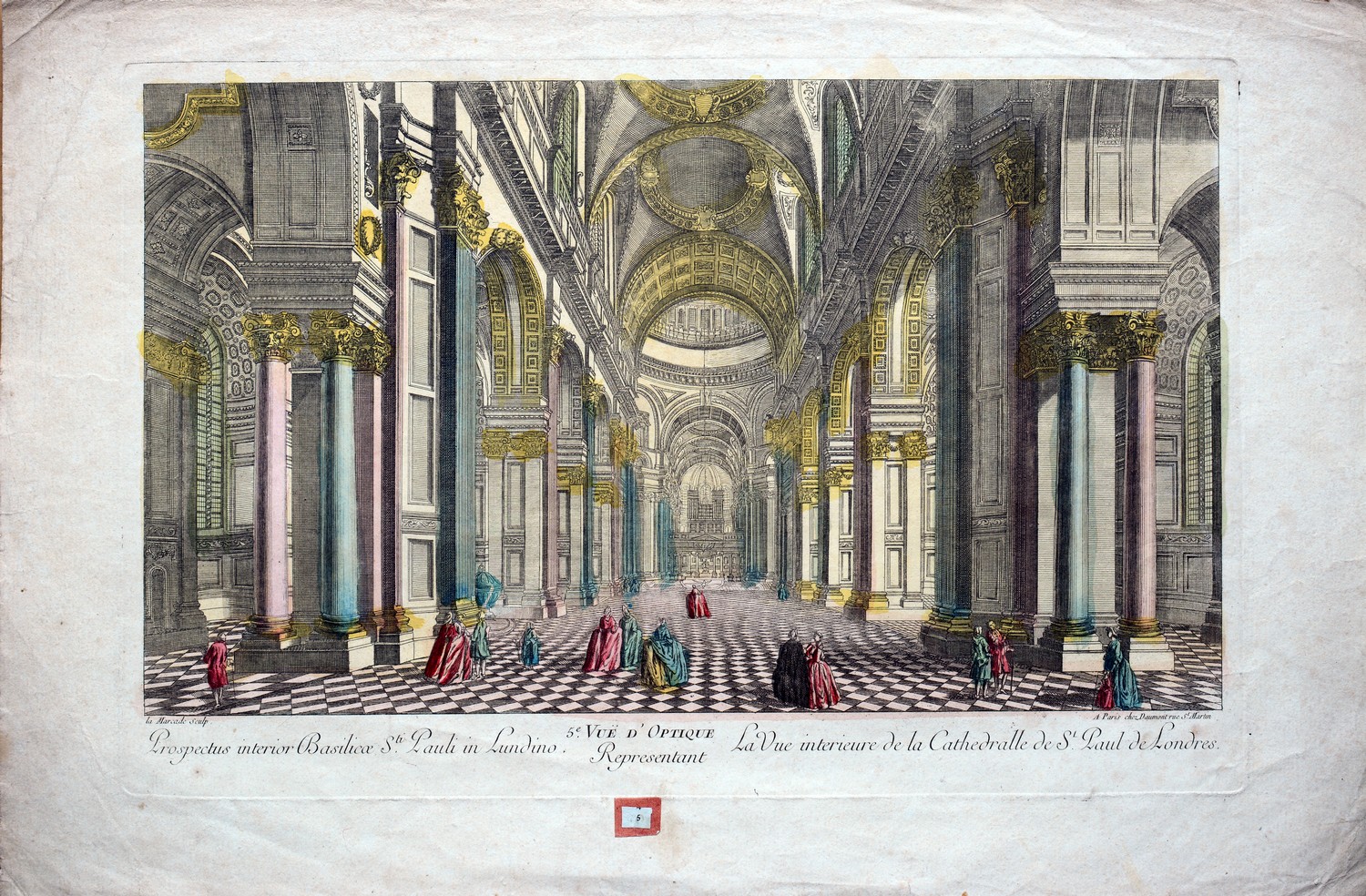 |
Figure V.1 –St. Paul's Cathedral, London |
| This is an impossibly expanded view in hybrid projection. |
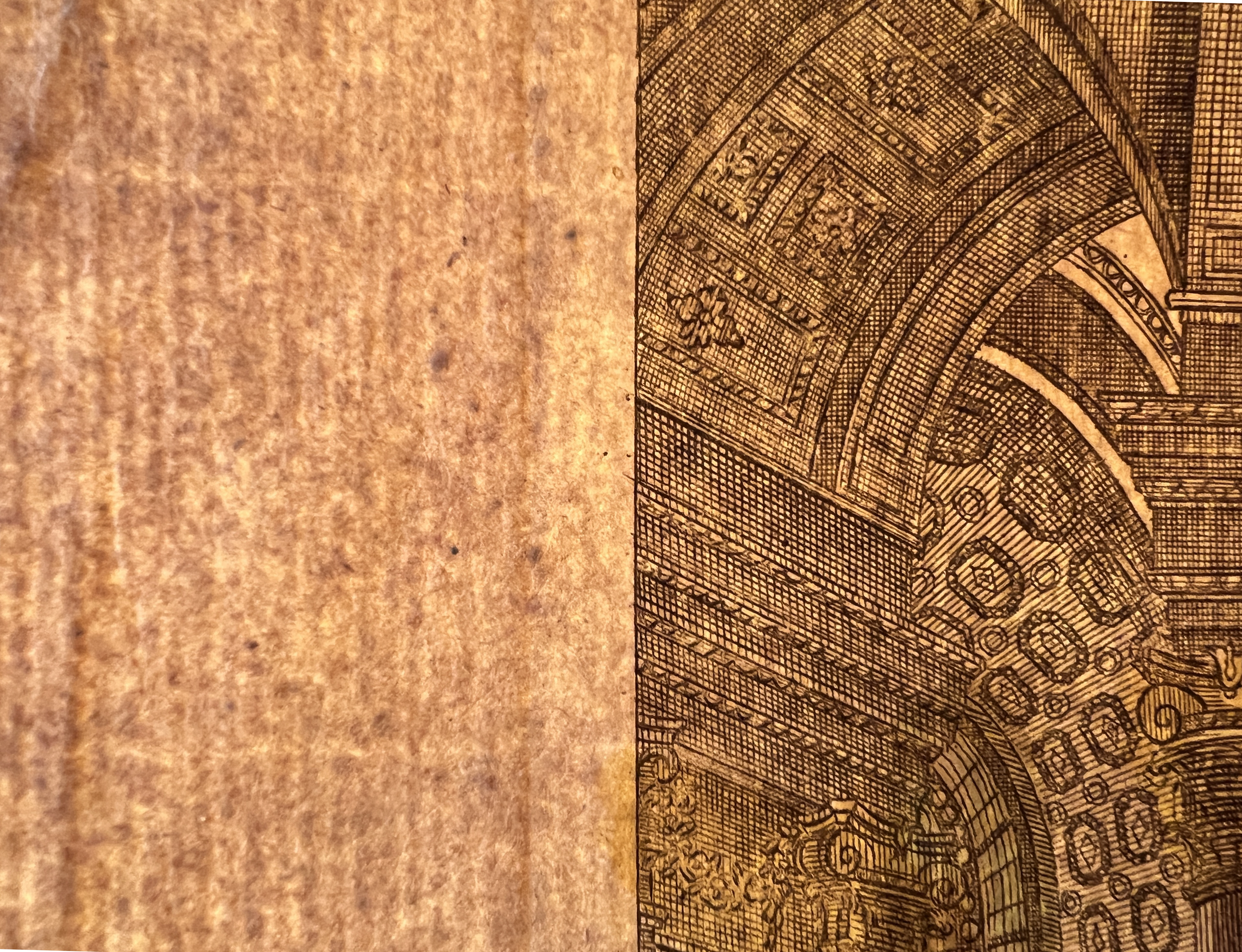 |
Figure V.2 –Laid Paper |
| When the paper is back-illuminated, you can see the marks of the wire grid used in making this type of paper. |
A vue d'optique is a copper-plate engraving on laid paper. It was the standard image-format for optical machines in the 18th century in Europe. It was gradually replaced by other print techniques in the early 19th century: lithographs, steel engravings and woodcuts on wove paper.
Many vues d'optique of the second half of the 18th century exaggerate the breadth and depth of spaces, particularly large interiors, not by exaggerating linear perspective, but by departing from it in favour of a wide-angle "hybrid projection."
Paper-making technology influenced the size of vues d'optique and therefore the size of the optical boxes that held them. The standard sheet was called "folio" and it measured approximately 36.8 x 46.6 cm. The sheet in Figure V.1 is 33.5 x 49.6 cm. The copper plate in this example, its edges visible as a depression in the thick, soft paper, was only 26.4 x 40.3 cm.
For the zograscope, people would typically use the whole sheet with text included, as in Figure V.1. Sometimes the title would be repeated in reverse across the top of the sheet so that it could be easily read when reflected by the zograscope mirror. For enclosed boxes, the sheet would typically be cropped to the edges of the image (in Figure V.1 the cropped image would be only 22.7 x 38.7 cm). If the box was vertical, the image could lie flat; but if the box was horizontal, and especially if the images were raised and lowered from a flytower, the sheet had to be stiffened by gluing it to a piece of cardboard so that it would not sag or become jammed in the guide-slots.
Footnotes:
[1] Footnote text.
References:
- Reference Entry