Rod Bantjes, “DFF-88-A-471 _Kinora.html,” created 9 August, 2025; last modified, 9 August, 2025 (https://people.stfx.ca/rbantjes/).
Kinora
Deutsches Filminstitut & Filmmuseum (DFF)[1] #DFF-88-A-471
English c.1912
Dimensions: H=30 cm, W=17 cm, D=30 cm
Lens: ⌀=6.7 cm, ƒ=28 cm
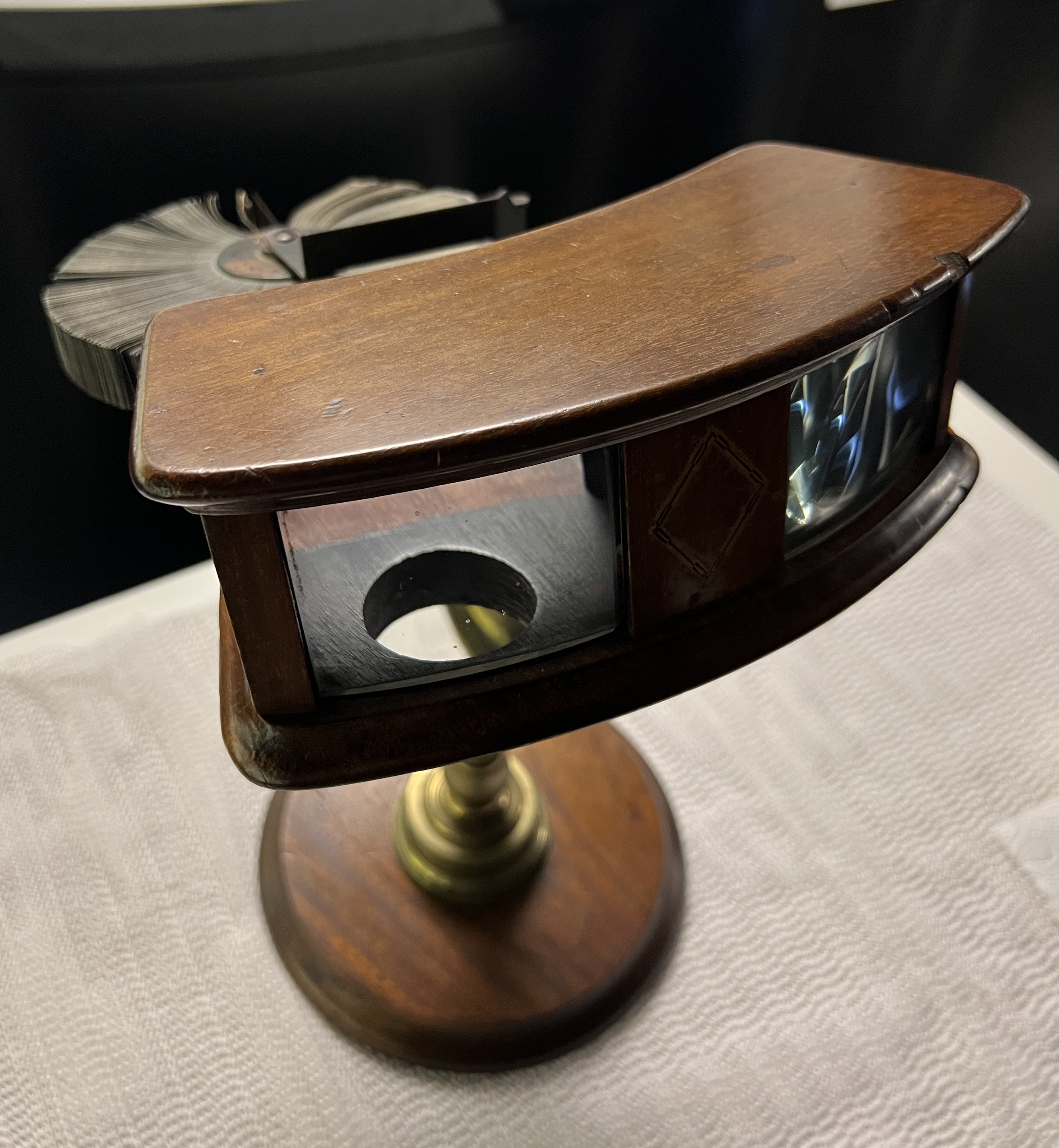 |
Figure 88-A-471.1 –Kinora |
| Flip-book with Lenses. Photo © Rod Bantjes. |
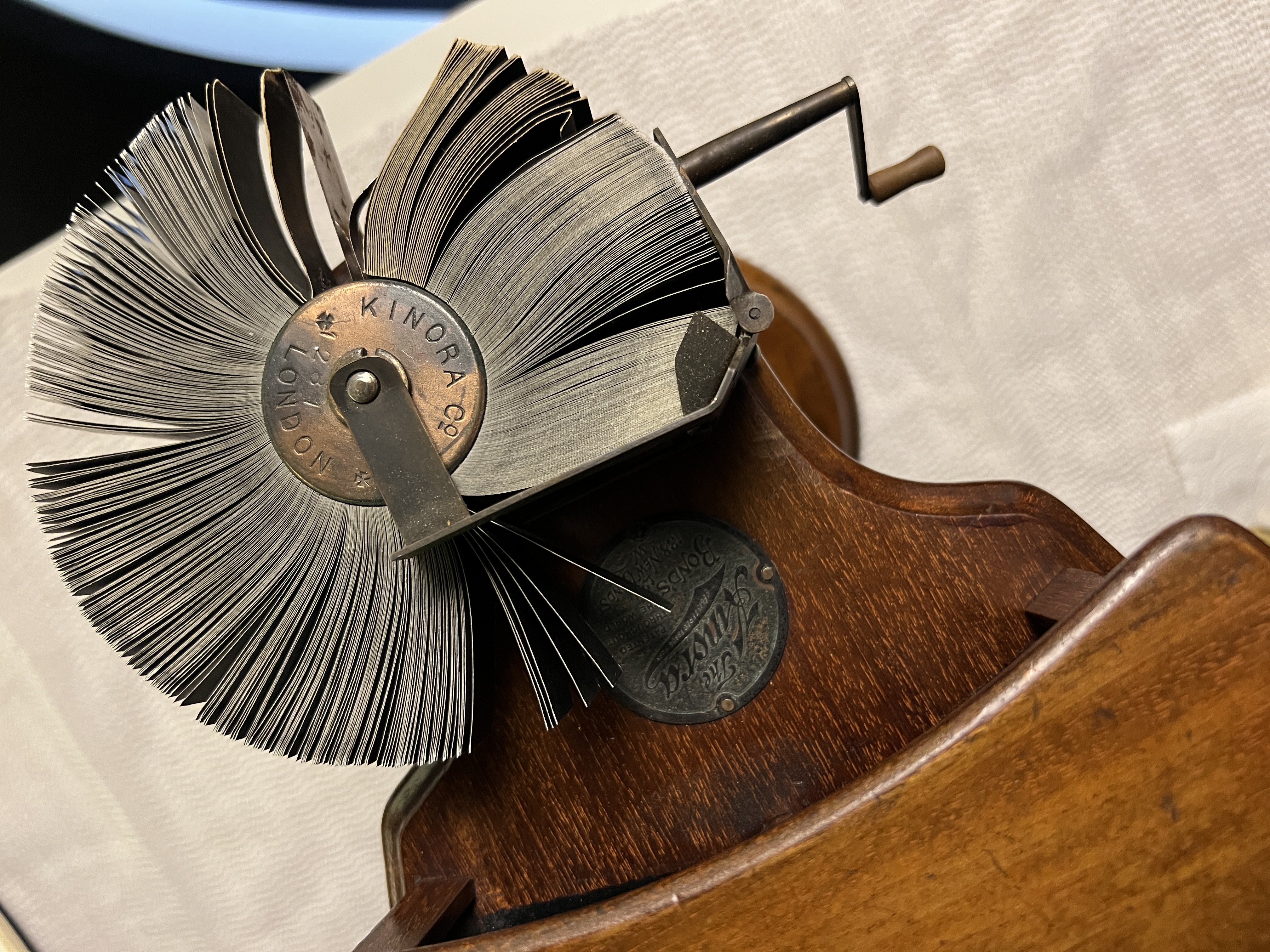 |
Figure 88-A-471.1 –Flip-Book Mechanism |
| Photo © Rod Bantjes. |
This is a hand-cranked flip-book in which the animated image is enlarged and 3D-enhanced by two biconvex lenses. It is an example of an "optical machine" and is included in the Optical Machine Taxonomy
One looks through one of the lenses, turns the hand-crank and watches a succession of photographic images that produce an illusion of continuous motion.
The Kinora is a mash-up between the 3D optical machine and an early form of animated image. A number of attempts were made after 1838 to combine Wheatstone's stereoscopic 3D technology with the early motion principles of Plateau's phenakistiscope. The Kinora is the first to apply stop-motion animation to the 18th-century convex-lens 3D technology.
Other mash-ups include combining the optical machine with: the wings or coulisses of the theatre stage (Kulissentheatre); the stereoscope (Graphoscope); the phonograph (Bioscope); the magic lantern (Lanternscope).
[1] I would like to thank Stefanie Plappert for her assistance at the DFF – Deutsches Filminstitut & Filmmuseum..