Rod Bantjes, “Optical_Box_Hypotheses.html,” created December 23, 2024, last modified, December 23, 2024 (https://people.stfx.ca/rbantjes/).
Explaining 18th-Century 3D Illusions
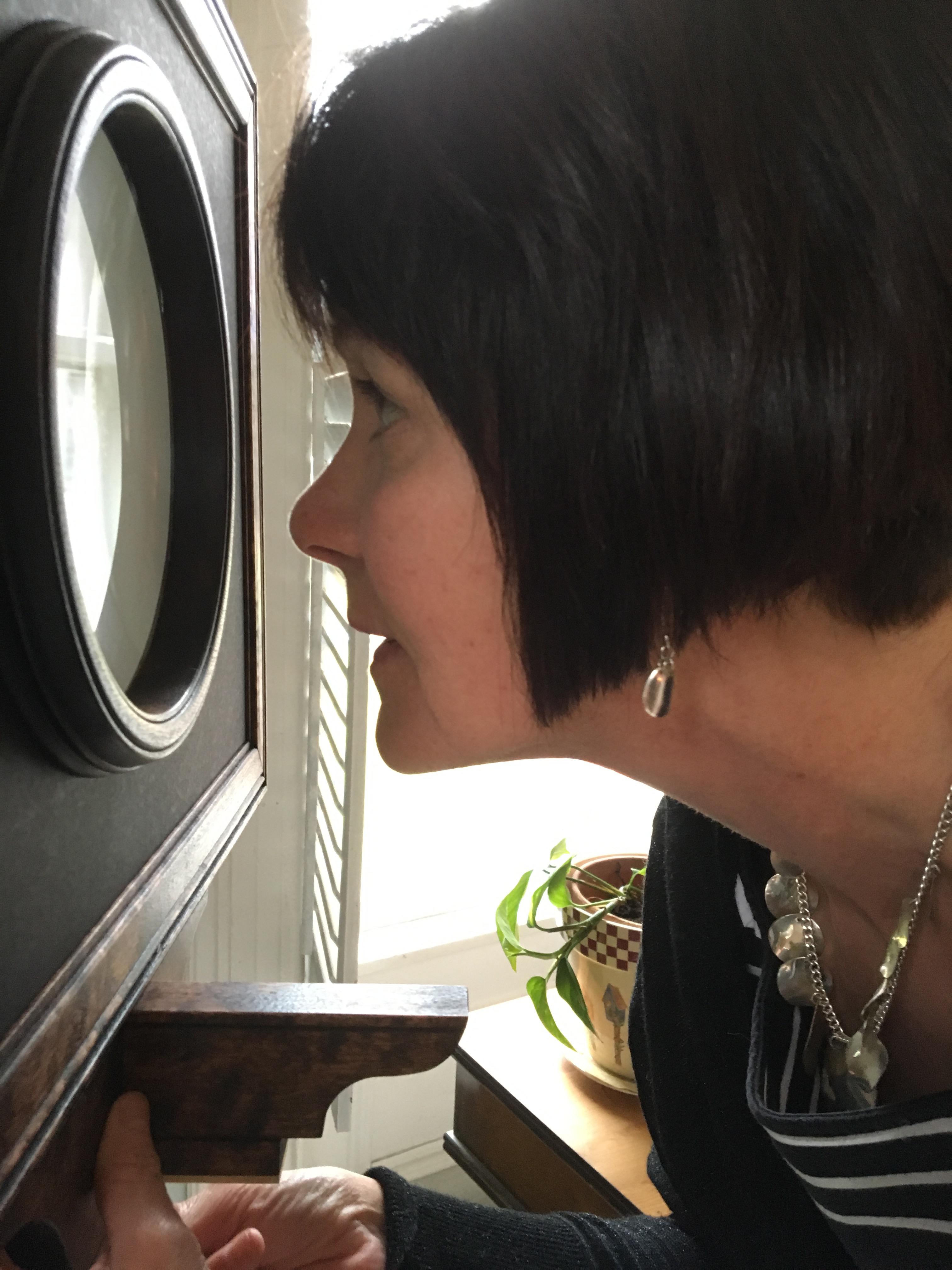 |
Figure 1 – Viewing an Engraving Through a Lens |
Eighteenth-century writers thought that when engravings were viewed either through a convex lens or reflected in a concave mirror, the 3D illusion was marvellous and unmatched by any illusionistic painting. When I first read their theories about how the biconvex lens produced these effects, I was doubtful. I was even unconvinced that the 3D illusion wasn't itself an illusion. The engravings, called vues d'optique (optical views) are drawn in a form of perspective that is itself meant to enhance a 3D illusion.[1] To my eye the lens, if it added anything, only added a mild enhancement of depth. However, the technology was immensely popular and enduring. People continued to use these devices long after the invention both of the stereoscope – to my mind a far more powerful 3D device – and modern cinema. Testing it against other devices, My colleague Ana and I found that some people find it more immersive than the stereoscope.[2] So, I have long been curious about why this is. How does the optical box[3] work?
To answer this question I looked at explanations that writers gave in the 18th and 19th centuries. My optical theatre is designed to test some of these theories. I also looked at the objects themselves to see what "artesanal knowledge" might be built into them. I have begun to post my notes on that work which you can begin to explore through these examples: Alethoscope; Polyorama Panoptique; Italian Show-box; Graphoscope; Cosmoscope. You can also consult the index of the Optical Machine Taxonomy.
Finally, Ana and I did experiments with test subjects (Figure 1). Let's start here with a list of hypotheses.
Optical Box Hypotheses:
1. Binocular Divergence [5]
The biconvex lens changes the paths of light to the viewer's two eyes so that the eyes diverge when looking at any given object represented in the print. This divergence of the eyes signals to the brain that the represented object is farther away than the surface of the print (see an animation that illustrates how this looks). The lens makes us believe that we see through the print as though it were a window into the space it depicts . Binocular Convergence is a strong index of depth and the biconvex lens does affect it in the way described. Yet this explanation raises a number of problems and perplexities.
2. Monocular Divergence
The principle of monocular divergence is similar to that of binocular divergence, except that it is supposed to work on the single eye. The 18th-century explanations of how this works are mistaken and for that reason I initially dismissed them (see an animation of how it might work). I have recently been finding them more interesting because they tell us a lot about 18th-century theories of vision. Nonetheless there might be a 3D enhancement effect, but one that is much weaker than for binocular divergence. Some optical box makers must have believed that this effect was real since they made boxes with lenses that were only large enough to see through with one eye.
3. Optics of Focal Length
Harris (1774: 232) advises that for the best 3D effect the print should be near the focus of the lens. That makes the rays from each point on the print parallel when they reach the eyes. Harris thinks this is a condition for making binocular and monocular divergence work. However parallel is what you need only if everything represented in the image is supposed to be at or near infinity. It should not work for images of closeup or foreground things. Also, optical box makers routinely ignored this advice and built boxes which to my eye are quite satisfactory. The optical theatre is designed to allow varying the distance between lens and image in order to test Harris's hypothesis (see Figure 4.1).
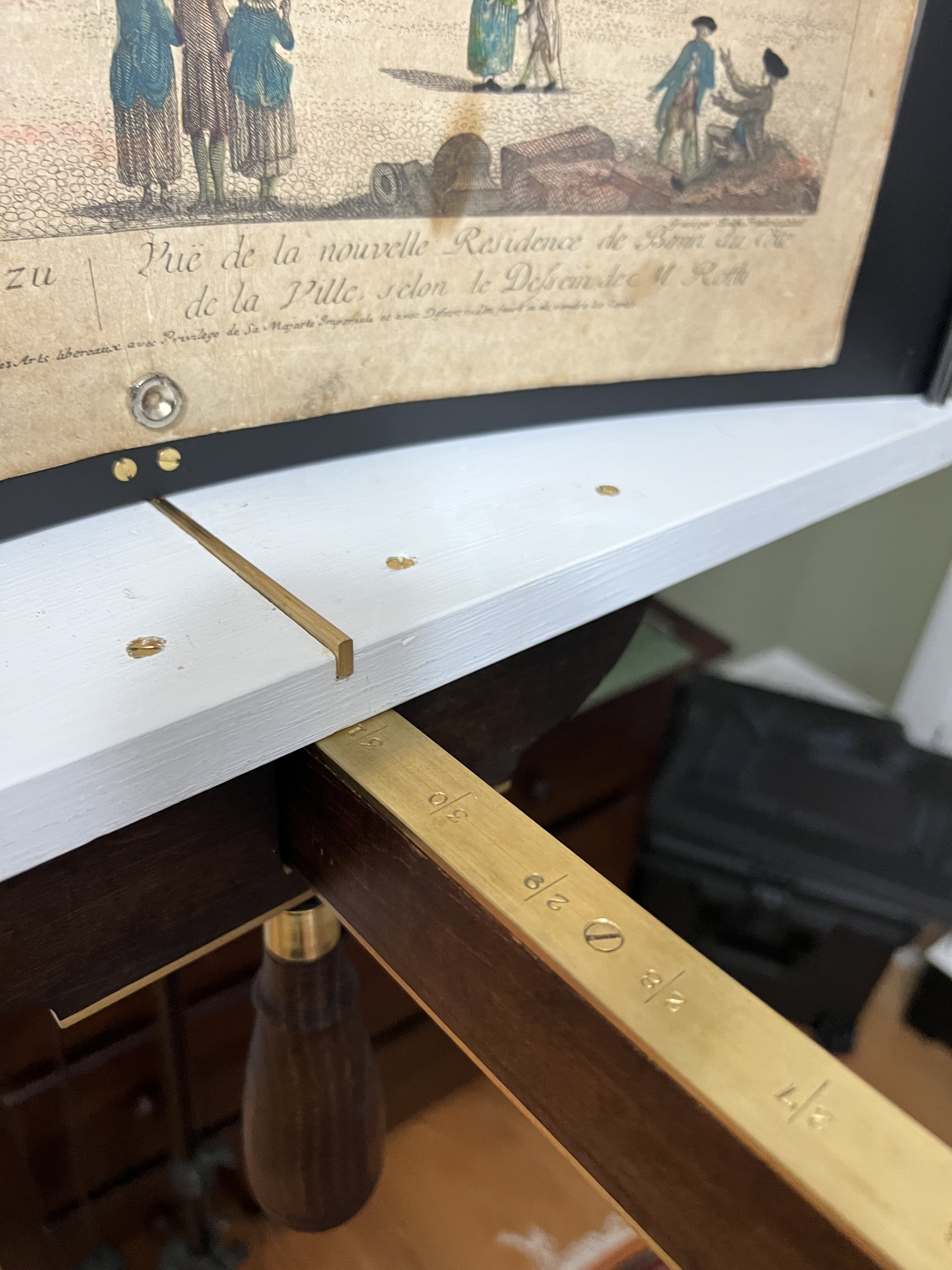 |
Figure 4.1 – Optical Theatre Image Plate |
| You can see how the curvature of the image plate can be increased or decreased as well as how the plate can be moved forward or back to change the distance between lens and image (marked on the brass rail in inches). Here is the mechanism to change the curve. |
4. Concave Image Plate
Harris (1774: 232) advises that "The apparent image in some cases will be also deeper or more hollow, if the print itself be made a little concave or hollow." Ponti used this idea of curving the image away from the viewer in his megalethoscope in the 19th century. It was also used by 20th-century American makers of stereoviews. To test this effect I made the optical theatre with an image plate that could change shape from flat to curved (see Figure 4.1).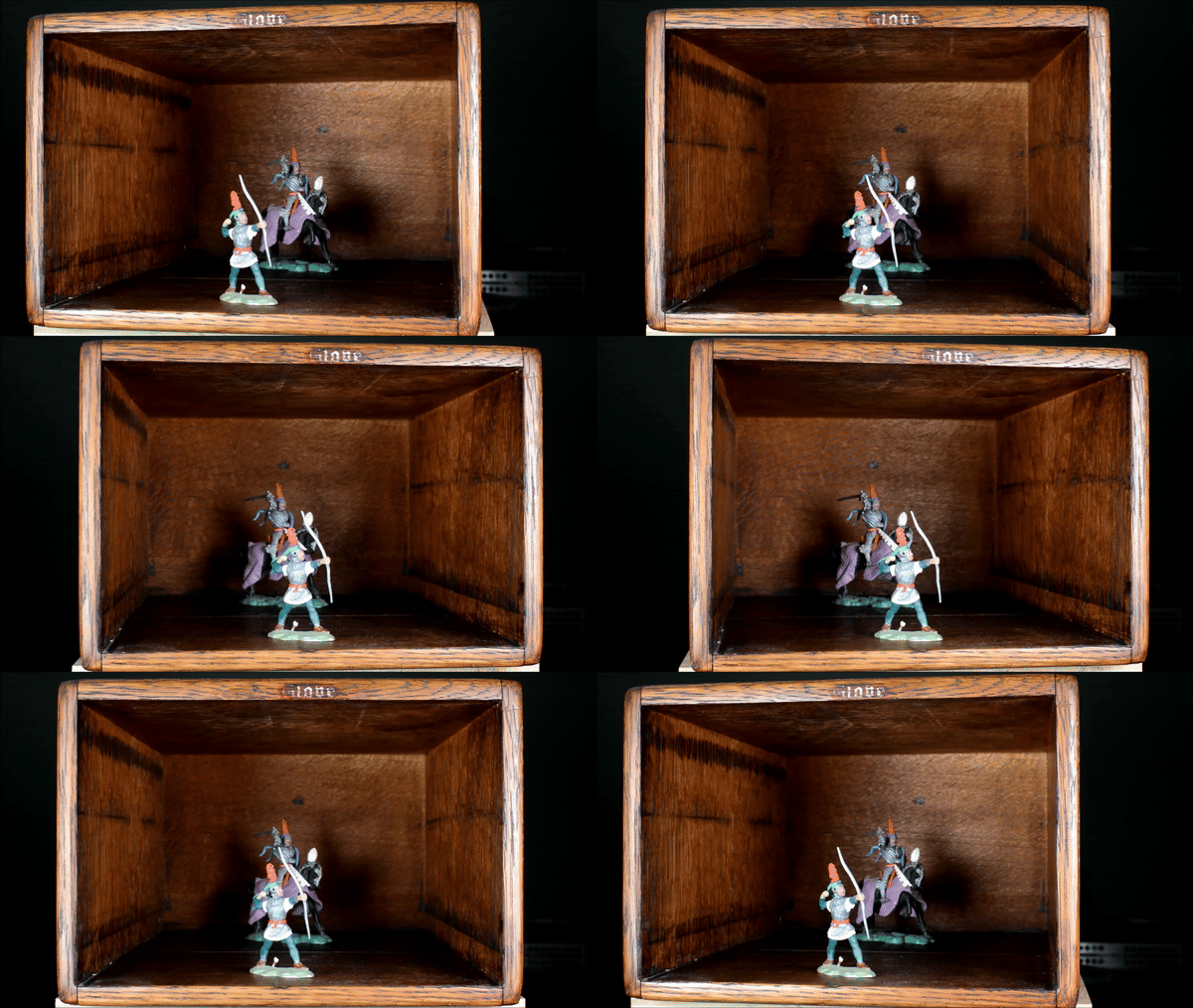 |
Figure 7.1 – Parallax Effect |
5. Focal Length /Print Size
Harris suggests that larger prints work best with lenses of longer focal length. Actual boxes do more-or-less follow this pattern. However the average focal length for boxes designed for vues d'optique (83 cm or 33 inches) is longer than what he recommends (24 to 26 inches or 61 to 66 cm). This relationship between focal length and image size is probably a corollary of the relationship between focal length and distance between lens and image (Hypothesis 3). Larger prints should be further away so that they can be comprehensively encompassed by the viewer's gaze.
6. Masking /Peeping
Some boxes mask out distractions from the surrounding world and allow the viewer to focus on the reality purported by the vue d'optique image. Zograscopes are one exception since they have an open structure which in some ways adds more distraction from the device itself. But the enclosed boxes allow viewers to peep into a self-contained interior world where the image is surrounded either by darkness or painted coulisses. Some, like my optical theatre, have curtains that block out glare on the lens, but also secrete the viewer from their surroundings. By these features, plus decoration that recalls the illusions of the theatre, boxes can create the expectation of entering into a magical other world.
7. Pseudo-Parallax Effect
If you stand back a bit from the lens (something Harris also recommends) and move your head slightly from side to side you can get a (false) parallax effect that enhances the illusion that you are looking into a real space. Figure 7.1 illustrates what actual motion parallax looks like. Figures in the foreground overlap those in the background. But look at the box – the opening moves in relation to the back wall. Vues d'optique frequently depict similar openings – theatre stages or the interiors of grand buildings. These images, viewed through a zograscope or concave mirror, do seem to move in this way in relation to the viewer's motion.[4]
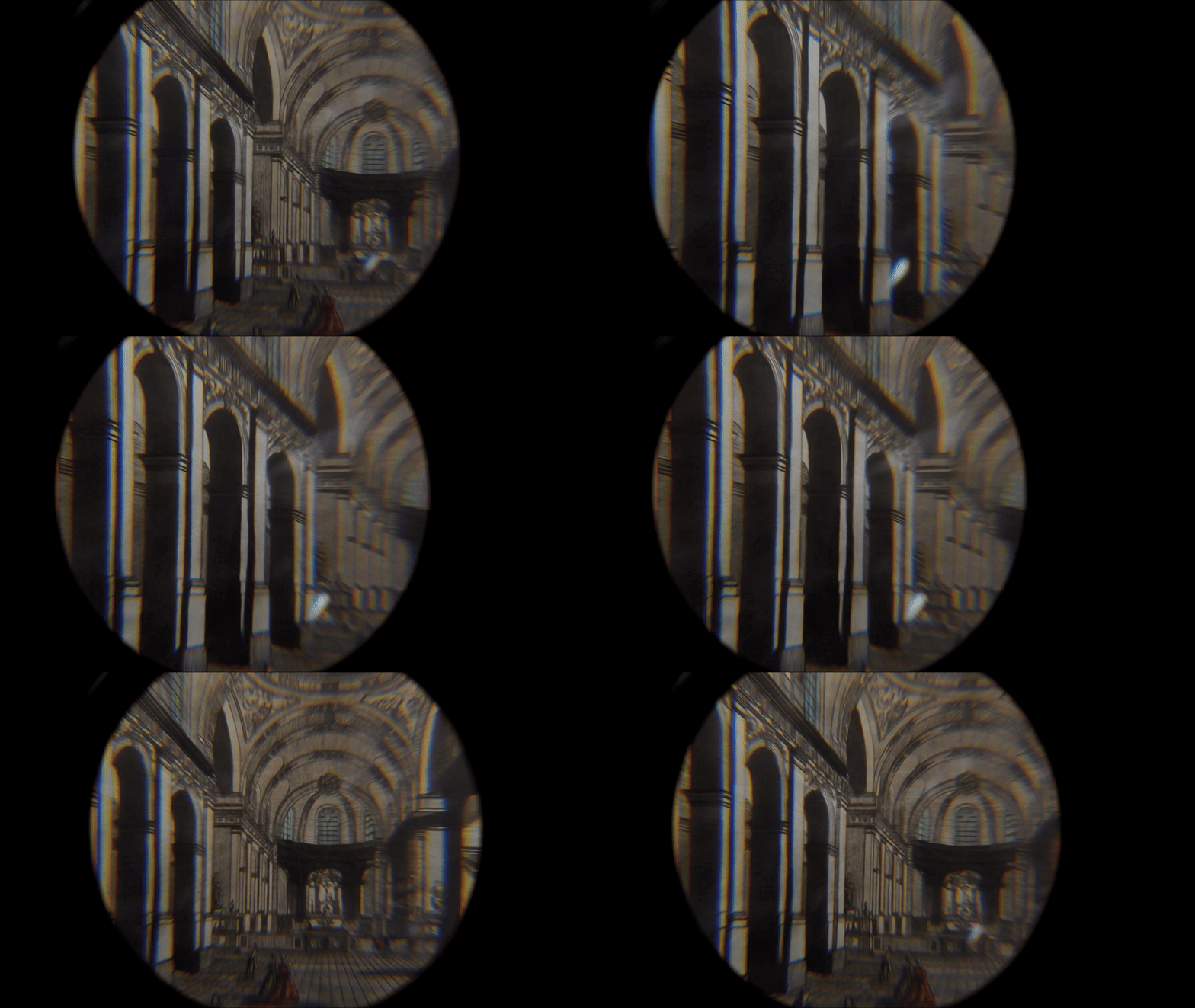 |
Figure 8.1 – Pseudo-Disparity Effect |
| This is also a good example of the pseudo-parallax effect (see Hypothesis 7). |
I am the only person who has described this pseudo-parallax effect. However there is evidence, in the way that craftspeople composed vue d'optique images, that they may have been aware of it. They either clear the stage (i.e. the space-box floor) of figures, or else ensure that nothing overlaps the back wall. In other words, they avoid a composition like that which you see in Figure 7.1. Overlapping figures that do not move in relation to one another or the back wall would betray the fact that there is no genuine motion-parallax.
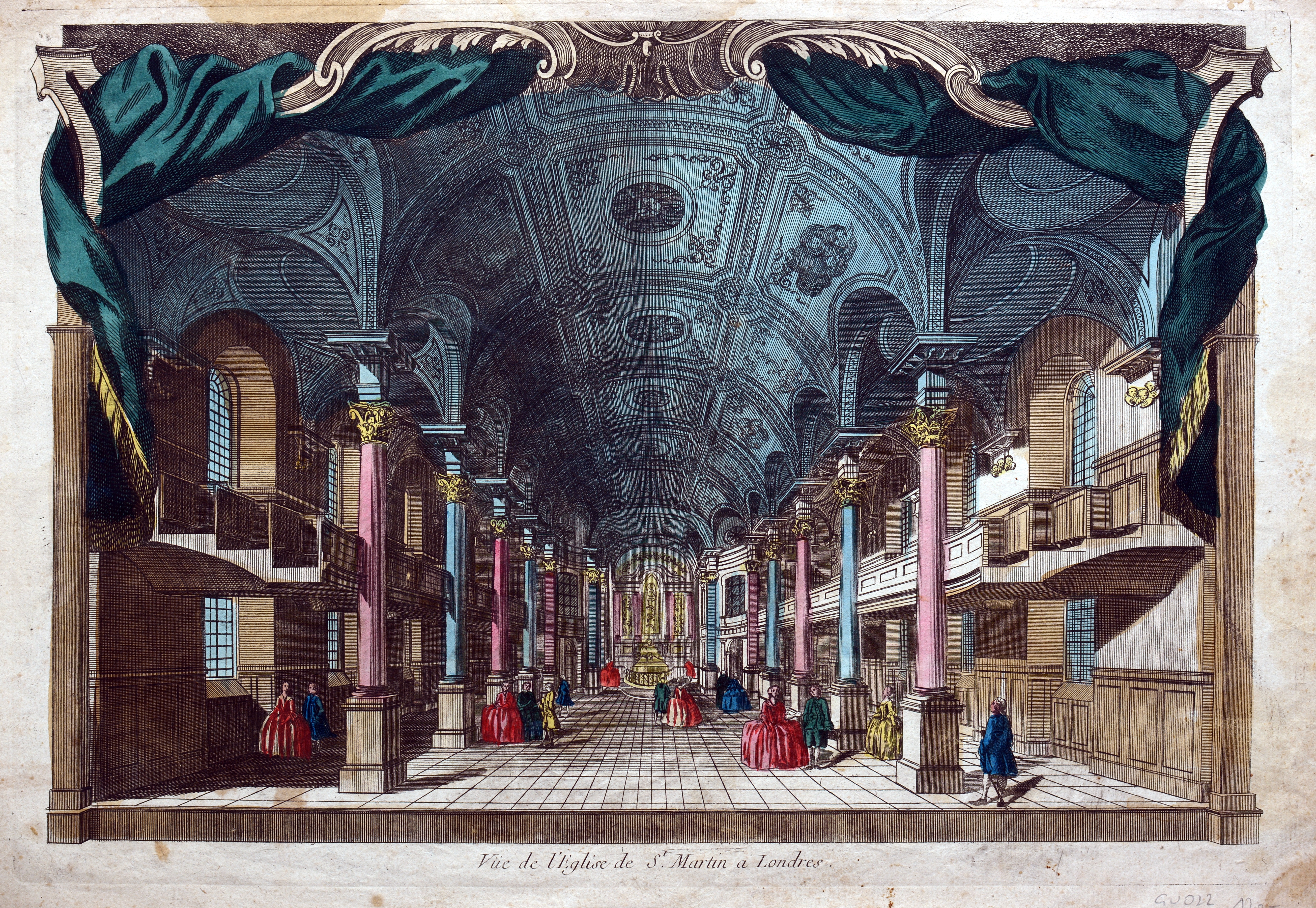 |
Figure 9.1 – Vue d'Optique Colouring |
| Note that the columns alternate between red and blue and there is a lot of blue, indigo and green in the foreground. |
8. Pseudo-Disparity Effect
My final hypothesis is that slight left-right distortions of the biconvex lens or concave mirror trick the mind into thinking that it detects binocular disparity which is a strong indicator of spatial depth. In figure 7.1 you can see the distortion produced by moving one's head to the right and looking at the left-hand row of columns in this image of a church. Since the two eyes are at different points along the path of this motion, one will see a slightly different projection of the image than the other.
9. Chromatic Aberration
When I heard the explanation that relies on the principle of chromatic aberration, I dismissed it as silly. It is true that light of different colours is refracted at slightly different angles by these old biconvex lenses. Consequently, if you view red through the lens your eyes will converge ever-so-slightly more than if you view blue. Red will seem slightly closer, blue will seem more distant.
In theory, colours should sort in order of the spectrum – red-orange-yellow-green-blue-indigo-violet – with red appearing to be closest and violet furthest. I have not seen a vue d'optique that consistently follows this order, foreground to background. Such a colouring would look quite daft if adhered to consistently. Where colouring does not follow that sequence it can only confuse the intended perspective effect. That is, assuming that colour has a marked depth effect, which I doubt.
Footnotes:
[1] For more on the unique type of perspective used, see: Bantjes, Rod. 2014. "Hybrid Projection, Machinic Exhibition and the Eighteenth-Century Critique of Vision." Art History 37(5):912-39..
[2] For this experimental work see: Bantjes, Rod. 2021. “The Optical Machine’s Asynchronic Progress.” Technology and Culture 62(4):1119-42..
[3] These boxes were of widely varying designs and were referred to by many names: boîte d’optique, chambre optique, optical or optic machine. Dutch variants were called rarekieks. Germans refer to them as guckkästen; those with coulisses, were called kulissentheaters. The touring boxes were known as peepshows, raree shows, or show glasses. Parlour versions or zograscopes were also known as diagonal print machines, inclined mirrors, optical diagonal machines, optical diagonal mirrors. For the concave mirror version there was no special name in the 18the century other than concave glass or concave mirror. In the 20th century these were known as Shomescopes, Snapscopes and Reflectoscopes. .
[4] Zograscopes and concave mirrors reverse the image and create this pseudo-parallax effect where the back of the space-box seems to move in the same direction as the viewer's moving head. In the optical boxes, where the image is not reflected in mirrors, the apparent rotation of the space-box is the opposite direction. However our brains seem good at simple reversals and treat this as a possible parallax effect that still enhances the spatial illusion, although to a lesser extent. .
[5] Molyneux and Halley writing in 1692 are the first, as far as I know, to explain the workings of the optical box in these terms. They base their explanation on the writings of Kepler (1604).
References:
- Harris, Joseph. 1775. A Treatise on Optics: Containing Elements of the Science, Etc. London: B. White.