Rod Bantjes, “EXBD-57765_Crypt.html,” created 27 November, 2025; last modified, 27 November, 2025 (https://people.stfx.ca/rbantjes/).
The Crypt
Bill Douglas Cinema Museum[*] #EXBD-57765
England ca.1840
Dimensions: H=26.5 cm, W=33.5 cm, D=20.3 cm
Lens: ⌀=7.3 cm, ƒ=na (flat glass)
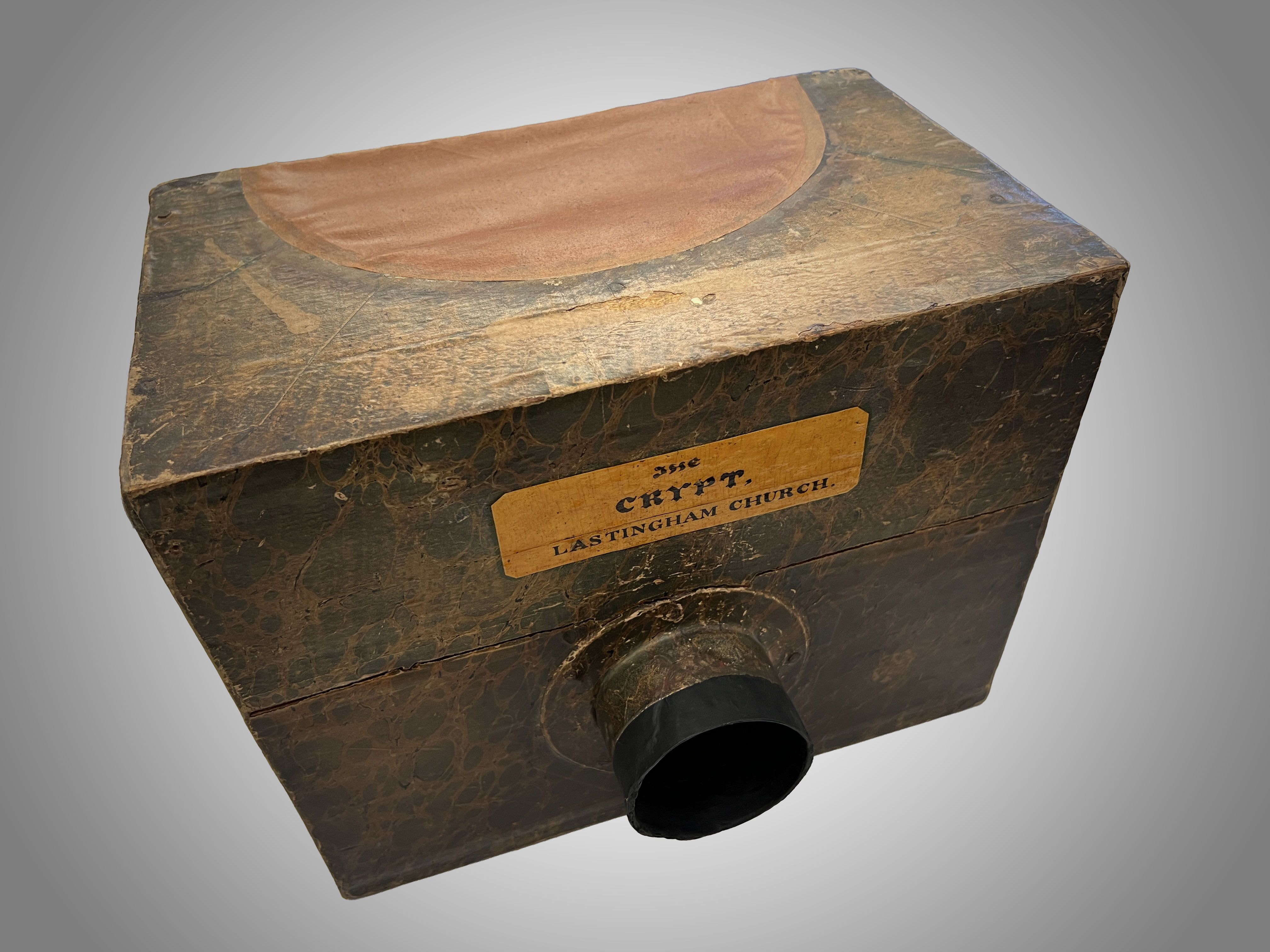 |
Figure EXBD-57765.1 –The Crypt |
| Photo © Rod Bantjes. |
This is a home-made viewing-box containing a single paper transparency of the crypt of Lastingham Church in North Yorkshire. It is fitted with a circle of window-glass rather than a lens and for this reason is not an example of an "optical machine ." However it is included in the Optical Machine Taxonomy as an outlier.
The torchlit Norman crypt has a wonderfully Gothic ambience very much in tune with the Romanticism of the early 19th century. Romantic painters like Jacob Philipp Hackert (1737 - 1807), Caspar David Friedrich (1774 - 1840) and Ernst Ferdinand Oehme (1797 - 1855) experimented with back-illuminated, translucent painting in order to intensify the glow of moonlight or hazy sunset that suited the Romantic mood of “benevolent melancholy.”[xxx]
This box can be taken as evidence of amateur engagement in this cultural trend. It is home-made using cardboard and papier maché. The “lens” is crudely fashioned with a roll of tin covered in papier maché and holds a circle of window glass rather than a lens. It is papered with pages of a rural newspaper, visible on the unpainted bottom, showing advertisements for Cuff’s Foot-Rot Powder for livestock (J. H. Cuff of Manchester was established in 1801).
A reddish-brown translucent paper applied across the back and in a semi-circle on the top provides front and back illumination. This paper also functions as a coloured filter giving the interior light an orange glow. The interior print depicting the Crypt is altered for further lighting effects. The paper is pierced to simulate bright light entering through an arrowslit. The back is likely painted where the artist wanted more shadow and varnished or oiled where she wished to intensify the orange glow. These techniques were outlined in Edward Orme’s, An Essay on Transparent Prints, written in 1801 for genteel amateurs and recommended by Orme as a recreation for “[his] fair country-women.”[xxx]
We might use our imagination, as the maker of this box surely did, and picture her as the daughter of a gentleman farmer or country pastor in Yorkshire. Like the Brontë sisters she has somehow, through reading or acquaintances, absorbed the Romantic sensibility of the period and has constructed this box for theatrical performances for family and friends. In gloom of night, with candle or oil lamp illumination for her miniature theatre she invents for the delight of her viewers lurid tales of the ghosts that haunt the ancient Crypt.
Endnotes:
[*] I would like to acknowledge support from the Bill Douglas Cinema Museum in the form of an International Research Stipend. Thanks also to the staff of the Museum for their assistance in the archive.
[xxx] Füsslin, Georg, Der Guckkasten : Einblick, Durchblick, Ausblick (Stuttgart: Füsslin, 1995), 74.
[xxx] Orme, Edward, An Essay on Transparent Prints, and on Transparencies in General. (London: Edward Orme, 1807), 45.