Rod Bantjes, “EXBD-69056_Boite.html,” created 9 June, 2025; last modified, 9 June, 2025 (https://people.stfx.ca/rbantjes/).
Bôite d’Optique
Bill Douglas Cinema Museum[*] #EXBD-69056
French c.1846
Box dimensions: H=10.6 cm, W=16 cm, D=26.6 cm (with back closed)
Lens: ⌀=2.9 cm, ƒ=22.2 cm
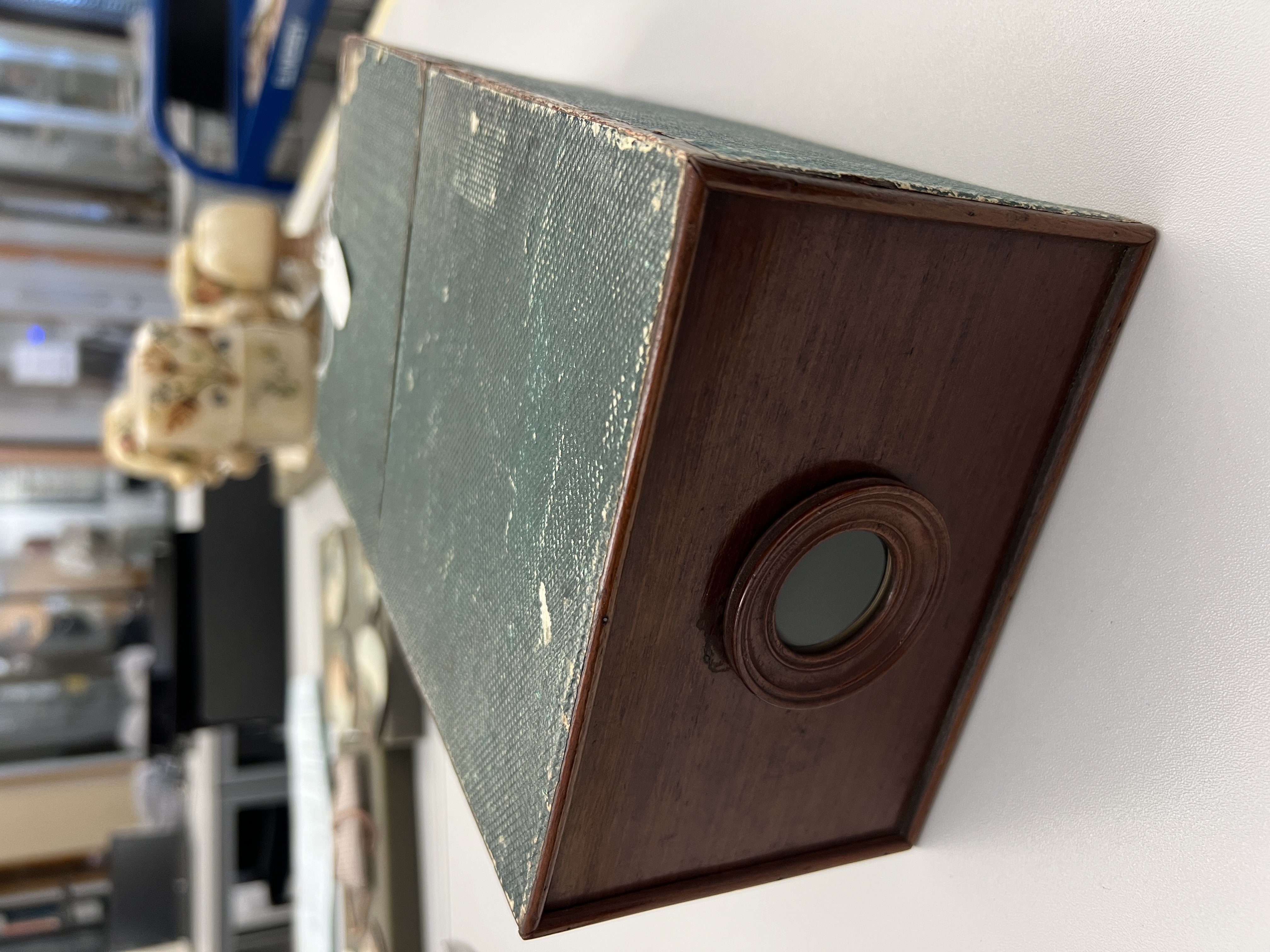 |
Figure 69056.1 –Bôite d’Optique |
| Optical box for translucent, layered images designed by Henri Lefort.
Photo Credit: Rod Bantjes. |
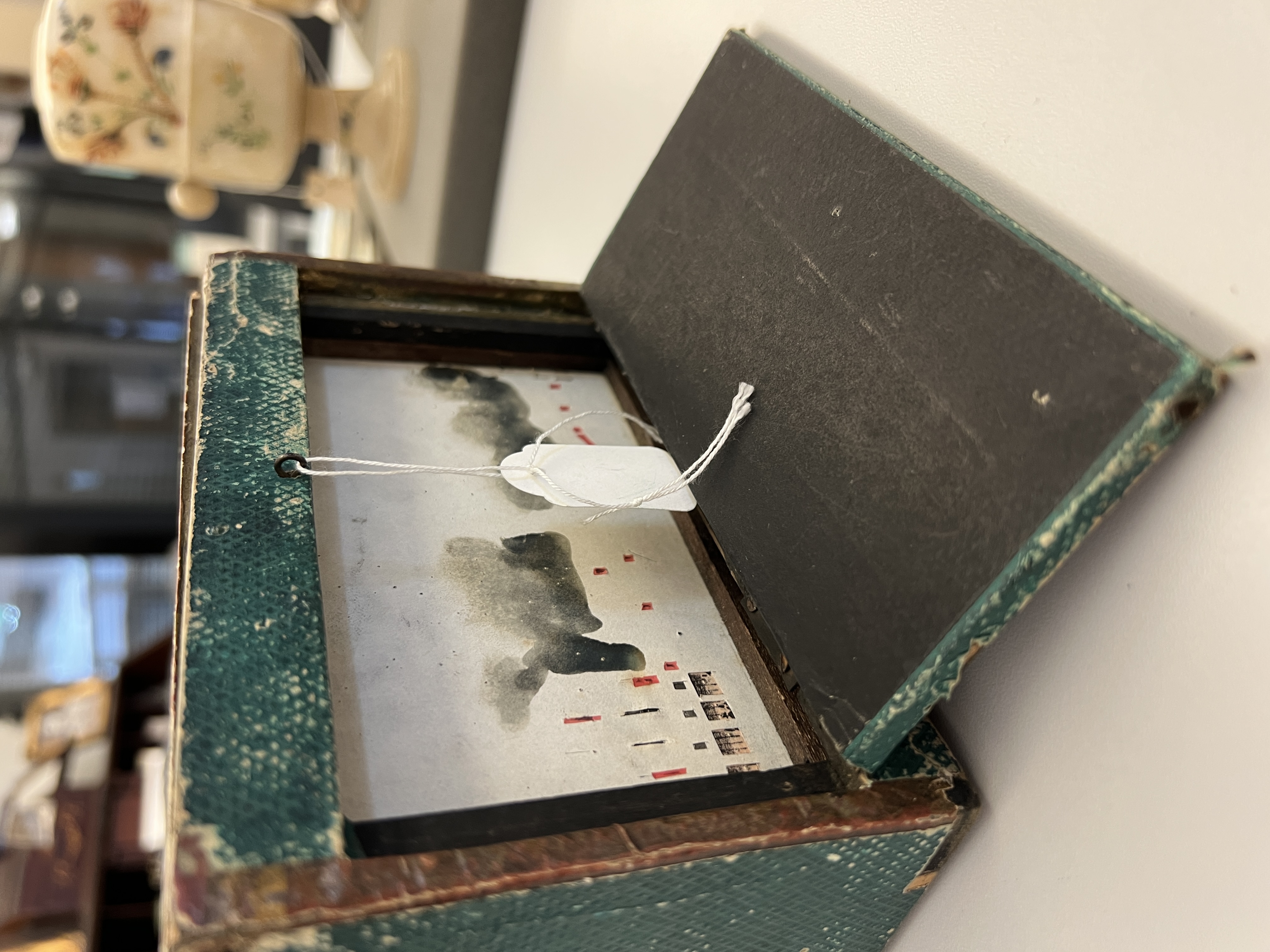 |
Figure 69056.2 –Back Flap |
| You can see the back layer of the image with masking and colour effects
Photo Credit: Rod Bantjes. |
This is a horizontal small-lens viewer for paper dioramas. It is an example of an "optical machine " and is included in the Optical Machine Taxonomy
Two similar boxes are listed in the catalogue of the Cinémathèque française (Boîte d'optique - AP-94-759; Boîte d'optique - AP-94-758). All three have the same simple hardwood structure papered on four sides with green patterned paper. One of the Cinémathèque examples (AP-94-758) has identical dimensions, to within a few millimeters, to the Bill Douglas example. The hardwood lens frames are turned to the same decorative pattern. They are no doubt from the same workshop.
Paper Dioramas
All three have the same mechanism for illumination. They are designed for paper dioramas (figure 69056.3). Paper dioramas are images made up of more than one translucent layer. The first image-layer, a print or photo, often has piercings to let light through to create relatively bright light effects – like stars or brilliant chandeliers. Under-layers can consist of additional images that become visible when the image is back-illuminated. These revealed images might be of figures, for example, that emerge within the first image or else entirely new images (more properly then called ‘dissolving’ views). Under-layers can also include masks that strategically dim the backlighting and coloured washes that introduce atmospheric effects like the glow of lamplight or fire (see figure 69056.2). You can see the effect in a polyorama panoptique view which is identical in form.
All three boxes have back flaps that, when opened, increase the back-illumination and bring out the surprise effects (figure 69056.2). They also have top flaps that open the front of the view to light as well as reflect light down upon it – bringing the surface ‘reality’ into view. The two flaps can be manipulated to change day into night, or make a fire burst forth from the widows of an afflicted building or even transport you from one virtual world into another one altogether.
Maker: Pierre Henri Amand Lefort
The Cinémathèque française attributes its boxes to Pierre Henri Amand Lefort (1804-1880), inventor of the polyorama panoptique in 1849. Their attribution to Lefort is plausible, but I am not sure about the dating ‘À partir de 1849.’ The 1849 patent includes the distinctive feature of the polyorama panoptique which was the bellows that allowed the user to position the lens at whatever distance suited them, and to collapse the device, making it more portable:
| "J'ai disposé une partie antérieure de cette chambre en forme de plis de soufflet, ce qui permet à chacun de fixer la distance de l'oculaire, en raison de la portée de sa vue, et lorsqu'on veut transporter l'appareil, en comprimant cette partie antérieure, la chambre noire est réduite à un petit volume." [I designed the front section of this box using a folding bellows, allowing each user to adjust the eyepiece distance depending on the scope of their vision. When transporting the device, compressing this front section reduces the camera obscura to a small volume.] |
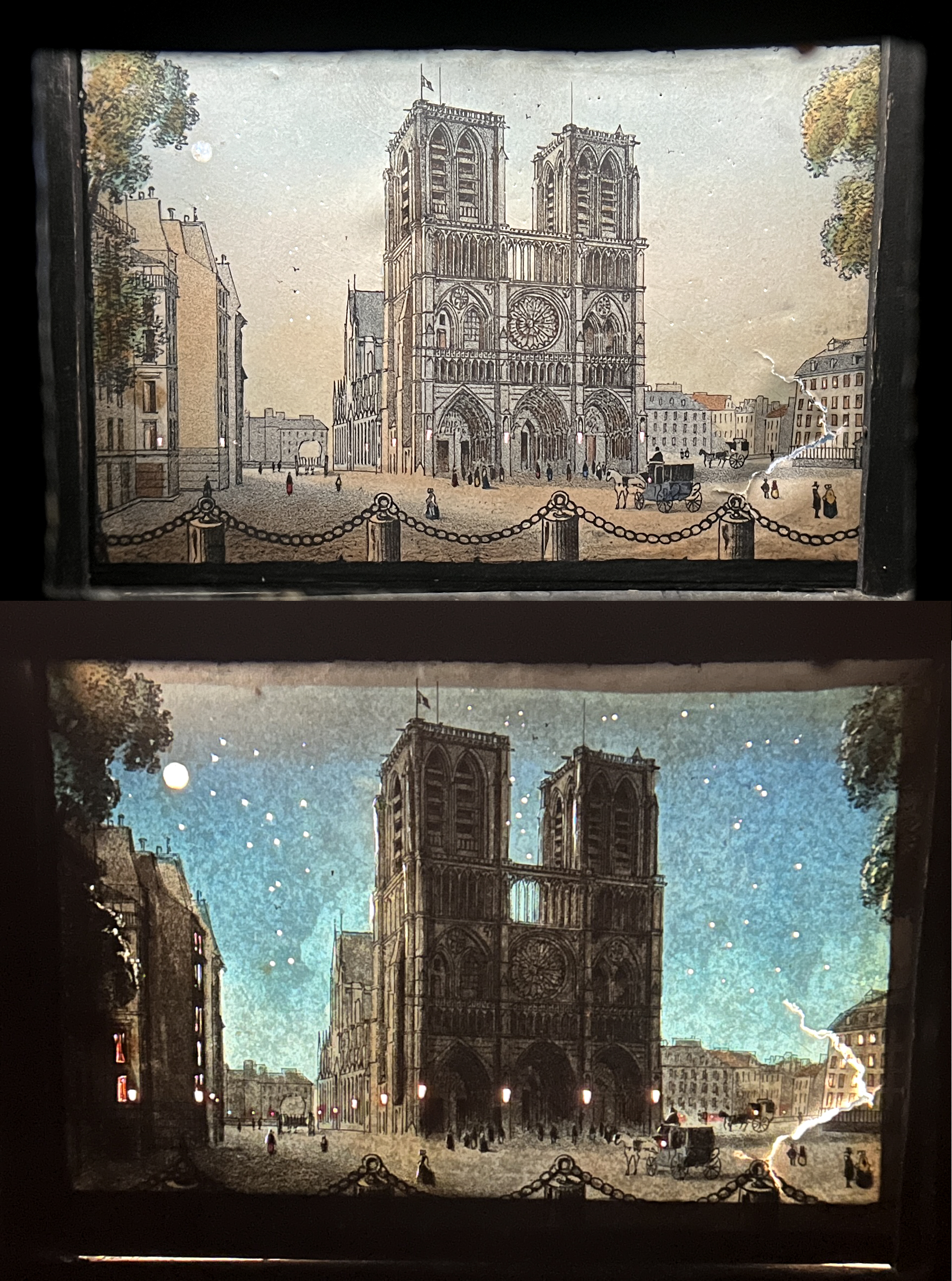 |
Figure 69056.3 –Notre Dame |
| Translucent image in the box with front illumination and back illumination.
Photo credit: Bill Douglas Cinema Museum. |
The new form became immensely popular, and many examples can be found in collections and on eBay. The rigid design is rare, as the Cinémathèque points out with regard to AP-94-758: ‘Rare modèle, d'une conception différente des polyoramas panoptiques habituels.’ Why would Lefort continue to manufacture the unimproved model when the new model proved so successful? I suspect that the three models we are discussing here are early design efforts that eventually led to Lefort’s polyorama panoptique. If that is so, then they should be dated prior to 1849. Lefort is first listed as a toy maker in 1846, so we can say between 1846 and 1849.[1]
The Cinémathèque examples share the same patterned green paper as the polyorama panoptique – a diamond latticework printed in black over green. The Bill Douglas example has a diamond pattern uniquely embossed in the paper, not printed. Could the Bill Douglas example be the rarest, perhaps one of the first that Lefort built?
Accompanying Views
The views that come with the box are called “Souvenir of Paris.” We are often expected when we travel to buy mementos for those we have left at home – This box might have served that purpose for the well-to-do traveller. The views are:
| ● Arch de Triomphe du Carrousel | ||
| ● Notre Dame | ||
| ● Panthéon | ||
| ● Les Quais | ||
| ● La Place du Chatelet | ||
| ● L’Hôtel de Ville |
Footnotes:
[*] I would like to acknowledge support from the Bill Douglas Cinema Museum in the form of an International Research Stipend. Thanks also to the staff of the Museum for their assistance in the archive.