Rod Bantjes, “EXBD-69055_Polyorama.html,” created 9 June, 2025; last modified, 18 February, 2026(https://people.stfx.ca/rbantjes/).
Polyorama Panoptique
Bill Douglas Cinema Museum[*] #EXBD-69055
French 1849-1857
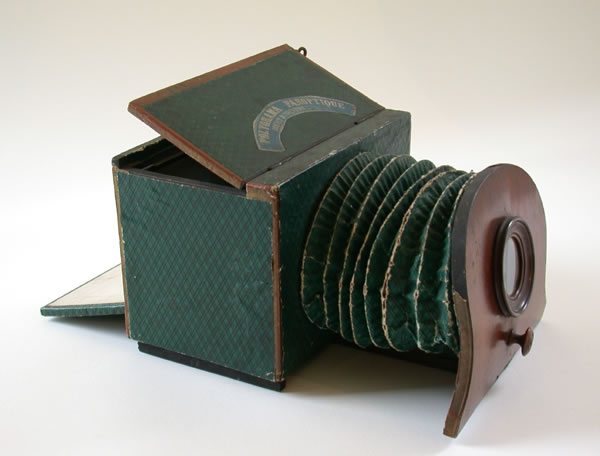 |
Figure 69055.1 –Polyorama Panoptique |
Photo credit: Bill Douglas Cinema Museum. |
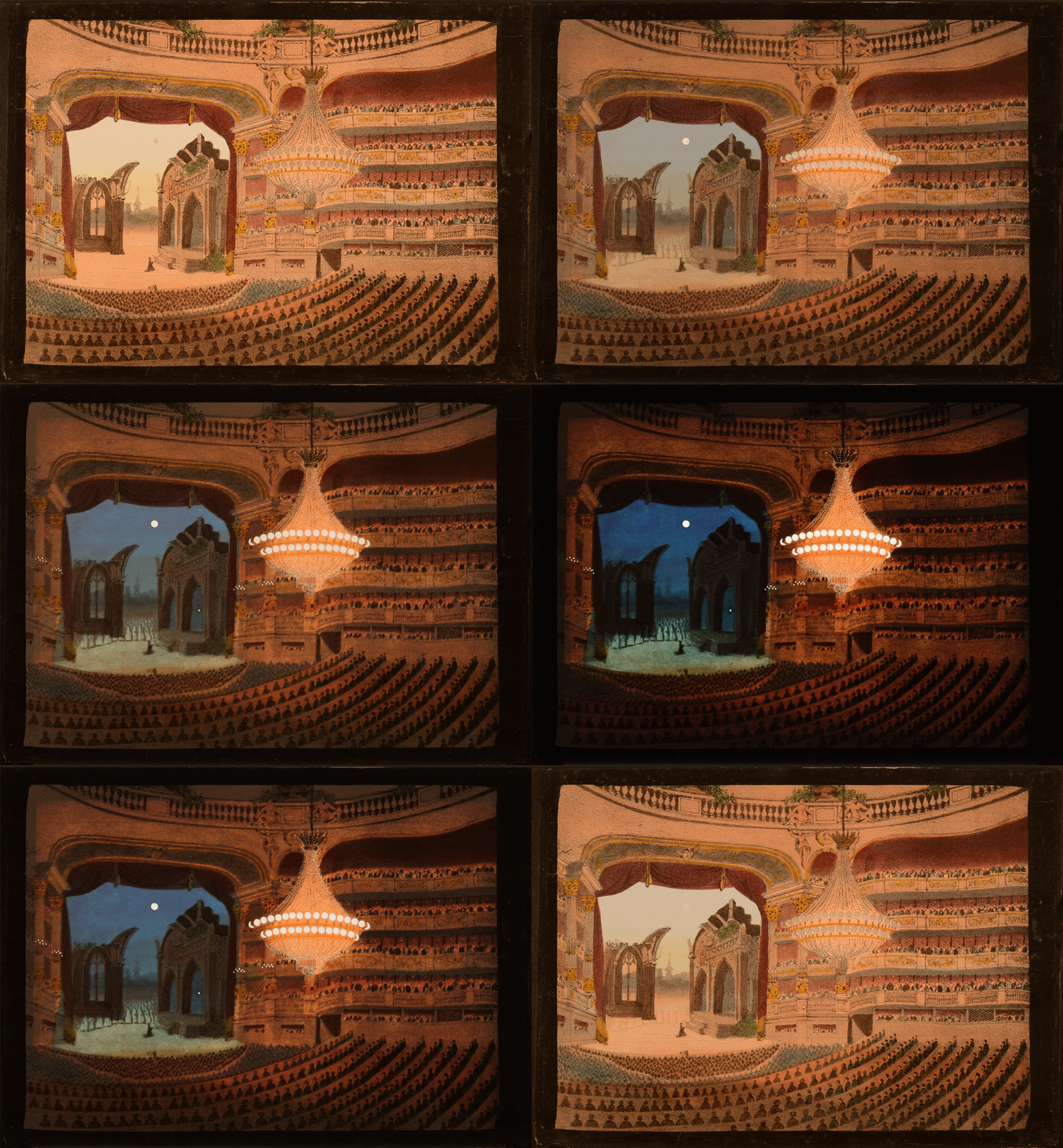 |
Figure 69055.2 –View Transformation: Salle de l'Opera à Paris |
| These lighting changes are controlled by the top and back flaps on the polyorama panoptique. This image is not in perspective but rather hybrid projection. Collection of Rod Bantjes, 14.5 x 20 cm.
Gif image © Rod Bantjes. |
This is a small viewer for paper dioramas patented in 1849 by the French toy maker Henri Lefort (1804-1880).
The user looks through the lens at a hand-drawn and coloured image at the back of the box. She can control the lighting by lifting and lowering the flaps at the top facing the view and at the back behind the view. Closing the top darkens the view, often revealing a night-time scene (figure 69055.2). Opening the back and directing it towards the light brings forth new lighting effects – moonlight glittering over water, bright candles in a chandelier, or flames bursting from a building.
Paper Dioramas: The views are composed of layers of translucent paper. The front layer is a coloured lithograph. It can be pierced to simulate points of bright light. A hidden layer can contain enhancements of the first layer – for example a fire-breathing steam engine pulling into a station at night. This hidden layer too can be pierced or scratched thin to increase points of illumination. The back layer is a thin tissue that can be shaded to enhance light-dark contrasts. Colour, for instance the red light of fire, can be applied here either by painting or by gluing scraps of coloured tissue over piercings in the overlayers. All the layers were stretched across a light wooden frame with a little cloth tab that one could grip when pulling it out of its slot in the viewer.
Photographic Paper Dioramas: The François Binétruy collection has examples of photographic paper dioramas that may be for the polyorama panoptique. The surface layers are photographs of the 1878 exposition universelle of Paris. These are not wood-framed and, depending on dimensions, may not fit any polyoramas panoptique. If they do, then perhaps the polyorama panoptique was still in use at this later date. Lefort had already been using layered, back-illuminated photographs, now known as "tissue-views," in his stereographs. This idea had earlier been applied to optical machine images by Carlo Ponti in his Megalethoscope.
Dissolving Views: Dioramic transparencies typically showed a view of a single location as it was transformed over time. But others magically transported the viewer from one scene to an entirely different one in a different location. This effect was achieved through a hidden second image being glued to the back of the first, or front image. You can see an example of a complete transformation or 'dissolving view' for the lorgnette pittoresque. In order to see it clearly, all light upon the front image must be extinguished by fully closing the top flap. Lefort mentions all these features of the layered transparent view in the patent for the polyorama panoptique that he applied for in 1849; however, none of them were by that time new or original. The only unique feature was the bellows that served to adjust the distance between lens and image. Lefort produced dioramic boxes without the bellows probably before the patent of 1849 (see one in the Bill Douglas collection, #EXBD-69056).
Diorama vs Polyorama: These translucent, changing views were called ‘dioramas’ after Louis Daguerre (1787-1851), and Charles Bouton’s (1781-1853) spectacular dioramas in Paris (1822) and London (1823).[1] The Daguerre and Boulton diorama was a small theatre in which the audience sat on a platform that rotated between two stages, each with a different scene. This was the spatial transformation that Lefort and others such as William Spooner (active 1831-1854) re-created in miniature by means of a single translucent image. The ‘di’ of diorama refers to the two major transformations; the ‘poly’ in Lefort’s polyorama, indicates that his device can effect multiple major transformations. A single layered transparency (a diorama) could do two, but the box or polyorama allowed for many ‘set changes’ where one transparency could be slid out and another inserted.[2]
In the earliest Lefort diorama boxes (see #EXBD-69056) as well as some polyorama panoptiques, the images are lowered in from the top, as they were in 18th-century show-boxes. In many polyorama panoptiques the images are inserted in a side-slot on the right as they were in Brewster stereoscopes (commercially introduced in 1851) and perhaps Lefort, in making this change, was following the example of the popular stereoscope design.[3]
Footnotes:
[*] I would like to acknowledge support from the Bill Douglas Cinema Museum in the form of an International Research Stipend. Thanks also to the staff of the Museum for their assistance in the archive.