Rod Bantjes, “EXBD-69071_Peep_Egg_Ramsgate.html,” created 6 September, 2025; last modified, 26 January, 2026 (https://people.stfx.ca/rbantjes/).
Peep Egg – Ramsgate
Bill Douglas Cinema Museum[1] #EXBD-69417
English, ca. 1850
Dimensions: H=14.4 cm; W (with handles)=12 cm; D=7.5 cm
Lens: ⌀=2.4 cm, ƒ=5 cm
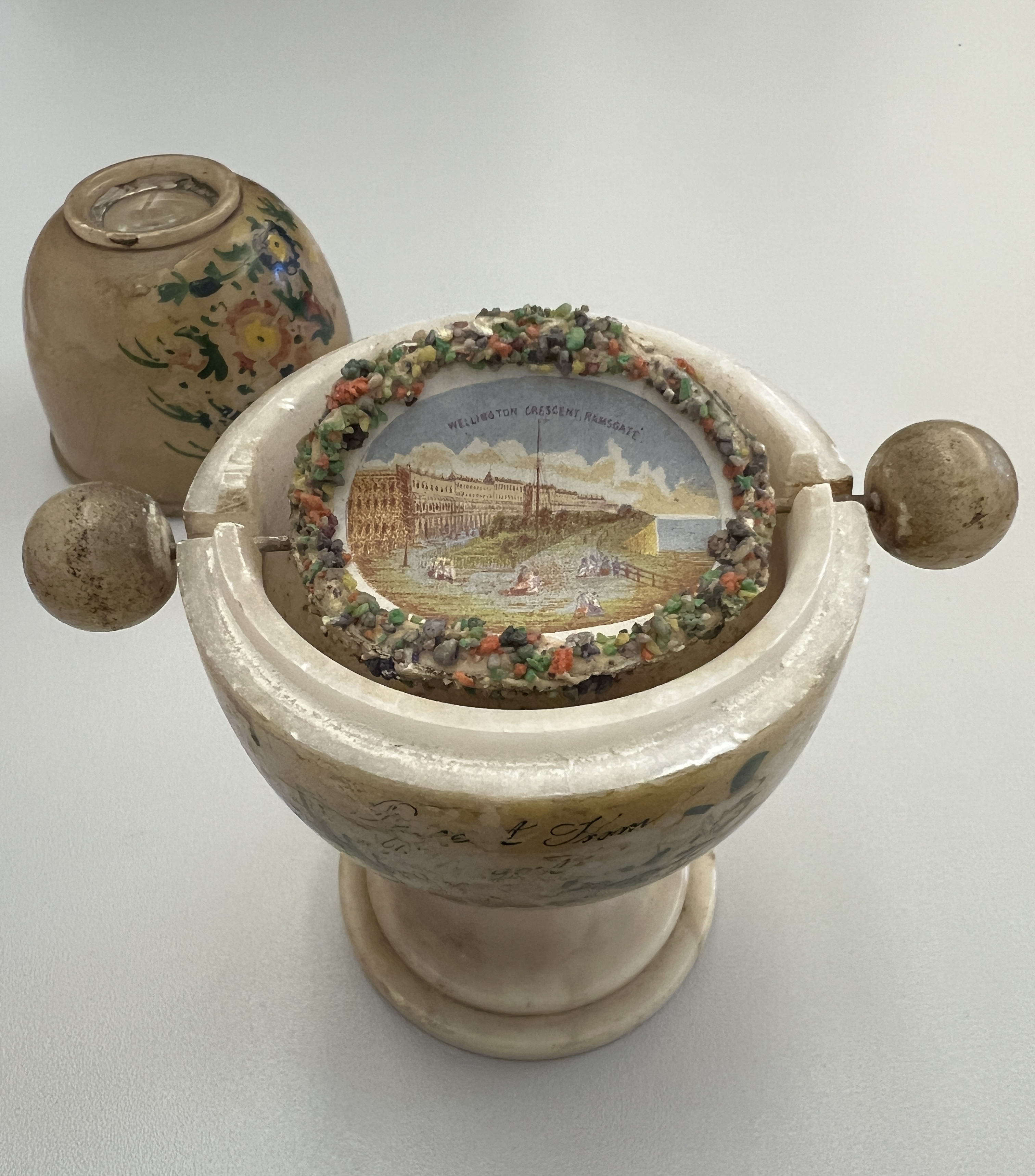 |
Figure EXBD-69071.1 –Peep Egg Depicting Ramsgate |
| Photo © Rod Bantjes. |
This is a miniature lensed viewing device showing scenes of Ramsgate, an English seaside town. It is included in the Optical Machine Taxonomy as an outlier. Since its purpose is not to enhance the 3D effect of the little seaside views it contains, it is not an optical machine.
The two halves of the ‘egg’ are normally glued together.[2] One looks down through the lens at the images within. The walls of the egg are turned alabaster and are thin enough (0.8 cm) to admit diffused light.
Three different views can be interchanged by turning a spindle by means of two side-knobs. Two are lithographed images framed by coloured pebbles: Wellington Crescent, Ramsgate and Ramsgate Harbour. One is a "faux terrain"[3] in which an undersea world is represented by coloured sand, shells, lichen and crystalline substances made to look like seaweed and coral.
Peep eggs are structurally analogous to other lensed viewing devices. An image, contained within an enclosure, is enhanced by being viewed through a lens. As in other such devices, the distance between image-plate and lens is roughly the same as the focal length of the lens. There is a means of illuminating the enclosed views and of changing between different views. However, miniaturization has been taken to the point where the function of the lens seems no longer to enhance the illusion of depth in the image and instead merely to make the details of the scene discernible in the tiny poor-quality litho. The peep egg is the limit where the logic of immersive viewing is displaced by a different logic of micro-storage, private secretion and retrieval. It is more akin to the Stanhope than the peepshow.
Peep eggs were sold as souvenirs of places and spectacular works like the Thames Tunnel. They are in the shape of mortuary urns as though memorial repositories for things long past but possible to return to at least in spirit.
Endnotes:
[1] I would like to thank the Bill Douglas Museum for a stipend that supported my research there and the staff of the museum for their generous assistance..
[2] The term ‘peep egg’ is a recent invention. In the 19th century they were known as a species of ‘spar ornament’ – ‘spar’ being a term for both gypsum and alabaster. See MacDonald, Robert, "Spar Ornament Views: The History of the Peep Egg," The New Magic Lantern Journal 10, no. 5 (2009), 80.
[3] "Faux terrain" is a term used to describe physical props placed in front of a painted backdrop of a panorama. A modern term for this kind of fake landscape with figures is "diorama," but for the optical machine taxonomy we will reserve that term for Daguerre and Bouton’s diorama of 1822 and paper dioramas.