Rod Bantjes, “Genus_Integrated-Graphoscope.html,” created 19 April, 2026; last modified, 30 April, 2026 (https://people.stfx.ca/rbantjes/).
Integrated Stereo-Graphoscope Genus (ca. 1870 - 1895)
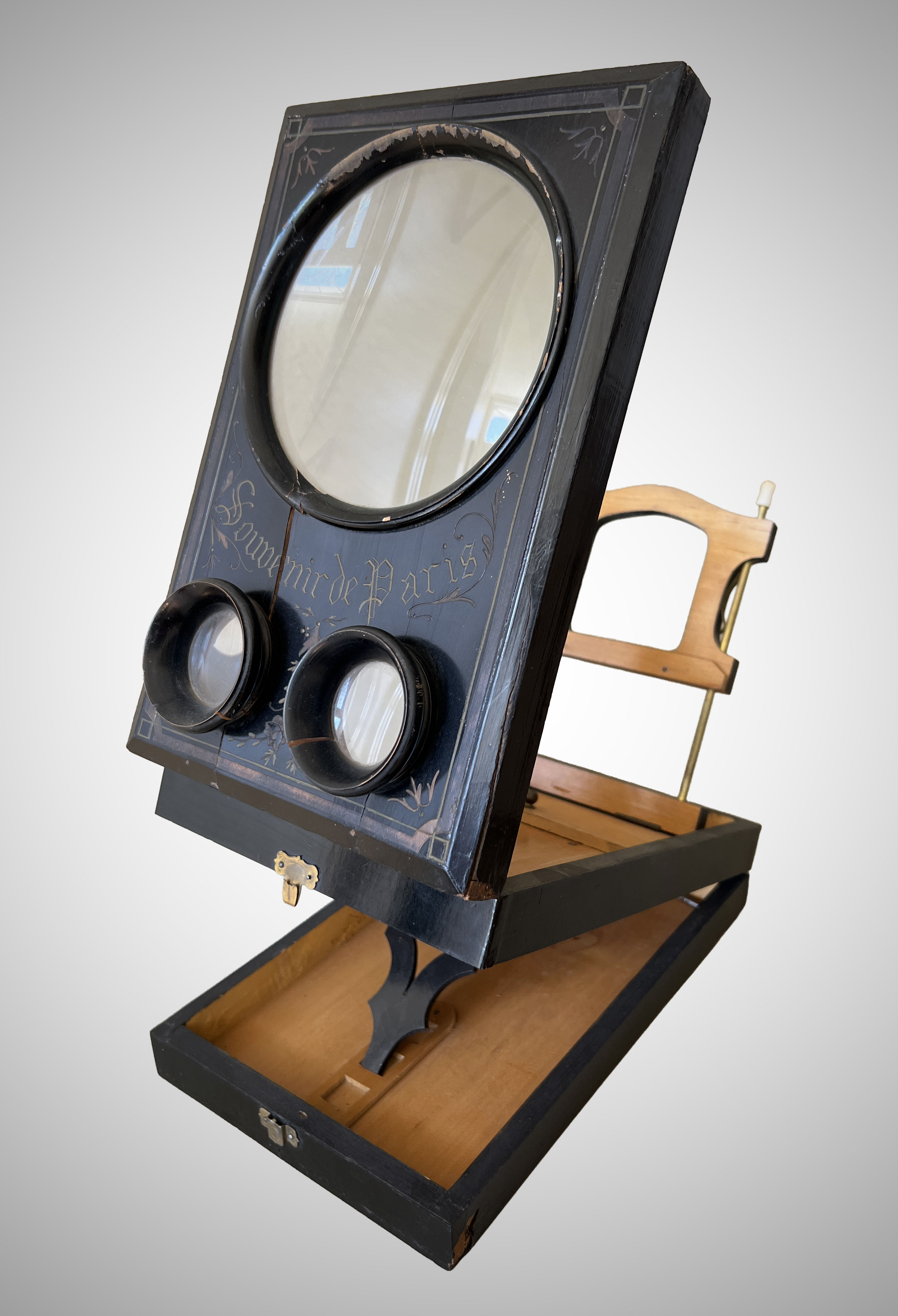 |
Figure ISG.1 – Graphoscope |
| Photo © Rod Bantjes. |
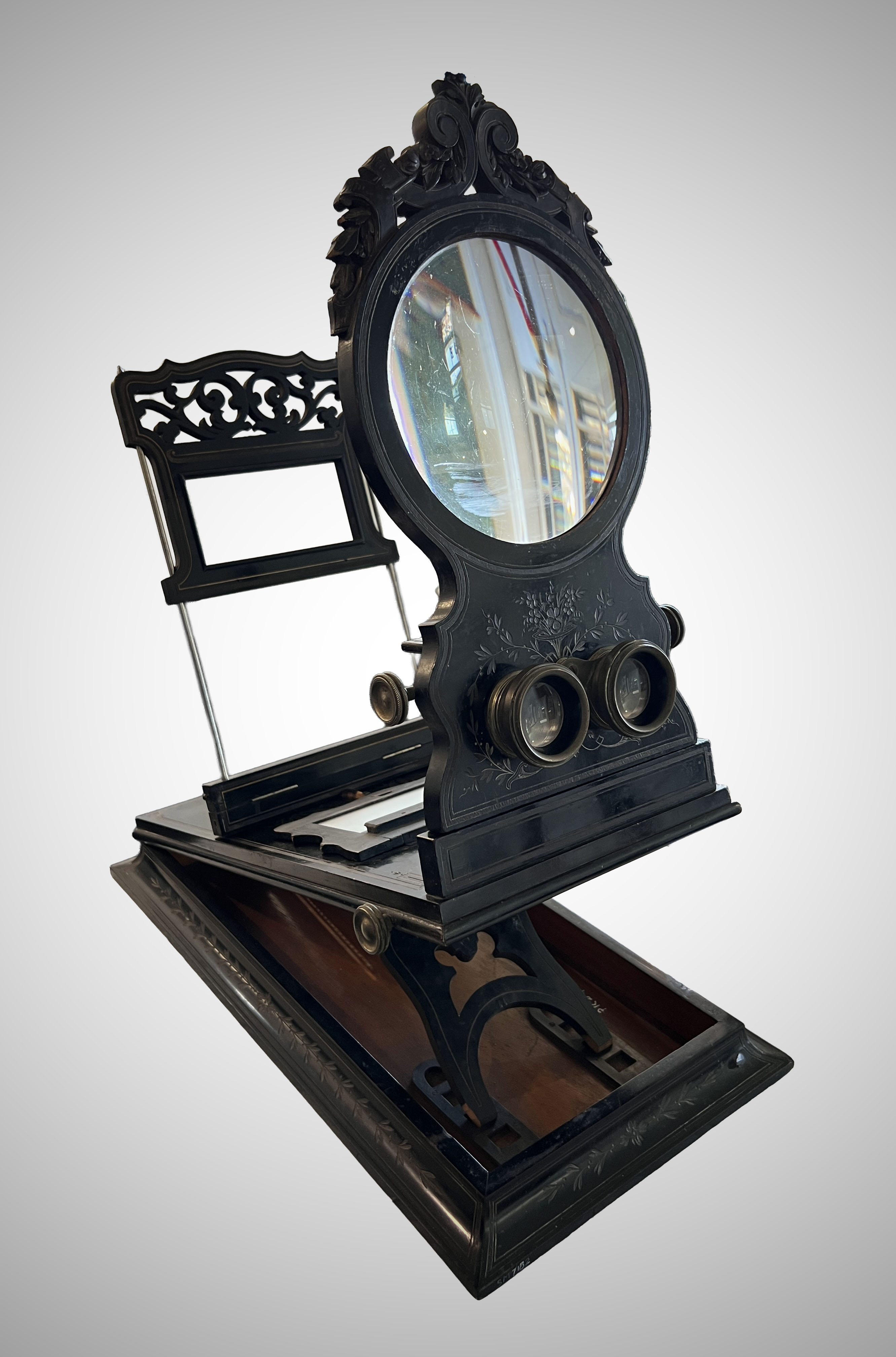 |
Figure ISG.2 – Graphoscope |
| Photo © Rod Bantjes. |
Charles John Rowsell patented the graphoscope in England in 1864 as a 3D-viewer for both stereographs and non-stereoscopic photographs of the carte de visite format. He may have been influenced by Carlo Ponti's very similar Pontioscopio or else other early optical machines designed for the new format of photography such as the Alethoscope (1861) or Neomonoscope (1860). However, while the Pontioscopio lens has a focal length of 71 cm, Rowsell's device and the whole family of graphoscopes that it inspired had much shorter focal lengths (ca. 30 cm).
Graphoscope Lens Effects: The short focal length of the binocular graphoscope lens has two interesting consequences. First, it allows for the device to be smaller. Second, it creates visible distortion of straight lines and chromatic aberration. Paradoxically, these features may enhance the 3D illusion of photographs seen through the lens over and above the the binocular effect.
Inter-media Hybrid: Like all the Stereo-Graphoscopes, it is an inter-media hybrid that combines two types of 3D technology: the 18th-century biconvex lens and the 19th-century stereoscope Why designers from Rowsell onward insisted that the older (and to my mind inferiour) technology had to have a place on the same platform as the newer is curious and demands an explanation. While there is evidence that some in the 19th century thought that the "monocle" rivalled the stereoscope, it may also have been that new photo-formats other than the tiny stereographs were becoming more popular and people felt that these were in need of some measure of enhancement. In an 1872 ad, the E. & H.T. Anthony Company attributed the graphoscope's desirability to "the increased demand for large portraits of superior excellence and large local views."[xxx]
Rectangular Plinth and Platform: Like the Rowsell-Graphoscope the Integrated-Stereo-Graphoscope has a rectangular plinth-style base with a hinged platform upon which the optics rest. The angle of this platform can be adjusted to suit the user. The platform can be held at different angles by a prop that folds out below the platform and lodges against stops in the base.
Integrated Optics: Unlike the Rowsell-Graphoscope where the optics interchange, transforming the device into either a graphoscope or a stereoscope, the Integrated-Stereo-Graphoscope, when in use keeps both types of lenses in place, affixed to the same image-plate or array.
Summary: The defining features of the Integrated-Stereo-Graphoscope genus are:
| • a large-diameter (> 8 cm), short-focal length (< 40 cm) convex lens | ||
| • graphoscope and stereoscope optics integrated in the same lens-plate or array. | ||
| • a rectangular plinth-style base with a hinged platform. | ||
Multiple Species: The proliferation of variants of this type of graphoscope, many of them patented, suggests that makers must have seen them as lucrative and in demand. Most of the examples in this style also aim at a prestige market – made with burl veneer, decorated with inlay and carving, furnished with brass and ivory hardware and accents.
Each row in the following table represents a different species of Integrated Stereo-Graphoscope. Multiple entries in a single row represent slight variants of the same species.
| Cigar-Box: | 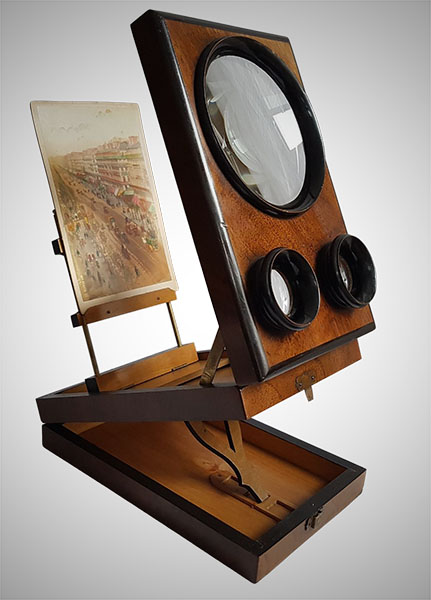 |
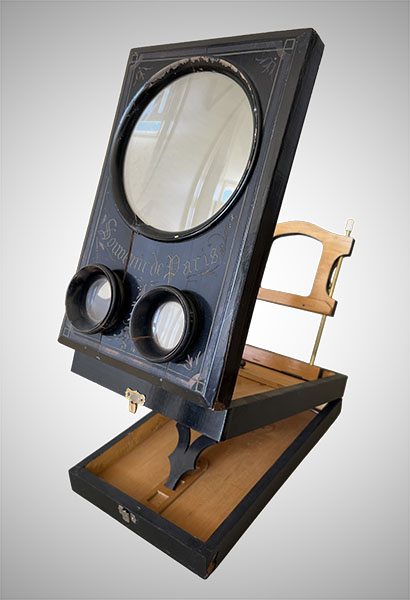 |
| Cigar-Box I | RB-04 |
This is the simplest form of Integrated Graphoscope with all three lenses in a rectangular face-plate the same size as the deck and the plinth. The three components are hinged so that they open in a Z-shape. They fold up flat in a cigar-box shape. Lens-image-plate distance is adjusted by moving the image-plate along a track where it stands in place by friction.
| Hautecoeur Simple: | 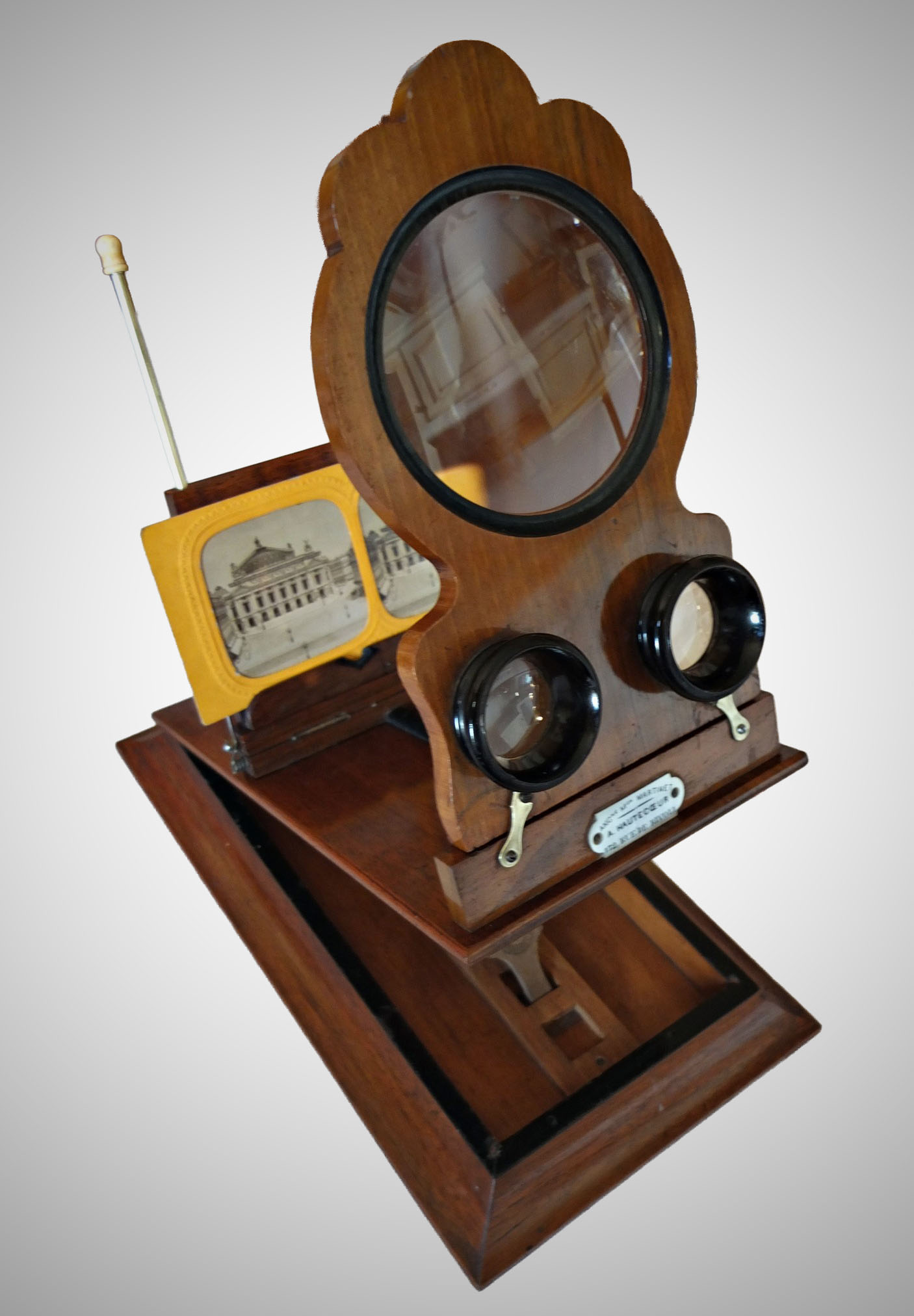 |
This device is similar to the Cigar-Box, except that the unified lens-plate is contoured around the lenses. The Cigar-Box lens-plate is held up by a prop; this one is secured by two front hooks. When it folds down it does not assume the aspect of a box-lid the way that the lens-plate does in the Cigar-Box. Lens-image-plate distance is adjusted by moving the image-plate along a track where it stands in place by friction.
Photo © Guy Françoise Laluque.
| Ziegler: | 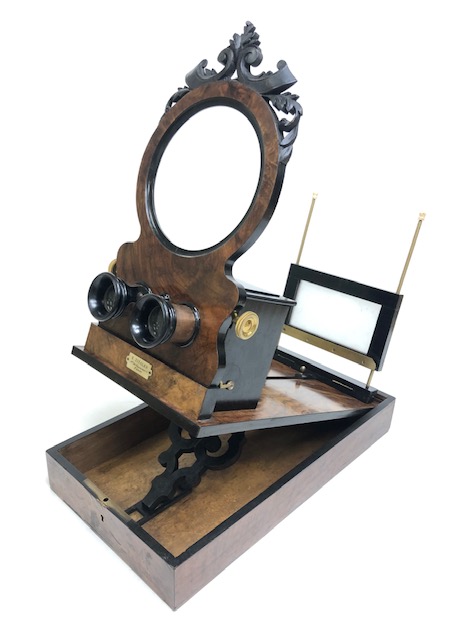 |
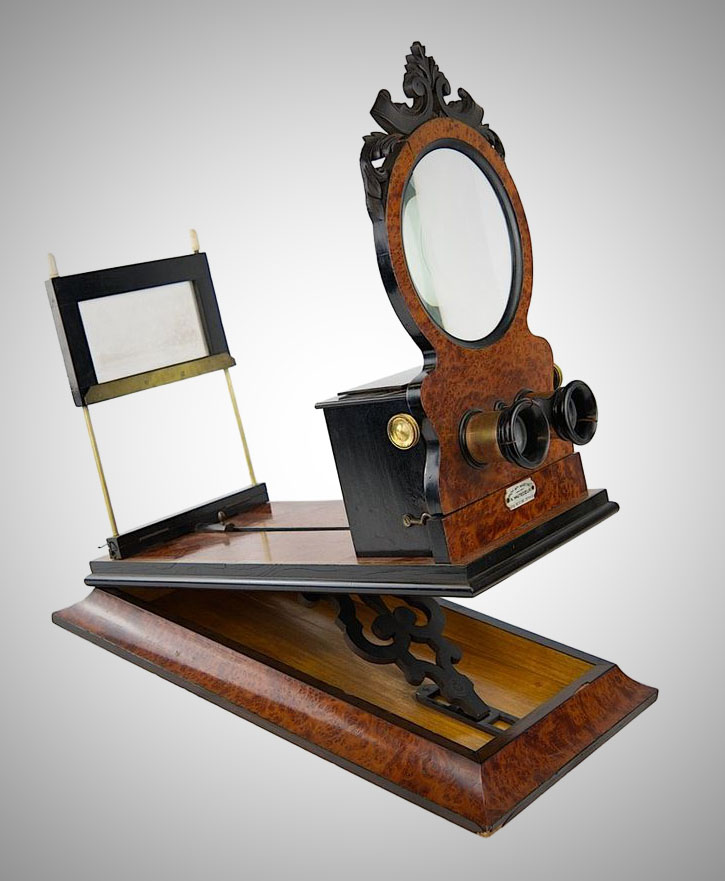 |
| Ziegler | Hautecoeur 1880 |
Like the Hautecoeur Simple, these devices have solid lens-plates decoratively shaped at the edges to echo the contours of the lenses.
They differ from the Hautecoeur Simple in having a folding light-box for viewing stereoscopic transparencies or "tissue views." The image-plate slides forward and its ground-glass panel forms the back of the stereoscope-box, mimicking an enclosed Brewster stereoscope with a top-flap to adjust front-illumination. Also unlike the Hautecoeur Simple these have knurled brass knobs to to focus the stereoscopic lenses. The distance between graphoscope lens and image-plate is adjusted as in the Cigar-Box and Hautecoeur Simple design.
Ziegler claims that his device has achromatic lenses and warns that it "must not be confounded with the counterfeits in similar mounting, containing inferior glasses."[xxx] Photo © Vintage-Cameras.
Hautecoeur dimensions: H = 16 cm, W+ 26 cm, L= 47.5 cm. Photo © Cinémathèque québécoise.
| Albany: | 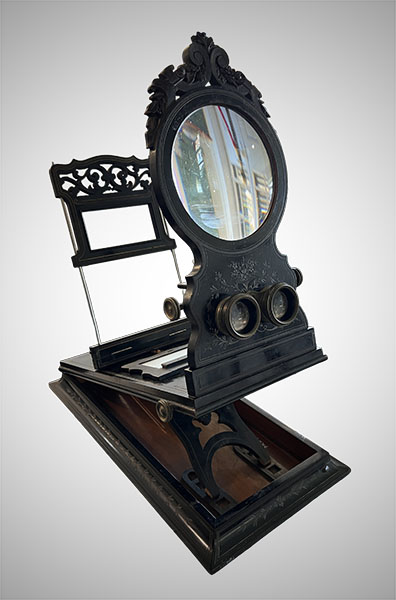 |
| SM-6939 |
In all significant respects, this viewer is like the Ziegler, including the light-box, most of the components of which are missing.
What distinguishes it from the Ziegler and Hautecoeur 1880 is a second pair of knurled brass knobs that control the image-plate position by means of a sprocket and chain-mechanism.
| Hautecoeur: | 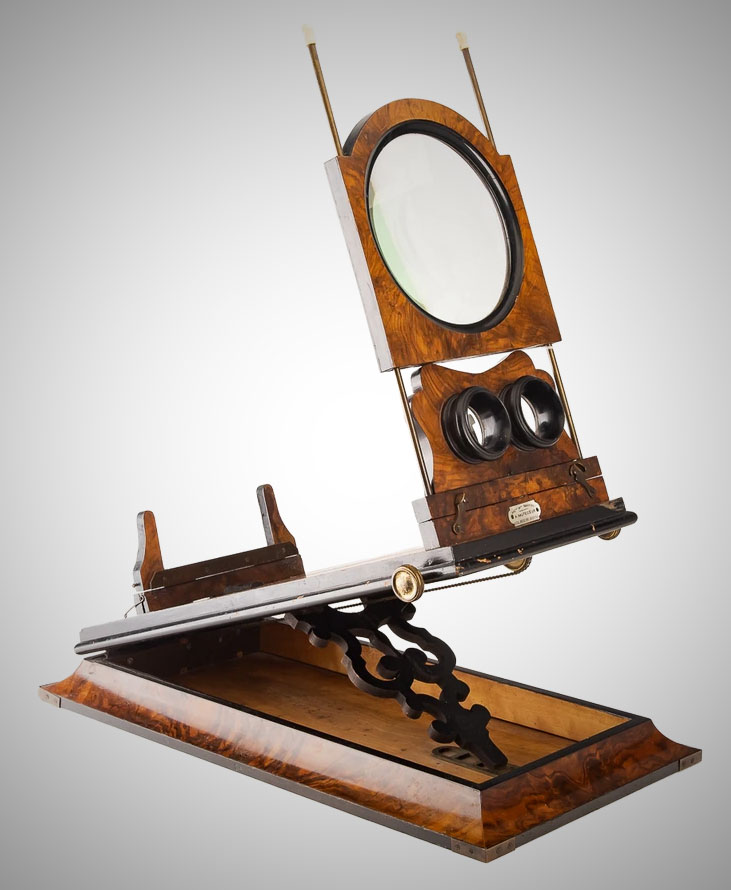 |
| Hautecoeur |
In this Hautecoeur viewer, the image-plate has been separated into a graphoscope and a stereoscope element. However, these separate elements do not fold out of each other's way as in the Rowsell-Graphoscope. Instead, separation allows the graphoscope lens to be adjusted vertically on two steel rods tipped with bone or ivory finials.
Photo © Photo © VSSOutlet.
| Lewis Round: | 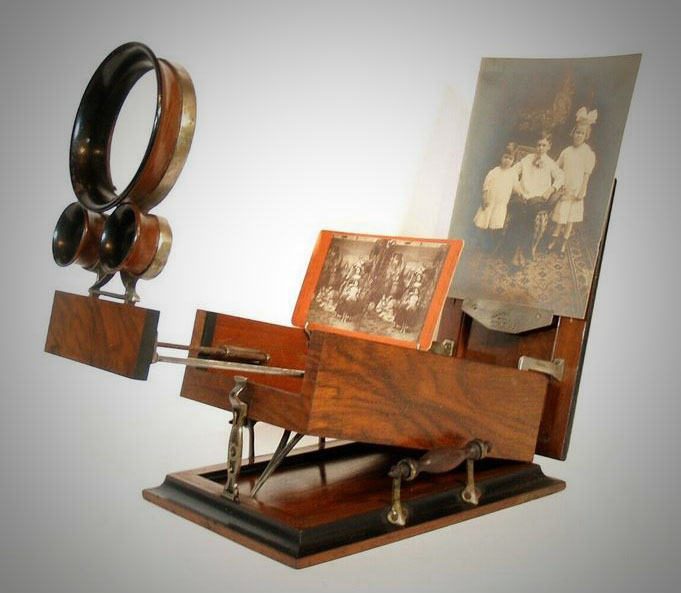 |
| Lewis Round |
W. H. Lewis's US patent #183,579, Oct. 24, 1876 (not depicted here) has the same metal rods to extend the lens array as this version, but has the square lenses with the rectangular blinders, like what I am calling the "Lewis Square" (below). This version has a triad of round lens-frames in a cluster, like Anthony 1882 Pedestal Stereo-Graphoscope. An image of the 1876 patented version can be seen in Paul Wing's Stereoscopes.[xxx]
| Lewis Square: | 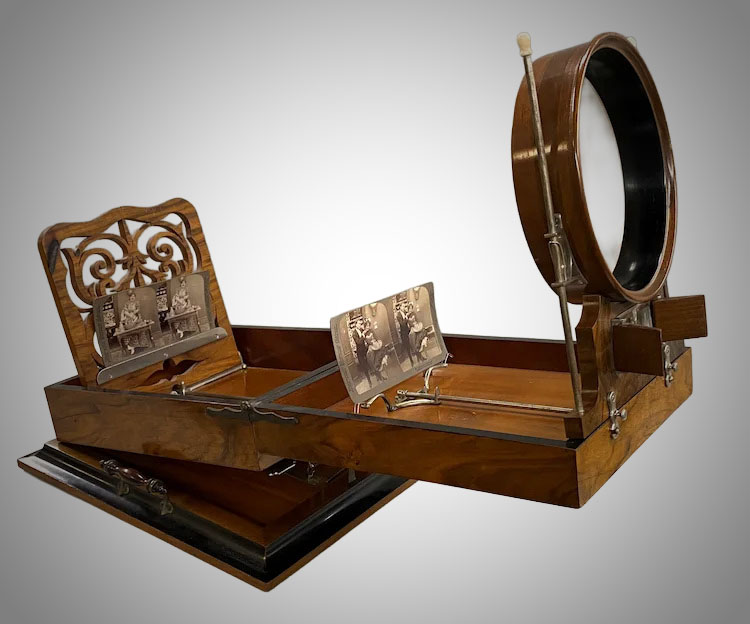 |
| Lewis Square |
I am calling this "Lewis Square" because of the shape of the stereoscopic lens-frames. However, the more significant difference from Lewis Round (above) is the mounting of the lens-array on the end of the hinged top of the box. The two image-plates (near, metal one for stereographs and further, wooden one for non-stereo photos) slide on steel rods for adjustment.
New Hampshire Antique Co-op: "a rosewood veneered graphoscope, patent date 1875, with large adjustable 7 ¼” (18.4 cm) diameter round magnifying lens ......Dimensions: 21 ¾” H x 30” W x 14” D, (55.2 x 76.2 x 35.6) fully open ...folds up into a 6” H x 16” W x 14” D (15.2 x 76.2 x 35.6) box with handles."
Photo © New Hampshire Antique Co-op.
| Cosmo-graphoscope: | 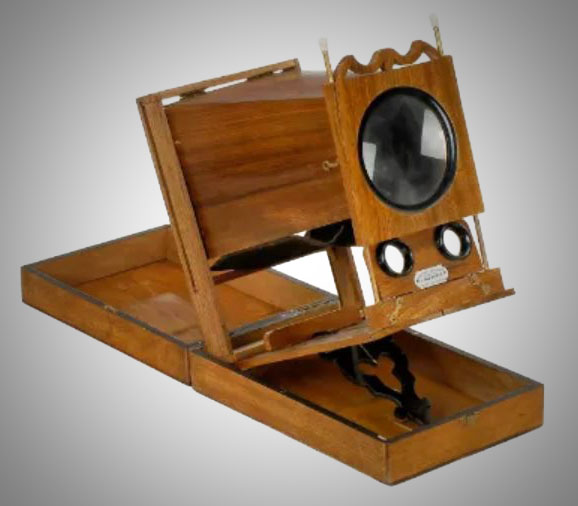 |
| Cosmo-graphoscope |
The folding box to control light on the graphoscope image is highly unusual and reminiscent of Frith's Cosmoscope or. It is difficult to say from this photograph whether it has flaps that open to admit light like those in Ponti's Alethoscope. With or without flaps, its purpose is to control light falling on the front of a photographic paper diorama so as to enhance the back-illumination necessary for the best paper diorama effects. Hautecoeur produced paper dioramas and stereoscopic "tissue views." for this and his other stereo-graphoscopes.
The lens diameter is 10 cm and the unit is 40 cm high when open.
Photo © LotSearch.
Endnotes:
[xxx] Wing, Paul, Stereoscopes : The First One Hundred Years (Nashua, N.H.: Transition, 1996) 132.
[xxx] Wing, Stereoscopes, 135.
[xxx] Wing, Stereoscopes, 146.