Rod Bantjes, “Genus_Pedestal-Stereo-Graphoscope.html,” created 19 April, 2026; last modified, 24 April, 2026 (https://people.stfx.ca/rbantjes/).
Pedestal-Stereo-Graphoscope Genus (ca. 1875 - 1882)
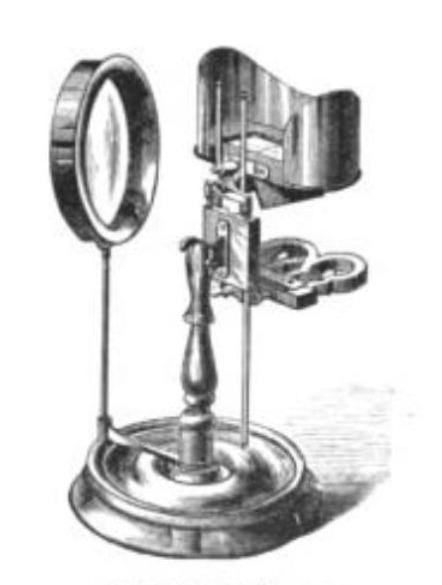 |
Figure PSG.1 –Ebony Graphoscope |
| Mashup of the graphoscope and Holmes stereoscope Source: The American Stationer, July 13, 1882, p.85. |
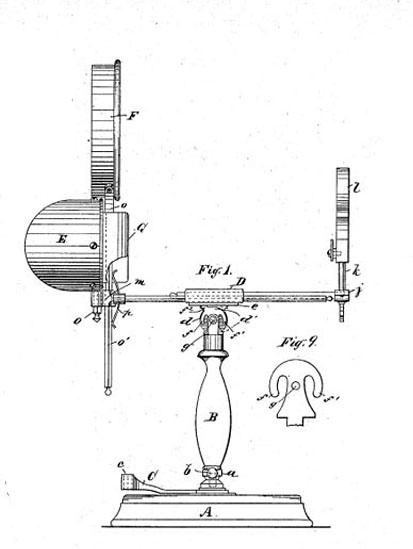 |
Figure PSG.2 –Lewis Graphoscope-Stereoscope |
| Patent application for a mashup design. Source: US patent #242,830, June 14, 1881. |
Graphoscopes are a family of optical machines all of the members of which have large-diameter (> 8 cm), short-focus (< 40 cm) convex lenses designed to enhance the 3D effect of standard photographic-format images such as the carte de visite.
The Pedestal-Stereo-Graphoscope is a genus of the family Graphoscope in the Optical Machine Taxonomy. You can learn more about graphoscopes, in particular how the unique characteristics of the lens are adapted to the photographic format and how they may offer a stronger 3D effect than lenses of other optical machines.
Two features of the Pedestal-Stereo-Graphoscope qualify it as a unique genus:
| 1) It has a pedestal-style base, unlike most graphoscopes that have a rectangular plinth-style base. It shares this feature with the Pedestal-Graphoscope. | ||
| 2) Unlike the Pedestal-Graphoscope, it is an inter-media hybrid, a mashup between a graphoscope and a Holmes-style stereoscope. |
Intermedia Hybrids
Intermedia hybrids are "mashups" between optical machines and other devices like the magic lantern, the phonograph, animation devices and in this case the stereoscope. The hybrid often borrows signature features of the component devices. The wooden lens-cups of many devices (e.g. EXBD-69117) are typical of many Brewster stereoscopes.
The two devices depicted here borrow instead from the Holmes stereoscope. Not only is the lens hood similar, but in the Lewis device (Figure PSG.2) the handle and the oddly-shaped connector that is enlarged in the diagram are identical to ones on Holmes devices.
The 3D effect of the stereoscope is far superior to that of the graphoscope in my view. Others, closer to the period, agreed. Arthur Judge observes in 1926 that ‘Those who have viewed single prints with any of the devices mentioned [single-lens devices including the graphoscope], and have also observed stereoscopic pairs in the stereoscope will agree that there is no comparison between the results, the latter being infinitely better in relief, solidity and perspective.’[2]
However the popularity of the graphoscope, and the fact that so many designers insisted that it should not be "left behind" and must have a equal place with the stereoscope, suggests that others valued its capabilities more highly than Judge and I do.
Each row in the following table represents a different species of Pedestal-Stereo-Graphoscope.
| Opposed I: | 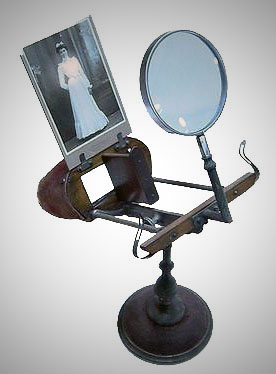 |
| [Future] Link |
I call this style "opposed" because the user looks in opposite directions to view stereoscopic vs non-stereoscopic photos. Both the hood and card-holder of the stereoscope element are Holmes-style. The image-plate for non-stereoscopic photos is atop the stereoscopic hood.
| Opposed II: | 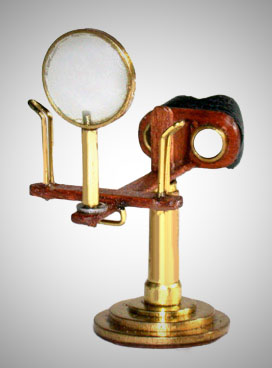 |
| [Future] Link |
I call this opposed for the same reason as above. Here there is a single image-plate for stereoscopic and non-stereoscopic photos. It slides to one side or the other depending on which format is being used. The stereoscopic hood mimics an uncommon Holmes-style stereoscope where the lens-frames are circular rather than rectangular as in Opposed I (above).
| Cremer 1875: | 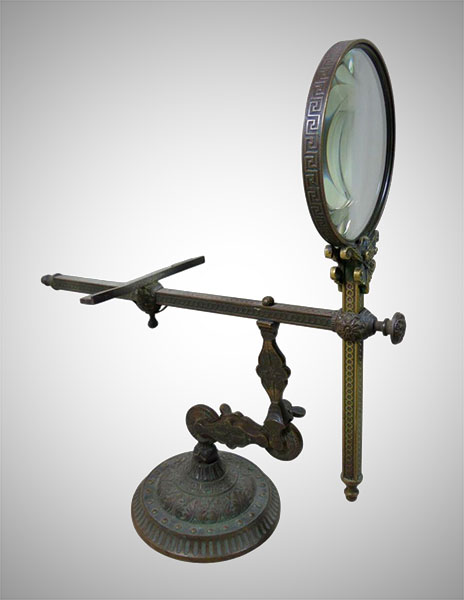 |
| [Future] Link |
This viewer was patented by James Cremer in 1875. The missing image-plate would have sat upon the T-bar on the left side of the cross-arm. The magnifying-glass (clearly it could be used independently as such) is removable, and there was a Holmes-style stereoscopic hood that could be secured in its place.[xxx] All points of intersection in the cross-arm and lower armature are adjustable and secured with thumb screws.
Dimensions as configured in the photo: H= 38.4, W= 34.9, D= 13.7 cm.
| Lewis 1881: | |
| [Future] Link |
This device was patented by Willian H. Lewis in 1881. At the viewing end it has both a Holmes-style stereoscopic hood and a large graphosco lens with vertical adjustment. The distance between lenses and image-plate is adjustable through a friction-mount at the centre. Paul Wing says that the " design was licensed 20 years later by Underwood & Underwood."[xxx] Perhaps that means that it was actually put into production.
| Orrery-Style: | 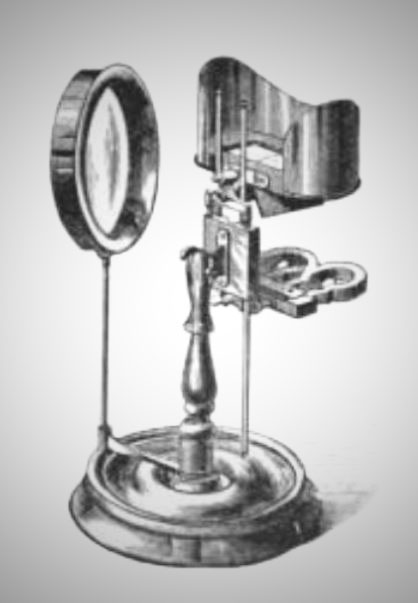 |
| [Future] Link |
This viewer appears in an 1881 advertisement for E. and H. T. Anthony and Co. wares. It has a wonderful orrery-style interchange between stereoscopic and graphoscopic elements. I would have to see one to be sure, but it appears that the hood can be used for both stereoscopic and graphoscopic viewing. The company called it "ebony" presumably because the base, column and perhaps the large-lens frame were made of ebony.
We know of no surviving examples.
| Anthony 1882: | 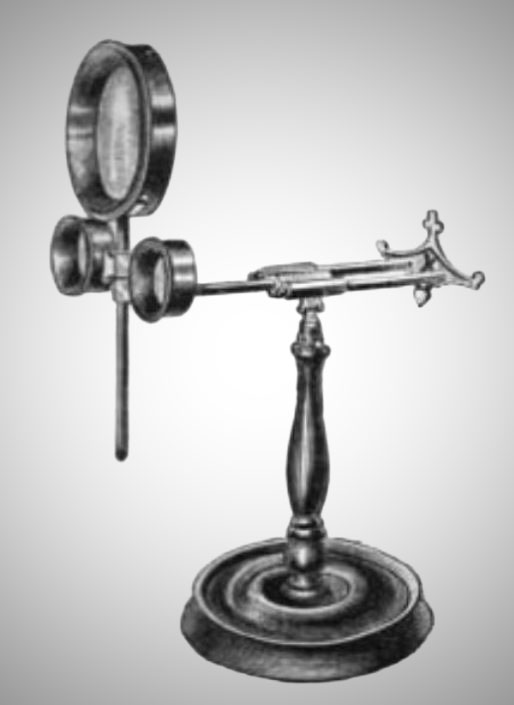 |
| [Future] Link |
This viewer appears in an 1881 advertisement for E. and H. T. Anthony and Co. wares. The isolated, circular lens-frames is a style that appears in some Integrated Stereo-Graphoscopes. The distance between lenses and image-plates is adjustable by a telescoping cross-bar. The turned base, column and lens-frames appear to be made of wood.
We know of no surviving examples.
Endnotes:
[xxx] Wing, Paul, Stereoscopes : The First One Hundred Years (Nashua, N.H.: Transition, 1996) 139.
[xxx] Wing, Stereoscopes, 136.