 |
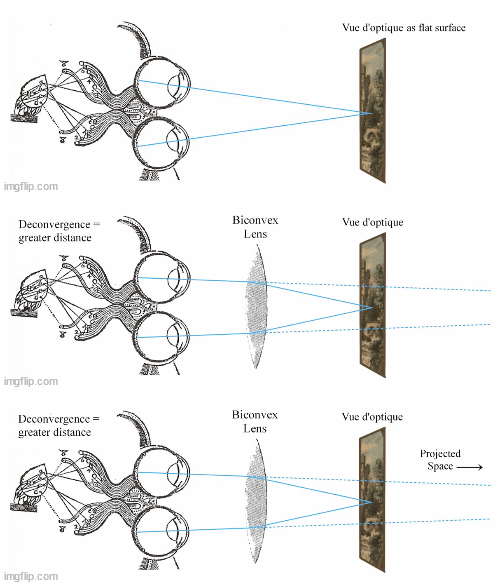
Figure P-2 – Binocular Convergence and the Spatial Deception of the Optical Machine
This animation contrasts viewing a print with and without a biconvex lens. Watch what happens to the angle of convergence of the two eyes. Without the lens the eyes converge on a point in the painting (let's say a church steeple depicted in the distance) and the two eyes converge at a steep angle. This is how they would converge if you were looking at an engraving close up, but not how they would converge if you were looking at an actual steeple in the distance.
When you introduce the lens, it changes the paths of light to the eyes so that when looking at the same steeple their lines of direction are closer to parallel just as they would be if you were looking at a distant steeple. This parallel orientation signals to the brain that the thing seen is far way. In this way the engraving is supposed to take on a greater illusion of depth.
While this was the main explanation given in the 18th century for how the biconvex lens enhances the depth effect of a perspective print, no purely optical explanation such as this is adequate. They had an overly mechanistic understanding of how the angle of convergence of the two eyes affected depth perception. Click here for additional optical explanations. For a more comprehensive explanation that argues for an essential role of intention and imagination, see Bantjes, Rod. 2021. “The Optical Machine’s Asynchronic Progress.” Technology and Culture 62(4):1119-42.
Note: The cross-section of the two eyes is based on an illustration from Descartes' Optics. I like to use it to remind those influenced by Crary's Techniques of the Observer that people in the 17th century when Descartes wrote, were thinking of visual perception not as clear and transparent apprehension, but rather as highly mediated by physiological processes. And in the 18th century people developed "physiological" forms of representation like the optical box.