Rod Bantjes, “Hybrid_Projection.html,” created 7 June, 2026; last modified, 7 June, 2026 (https://people.stfx.ca/rbantjes/).
Curvilinear Projection
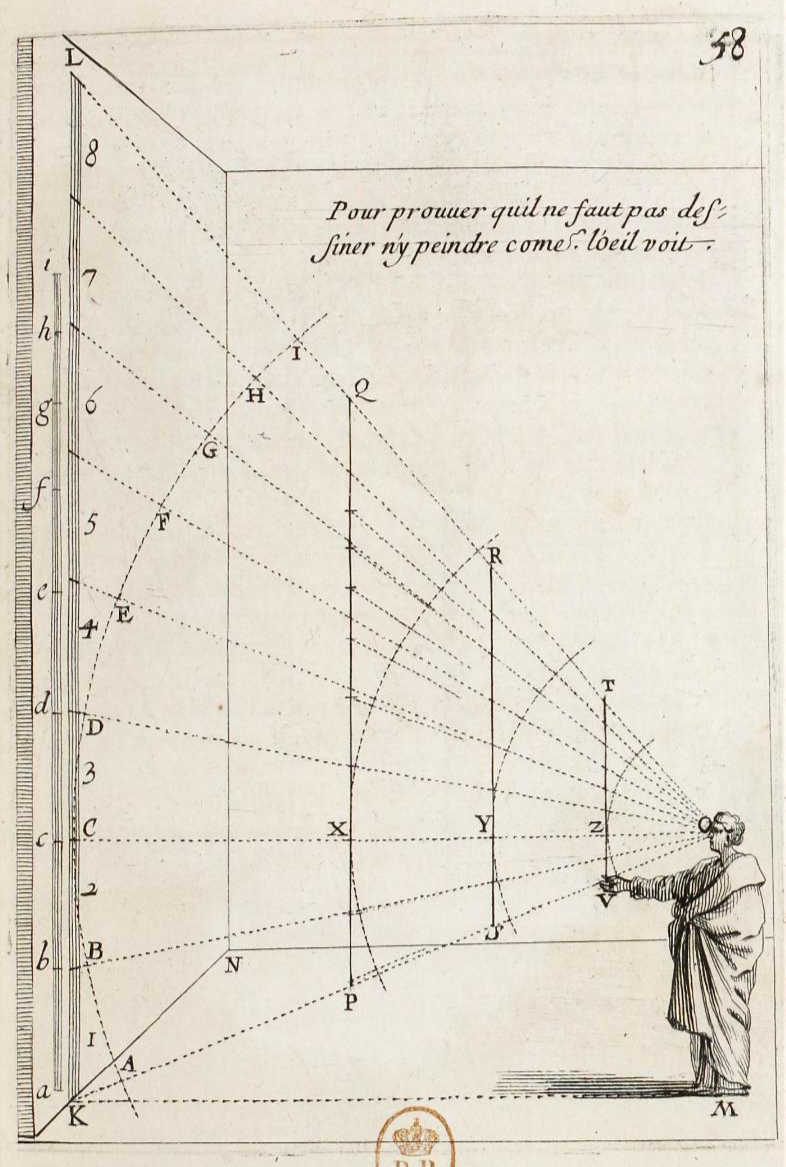 |
Figure CP.1 – Against Curvilinear Projection |
| Source: Bosse, Abraham. Traité Des Pratiques Geometrales et Perspectives. Paris: chez l’Auteur, 1665. |
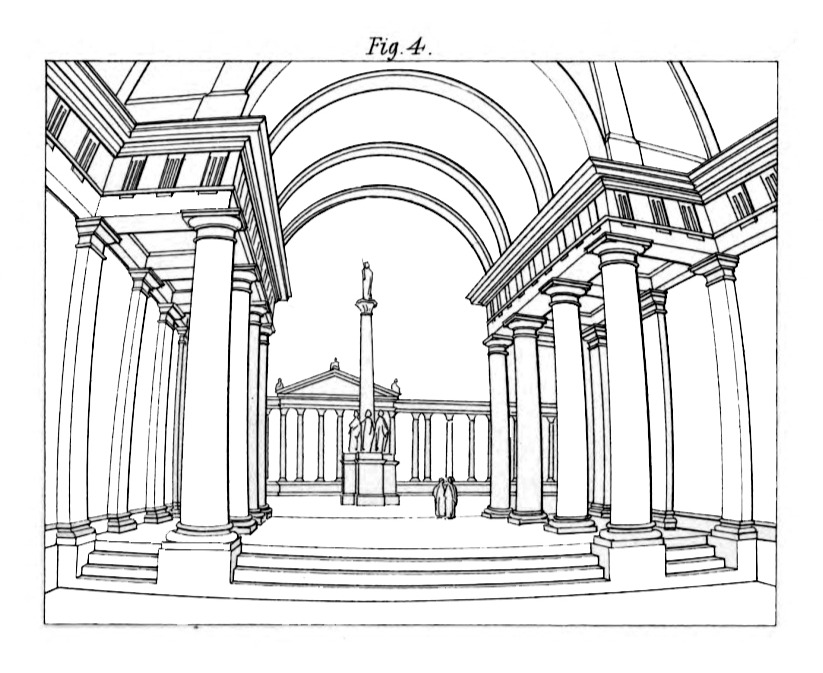 Figure CP.2 – Curvilinear Projection |
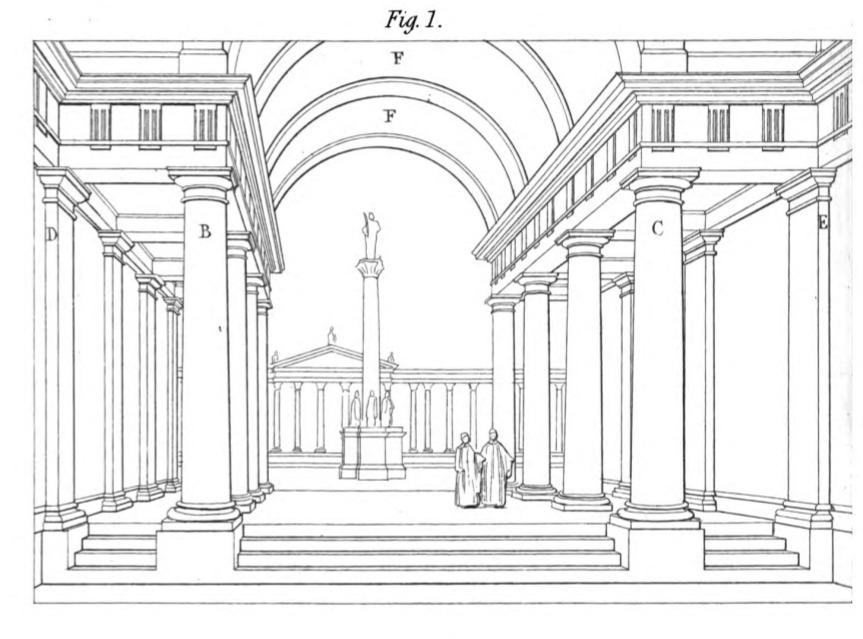 Figure CP.3 – Linear Projection |
| Source: G. B. Moore, Perspective Its Principles and Practice. London, 1850, Plate 11. |
Curvilinear projection is representation on a flat surface of a scene taken from a fixed point of view and a changing direction of view through an arc of more than 90°.[xxx]
Abraham Bosse, in Figure CP.1 is warning artists against using curvilinear perspective,[xxx] because it will create the distortion that you see in Figure CP.2. Notice how the depicted architecture appears to bulge at the centre and diminish towards the edges of the drawing.
To understand Bosse’s diagram, first locate the line KL divided into equal-length parts numbered 1 to 8. That is supposed to be the thing we are depicting – let’s say it is the colonnade in Figure CP.2.
Linear Projection: If the artist measures the equal divisions 1-8 using his stick TZV as a guide, then the spaces will be marked off in equal lengths and he will depict them on his canvas as equal in length.
He can do the same for the width of his painting as he has for the height. For this purpose it is better to imagine that instead of a stick, he places a perspective grid or glass window at TZV held at right angles to his line of sight. Perspective theorists often called this device the plane of delineation. If he never moves his plane of delineation and depicts only how things appear on it from his point of sight O, then he will produce a picture in linear perspective like Figure CP.3.
Moving Direction of View: If, however, the artist forgets the plane of delineation and measures with his eye, he will get curvilinear projection. His eye moves though an arc from A, B, C, through to G, H, and I. It registers the angle of movement or the chords AB, BC etc. which are different in size from one another. DE at the centre of the picture will be much larger than HI at the periphery. That will give the resulting picture the bulge that we see in Figure CP.2.
Bosse thinks that curvilinear perspective is “come l’oeil voit,” or how the eye sees. In other words, in the 17th century he understands that we see through motion, not fixedly as though staring straight ahead.
The idea of the moving eye rendering straight lines as curves was shared by others in this period. Here is the painter Samuel van Hoogstraten writing in 1679:
| “First we must note that we see around us with our eyes, and for that reason no straight line can be drawn that is equally near to our eyes in all places; but well a curve, such as the outline of a circle, whose centre point is our eye. Similarly one sees standing before a building or Church that not only both ends of the walls, but also the Towers slope, foreshorten, and recede from us. How foolishly [sic.] would it be to portray it thus, unless your work would also be seen from very nearby and required the same [out] of necessity.”[xxx] |
How Do We See?: Bosse is right that we see through motion (of the eyes and head). But we do not see in curvilinear projection. Curvilinear projection is what you get when you take successive retinal impressions and try to represent them on a flat surface simultaneously. Our mind does not “see” any planar projection. Instead it registers the successive retinal impressions, correlates them with sensations of movement and constructs from them an experience of a spatial world. We do not see straight lines as curved, nor do we see parallel lines as converging at the horizon.[xxx] We see through to a world where architecture is how we know it to be with parallel lines that remain parallel regardless of our position and where things do not change size when they move closer to or further away from us. On the question of straight lines we see much more like linear perspective, but not on the question of parallel lines and the fixed size of objects.
Types of Curvilinear Projection: Cylindrical vs Spherical
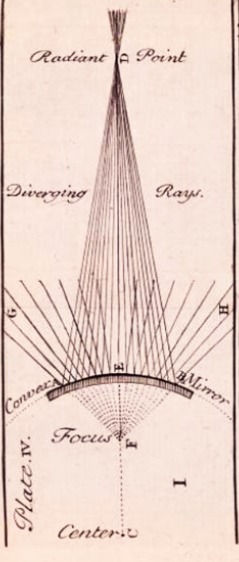 |
Figure CP.4 – Ray Diagram |
| Source: Martin, Benjamin. A New and Compendious System of Optics. London: J. Hodges, 1740. |
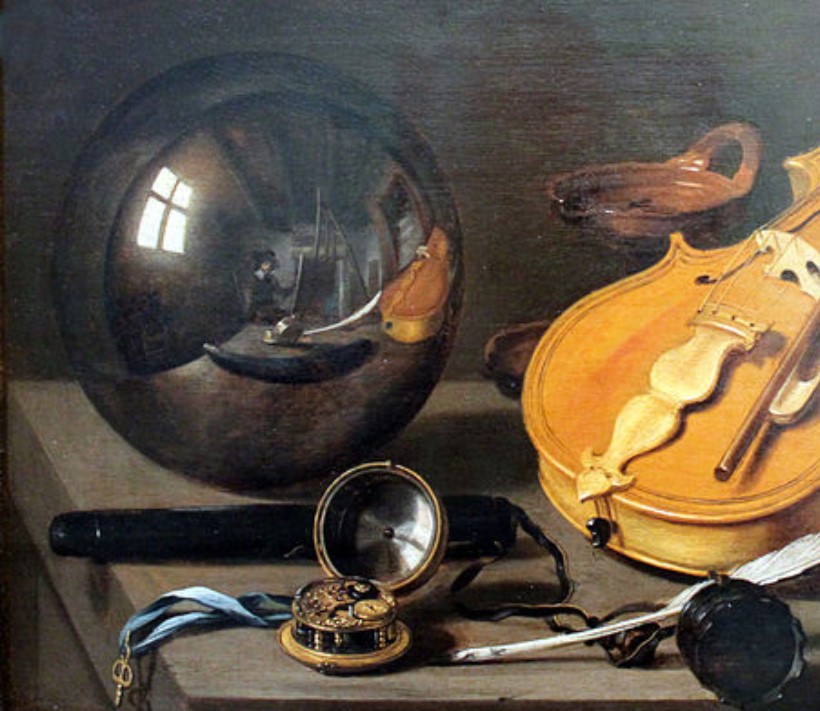 Figure CP.5 – Convex Mirror |
| Detail from Pieter Claesz, c. 1628, Vanitas with Violin and Glass Ball, oil on panel, 36 x 59 cm Germanisches Nationalmuseum. |
Spherical Curvilinear Projection: Instead of an arc in a single plane, the direction of view in spherical curvilinear projection shifts in an infinite number of planes that intersect with the point of view. In this projection all straight lines are rendered as curves. The device that early artists used to render this projection was a convex mirror, or other convex reflecting surface (see Figure CP.5).
The Kepler and Lanci devices mechanically shift the artist’s direction of view, producing a sequence of observations that are added together. The convex mirror registers the projection at a glance. Benjamin Martin’s ray diagram (Figure CP.4) gives insight into how the mirror renders sequential changes of direction in a glance. We can place the eye at his “radiant point” D and consider its direction of sight to be straight ahead and the fan of diverging rays to represent its angle of view.
If the mirror were flat it would reflect back an image from a fixed direction and in linear perspective.
The convex mirror bends the reflection so that it is as if the eye were rotating from a pivot at the focal point F. In this way it simulates a changing direction of view and produces a curvilinear projection like the one we see in Figure CP.5.
If the mirror were a cylinder it would produce a cylindrical projection; a mirror that is a sphere, or in practical terms a hemisphere, will produce a spherical projection.
Footnotes:
[xxx] Linear projection or perspectiva artificialis is representation on a flat surface of a scene taken from a fixed point of view and a fixed direction with an angle of view limited to 60° or less.
[xxx] I use the words “perspective” and “projection” interchangeably here. “Perspective” can mean generally “from a subjective point of view,” (e.g. ”that’s my perspective on this matter”). Used in relation to visual representation it typically brings to mind linear perspective, while here I am using it to refer to other approaches to visual representation. “Projection” is less encumbered but not commonly used.
[xxx] It is possible through guided self-reflection to attend to these features of the visual field, but normally we default to the “natural attitude’ where we see the world and suppress consciousness of how we see the world. In the natural attitude we think we see things that are not in the visual field (numerous experiments in perceptual psychology have demonstrated this). The problem of determining what we are able to see of how we see (i.e. what is present to consciousness in the visual field) is even more intractable. Philosophers, who have struggled with this problem for centuries, still disagree (see for example Noë, Alva. Action in Perception. Representation and Mind. Cambridge, Mass.: MIT Press, 2004). Our reflexive perception of what we see of our visual field is variable and subject to direction. Despite Alva Noe’s claims about perspectival distortions that he calls “P-properties,” he is unaware that until the 1830s people believed that they could not see upwardly converging parallel lines (perfectly valid P-properties). The reason for this was that they had never seen them represented, i.e. they had not been taught to see them (Bantjes, Rod. “‘Vertical Perspective Does Not Exist:’ The Scandal of Converging Verticals and the Final Crisis of Perspectiva Artificialis.” Journal of the History of Ideas 75, no. 2 (2014): 305-36).
[xxx] Hoogsraten quoted in Wheelock, A. K. (1977). Perspective, optics, and Delft artists around 1650. New York: Garland Pub, 80.