Rod Bantjes, “Camera_Kepler.html,” created 5 June, 2026; last modified, 5 June, 2026; (https://people.stfx.ca/rbantjes/).
Kepler’s Panoramic Drawing Device
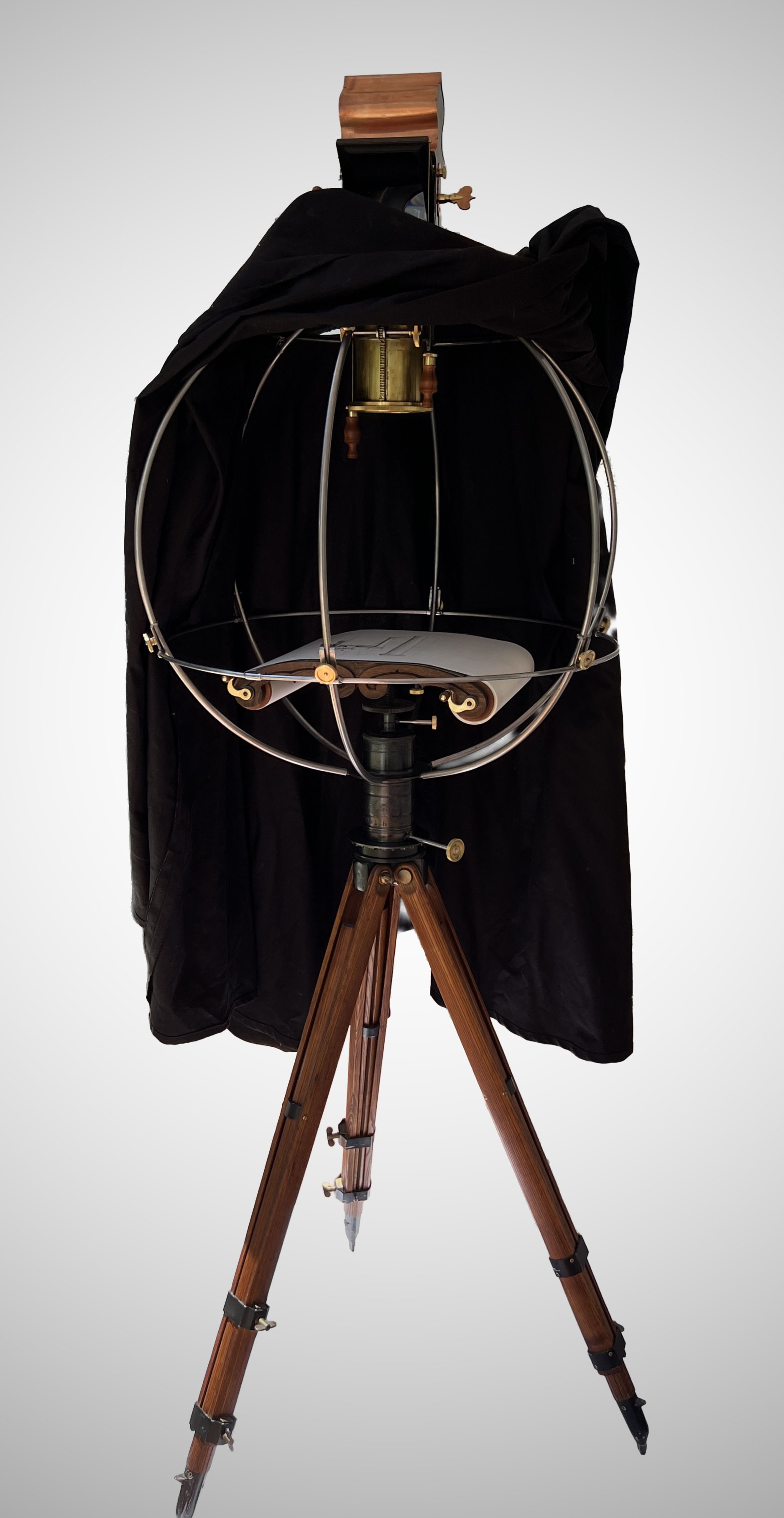 |
Figure KCO.1 – Kepler’s Camera Obscura ca. 1620 |
| This is Kepler’s device as re-imagined by Rod Bantjes Photo © Rod Bantjes. |
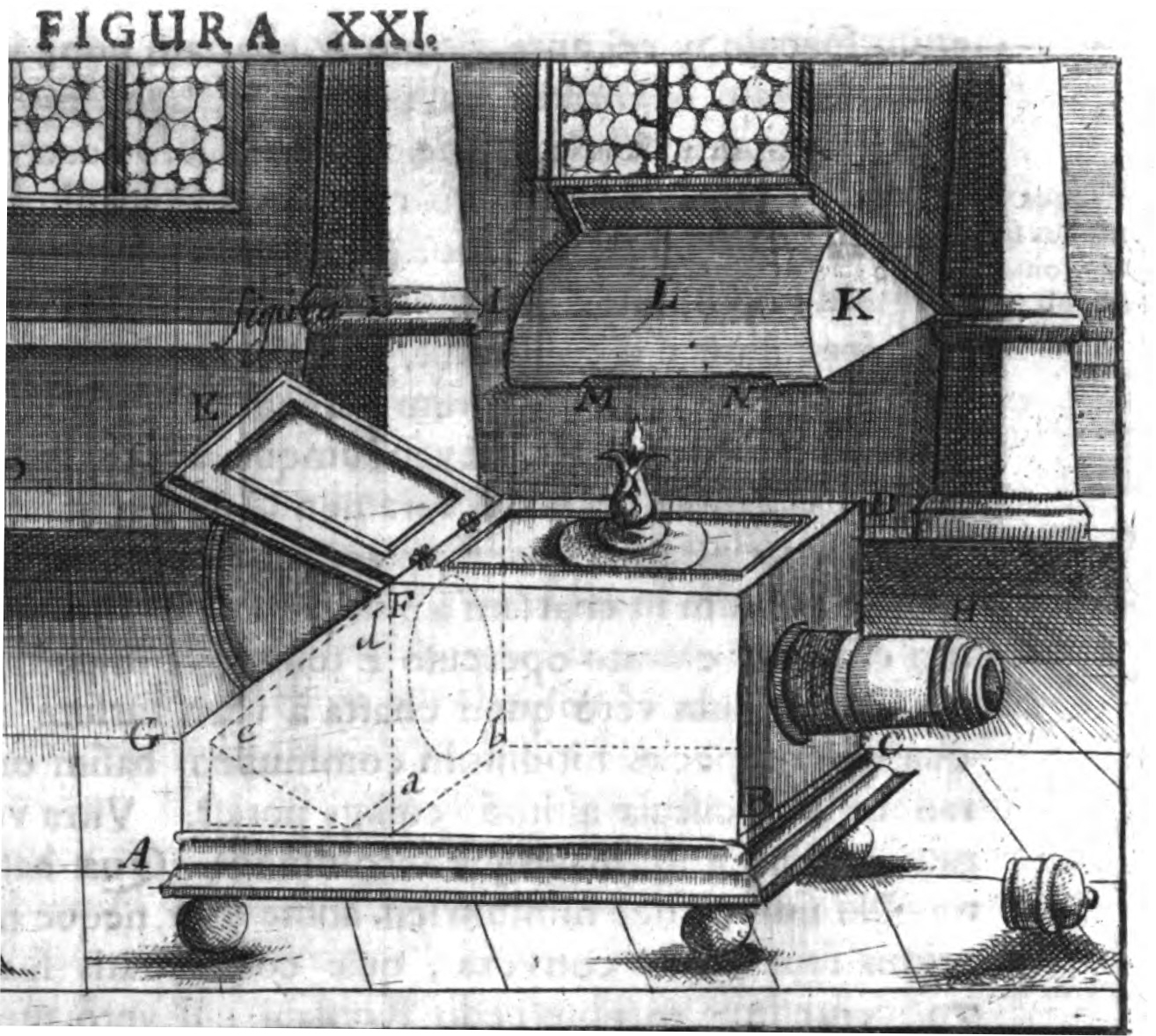 |
Figure KCO.2 – Zahn’s Camera Obscura ca. 1685 |
| Source: Zahn, Joannes. Oculus Artificialis Teledioptricus, Sive Telescopium Würzburg: Herbipoli, 1685. |
1.0 Uniqueness of Kepler’s Design
When I first read Sir Henry Wotton’s description of Kepler’s rotating camera obscura, I knew it was something radically different from any other camera obscura in his time and since. I had to build one to transform what for many might be an obscure verbal description into something real, and to explore the implications of this remarkable artefact for Kepler’s thinking about how visual perception works. As far as I have been able to tell, my device is the first that the world has seen for 400 years.
1.1 Overhead Lens: Kepler has placed the camera lens above the user’s head so that it projects its image downwards onto the image-plate.[xxx] This design was not common until the 19th century when tent-style camera obscuras were widely used as aids in landscape drawing. Camera obscuras in Kepler’s time, like Zahn’s depicted in Figure KCO.2, had the lens in front pointing towards the scene. Kepler’s lens pointed directly upwards and would have projected an image of the sky were it not for an angled mirror above it to reflect light from the horizon down into the device. In order for the image to be upright, the mirror must be directed to the scene behind the observer.
1.2 Rotation: Zahn’s device is designed for fixed viewing. Kepler’s is designed to pivot around a central axis as though one were turning one’s head for an all-round view. As Kepler’s camera turns, the mirror sweeps round and reflects a changing scene down onto the image plate – a full 360° panorama.
In the 19th century, numerous rooftop panoramic camera obscura were built – such as the ones in Eger, Hungary, Lisbon castle and Grahamstown in South Africa. But in these devices only the optical head turns while the image-plate and platform on which the observers stand remain fixed. As the panoramic image scrolls across the image-plate it also rotates so that it sometimes appears upside down or sideways to the viewer. In Kepler’s design, the entire device rotates so that from the individual observer’s perspective, the panoramic image scrolls across the image-plate right-side up. This whole-device rotation makes Kepler’s design entirely unique.
1.3 Image-Scroll: Instead of a single sheet of paper for tracing the projected image, Kepler’s device has a continuous roll of paper. The tent-style camera obscuras of the 19th century were used to draw conventional rectangular landscapes from a single point and direction of view. Kepler used his to create a long, narrow image which records a constantly changing angle of view. My version of the device produces an image 28.5 cm high and about 2 metres long (see Figure KCO.10). This paper-scroll for recording a panoramic image is the second feature that makes Kepler’s camera absolutely unique.
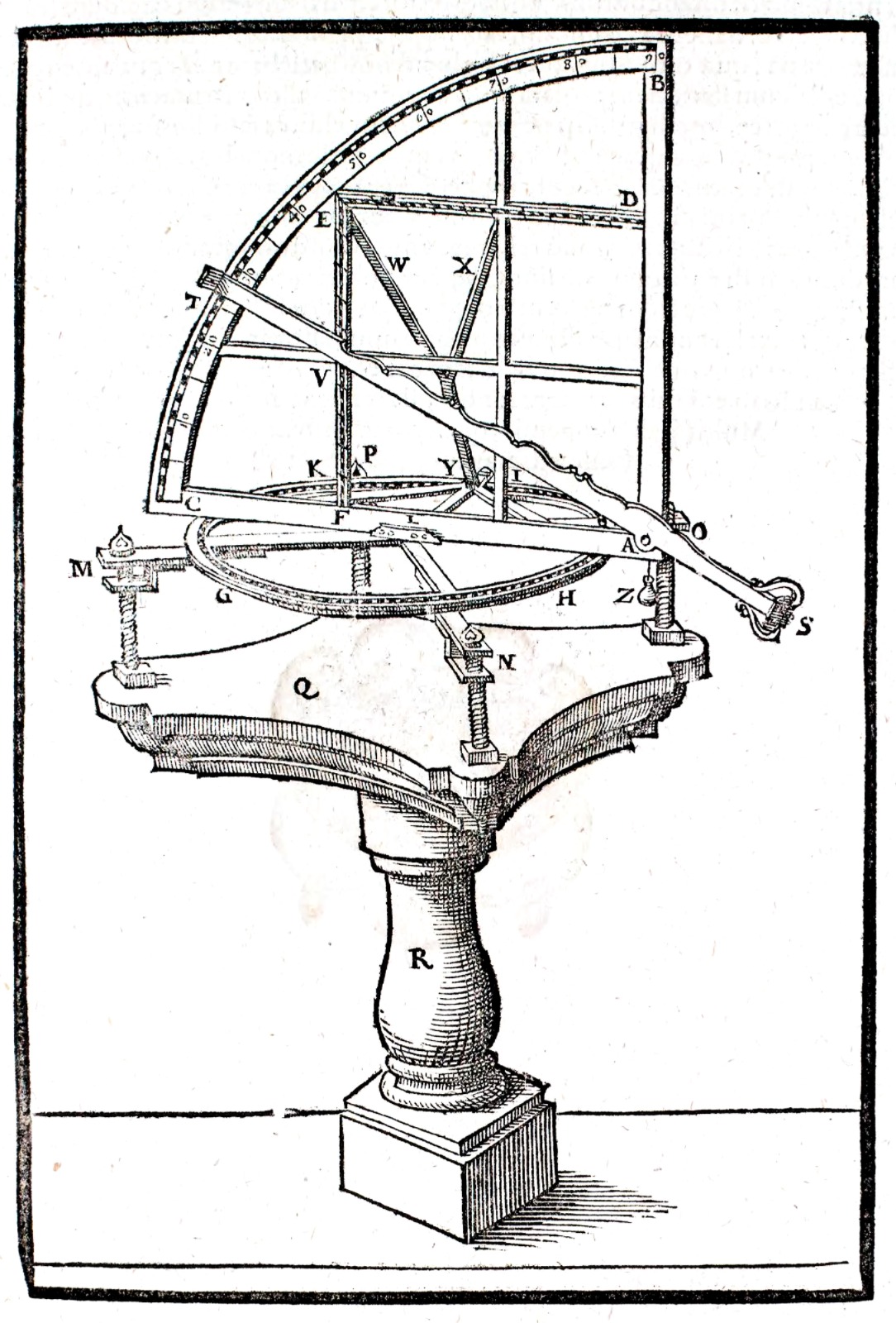 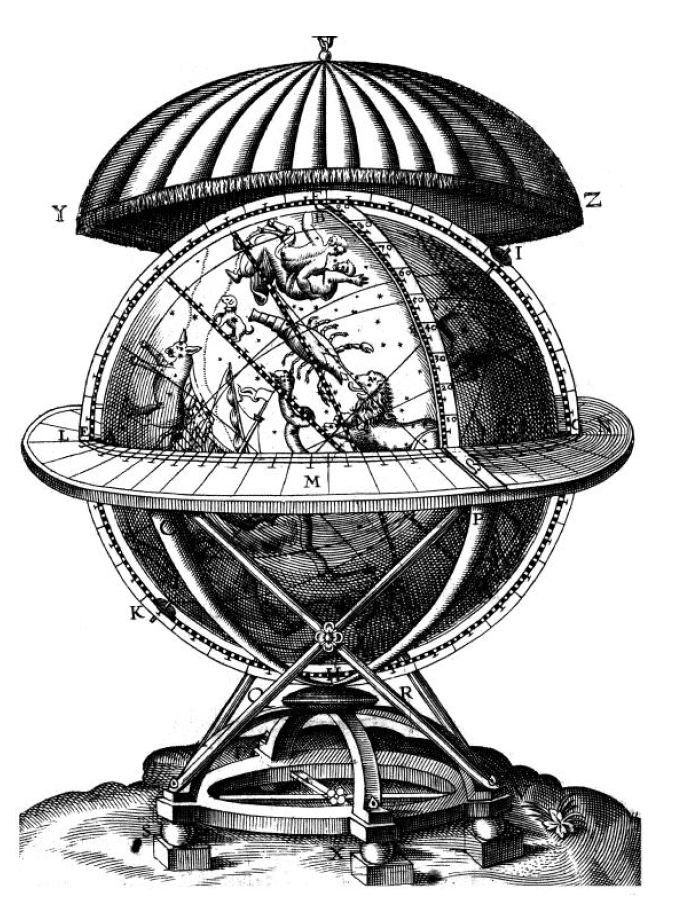 |
Figure KCO.3 – Brahe Quadrant and Celestial Sphere, 1602 |
| Source: Brahe, Tycho. Tychonis Brahe Astronomiae Instauratae Mechanica. Noribergae,: Apud L. Hvlsivm, 1602. |
1.4 What was Kepler Thinking?: Why was Kepler dissatisfied with the fixed camera obscuras of his time and what was he trying to achieve with this radically different design? As an astronomer, Kepler needed to observe very distant objects with great precision. Because any amount of distortion caused by their instruments or their eyes would compromise this accuracy, early astronomers had to concern themselves with how observational instruments, including the eye, worked. Jonathon Crary is right that for early thinkers the camera obscura was a model of the eye, and its effects were thought to give insights into how we see. Kepler was an influential theorist of perception, and in building the camera obscura he was no doubt trying out new ideas about how perception worked.
Thinking through artefacts is a dialectical process. We start with a new idea that we want to test by creating a working model. In this move our idea becomes built into the model. By trying out and exploring the properties of the artefact, we better understand the original idea, its limitations and possibilities, and are able to build upon it with better ideas. Thinking unfolds in two parts: 1) in the head, prior to the artefact, and 2) in interaction with the artefact. We can’t get inside Kepler’s head, but we can interact with his artefact-of-thought and in this way gain insight into his thinking process.
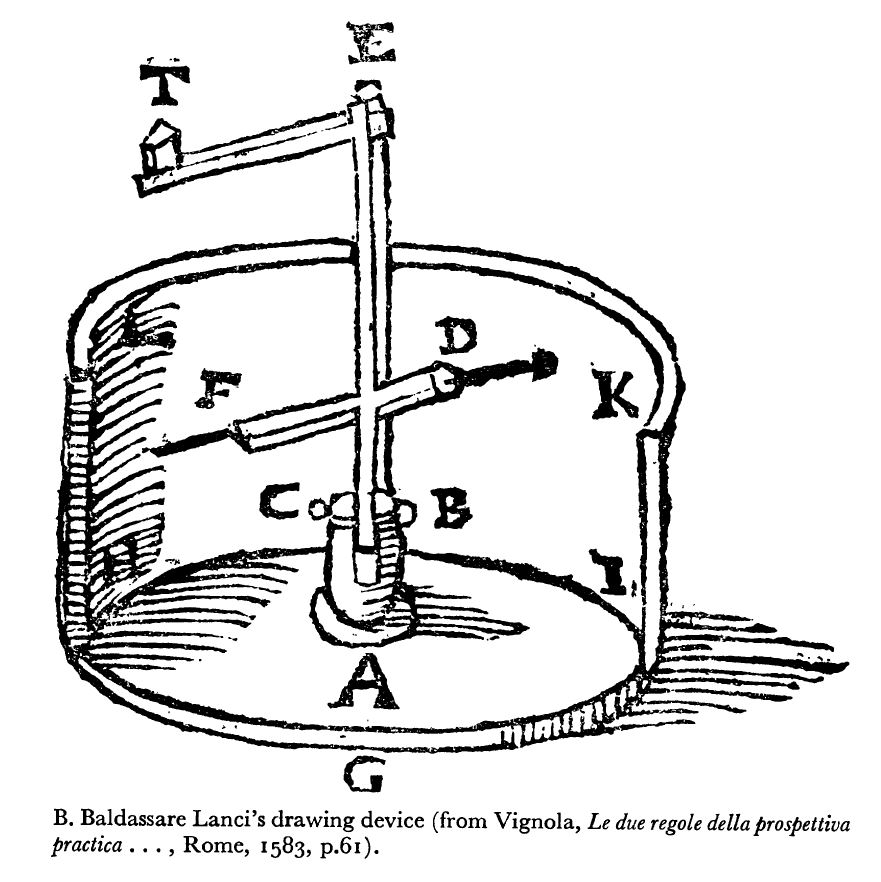 |
Figure KCO.4 – Lanci’s Panoramic Drawing Machine, ca. 1583 |
Source: Liedtke, Walter A. “The ‘View in Delft’ by Carel Fabritius.” Burlington magazine 118, no. 875 (1976): 61-73. |
2.0 Design of the Device
All I had to go on in designing this device was the following description written by Sir Henry Wotton of his visit to Kepler in 1620:
| He hath a little black tent … which he can suddenly set up where he will in a field, and it is convertible (like a windmill) to all quarters at pleasure, …[it has a biconvex lens from a telescope] through which the visible radiations of all the objects without are intromitted, falling on a paper, which is accommodated to receive them; and so he traceth them with his pen in their natural appearance, turning his little tent round by degrees, till he hath designed the whole aspect of the field.[xxx] |
2.1 Windmill: Wotton describes this oddity by comparison to three known things: a tent, a telescope and a windmill. In this period, the entire machinery of a windmill rotated on a platform so that it could be turned to follow the changing direction of the wind (first image in Figure KCO.5). My first design idea was much more like a windmill, where the observer sat inside upon a revolving platform. Perhaps this was how Kepler’s was designed, but that would have been too heavy for me since I hoped to carry it in my checked baggage to Europe and South Africa. Instead, mine rotates on top of a surveyor’s tripod so that the user must move as she rotates it.
2.2 Tent: You can see from the illustration (KCO.1) that I have retained the idea of the tent. So mine looks rather like a 19th-century tent-style landscape drawing machine (second image in Figure KCO.5), except taller since the user must stand.
2.3 Armillary Sphere: I took inspiration from other devices from Kepler’s time whose purpose was to record the locations of things in space. The quadrant in figure KCO.3 is from Tycho Brahe’s book on astronomical instruments that Kepler would have been very familiar with. I have depicted it here next to Baldassare Lanci’s panoramic drawing device (Figure KCO.4) to show the similarities between them.
They each have a sighting rod (an alidade) (TS in the depiction of the quadrant and TE for the drawing machine) that can be used to locate things in space. The sight swings round (360° in the quadrant and 180° in the drawing machine) and up (90° and ~45°). These devices, like Kepler’s camera obscura, model seeing and measuring the world-in-the-round from a central pivot. Spatial positions are recorded in writing (in degrees of arc) in the case of the quadrant and they are recorded by drawing on a sheet of paper in case of the the drawing machine.
The armillary sphere (third device from left in Figure KCO.5) is a fully spherical version of this idea of seeing-in-the-round from a central point. Tycho Brahe’s celestical globe (Figure KCO.3) is a spherical depiction of what one sees when one charts the heavens with an armillary sphere. I am certain that this way of seeing, thoroughly familiar to astronomers in his time, was an influence on Kepler’s thinking when he imagined the rotating camera obscura. So I have designed the body of my reimagined version on the inspiration of the armillary sphere.
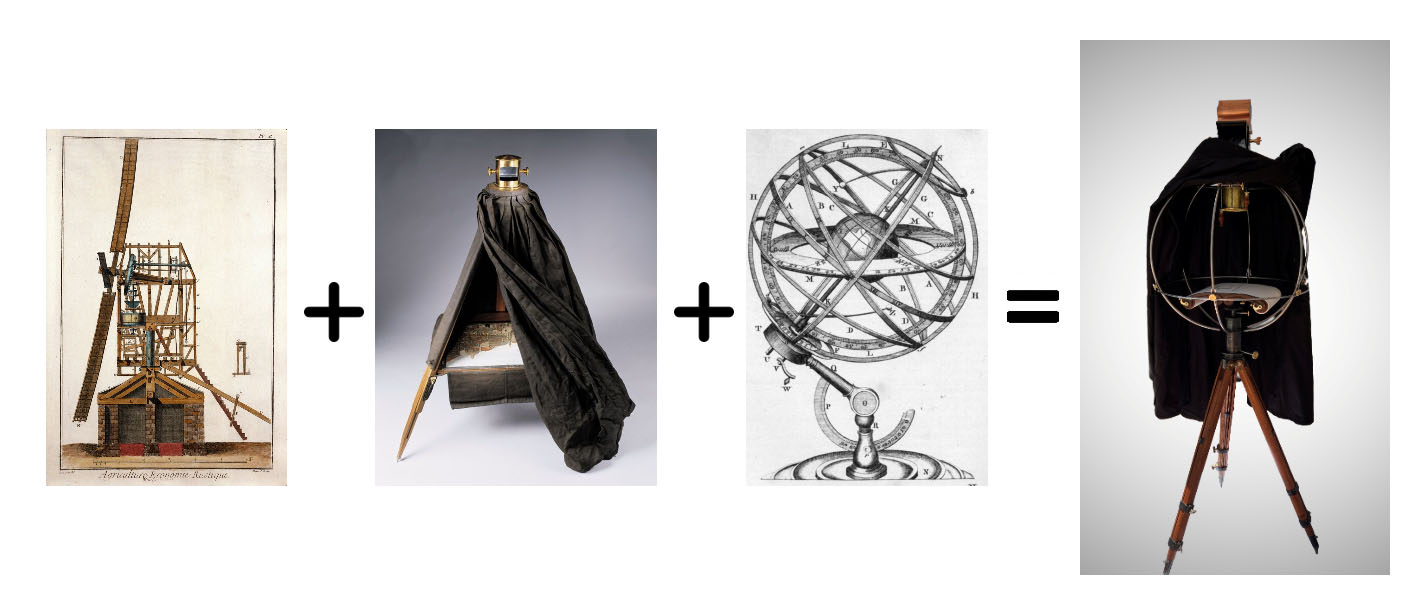 |
Figure KCO.5 – Design Equation: Windmill + Tent Camera Obscura + Armillary Sphere = Rotating Camera Obscura |
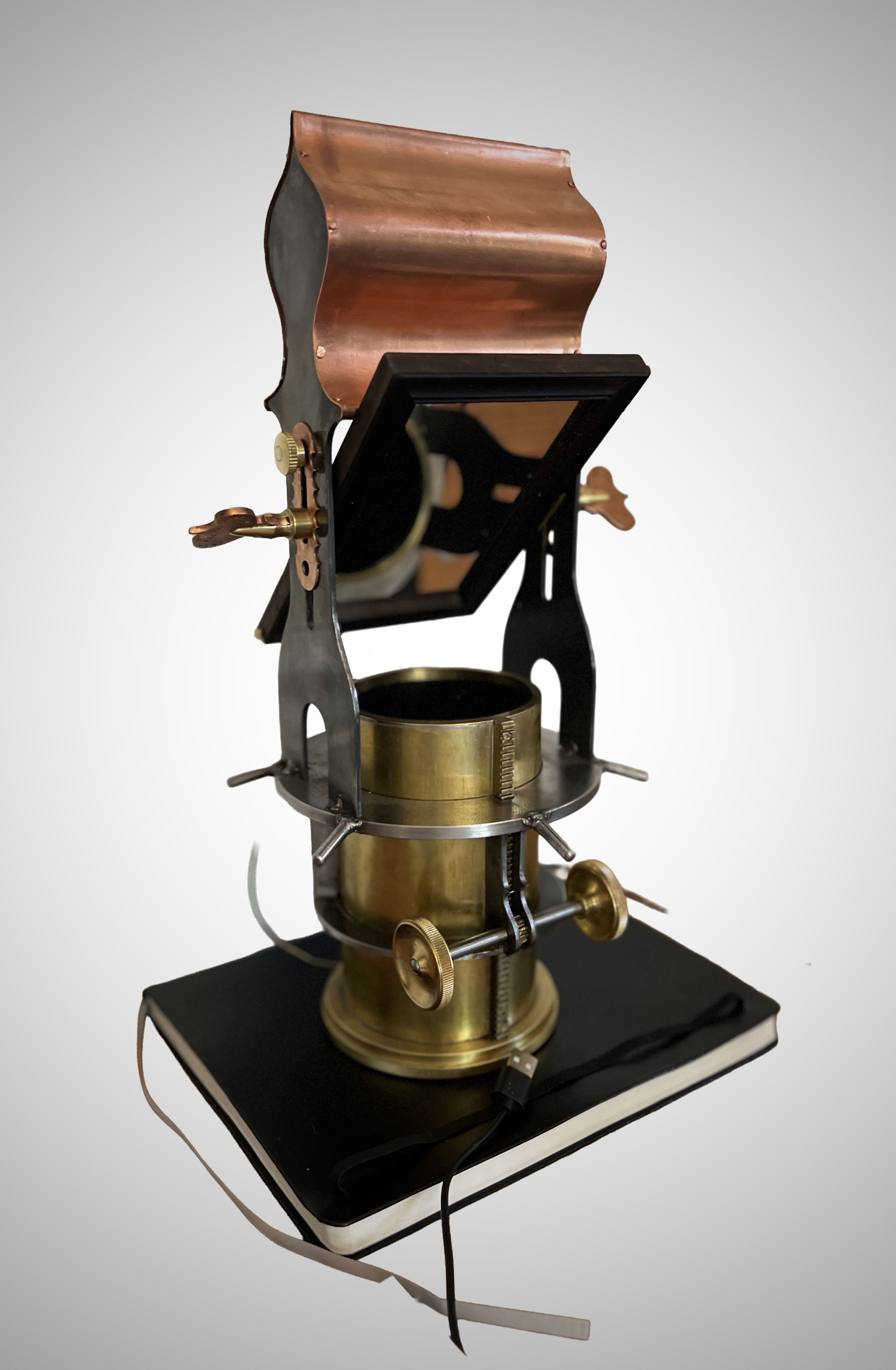 |
Figure KCO.6 – Camera Obscura Optics |
Video KCO.7 – Outline of the Stellenbosch Panorama |
| Right-click and select "play" to play the video. |
3.0 Using the Device
3.1 Controls: On the left you can see the optics of the device (Figure KCO.6): the lens tube, the focusing mechanism and the angled mirror. You can adjust the focus by means of the two brass knobs. You can also adjust the tilt of the mirror from under the cloak by means of two strings (not shown here).
3.2 Seeing the Image:The cloak keeps the interior space dark – the darker it is inside, the brighter the image will appear. You must lift the cloak and place your head and shoulders underneath it. You look down at the image-plate (Figure KCO.7 to the right) and focus the image on it. It is a circlar image of approximately 20 cm.
3.3 Drawing: You can trace the image onto the paper as it is – that would be a 20 cm image from a single direction. The machine is really designed to allow you to change the direction of view incrementally. To do this, first you trace only a narrow slice from the centre of the image no more than 10 cm wide. Then you turn the spherical part of the apparatus that pivots on the tripod – turning to the right. The image of the scene will scroll across the image-plate from left to right. New parts of the scene will scroll into view – you want about 10 cm more. Leave enough of the previous scene in view so that you can match it to the lines you have just drawn. The paper is on rollers, so you can advance it to match the drawing to the new position of the image.
By this method, slice-by-slice you can draw a complete 360° panorama of the scene. You can see my outline panorama that I drew from the roof of the Stellenbosch Institute for Advanced Studies (STIAS) in 2026. It is about 30 cm high and 190 cm wide.
3.4 Height Adjustment: In order to get a 30 cm high drawing from a 20 cm image, I made the angle of the mirror adjustable (this captures more of the scene up and down). I have also made the image-plate position adjustable forward and back (effectively up and down in relation to the image) so that image and drawing can be more easily aligned.
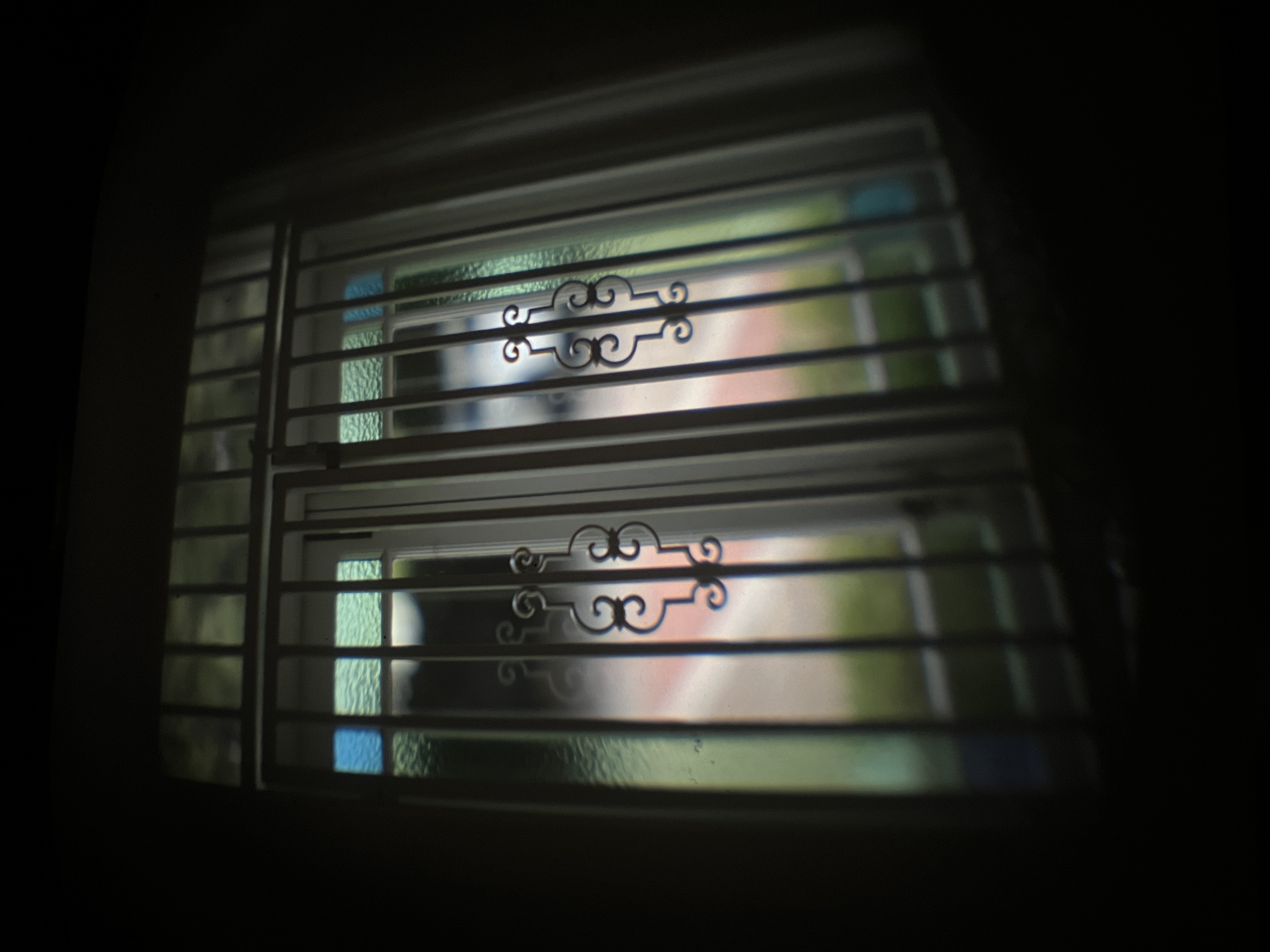 |
Figure KCO.8 – Camera Obscura Image |
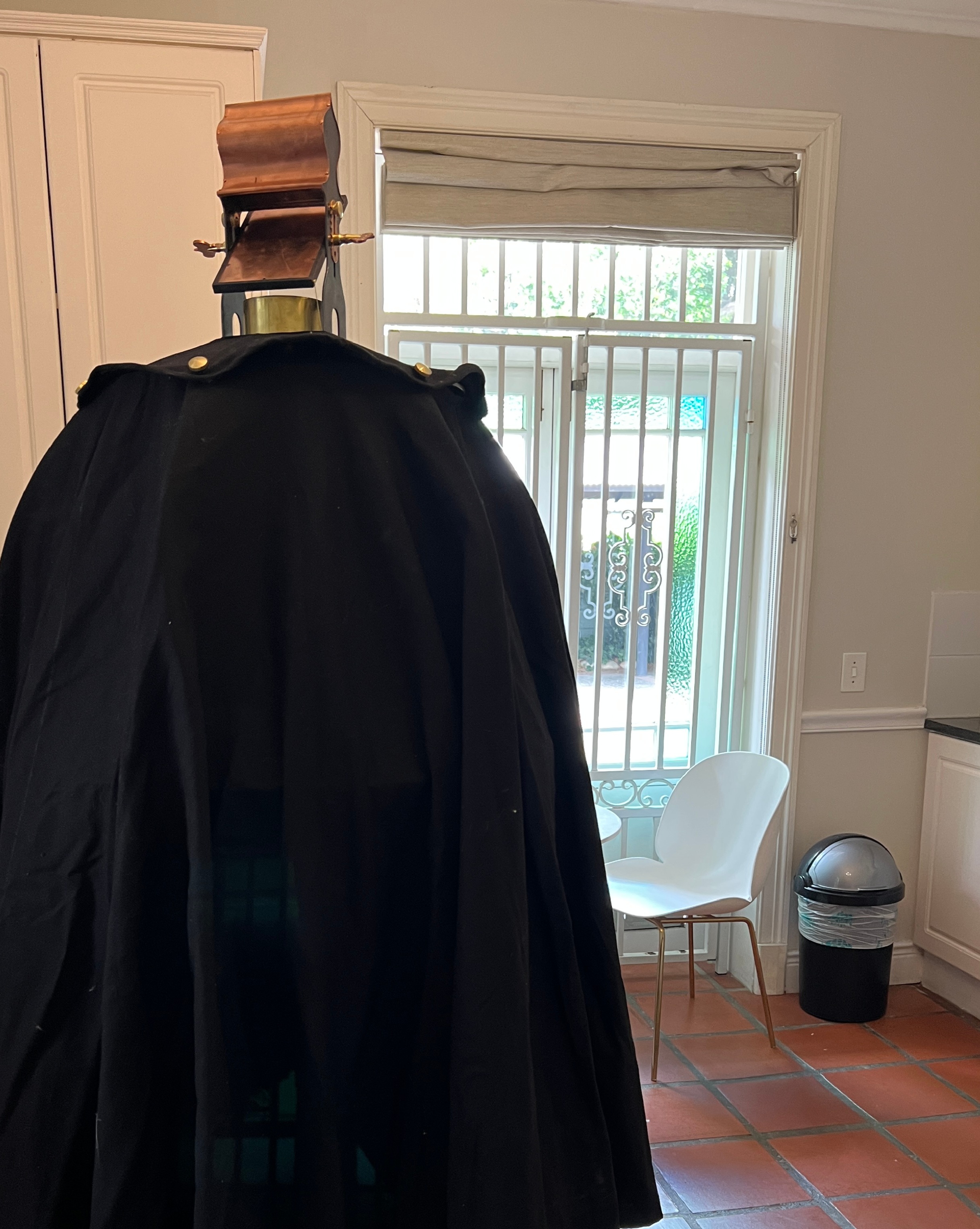 |
Figure KCO.9 – Setting for the Image in Figure KCO.8 |
4.0 What did Kepler Experience?
I suspect that Kepler had expectations about what he might learn from his new invention. What exactly they were is difficult to know. However, we can get an idea of what he might have experienced by experiencing it ourselves.
4.1 The Quality of the Image: People are generally amazed and delighted when they first see the image inside the camera obscura. There may be many reasons for this reaction, and I am still listening to what new users say. To me it seems richer, warmer. The contrasts are greater: between light and dark and between areas in and out of focus.
If it were true, as many have thought during Kepler’s time and since, that we see by seeing little camera obscura images on our retinae, then there should be nothing surprising about what the camera obscura shows us, because that would be what we see all the time. I think Kepler’s camera is showing us that that is not how we see. The retinal image exists, but it is only one element in a complex perceptual system processing our experience of the visual world. Taking it out of this system and examining its strangeness, gives us clues as to what is missing – how the brain, if you like, processes this and other tactile, proprioceptive, and auditory data.
Remember that in figures KCO.8 and 9 you are not comparing a camera obscura image with how the eyes see a scene. In both cases you are looking at how your computer renders iPhone images. The iPhone has a mini-brain. Like our own brain, it samples and adjusts exposure and focus. You need to experience the actual device to fully appreciate it.
4.2 Focus and Depth of Field: Notice how everything beyond the grating on the window in Figure KCO.8 is out of focus. The room is too dark to see, but everything this side of the grate is also out of focus. This is an example of narrow depth of field.[external note 9] All lenses, including those in our eyes, have limits to their depth of field. However, we are rarely aware that much of our visual field is out of focus. It is very difficult to observe directly (try it). The reason is that our eyes are constantly darting about, sampling the scene in front of them. As they do so they are constantly refocusing. What the mind delivers to consciousness is a fully-focused scene assembled from many samples.
I believe that the camera obscura made Europeans aware for the first time that much of the visual field might be out of focus. Artists, like Johannes Vermeer (1632 - 1675) who consulted the camera obscura, struggled to understand which plane of depth should be represented as out of focus – choosing often the distance.[xxx] Martin Engelbrecht (1684 - 1756), I have argued, responded to the problem by drawing each plane of focus on a separate cutout and assembling them in a special viewing box. The philosopher George Berkeley (1685 - 1753) consulting his own visual experience, wrote about focus in a way that I, when I first read it, found very confusing. He thought that we unconsciously judge distance by correlating it with focus, but didn’t seem to realize that the distance is often out of focus:[xxx]
| “The greater Confusion [i.e. lack of focus] still implying the lesser Distance, and the lesser Confusion, the greater Distance of the Object.”[xxx] |
I have great respect for Berkeley’s judgment, so how could he be unaware that when we focus on something close to us, everything further away is out of focus? This was obvious to me, but only because I had grown up using manual-focus cameras. I later realized that while out-of-focus distant objects must have been a feature of Berkeley’s visual field (as they are for all of us) he was only able to bring unfocused objects to conscious awareness where his eyes were unable to focus. Most of us cannot focus on objects nearer than about 25 cm. Therefore the mind has no in-focus samples to “fill in” these areas of the scene-as-experienced.
 |
Figure KCO.10 – STIAS Panorama, 2026The drawing is 28.5 x 208 cm, done in pencil and ink. The camera image is not bright enough for my eyes to see detail very clearly. So I filled in the texture and detail in ink without the cloak and looking directly through the space where the mirror directs light into the lens. Note the distant building (square and apartment-block-like) at the start and finish of the panorama and marking the full 360° rotation. I drew only late in the day to avoid the punishing summer heat and to control for daily variations of light and shadow. However, I took so long completing this drawing that the seasons began to change and I could no longer find the same vertical and horizontal angles of the shadows and had to reconstruct them. Time is folded into this depiction in surprising ways. |
4.3 Making the Depiction Work: From late January to early April of 2026, I drew the first 360° panorama from atop the STIAS building in Stellenbosch, South Africa (Figure KCO.10). We know that Kepler also drew a panoramic landscape with his device, because that was what first drew Wotton’s attention. He was so impressed with Kepler’s work that he asked how the astronomer had achieved it.
Wotton thought that to make a work of art with such a drawing aid “were illiberal” as though it were a kind of mechanical reproduction. Having tried it, I can assure you it is far from a mechanical process of passive transcription, but requires a lot of skill and judgment.
4.3.1 Constant Motion: You find yourself constantly moving and adjusting the machine: focusing to capture different depths of the scene; shifting the image-plate up and down; rotating the head and scrolling the paper back and forth to keep the drawing in alignment with the projected image.
4.3.2 Sampling and Splicing: Drawing is always a process of abstraction. The lines that you draw are rarely given in the image. You have to choose what sorts of lines will best convey the spirit of the things depicted. Masters like Van Gogh, Dürer and Rembrandt do it with an economy of line and degree of invention that is pure genius. In the Kepler camera it is hard to follow and connect lines in the image. Focusing changes the geometry of the image so that line-segments don’t connect well. You must only draw a narrow vertical slice of the image before you rotate the device. As soon as you turn the instrument the orientation of all horizontal lines changes – most dramatically in the foreground. So the new section of the sketch never quite matches the previous one. Narrowing the sample helps minimize discontinuities, but you always have to “fudge” a bit when you splice line-segments between sections. You are not simply recording and image, you are building it like a long collage.
4.3.3 Motion and Memory: You find yourself moving your body with the device around in a wide circle. The image of the scene scrolls into view and then back out of view. Perceiving takes time and your sense of the totality of what you see relies on your immediate memory. Similarly for your depiction – it is a long record of samplings over time. The scroll of paper functions as a cybernetic memory. the machine embodies the mechanics of wide-angle perception.
5.0 What was Kepler Thinking?
I treat scientific artefacts, like this one, as concretizations of thought. There was an initial thought that Kepler wished to try out by building the device. Then there are the ideas that using the device may have suggested. I am assuming that Kepler’s experience drawing a landscape with a rotating camera obscura was not so different from my own.
5.1 Spherical Visual Field: Kepler’s radical re-design of the fixed-direction camera obscuras of his time suggests that he was, like many of his contemporaries, interested in spherical and cylindrical projection. His hypothesis was likely that spatial vision is closer to these alternative projections than to linear perspective. That he may have favoured cylindrical projection is hinted in his writing that the “visual world …is round.”
5.2 Bodily Motion: I have shown elsewhere that Kepler preferred to explain vision using mathematically-pure geometric optics, consistent with the camera obscura /linear perspective paradigm. But there are hints of ambivalence in his writing. A core assumption of geometric optics is that the eye or eyes have the capacity to measure angles as though they were quadrants or armillary spheres. However, in discussing the idea that the single eye can measure distance trigonometrically, he admits:
| “…[the eye] will consequently observe [the angles] αθ and αη, not, indeed, by numbering, but by comparing the distances of the object through this habit, as it were, with the powers of its body, and the extension of hands and of paces.”[xxx] |
This idea of habitual associations between visual sensations and tactile/proprioceptive sensations acquired through experience, was picked up by philosopher George Berkeley and formed the basis for his opposition to geometric optics. One implication of this idea, made explicit by Berkeley, is that visual spatial experience is constructed using tactile sensations from both the present and past.
The constant motion – of the body and of the machine – that Kepler would have experienced in his modelling of wide-angle vision in the rotating camera may have helped to inspire and certainly would have reinforced this insight about the tactile, constructed character of spatial perception.
5.3 Time and Memory: Kepler built a recording surface that moved and could only be filled with visual impressions in sequence over time. The paper scroll is a physical analogue of memory and its role in experiencing space. The rotating camera obscura was a concrete demonstration of the kinds of doubts that Kepler entertained about the paradigmatic camera obscura of geometric optics.
6.0 The Problem of Exhibition
Footnotes:
[xxx] Wotton, Henry Sir. Reliquiæ Wottonianæ. 3rd ed. London: T. Roycroft, 1672.
[xxx] Fink, Daniel A., "Vermeer’s Use of the Camera Obscura - a Comparative Study," The Art Bulletin 53, no. 4 (1971).
[xxx] Berkeley got this idea from Kepler and Descartes who understand it better because they were familiar with camera obscuras and their focusing mechanisms. Berkeley, despite the specious claims of Jonathan Crary, does not make even oblique reference to the camera obscura and likely was not very familiar with it. To learn more about what European philosophers did and did not know about focus in the 17th century, see The Theory of Focus.
[xxx] Berkeley, George. An Essay Towards a New Theory of Vision. Dublin: Aaron Rhames for Jeremy Pepyat, 1709, Sect III, Part XXI, p. 13.