Rod Bantjes, “Hybrid_Projection.html,” created 18 August, 2025; last modified, 7 June, 2026 (https://people.stfx.ca/rbantjes/).
Hybrid Projection
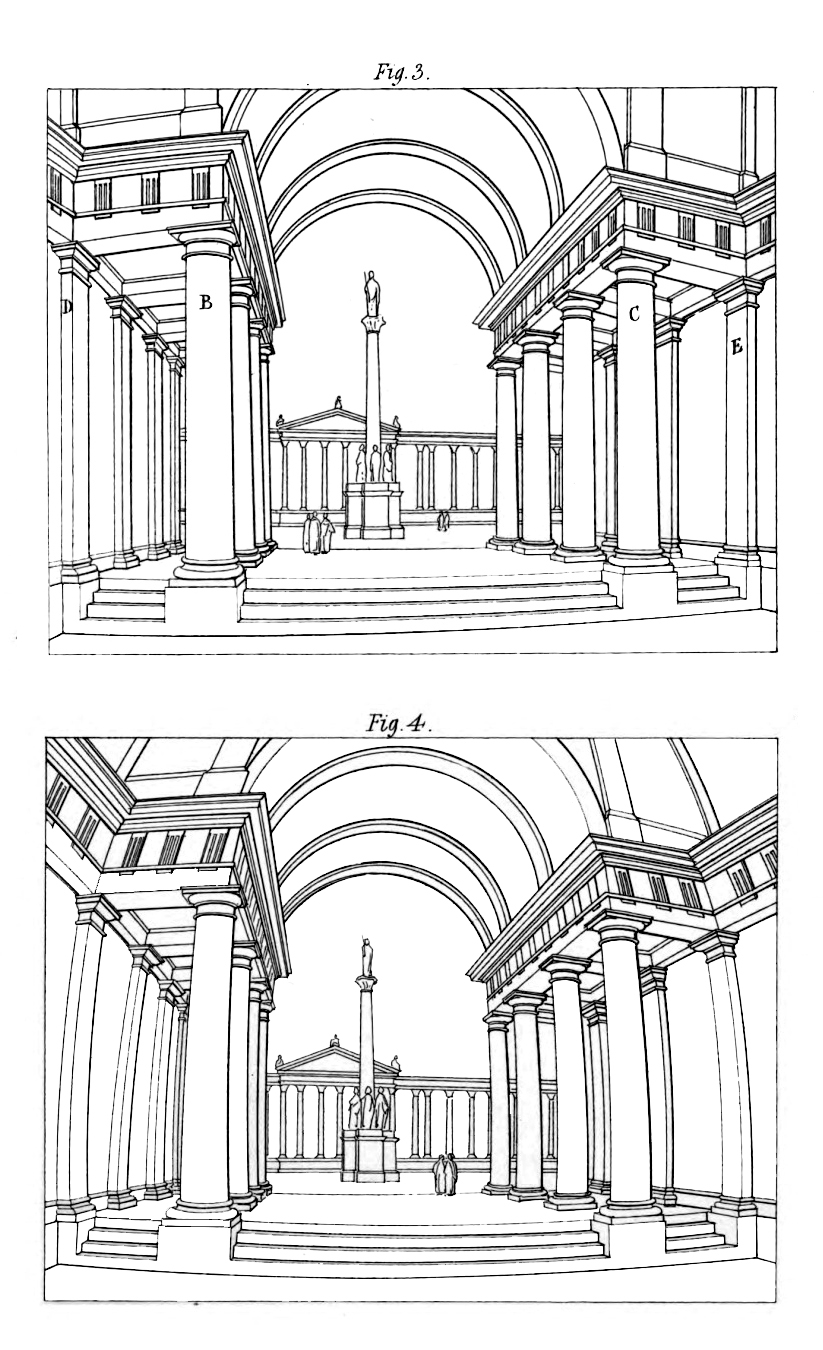 |
Figure HP.1 – 3. Hybrid Projection 4. Wide-Angle Projection |
| The lower image is a wide-angle view; the upper image is the same projection with the curved lines straightened. Source: G. B. Moore, Perspective Its Principles and Practice. London, 1850, Plate 11. |
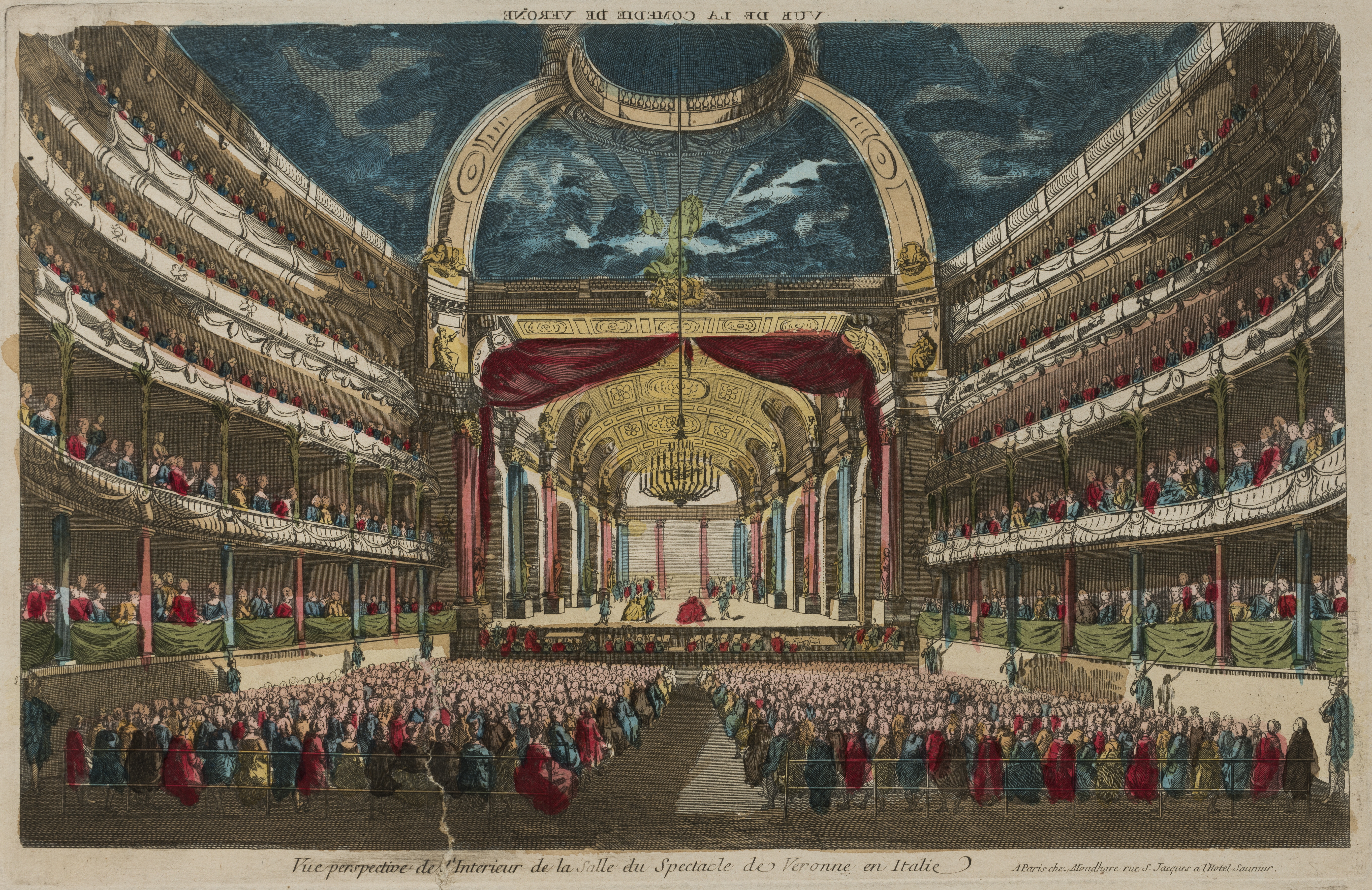 |
Figure HP.2 – Vue d'optique in Hybrid Projection |
| Source:Louis-Joseph Mondhare (publisher), Vue perspective de l'intérieur de la salle de spectacle de Véronne en Italie, late 18th century, copperplate engraving, 24.8 x 38.2 cm. Collection of the author. |
Definition: Hybrid projection is curvilinear perspective, or a wide-angle view (Figure HP.1.4) with the obvious distortions straightened so as to masquerade as linear perspective (Figure HP.1.3.).
Critique of Linear Perspective: Many artists in the 17th century became unhappy with the limitations of linear perspective. Perspective treatises recommended a very narrow angle of view of around 60°. In Holland, painters were seeing full surrounds of space reflected in the curved surfaces of convex mirrors, glassware and even the shiny surfaces of cherries. They included these as small details in their paintings as though to say “look what perspective has missed!”
Apparatus Mediation: These little wide-angle images were produced by optical devices (yes, even found objects like raindrops or wet grapes can be optical devices). The obvious way that they distorted reality, by making straight lines seem curved, was understandable if you could see the distorting device. To make a whole painting in curvilinear perspective would be to suggest that was how we actually see. But somehow, while we do experience the world in wide-angle, we don't see the curves.
Hybrid Projection: In the 18th century, set designers for the theatre and printmakers for optical machines began experimenting with images that conveyed the wide-angle experience while suppressing the most obvious curvilinear distortions. This is what I call hybrid projection – a hybrid between curvilinear and linear perspectives. You can see an example in Figure HP.2. This is a vue d'optique designed to be viewed within an 18th-century optical machine.
High-Art Opposition: Perspective treatises continued to preach linear perspective exclusively. G. B. Moore, in 1850, was the first to write explicitly about hybrid projection (see Figure HP.1), but he did so only to warn painters against it. Painters of reputation avoided hybrid projection and it remained relegated to the less prestigious arts associated with machines and apparatuses: printmaking, the theatre stage and optical boxes.
Theatre Metaphor: The hybrid projection was a way of capturing how our perceptual apparatus processes our experience of visual reality. That apparatus, that some called the “visive faculty,” was often understood through the metaphor of the theatre. The theatre in turn was understood as a kind of machine – a machine that staged an immersive experience of a world. Theatres are very common as subjects of prints in hybrid projection. The vue d'optique you see here is one of many. As optical machines changed in the 19th century, they continued to feature these images of theatres in hybrid projection. There is one for the Polyorama Panoptique. You can also find them in boxes designed for photographs, such as the Graphoscope and Megalethoscope. They were produced even for the Stereoscope – a more advanced 3D technology of the late 19th century.
If you are interested in these ideas you can read my paper “The Optical Machine’s Asynchronic Progress.” In an earlier paper on the same theme, "Hybrid Projection, Machinic Exhibition and the Eighteenth-Century Critique of Vision," you will also find how I prove that engravings and vues d'optique use hybrid projection.