Rod Bantjes, “Focus_Theory_of.html,” created 30 December, 2024; last modified, 1 January, 2025 (https://people.stfx.ca/rbantjes/).
The Mysterious Focus of the Eye
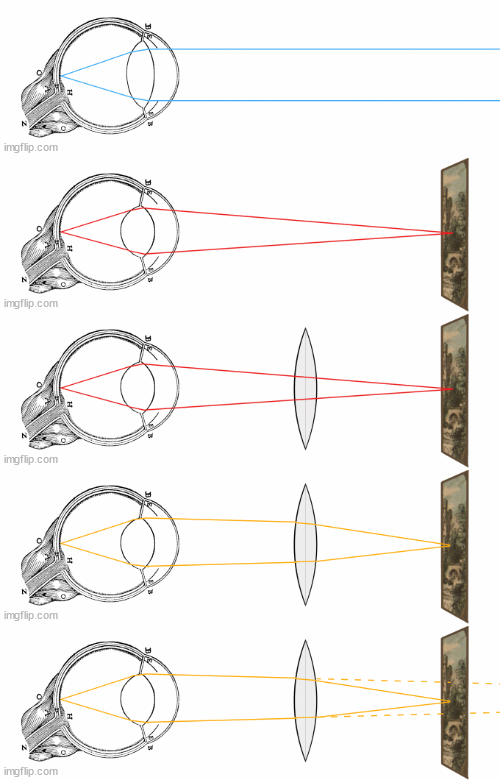 |
Figure 2.2 – Deceiving Focus |
| Here is a reconstruction of the way that the biconvex lens might alter how the eye focuses and enhances the illusion of depth in an engraving seen through an optical device. |
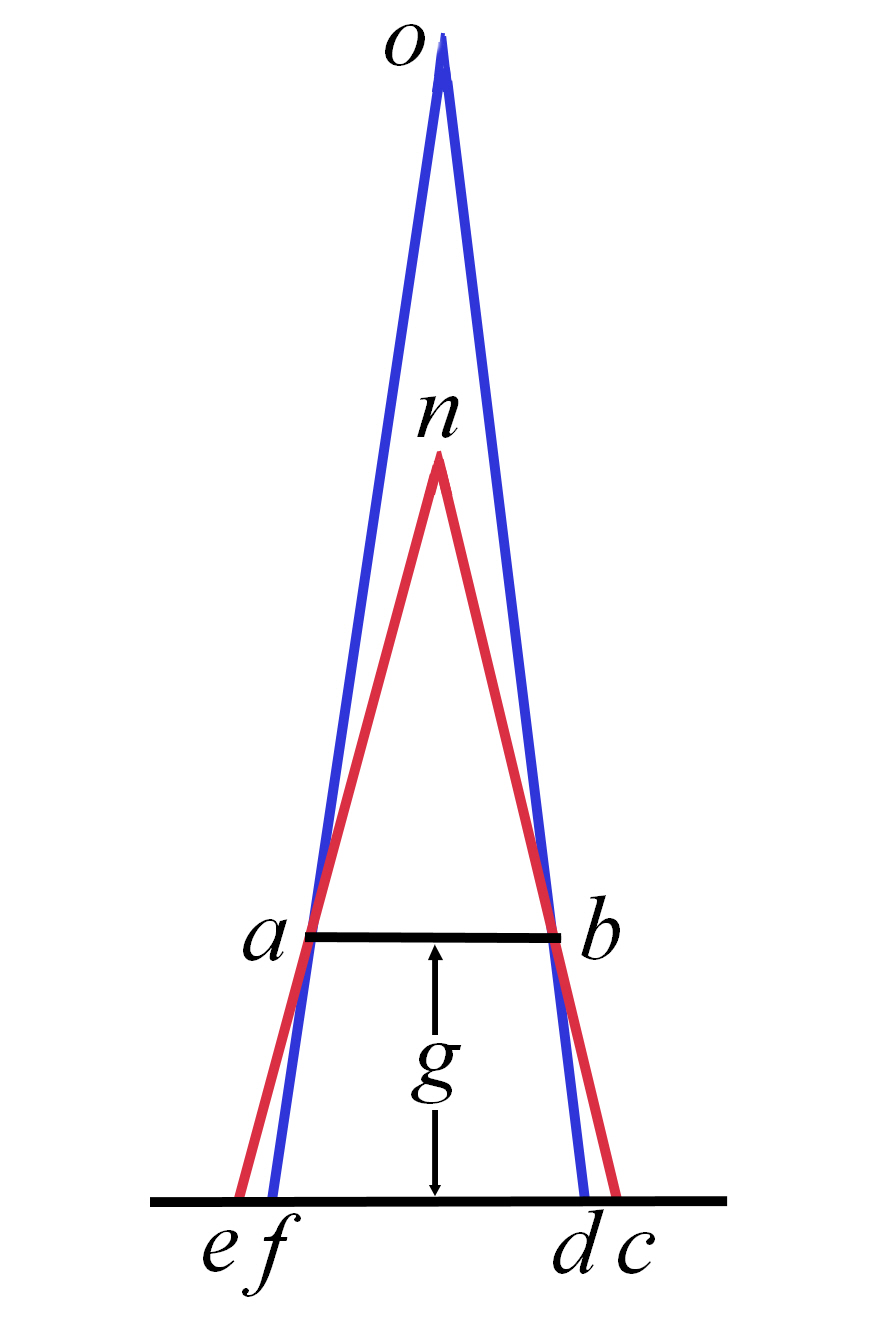 |
Figure 2.3 – Kepler’s Diagram |
| This is a schematic of the eye: ab is the pupil; efdc is the retina. |
When 18th-century theorists attempted to explain how the optical box might enhance the illusion of depth for the single eye, they had first to understand how the eye perceives spatial depth. They had a geometrical theory for how two eyes could precisely measure the distance and shapes of objects seen by the observer. That was through binocular convergence. They wanted model with similar mathematical precision for the single eye.
Geometrical Optics vs Physiology
Kepler (1604): Geometrical Optics
This story begins in the 17th century with the influential writings of Johannes Kepler who was interested in eyes and lenses so that he and other astronomers could improve observations of the heavens and measurements of the vast spaces between the sun and planets. Like many early scientists or “natural philosophers” he believed that all knowledge came from observation using our senses – our eyes especially. This was a provocative idea with many opponents – clerics mostly who dominated scholarship at this time. So Kepler and his fellow “empiricists” were best pleased when they could show that the eyes saw with objectivity and mathematical precision.
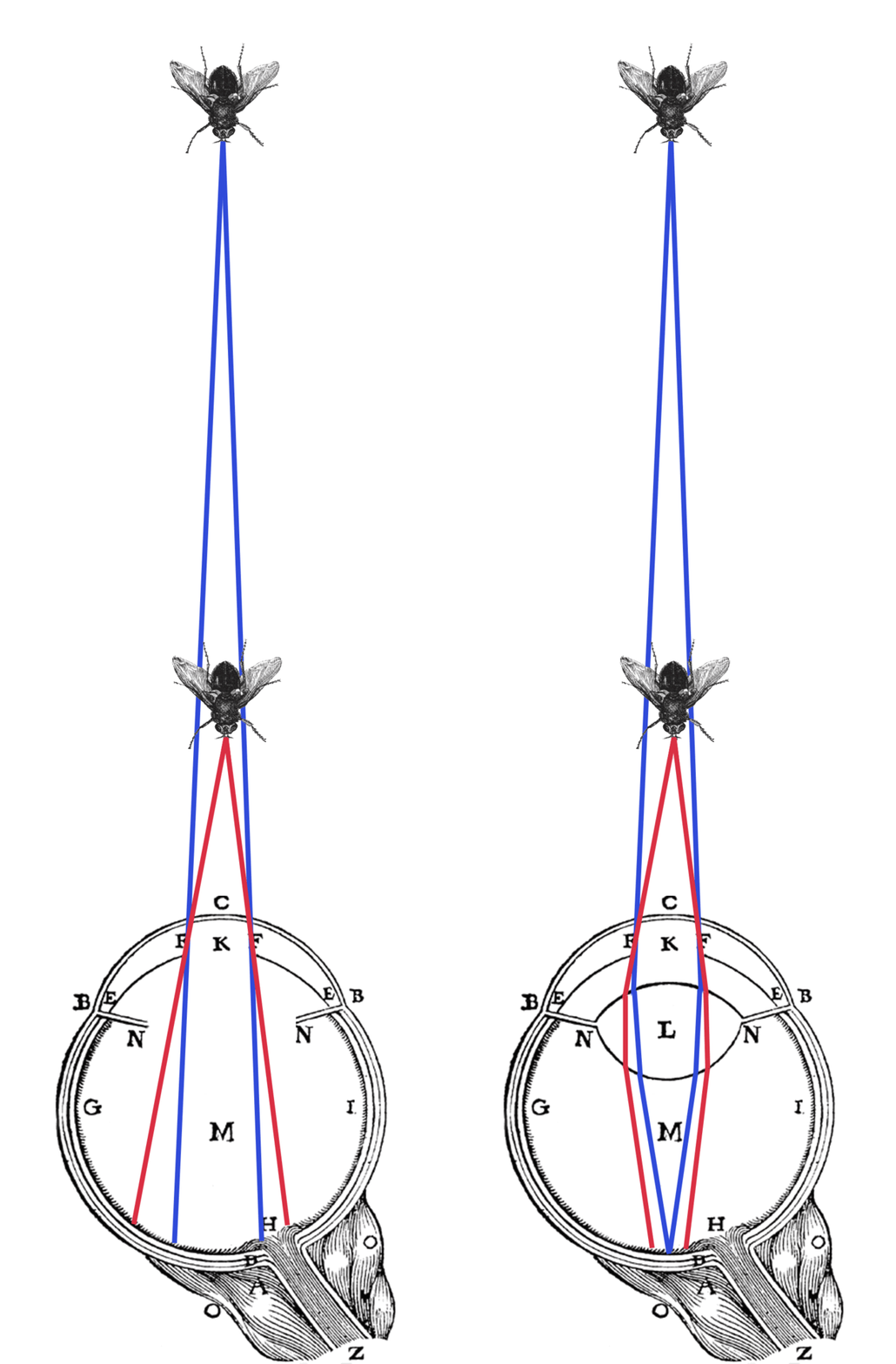 |
Figure 2.4 – Kepler Made Concrete |
| Here is more concretely what Kepler is representing in Figure 2.3. The animation switches between two states: 1) without the lens like Kepler’s figure and 2) as it should be, with the lens of the eye. |
My reconstruction of how the optical box works to exploit focus (Figure 2.2) would not have made them very happy. The eye senses distance through changing the shape of its organic lens. Who feels the muscles that flex the lens (ciliary muscles)? How is (tactile) muscle strain related to the visual impression of distance? There is physiological, neural mediation here that people did not fully understand until centuries later. The process would have seemed opaque and its accuracy uncertain.
Kepler preferred to explain how the eye perceives depth by appeal to the kind of geometric optics used in perspective theory.[1] Figure 2.3 is supposed to show how the eye uses trigonometry to calculate the distance of objects (o and n) with precision and certainty. Let’s not trouble ourselves with the geometric proof, but I think Kepler is right that if the eye “knows” the distance g (between pupil and retina) and ab (the width of the pupil) and the distances ef and dc, then it can calculate the distances to the two objects (o and n).[2]
His diagram is a geometric abstraction; let’s make it more concrete (Figure 2.4). I have chosen flies on the wall for the objects because the mechanism supposedly works only with closeup objects. As Molyneux and Halley put it: “by one single Eye we can only Judge of the Distance of such Objects, to whose Distance the Breadth of the Pupil has a sensible Proportion (1692: Prop.XXXI/Sect.2/p.114).”[3] Figure 2.4 is an animation. It switches between two versions, one of which includes the lens of the eye which Kepler has left out of his abstract diagram!
Difficulties for Kepler’s geometrical optics become evident when we look at it concretely, even if we keep the lens of the eye out of the picture. The retina is curved, so the trigonometrical calculations possible in Figure 2.3 become far more complex. But what business has the pupil in measuring depth? In my diagram the pupil (k) is an opening or aperture in the iris (ef). It controls the amount of light that enters the eye. When we look at something bright it constricts to let in less light; and when we look at something dark, it opens to let in more light.[4] Kepler himself was aware of this basic idea. When we look at a scene it is constantly making minor adjustments so that its diameter (ab in his diagram) is never the same. In the real world it would have to revise its trigonometric calculations every fraction of a second.
Adding the lens of the eye (L in Figure 2.4) renders Kepler’s diagram (Figure 2.3) completely invalid since his perfectly straight lines get bent twice by refraction through the lens. In my diagram the eye focuses on the furthest fly. Light from each point on the fly’s head gets refocused to its corresponding point in the image of the fly on the retina. When the furthest fly is in focus, light from every point on the head of the closer fly lands in large dots on the retina. Since all these dots overlap, the result is a blurry and confused image on the retina. There is no ef and dc (as in Figure 2.3) to measure and the supposed trigonometry falls apart.
An Alternate Paradigm: Physiology
Kepler must have been aware that there was something wrong here because later in the same text he admits that the eye probably is not making the precise measurements necessary for his geometrical theory to work. He writes that the eye “will consequently observe ao and an,[5] not, indeed, by numbering, but by comparing the distances of the object through this habit, as it were, with the powers of its body, and the extension of hands and of paces (Chap.3/Prop.13/Pg.82).”
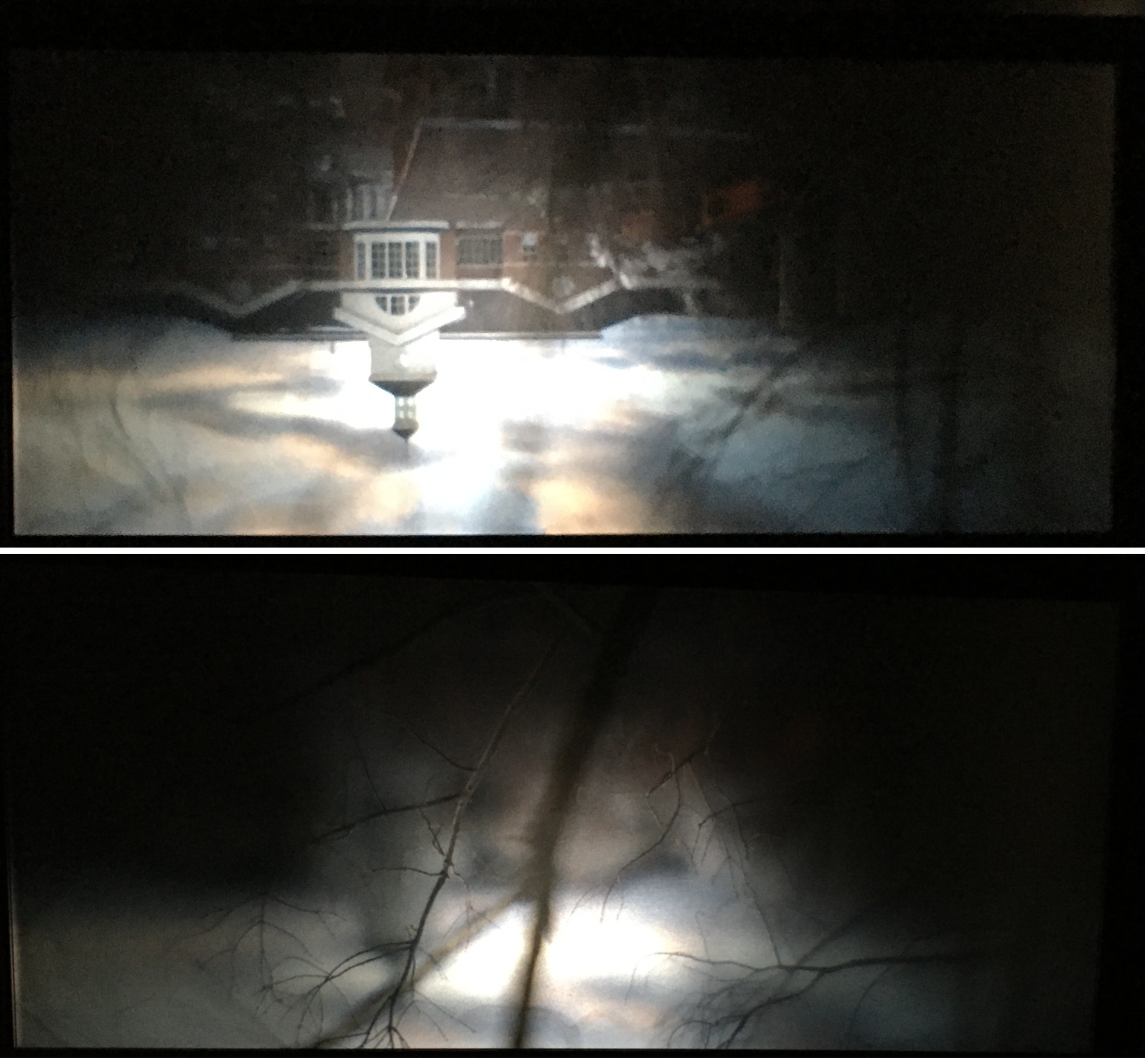 |
Figure 2.5 – Camera Obscura Focus |
| These are two images of the same scene from inside a camera obscura. Camera obscura lenses were large (this one was 4 inches or 10 cm) to admit maximum light and had no adjustable apertures. Consequently the depth of field was very shallow. When the focus is on the foreground branches, the building is so out of focus it is barely recognizable. Conversely, focusing on the building blurs the main branch so much it effectively disappears. |
This intriguing idea that we “see” distance partly by walking and extending our hands to touch things was elaborated upon by George Berkeley in 1709. Berkeley, who later became a bishop (in 1743) was one of the opponents of empiricism and the natural philosophers’ faith in human reason. He was gleefully skeptical of geometrical explanations of vision and perception. No-one, he writes, sees these “lines and angles” that “optic writers” such as Kepler draw for us. Instead they see the effects of focus in the form of clear or blurry images. We connect degrees of focus to apparent distances through bodily experiences that we have had in the past – as we have reached out for an object that we focus on or stepped too close to something and watched its image become blurry. Berkeley uses Kepler’s term “habit” to describe how we come to correlate our experiences of focus with our judgments of distance. He wants us to recognize the there is nothing certain about these inferences we make. The empiricists are wrong to have such faith in the report of their senses. Moreover, we are not actually seeing distances; we are making guesses based on past experiences.
The philosopher René Descartes also took a physiological approach to how we see distance and spatial relationships among the things in our field of view. He understands focus not in terms of images, blurry or otherwise, but in terms of muscles and nerves.[6] He writes “as we adjust the shape of the eye according to the distance of objects, we change a certain part of our brain in a manner that is ordained by nature to make our soul perceive this distance (1637: 170).” Descartes, along with everyone else at this time, wasn’t sure what part of the eye changed shape or how. It might have worked like the focus of a camera obscura – bringing the lens closer to or further from the image-plate by squeezing the retina and lens closer together or further apart. Or the lens might have changed shape, although this might have been a little more difficult to picture since lenses at the time were made of glass and had to be painstakingly ground to give them one focal length or another.
Descartes' explanation was like Berkeley’s in undermining faith in the reliability of vision. Spatial perception is in his account mediated by what we would now call neurological processes which no-one was aware of taking place and which no-one fully understood. He was not as concerned about the fallibility of vision as most natural philosophers were. He was not like Berkeley who placed his faith in scripture and the word of God, but rather a rationalist relying instead on human reason, even sometimes unaided by empirical observation, to reveal truth about the world.
Relying on the Paradigm
Whether or not Descartes was right, we know that sometimes the best scientific minds have chosen theory[7] and the paradigm assumptions[8] that inform it over observational report (Kuhn 1970). Very few of the physiological “facts” of the period or even observational report of focus could be relied upon. The facts about focus remained a bit mysterious throughout the 17th and 18th centuries. One reason for this was that your own eyes’ change of focus is hard to see even if you look for it. Berkeley simply failed to notice what we all now know is there: when we focus on an object (let’s say our finger placed close to our face) everything further from it remains out of focus. He writes as though we can only see blur when it is forced upon us by something coming closer than it is possible to focus (try bringing your finger two inches from your nose). Painters like Vermeer who saw how focus worked in a camera obscura seem to have made this same mistake (Fink 1971). The truth is that our eyes are constantly adjusting as they sample the scene, feeding our visual system many focused “snapshots” that the mind stitches into an impression that everything it sees is clear and in focus. People seem not to have trusted that the limited depth of field[9] that the camera revealed (see Figure 2.5) accurately captured how the eye worked. It was so unlike most people’s experience of a fully-in-focus world.
Reliance on the paradigm can help to explain how intelligent people like Kepler can make what to us seem to be glaring mistakes. He had good reasons, given the academic climate of the 17th century, for preferring an eye that worked with the precision of geometric optics. His explanation of focus fits the geometric paradigm even as it neglects important physiological facts. Still, he is not closed-minded. He allows himself to explore the inconsistent and radically different approach later taken up by Berkeley.
Explaining the Optical Box with Geometric Optics
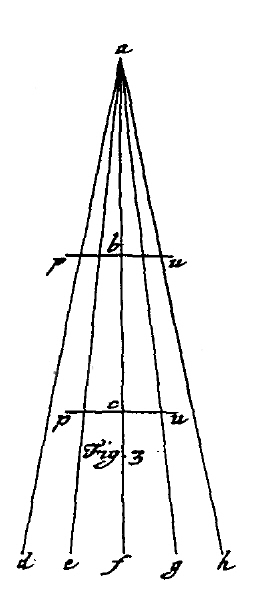 |
Figure 2.6 – Molyneux’s Pupil Diagram |
| This is a further simplification of Kepler’s oversimplified Figure 2.3. |
Molyneux and Halley (1692) were the first to describe how both the binocular and monocular principles (Figure 2.2) worked to enhance the depth illusion in engravings seen through convex lenses. For the monocular principle they first had to explain how the single eye measures depth. Their version is probably based on Kepler’s, but they have omitted both the lens and the retina so that their geometry is almost completely abstracted from physiology (Figure 2.6). In their diagram pu is the pupil and it moves between positions c and b in relation to the object seen at a. The geometry is the same as if the object (a) moved closer to or further from the retina.
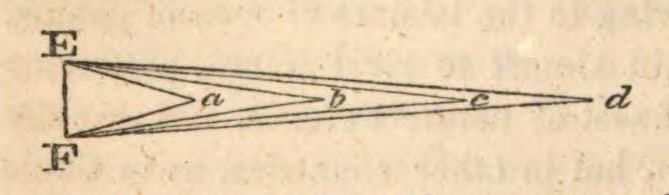 |
Figure 2.7 – Arnot’s Pupil Diagram |
| Arnot’s 1831 diagram looks like geometric optics but his explanation is physiological. |
They imagine that the pupil is able to measure angles on its own (Prop. XXXI/Sect.2/p.114). How could an aperture such as the pupil measure the angles of the rays of light that travel through it? Molyneux and Halley seem to be treating it not as an opening but as a surface like a plane in geometry. However, the intersection of a line and a plane is a single point regardless of the angle of intersection. All that is given in the plane is a point from which no angle of entry can be calculated.
After pondering many similarly perplexing diagrams produced by Enlightenment writers, I have begun to be almost as skeptical as Berkeley about them. Ray diagrams often seduce us into taking an omniscient perspective where we imagine that instead of seeing through our eyes we see our eyes laid out in cross-section and can examine them and how they see. We see the ray diagrams from the outside of embodied perception such that the "lines and angles" are presented to us ready for us to pull out our protractors and measure. It is a pleasant fantasy that has caused a good deal of confusion in the history of theories of perception.
The Scottish physician Neil Arnot (1831) also explained the optical box using a similarly stark representation of the pupil and its supposed function (Figure 2.7). Arnot’s pupil is labelled EF and it is receiving rays of light from a variety of objects a to d. Having explained this diagram he then, like Kepler, abandons the idea that the eye is measuring angles and calculating trigonometry. Like Descartes, he suggests that the muscular effort involved in focusing the lens serves as a pre-conscious index of the distance of the thing focused on: “Now, the eye, to form an image on its retina, requires to exert a bending power exactly proportioned to the divergence of the rays; and it appears to have a sense of the effort made, which becomes to the person a kind of measure of the distance of the object (198).” This “kind of measure” derived from a minute muscular “sense of...effort” lacks mathematical precision but might offer some aid in helping us navigate our spatial environment.
By 1831 Arnot had plausibly explained how the optical box might work when viewed with only one eye. If you forget about the pupil, his account makes sense, so that is what I have modelled in Figure 2.2 (above). If you are still reading this you must have found something interesting in my efforts to untangle the historical confusion. For me it is important to know that optical boxes that had small lenses like the French Polyrama Panoptique might actually have worked. I am also interested in the ways that this story of understanding focus is bound up with people’s interaction with optical devices. Optical theories are used to design devices, and optical devices are used as models of how vision and perception work.
Paradigms in the Writing of History
This history of ideas about how focus works is also interesting for what it reveals about epistemology (theories of how we know truth) and how paradigms influence our thinking. If you have read or been influenced by the writings of Thomas Kuhn, Michel Foucault or Jonathan Crary, then this final discussion and conclusion is for you. These writers all share a paradigm about paradigms: believing that they reign exclusive within successive historical periods. Kuhn claimed that within particular areas of scientific research – on the nature of gravitation for example – all scientists work within a given paradigm until someone like Einstein comes up with a radically different one that offers greater explanatory breadth. Foucault (in his early writings) toyed with the idea that epistemological paradigms or epistemes dominated all thought within an era. During the Enlightenment everyone thinks that ideas come clear and unmediated from the world into the mind like pictures projected onto the screen of the camera obscura. Physiological accounts of perception and understanding are “unthinkable” until this “epistemic regime” changes all of a sudden around 1830.
This historical framework has often been used as a Procrustean bed. Procrustes was a Geek mythical figure who welcomed travellers to spend the night as his guest and sleep in his spare bed. He had a nasty habit though, of insisting that they fit it exactly. If they were too tall he would sever their legs; if they were too short he would stretch them until their spines broke. Enlightenment philosophers like Descartes and Berkeley who used physiology to explain perception and who accepted that organic mediation often made the mechanisms of seeing opaque and unreliable, have been subjected to the Procrustean bed of the “epistemic regime.” Some people just need things to fit. Others, like those forced to fit, or those who care about them, can find this a violent and painful operation.
A better model of the history of science was articulated by Imre Lakatos (1978) in response to Kuhn. Even when one paradigm is dominant (as geometrical optics was in the 18th century) older or emergent paradigms can be active. In the debates about the focus of the eye, there were three distinct epistemological positions: Kepler’s (empiricist), Descartes’ (idealist) and Berkeley’s (theist). On the question of how the eye worked, there were two competing paradigms – geometric optics and physiology. Typically these were held by different people for reasons that were connected to their epistemological preferences. Sometimes the same person used elements of each (e.g. Descartes) or wrestled with the inconsistencies between them (e.g. Kepler). This short history of theories of the focus of the eye adds to the evidence in favour of Lakatos’s approach.[10]
Footnotes:
[1] On the historic connection between perspective theory and theories of perception see Bantjes, Rod. 2014. “‘Vertical Perspective Does Not Exist:’ The Scandal of Converging Verticals and the Final Crisis of Perspectiva Artificialis.” Journal of the History of Ideas 75(2):305-36..
[2] The geometric proof does not work if there is only one object, say, o. In this case the base of the blue triangle fd could be located anywhere along the line efdc which would change the lengths of the two sides fo and do and therefore the distance between object o and eye.
[3] The diameter of the pupil varies constantly with changes in the light, but let’s give it a mid-range value of 3 mm. A distance from the eye with a “sensible” proportion to 3 mm is presumably one where the angles the eye needs to measure are not impossibly small. An object at 30 cm gives a ratio between iris and object distance of 0.01. A ray of light would enter the edge of the pupil at an angle of 0.286 degrees – too small to measure with a protractor. Kepler (Ch.3/Prop.9/p.80) thinks that depth discernment with one eye might extend to 10 paces (914 cm). That would be a ratio between iris and object of 1/3.3 x 10-4.
[4] Controlling light is its main, but not only function. When the pupil narrows to a smaller diameter it increases depth of field and improves image-quality by minimizing peripheral distortions that lenses can be prone to. In this way it can have an effect on the quality of the image but without changing the point of focus, which only the lens can do..
[5] Distances to the objects o and n.
[6] The image of the anatomy of the eyes that I use to illustrate binocular convergence is taken from Descartes’s Optics as a graphic reminder of just how physiological his thinking was.
[7] An example would be Kepler’s theory that the eye calculates distance using trigonometry (Figure 2.3)..
[8] For example, the paradigm that informs Kepler’s theory of focus (see note 7) would be geometric optics..
[9] Strictly speaking when the eye focuses at a given distance, say 2 metres, only things 2 meters away are in focus. Things closer or further fall out of focus by degrees. In a small region closer to and beyond the 2 meters the image of things is out of focus but clear enough that we find it acceptable. This is the depth of field. A narrow aperture on a lens extends the depth of field; a wide aperture narrows it. There was typically no aperture on camera obscura lenses and the range of acceptable focus was very limited as you can see in Figure 2.4.
[10] My work in the history of science and media technology has always followed Lakatos’s model. For some discussion of the historical mis-readings caused by Foucauldian periodization see Bantjes, Rod. 2015. “Reading Stereoviews: The Aesthetics of Monstrous Space.” History of Photography 39(1):33-55; Bantjes, Rod. 2014. “Hybrid Projection, Machinic Exhibition and the Eighteenth-Century Critique of Vision.” Art History 37(5):912-39..
References:
- Arnott, Neil. 1831. Elements of physics. Philadelphia: Carey & Lea.
- Berkeley, George. 1901 [1709]. "An Essay Towards a New Theory of Vision." in The Works of George Berkeley Including His Posthumous Works, edited by G. Berkeley and A. C. Fraser. Oxford: Clarendon press.
- Crary, Jonathan. 1990. Techniques of the Observer: On Vision and Modernity in the Nineteenth Century. Cambridge, Mass: MIT Press.
- Descartes, René. 1984 [1637]. “Discourse and Essays: Optics.” The Philosophical Writings of Descartes., vol. 1, eds John. Cottingham, Robert. Stoothoff, and Dugald. Murdoch. Cambridge: Cambridge University Press.
- Foucault, Michel. 1970. The Order of Things: An Archaeology of the Human Sciences. New York: Random House [1966].
- Kepler, Johannes. 2000 [1604]. Optics: Paralipomena to Witelo & Optical Part of Astronomy. Santa Fe, N.M: Green Lion Press.
- Kuhn, Thomas S. 1970 [1962]. The Structure of Scientific Revolutions. Chicago: University of Chicago Press .
- Lakatos, Imre. 1978. The Methodology of Scientific Research Programmes. Cambridge: Cambridge University Press.
- Molyneux, William and Edmond Halley. 1692 Dioptrica Nova, A Treatise of Dioptricks. London: Printed for Benj. Tooke.
- Young, Thomas. 1801. "II. The Bakerian Lecture. On the Mechanism of the Eye." Philosophical Transactions of the Royal Society of London 91:23-88.