Rod Bantjes, “Stereoview_Intro.html,” last modified, 10 February, 2025 (https://people.stfx.ca/rbantjes/).
Bantjes’ Stereoview Gallery
1.0 Love of Stereoviews
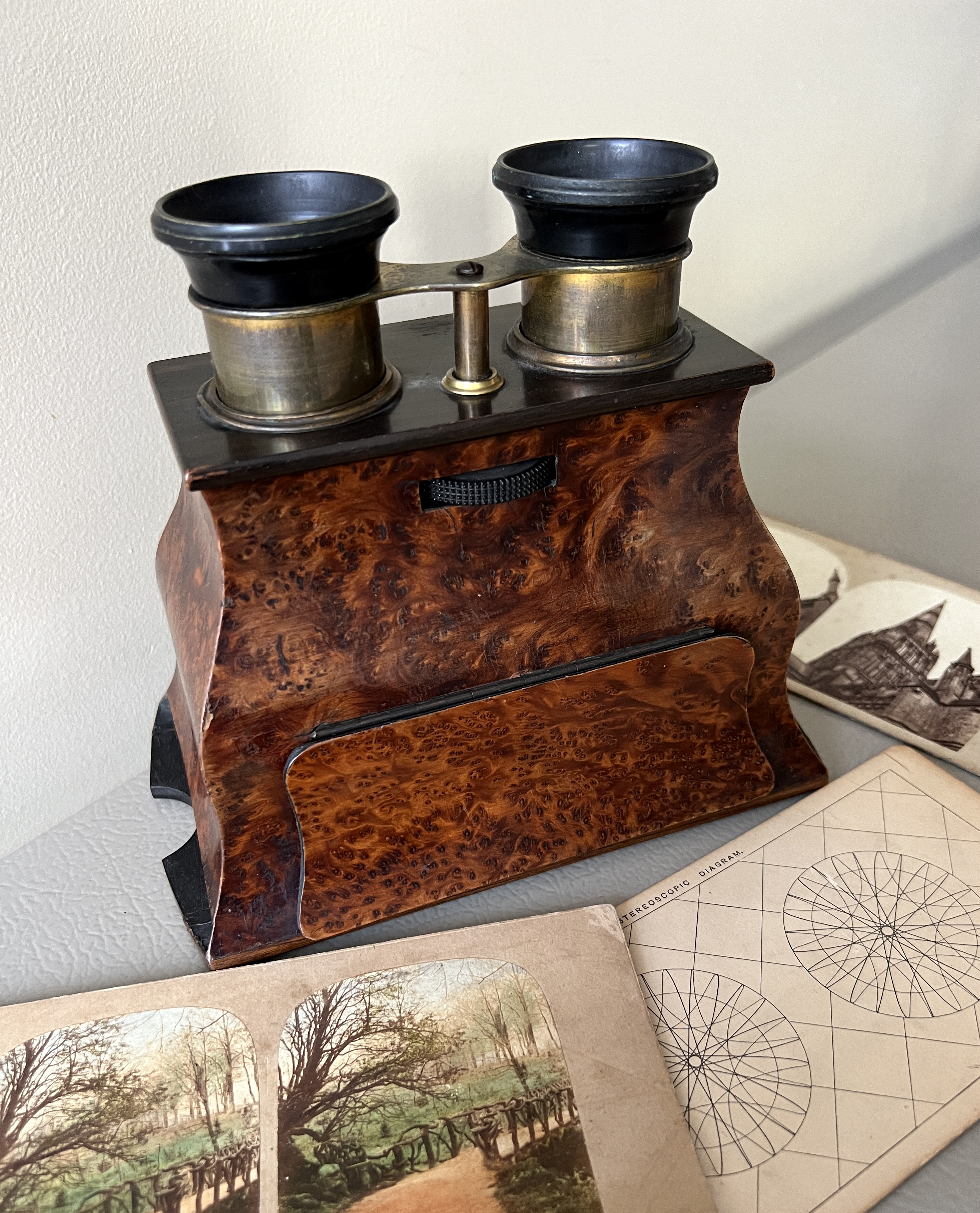 |
Figure 1.1 – Brewster Stereoscope |
| This was my first stereoscope. I wanted a 19th-century lenticular viewer suited to the early stereocards I was collecting. It is the only way to see glass views or tissue views. |
Video 1.2 – Amazement and Wonder of a Glass Stereoview |
| Graphic designer and artist Marian Bantjes being amazed by one of Claude-Marie Ferrier’s stereo abstractions of ice. Right-click to run the video and hear how she describes the experience. |
I learned of the existence of 19th-century stereoviews in 2009 when I read Jonathan Crary’s Techniques of the Observer. These were the early days (for me) of eBay, and I thought "I wonder if you can find them on eBay?" Not only was I able to find them, but at that time they were ridiculously cheap – a few dollars for pairs of beautifully detailed original 19th-century albumen prints! The 1850s photographic stereoviews were often exquisite artefacts with their hand-cut arched prints and embossed maker’s marks. In the stereoscope, the flat images blossomed to reveal hidden depths and volumes. I fell in love with them. There was no other way for me to fully appreciate them than to handle them, slide them into a stereoscope and peer into the darkened box (Figure 1.1), and there was no other way for me to do that than collect my own. This online gallery that I am offering is a very poor substitute.
In 2009 no-one was writing about stereoviews with the appreciation and understanding that I felt they deserved. Crary clearly didn’t "get" either their seductive beauty or the important perceptual principles that they illustrated. Collectors loved them, often for the qualities of 3D-ness that I saw in them, although no-one seemed to have a language to articulate that 3D aesthetic. Many understood their value in terms of the historic interest of the people and places depicted in them. So did I; but I was also interested in their artistic merit – their formal characteristics of colour, line and composition as well as their contribution to new ways of seeing the world. Like architecture and sculpture, they add volume and space to line and contour. Like theatre set designs they arrange space for maximum effect from one angle of view. The very best are brilliant compositions in three dimensions, unequalled in any other art form (see Video 1.2).
I like non-realist stereoviews that are imaginative and fantastic, like french tissue views or purely theatrical views. I love stereoviews that turn away from depiction in 3D towards the sheer beauty of space and volume in themselves. I particularly love those that reveal the gymnastics of our minds in "making space." The problem of how we perceive space was what led scientist Charles Wheatstone to invent the first stereoscope. Both he and one of his early French followers, Jules Duboscq, made hand-drawn stereo-images that were visual tricks to get the mind to reveal its space-making activity (see Figure 2.1.2). These are one of the main categories in my collection. Related to this category are line-drawings of pure spatial geometry, early drawings in exaggerated 3D (Figure 2.1.1) and "eye-training" stereocards. The very best celebrate the beauty of abstract space and volume. These were radical experiments decades in advance of the Cubists and abstract photographers and painters of the 20th century. In ‘Perspectives Bâtardes’ I argue that stereoscopic photography was an important influence in the development of modern art.
2.0 A Language of Stereoscopic 3D
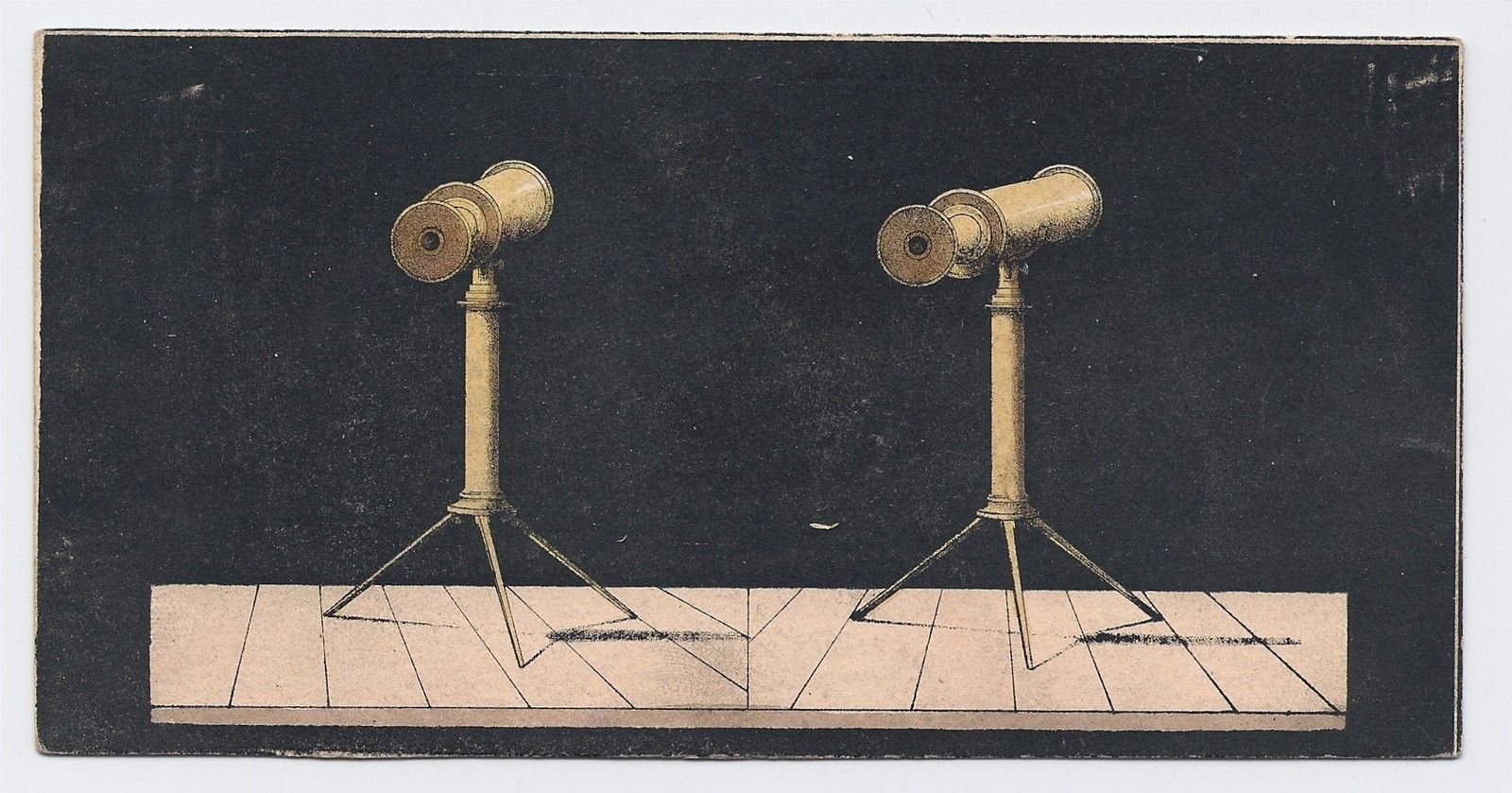 |
Figure 2.1.1 – Hand-Drawn Stereoview |
| Note the different outline shape of the telescope in the left and right-hand views. |
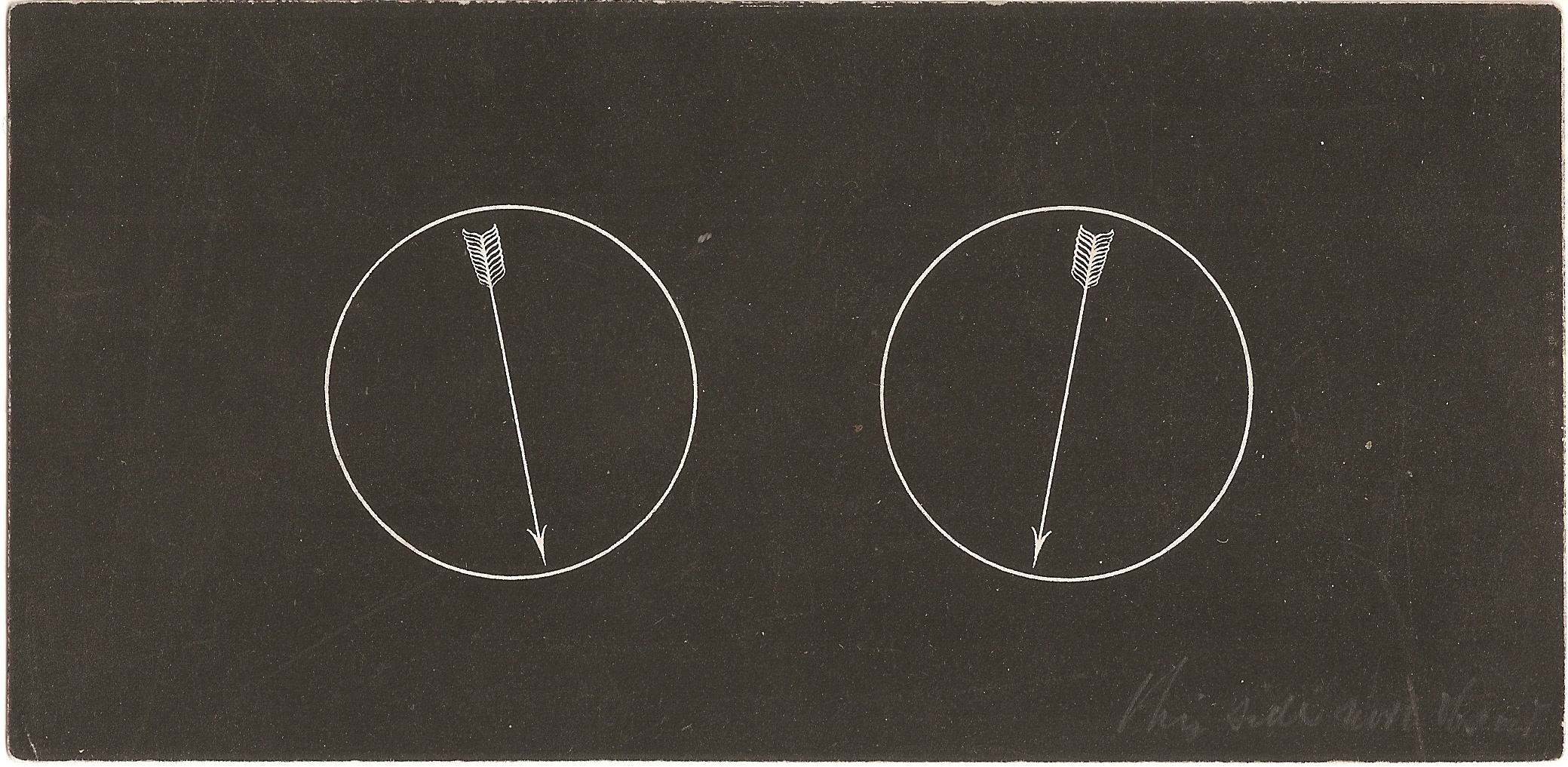 |
Figure 2.1.2 – Duboscq’s Wheatstone Line |
| Note the disparity in orientation of the two views of the arrow. Viewed in the stereoscope, the arrow appears to fly towards you. |
Here I explain the language I developed to talk about the 3D aesthetics that I see in stereoviews, but which no-one seemed in 2009 to know how to discuss. Stereoviews combine two 3D principles that artists can use to create 3D effects. The first is binocular disparity, the idea that the image seen by the left eye is slightly different in shape from the image seen by the right eye (see figure 2.1.1). The use of binocular disparity is unique to stereoscopy. In fact, the whole purpose of Wheatstone’s stereoscope, as scientific apparatus, was to reveal binocular disparity.
The second principle is binocular convergence, the idea that the degree to which the two eyes turn inwards to fix on an object tells us how far away it is. Older visual media like the Baroque stage, or 18th-century optical boxes with overlapping ranks of coulisses inside them (see Figure 2.2.1), had long exploited the principle of binocular convergence for 3D effects.
2.1 Binocular Disparity: Volumes and Wheatstone Lines
Two disparate images like the ones in figure 2.1.1 or 2.1.2 should never cohere to make a single perceived object. Amazingly, they do (or at least they do for most people). Images from two slightly different perspectives on a volumetric object create the experiential illusion of its volume. The tube of the telescope in figure 2.1.1 extends, like all volumes do, into the depth of the view, away from us. The disparity between the left and right images on your retinæ increases the closer you are to an object and as a consequence the intensity of volume-experience increases. Stereo photographers took advantage of this fact and moved volumetric objects into the near foreground. The practise was so unlike what you see in previous forms of depiction that I have to say "near foreground" because older meanings of "foreground" in painting and engraving refer to distances at minimum twice as far from the viewer. Objects so positioned take on a fullness, weight and density unequalled in any other two-dimensional representation.
The arrow in figure 2.1.2 does not really have volume. Wheatstone’s original, on which this is based, is simply a geometric line. This Wheatstone line nonetheless traverses space from the back to the front of the view. In so doing it defines the empty space around it as though tensioning it with a "field of force." In my notes on stereoviews within this gallery I frequently comment on the use of Wheatstone lines. Bridges, roadways, walls and stream-beds commonly serve as Wheatstone lines that carve space into the view. You can also see the essential form of the Wheatstone line in the telescope in figure 2.1.1.
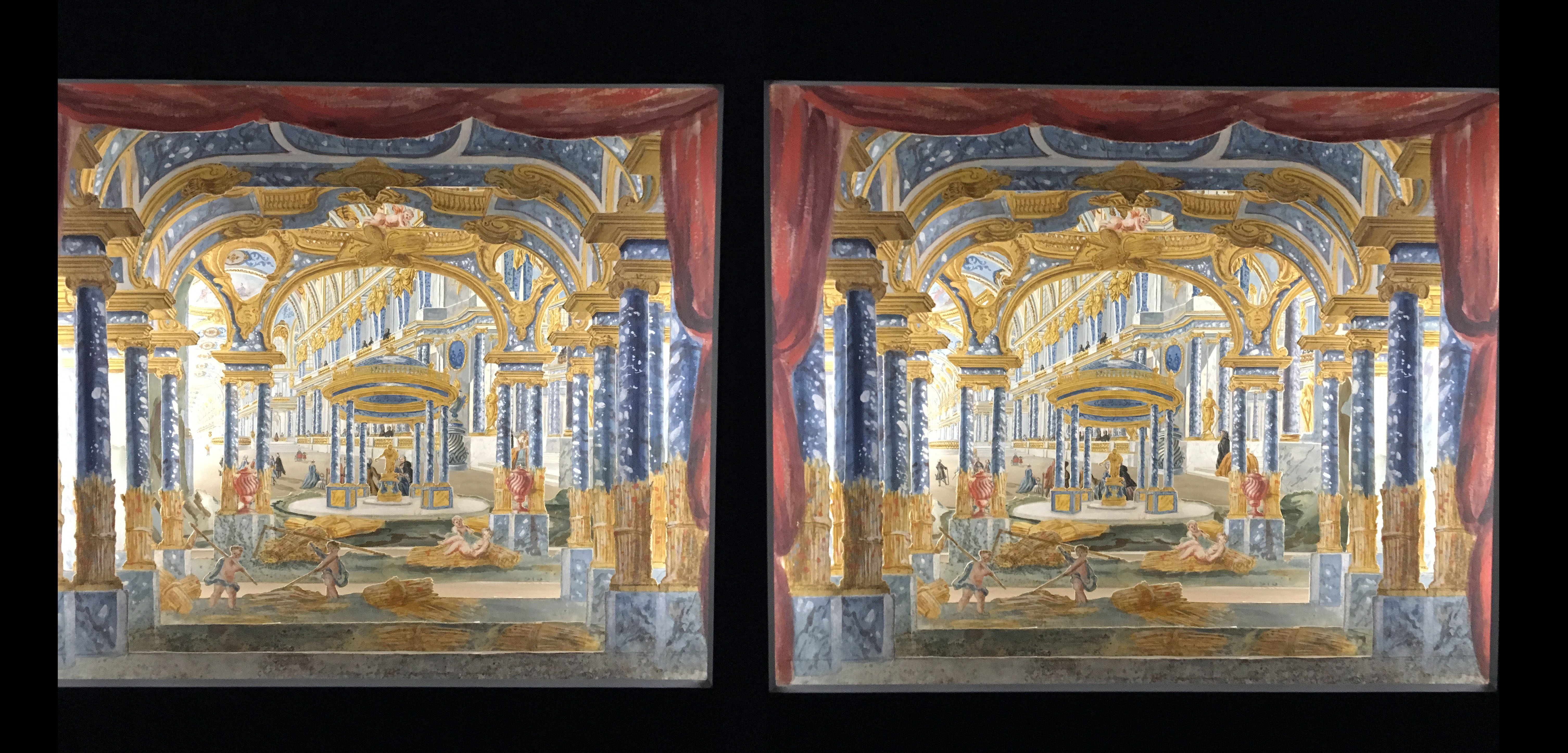 |
Figure 2.2.1 – Theatre Maquette |
| If you can freeview this stereoview, you will see the separate coulisses receding into space. Stereoviews like this one frequently recall their theatrical heritage. |
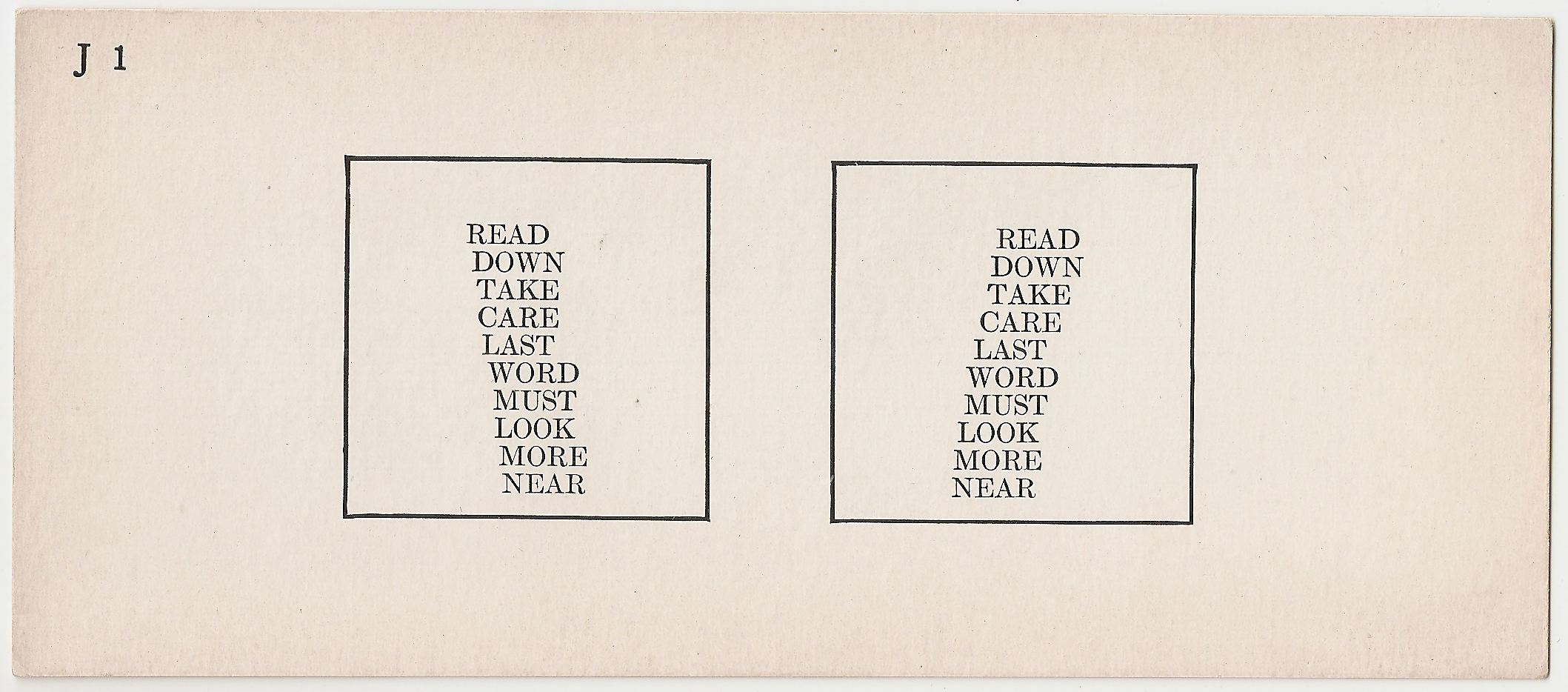 |
Figure 2.2.2 – Wells’ Eye-Training Stereocard |
| The text narrates the spatial effect that you should see in the stereoscope. If you cross-eyed freeview it, the words will assume the opposite spatial order (i.e. "near" will be far). |
2.2 Binocular Convergence Effects
The eye-training stereocard on the right (Figure 2.2.2) illustrates how binocular convergence works in a stereoview.[1] When your eyes are directed to the two instances of the word "READ" they must diverge. That indicates to your mind that the fused word is far away. When you direct your eyes to fix on the word "NEAR" they have to converge. That indicates to the mind that the word is near. Using this principle of binocular convergence, the eyes (and mind) sort all elements in paired stereo images according to distance or depth within the view (you can see an animation to get a better idea of how this works). Two guiding principles for understanding the construction of stereoscopic space follow from this:
1) Paired points that are closer to the centre of a stereocard will appear to be closer to the observer. Paired points that are further from the centre of the stereocard will appear to the viewer to be further away.
2) The more well-defined paired points there are in a stereo-pair, and the better distributed they are through the depth of the view, the better 3D space will be defined.
 |
Figure 2.2.3 – Milan Cathedral Buttresses |
| The buttress openings act like coulisse frames leading the eyes to fix on and measure successive depths with the scene. |
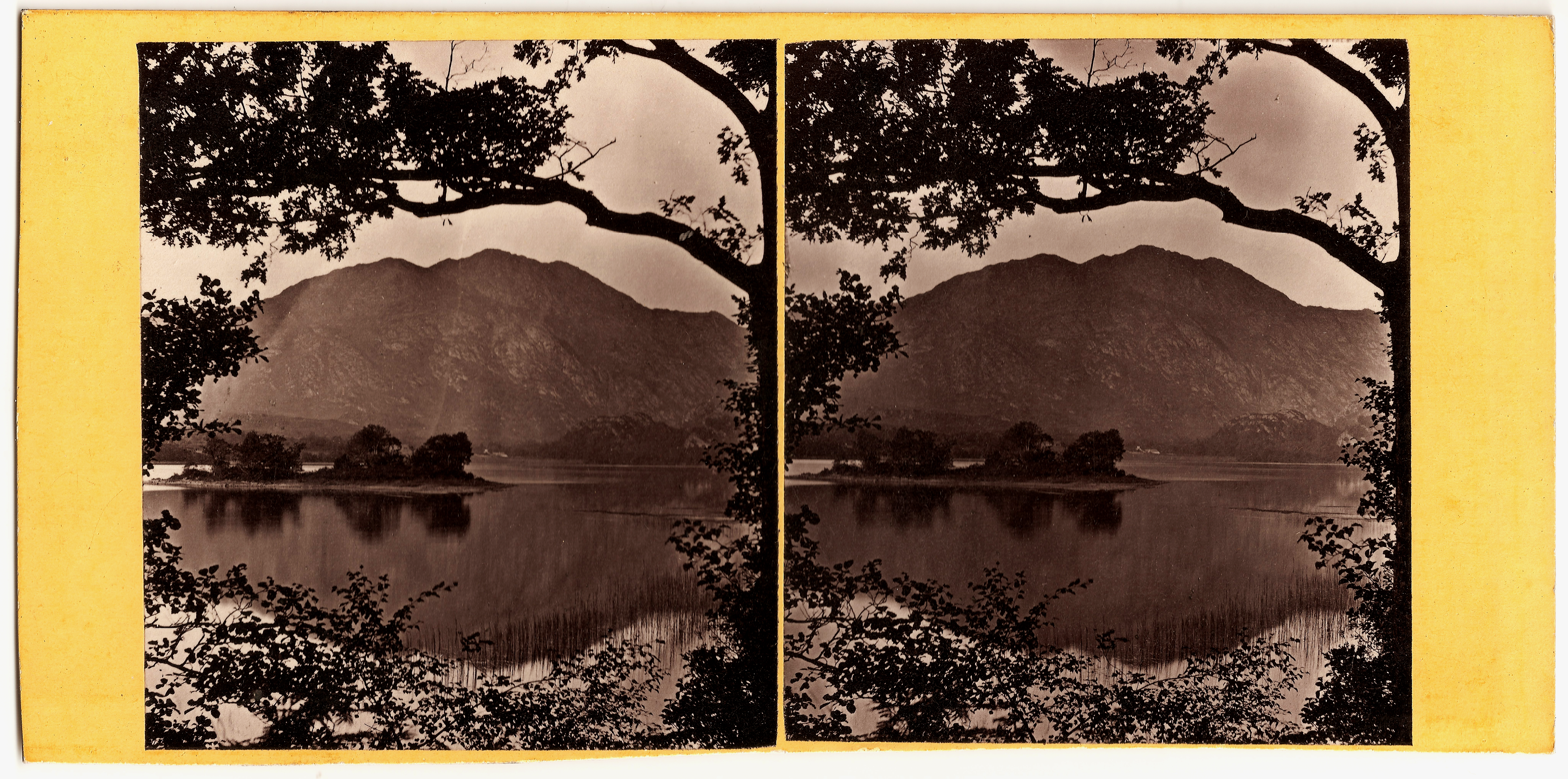 |
Figure 2.2.4 – George Washington Wilson, Loch Achray, Perthshire |
| A good example of a coulisse frame with a strong sky-drop and an open fretwork ground-row. |
2.2.1 Coulisses, Ground-rows and Sky-drops
Theatrical set design (Figure 2.2.1) provided a model for European pictorial composition in the 18th and early 19th centuries. Stereoview artists often departed from that model, but the terminology of set design is still useful for describing features of their work. The theatre has a stage, a central open area flanked by coulisses. In figure 2.2.1 the stage is the floor of a building, and the coulisses are depictions of columns on flat cardboard cutouts. In actual 18th-century theatre sets these "flats" were made of canvas stretched over wooden frames.
The maquette in Figure 2.2.1 also has low-lying flats that extend across the stage on which there are cutouts of little figures ("putti") who appear for some unknown reason to be doing agricultural work on the floor of the hall. (Right click on the image and choose "Open image in a new window" to see more detail.) Flats like these that define space receding into the depth of the stage floor are called ground-rows.
Across the top of the Maquette in Figure 2.2.1 are a series of flats depicting first a "grand drape," then a series of receding arches. These elements are called sky-drops. They were typically separate from the coulisses and could be lowered or "dropped" from a flytower above the stage. In the maquette coulisses, ground-rows and sky-drops are welded together to form what we might call a "coulisse-frame." Skydrops are common in stereoviews (see Figure 2.2.4), but not in paintings for reasons I explain in “Perspectives Bâtardes.”
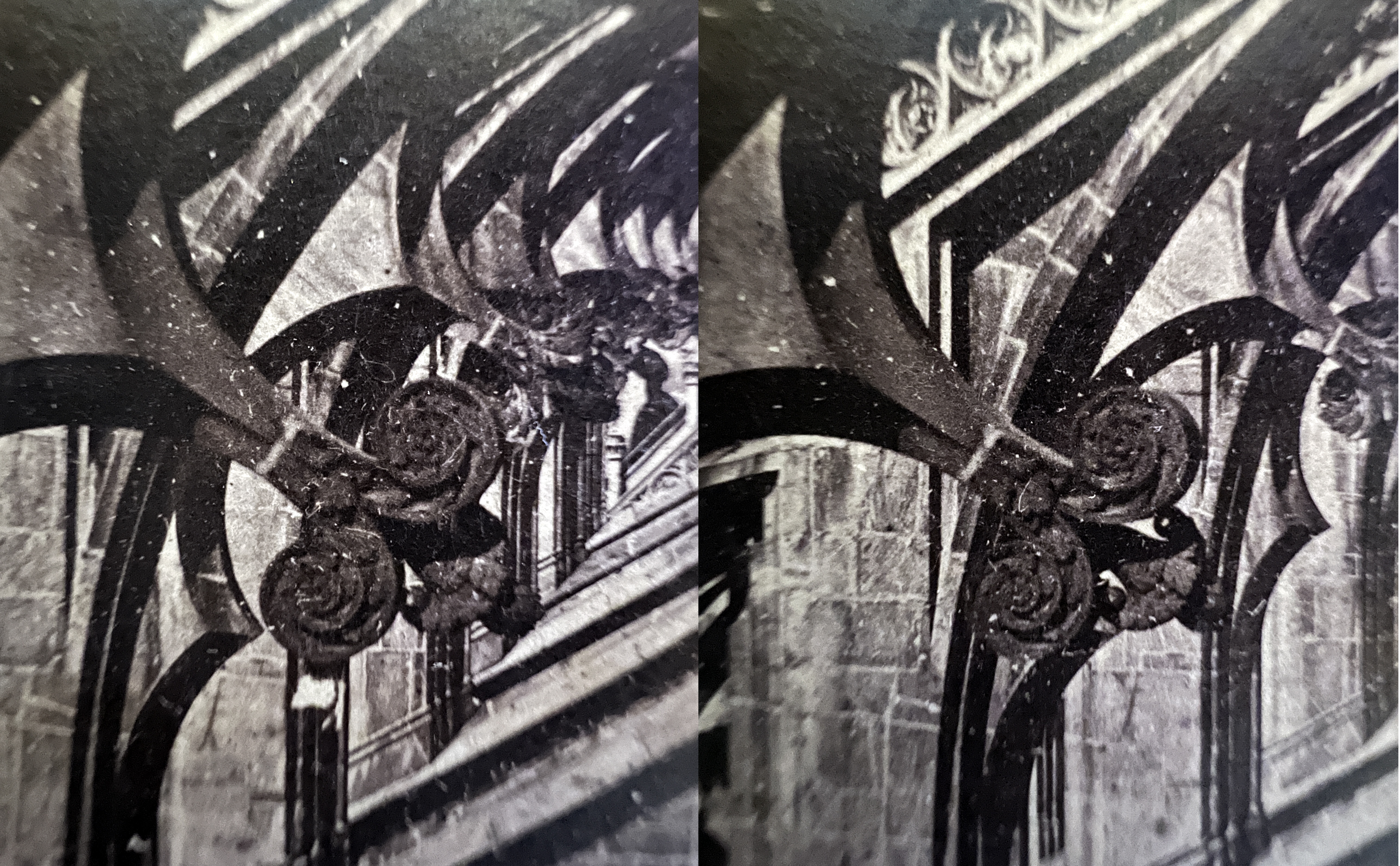 |
Figure 2.2.5 – Detail of Milan Buttresses |
| The fleur-de-lis-like ornament is a "circumparent" object: we can see fully around it from the left and the right. |
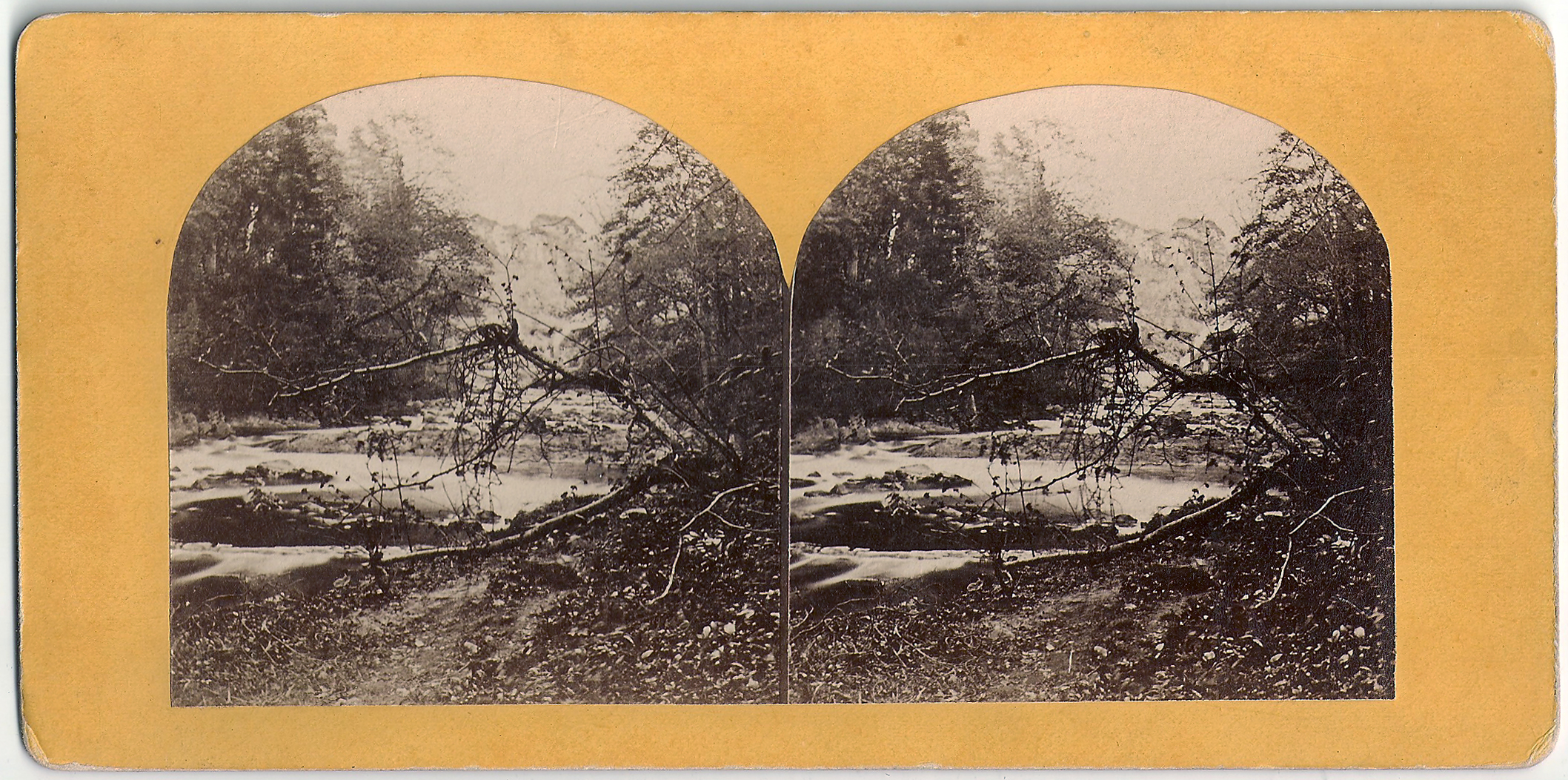 |
Figure 2.2.6 – Water of Leith |
| The overhanging branch in front of the open "stage" of the stream-bed is an example of a screened opening. |
2.2.2 Circumparent Objects and Screened Openings
The fleur-de-lis-like ornament in Figure 2.2.6 is a "circumparent" object. We can see around it to everything that is behind it. I at first called these amazing features in stereoviews "transparent objects" because they don’t obscure anything. But that does not capture the paradoxical way they appear – they are solid and block light and at the same time allow us to "see around" them. "Trans-parent" is the property of allowing a viewer to see through; and on this basis I invented "circum" [as in circumnavigate or circumvent) "-parent," to mean the property of allowing a viewer to see around.
All of the edges of coulisses have this property of allowing the viewer to see around, a least a little bit. In stereoscopy even the tiniest hint of seeing-around-behind can evoke a powerful sense that hidden spaces exist and are accessible to explore. I reserve the term "circumparent" for those elements that let the viewer see all the way around on both sides.
Small or narrow objects like tree-branches are typically circumparent. However, the extent to which they allow seeing-around depends on how far apart the two stereosopic photos were taken and how far away the background objects are. Milan Cathedral Buttresses is a hyperstereo, meaning that the two photographs were taken further apart than the distance between the two eyes. The camera positions were probably over a metre apart and were therefore better able to "see around" the rather large ornament (Figure 2.2.5).
Circumparent objects help to carve out the dimensional spaces behind them. They act like sighting devices. In Figure 2.2.5, the ornament is a sighting device which reveals the relative displacement side-to-side of the buttresses behind it. That gives a measure of their relative distance in addition to the evidence of binocular convergence and without the two eyes, at that moment, fixing on any of the more distant buttresses.
Circumparent objects so powerfully define the space behind them that stereo-photographers often place them in front of the stage to enhance its largely empty spatiality. A screen or grill of circumparent or nearly circumparent objects across the stage I call a screened opening. Wilsons’ ground-row (Figure 2.2.4) is an example, as is Figure 2.2.6 – Water of Leith.
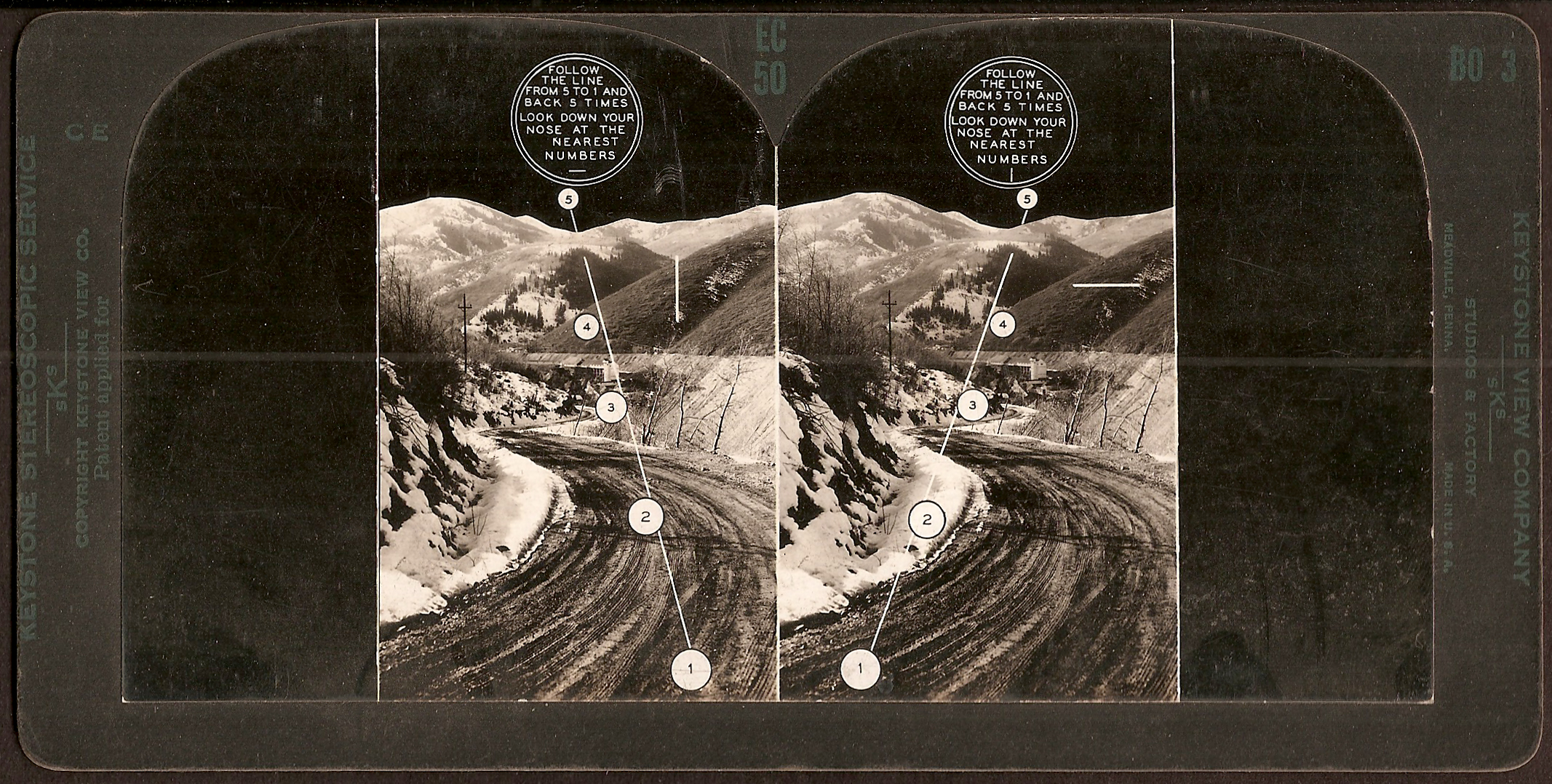 |
Figure 2.2.7 – Keystone Eye-Training Stereocard |
| The numbered line illustrates both stepped convergence and the broken zipper effect |
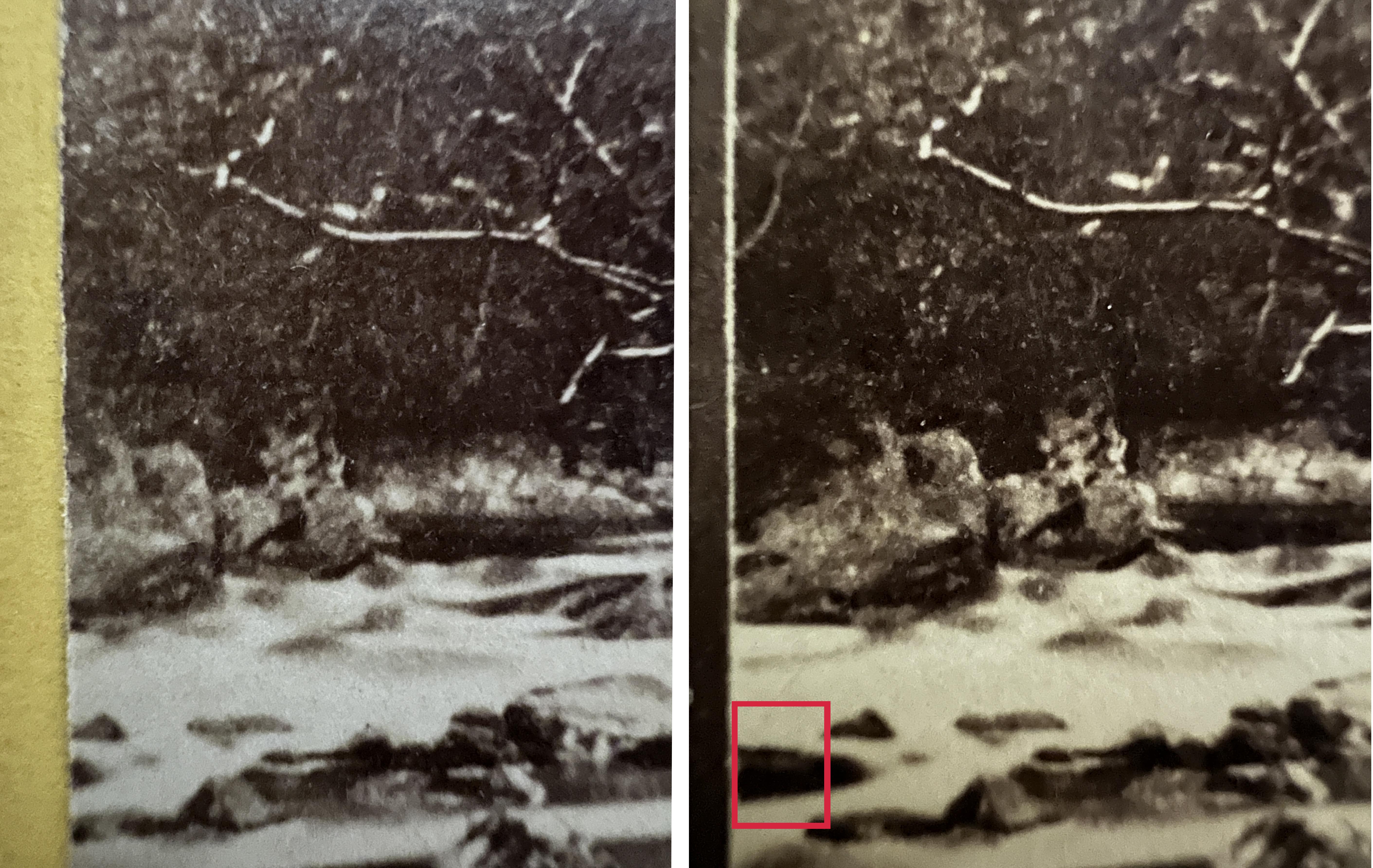 |
Figure 2.2.6 – Water of Leith Detail |
| In Water of Leith, the image-frame is located so that the whole scene appears to be behind it. The red square indicates identifiable space that the right eye sees around the edge of the frame. |
2.2.3 Stepped Convergence and the Zipper Effect
As I have said, "The more well-defined paired points there are in a stereo-pair, and the better distributed they are through the depth of the view, the better 3D space will be defined." When clearly demarcated points of interest lead the eyes to converge step-by-step through stereoscopic space, I call that "stepped convergence." The numbers along the Wheatstone line in Figure 2.2.7 are an explicitly demarcated example. The prominent features of the receding buttresses in Milan Buttresses (Figure 2.2.5) are another example.
Binocular perception has a messy structure that our minds constantly struggle to deny. It is only physically possible for the eyes to fix on one of the numbers in the Keystone eye-training stereocard (Figure 2.2.7) at a time. When they fix on any one – the "3" for example – all of the other numbers appear doubled. That is always true when we look at near elements in any scene – whatever we fix on, everything closer to and further from it doubles. Yet we are almost never aware of this everyday doubling because our minds are so successful in their sleight-of-hand that tricks us into believing that the visual world before us is coherent and stable.
Most people’s spatial imagination allows them to see Wheatstone lines as coherent objects that traverse the depths of a view. But when that coherence fails, you get a [broken] zipper effect. Like a zipper that pulls apart again after the slider moves up it, the object, and sometimes the space that surrounds it, pulls together as the eyes pass over it and then splits back apart. You can see the effect clearly in the Keystone view if you follow the instructions to "Follow the line from 5 to 1 and back..."
The word "suture" (i.e. "sew") is apt to describe the effort of the mind to pull together a coherent 3D space by hooking on to many convergence points. To suture Keystone’s eye-training stereoview (Figure 2.2.7) the mind passes the needle through the two "1"s and pulls tight, then through the two "2"s and pulls tight; but now that strain threatens to pull apart the "1"s again. Suturing tensions an elastic space. Even when suturing does not succeed in closing the gaps and leaves doubling evident, the tension nonetheless radiates "spatiality" throughout the view. It is an amazing thing to see.
2.2.4 Lateral Groundrows
2.2.5 Frame Location
2.3. Non-Euclidean and otherwise Unmappable Spaces
Space-box, gridlines and ground-plane ...A related term that I sometimes use is "orthogonal" line. It literally means "at right angles." Art historians use it to mean ... [treat of this in a section on space boxes]
3.0 Index to Categories in the Collection
3.1 Hand-Drawn
3.1.1 Stereoscopic Tricks and Imaginary Figures
3.1.2 Purely Geometric Stereoviews
3.1.3 Eye-Training Drawings
[1] I do not follow this usage pedantically, but sometimes it makes sense to distinguish between the "stereocard" or "stereogram" that you hold in your hand and see as two images on a backing, and the "stereoview," which is the fused image that you see through the stereoscope..
3.1.1 Stereoscopic Tricks and Imaginary Figures
3.1.2 Purely Geometric Stereoviews
3.1.3 Eye-Training Drawings
[1] I do not follow this usage pedantically, but sometimes it makes sense to distinguish between the "stereocard" or "stereogram" that you hold in your hand and see as two images on a backing, and the "stereoview," which is the fused image that you see through the stereoscope..
3.1.2 Purely Geometric Stereoviews
3.1.3 Eye-Training Drawings
[1] I do not follow this usage pedantically, but sometimes it makes sense to distinguish between the "stereocard" or "stereogram" that you hold in your hand and see as two images on a backing, and the "stereoview," which is the fused image that you see through the stereoscope..
3.1.3 Eye-Training Drawings
[1] I do not follow this usage pedantically, but sometimes it makes sense to distinguish between the "stereocard" or "stereogram" that you hold in your hand and see as two images on a backing, and the "stereoview," which is the fused image that you see through the stereoscope..
[1] I do not follow this usage pedantically, but sometimes it makes sense to distinguish between the "stereocard" or "stereogram" that you hold in your hand and see as two images on a backing, and the "stereoview," which is the fused image that you see through the stereoscope..