Rod Bantjes, “Scanning_Stereoview.html,” created 29 August, 2025; last modified, 29 August, 2025 (https://people.stfx.ca/rbantjes/).
What follows is an explanation of how the stereoscope and stereocard play upon your eyes, and your built-in capacity for depth perception, to create for you an illusion of differential depths with the stereo-image.
 |
Figure SF.1 – Path of light through the stereoscope |
| Gif image © Rod Bantjes, 2025. |
Binocular Convergence through the Stereoscope
Note the blue dots on the stereocard. These mark the points in the image that the two eyes fix on. The two halves of the image are fused for the observer so she sees a single image. To her the blue dot is a single point.
The lenses of the stereoscope bend the path of light so that it is easier to fuse the two images. The actual angle of convergence of her eyes is represented by the dotted lines.
When she fixes on this point her two eyes converge at a certain angle. The lines intersect at a certain point in space before her. Her mind interprets the position of that intersection as the relative distance of the blue dot in front of her.
This is binocular convergence, one of our most powerful indexes of spatial depth.
 |
Figure SF.2 – Fixing on the Circle |
| Gif image © Rod Bantjes, 2025. |
Scanning the Circle
The two circles, one on each of the paired images, are identical and are in identical positions left-to-right. That means that when the eyes fix on them, they appear to be located at the surface of the card.
No matter where the eyes fix on the circumference of the circle (follow the blue dot) the angle of convergence is the same. So all points on the circle seem to be at that same distance from the observer.
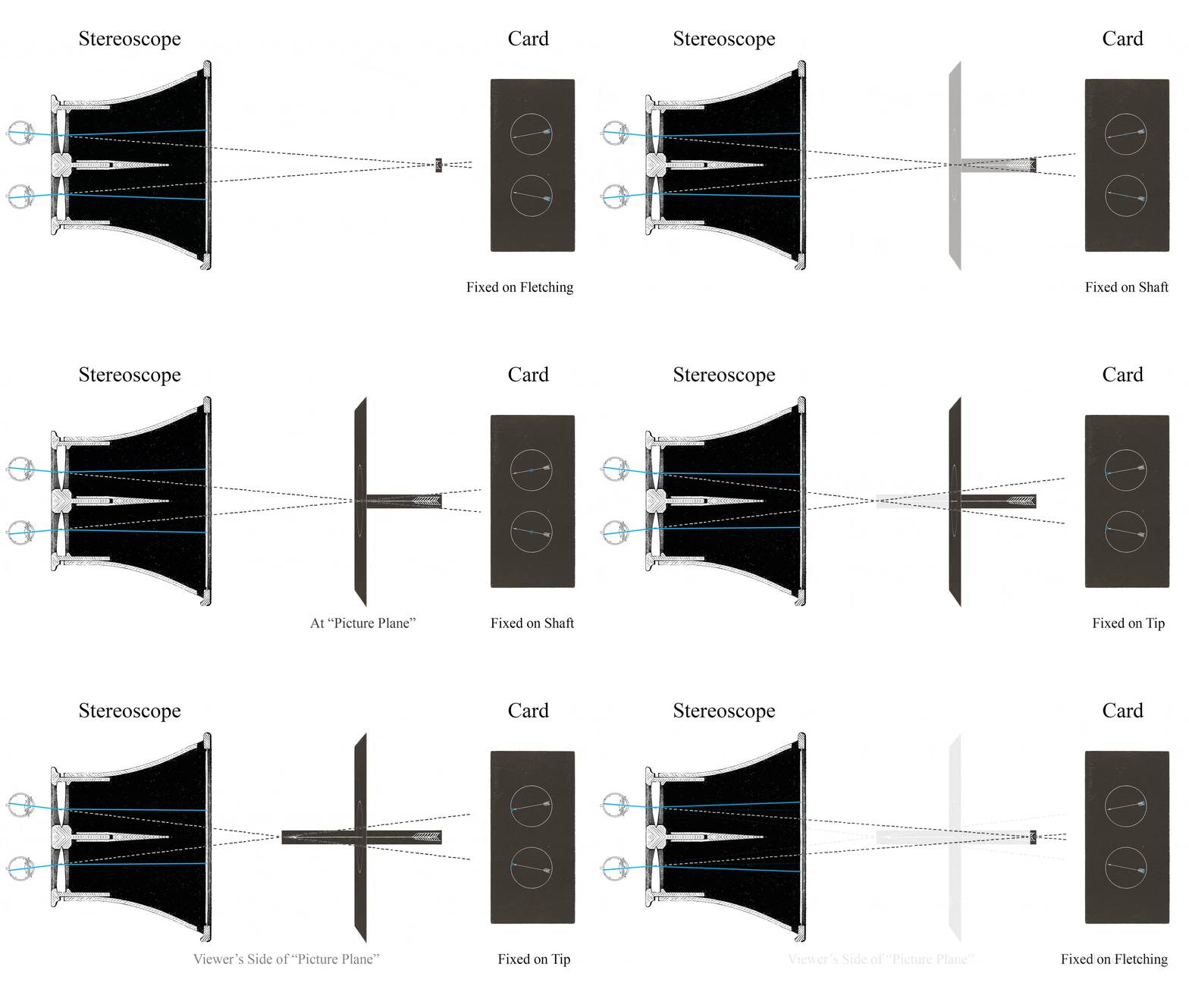 |
Figure SF.3 – Fixing on the Arrow |
| Gif image © Rod Bantjes, 2025. |
Scanning the Arrow
The two depictions of arrows, one on each of the paired images, are different from one another. When the eyes see slightly different images of the same thing, from slightly different angles, we call this binocular disparity.
The images of feathers or fletching of the arrow are further apart relative to the circle. So, when the eyes fix on them, they diverge (look for the blue dot in the animation; it can sometimes be hard to see). Divergence signals to the brain that the thing is further away.
So when you look through the stereoscope the fletching of the arrow seems further away, beyond the circle. In this case, given that the circle seems to be located on the surface of the card, the fletching of the arrow seems to be beyond the surface of the card and "inside" the view.
The images of the tip of the arrow or arrowhead are closer together. To fix on them the eyes have to converge. The larger the angle of convergence, the closer the fused object seems.
So the tip of the arrow seems closer than the fletching and closer than the surrounding circle. In this case, that means that it appears to be on the observer's side of the image plane, in other words "outside" the picture. This is one of the cool effects that you can create with stereoscopic images.
Makers of stereoscopic images learned to use these principles to change the way that they composed images so as to enhance and play with 3D effects.
Multiple Angles of Convergence
In a photographic stereo-image, objects and surfaces at many different depths will require subtle changes in the angle of convergence of the eyes (you can review how this is accomplished in a simple image). In this way the mind is able to sort everything in the scene according to its relative location in space. That is what gives stereoviews their powerful 3D illusion.
Optical machines, by which one views a single image through a lens, also affect binocular convergence for a 3D effect, but in a much simpler way. Here the lens creates a single angle of convergence – typically at the horizon or infinity. There is no variation to allow the brain to sort differential depths within the image. For this reason it creates a far weaker 3D effect than stereoscopy.
Note on Binocular Disparity
The stereocard used in this explanation is based on one of Charles Wheatstone's very first stereoviews. He invented the stereoscope in 1838 as a scientific instrument to test whether binocular disparity (not binocular convergence) created a 3D effect. He insisted that the mind can fuse images like this one all-at-once without the eyes scanning. He gave experimental proofs that authorities like Herman von Helmholtz accepted as sound. For more on this question you can read my essay "Reading Stereoviews," p.49.
Wheatstone is no doubt right. The mind has to accomplish something like an overall fusion even after it has collected the points in a scan of a scene or image. Stereoscopic viewing normally combines both the principles of binocular disparity and binocular convergence.