Rod Bantjes, “GST-374_Clock_mender.html,” created 4 August, 2025; last modified, 10 October, 2025 (https://people.stfx.ca/rbantjes/).
Diagonal-Mirror Box: The Clock Mender
Gestetner Collection (V&A)[*] #GST-374
German or Austrian c.1850
Dimensions: H=32.5 cm, W=14 cm, D=11.3 cm
Lens: ⌀=2.3 cm, ƒ=45 cm
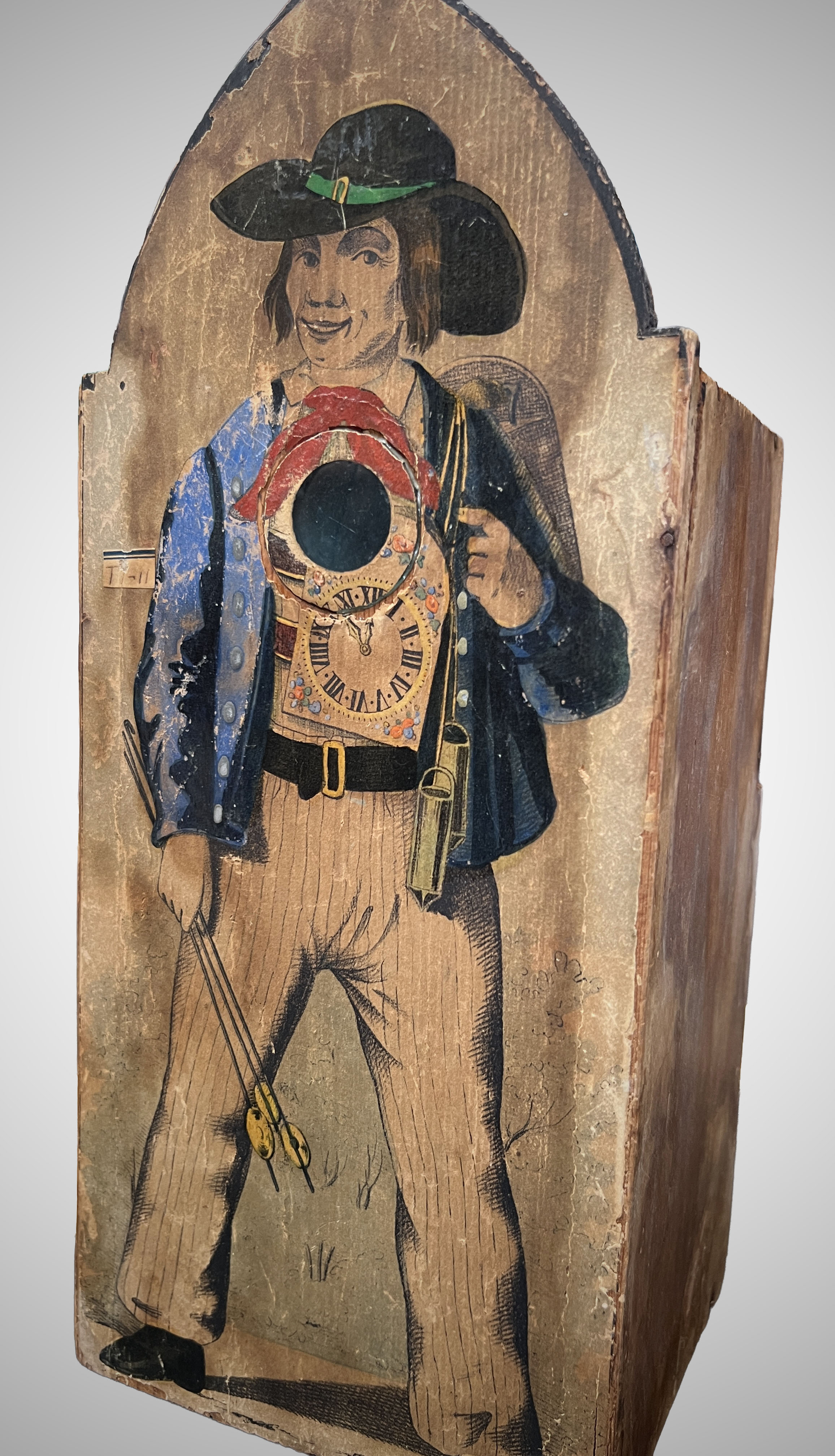 |
Figure 374.1 –The Clock Mender |
| Photo © Rod Bantjes. |
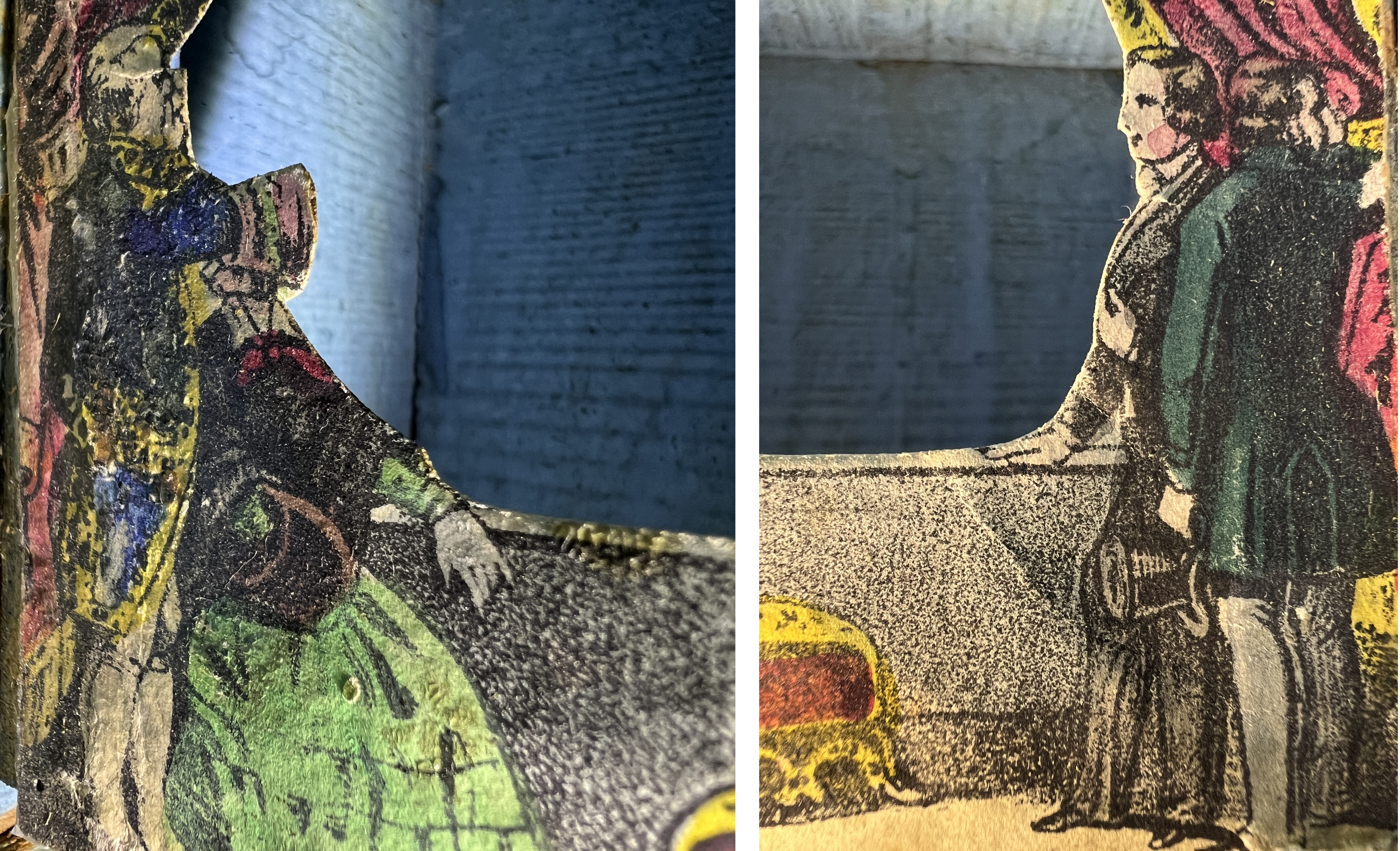 |
Figure 374.1 –The Coulisse |
| Photographs of the left and right sides of the fixed coulisse. It is joined across the top with a grand drape. Photo © Rod Bantjes. |
This is a diagonal-mirror box for viewing small litho-prints. It is an example of an "optical machine " and is included in the Optical Machine Taxonomy
It is made to be lightweight: with thin softwood boards (6 mm) tacked together and surfaced with paper. The image of the clock mender (note the spare pendula in his right hand) is a hand-tinted lithograph. The rest of the exterior is papered in brown paper.
Inside there is a single coulisse representing distinguished viewers surveying the scene from an opera-box. The interior walls are painted light blue. It shares these features with other boxes that likely came from the same workshop (GST-373, GST-375, EXBD-69331). Ralph Hyde thinks that they are German, on the evidence of the German labels of the views. I took one of them to be Swiss (EXBD-69331), given the Swiss or alpine themes on the exterior. Perhaps a compromise might be Austria: both German speaking and alpine.
Why do we look into the heart of the itinerant clock mender? Perhaps we are seeing his memories of far-flung travels, a veritable theatre-of-the-mind for our distant admiration.
Coulisses were often components of the depicted scene and were understood to create a deceptive realism. In these Austrian boxes, as well as the Trentsensky "panoramas" the coulisses serve instead to mark the scene as a fiction – viewed from a theatre box or through a proscenium arch. Trentsensky's Henry VIII takes the second-level fiction – that we are in a theatre – and confirms it in all the external imagery of the box. The Austria boxes opt for a third level of meta-fiction, showing how we enter the theatre through the heart of a clock-mender or from a military field of encampment. These are sophisticated plays on childish make-believe.
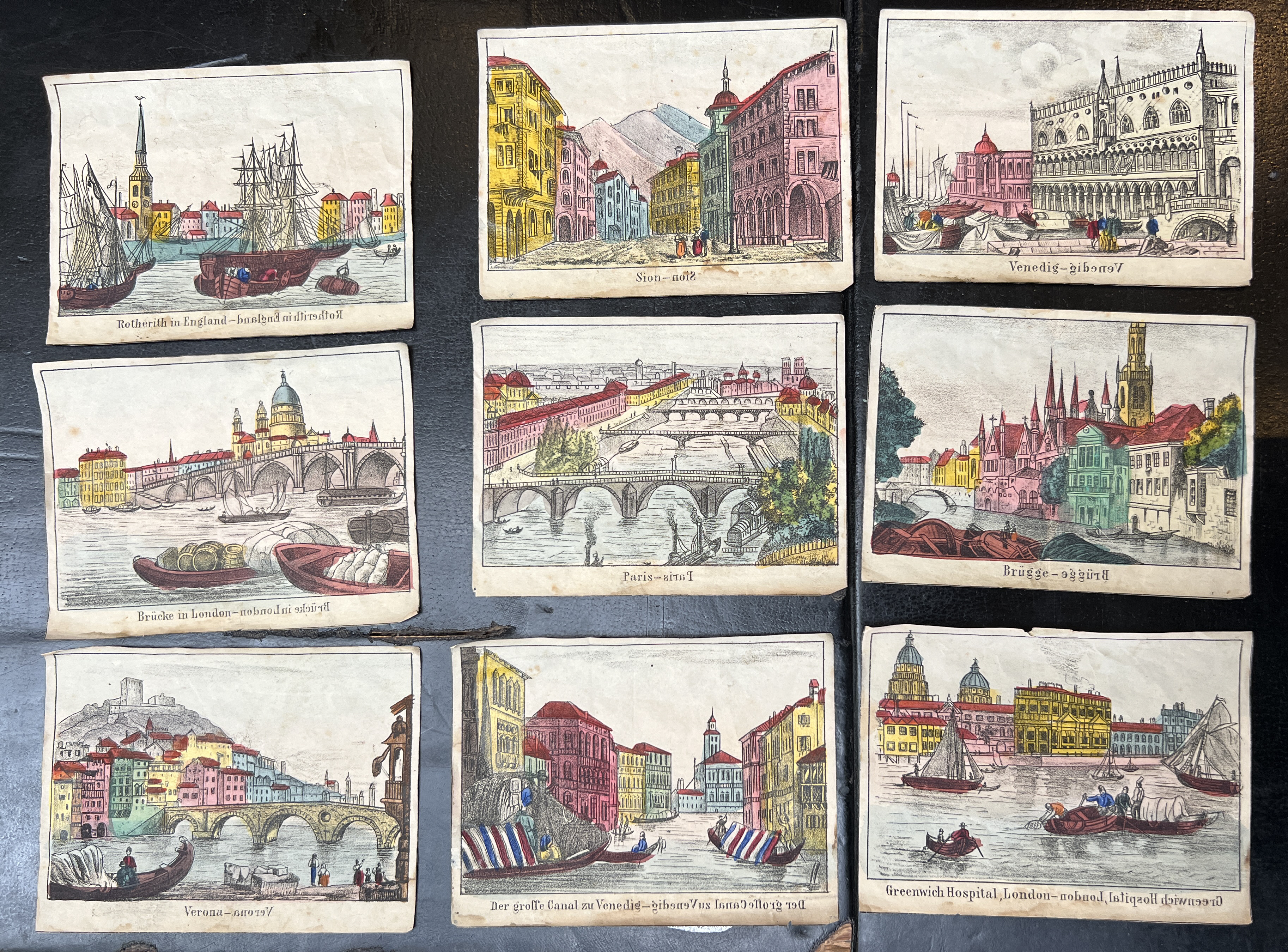 |
Figure 374.3 –The Images |
| Small hand-coloured lithographs. Photo © Rod Bantjes. |
List of Views:
- Brücke in London (St Paul's and Blackfriars Bridge). The same view accompanies box GST-375.
- Rotherhith in England (Rotherhithe, London). The same view accompanies box GST-375.
- Greenwich Hospital, London
- Brügge (Bruges)
- Venedig (Venice)
- Der grosse Canal zu Venedig (Venice)
- Paris
- Sion (Switzerland)
- Verona
Endnotes:
[*] I would like to thank Amy Orr and especially Catherine Yvard for their generous assistance in the V&A archives..