Rod Bantjes, “GST-378_Henry_VIII.html,” created 5 August, 2025; last modified, 19 October, 2025 (https://people.stfx.ca/rbantjes/).
Folding Diagonal-Mirror Theatre: Henry VIII
Gestetner Collection (V&A)[1] #GST-378
Austrian, c.1855
Dimensions (open): H=34.5 cm, W=25.7 cm, D=19 cm; Dimensions (closed): H=7.2 cm, W=25.7 cm, D=19 cm
Lens: ⌀=3.9 cm, ƒ=23.2 cm
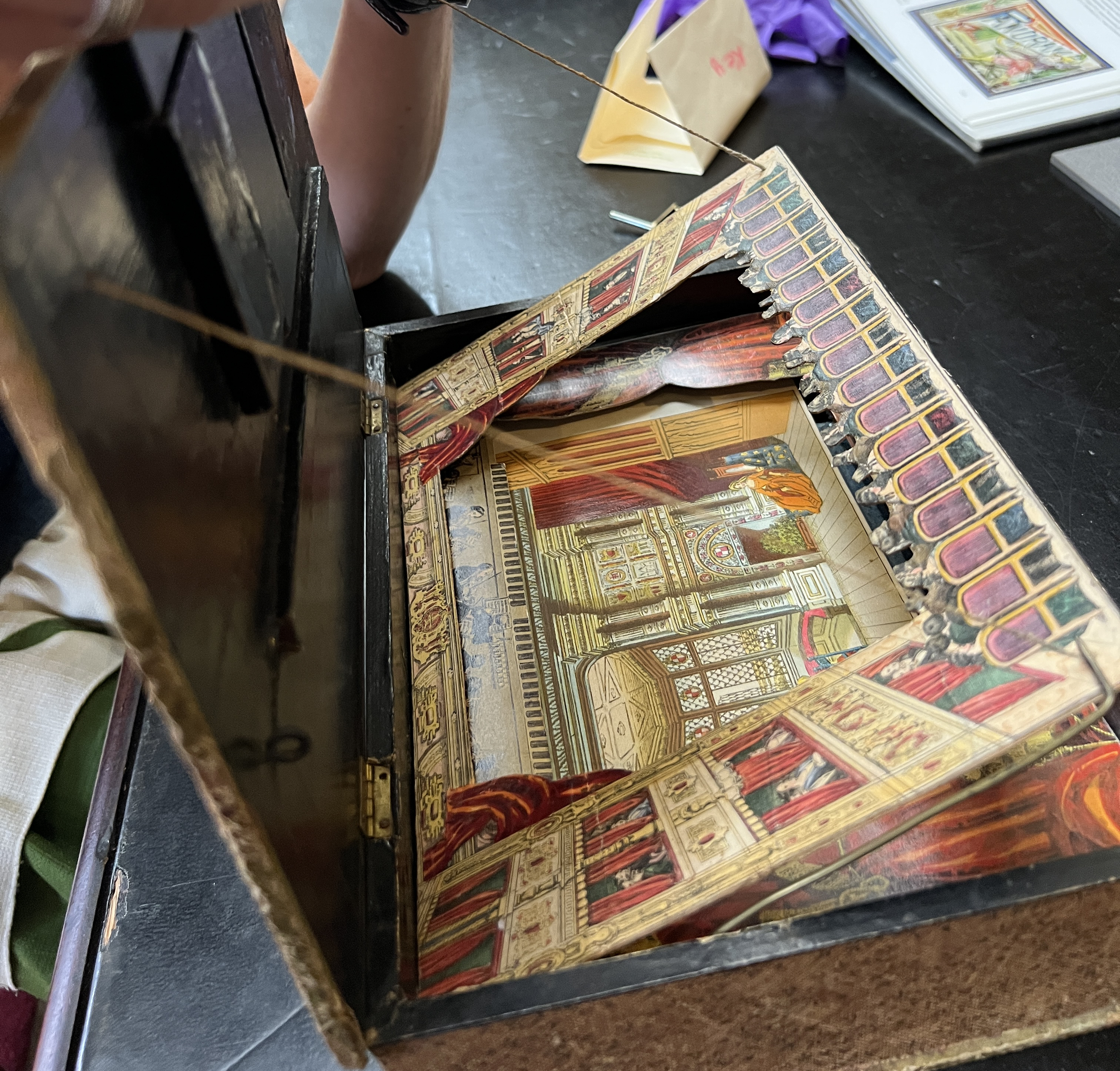 |
Figure 378.1 –Panorama of Henry VIII |
The opened box with the first coulisse lifted.
Photo © Rod Bantjes. |
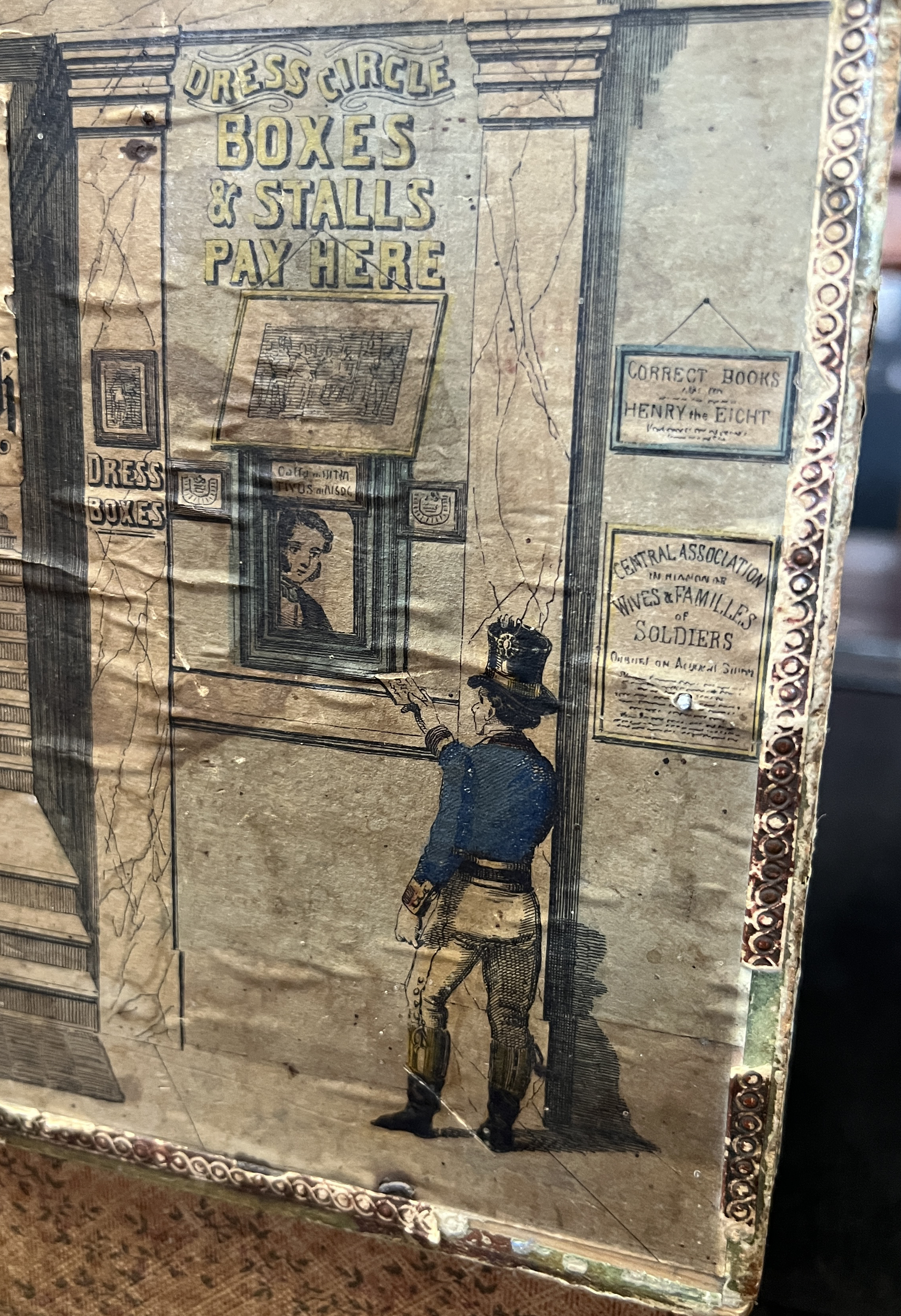 |
Figure 378.2 –Box Office |
| Photo © Rod Bantjes. |
This is a folding diagonal-mirror theatre with views on a continuous roll.[2] It is an example of an "optical machine " and is included in the Optical Machine Taxonomy.
It is a lightweight version of the 18th-century folding diagonal mirrors that often took the form of a book (see GST-377, WN-2396). The top folds up and into it a folding lens-mirror assembly is inserted. It is made of thin softwood with richly decorated paper on all surfaces. It uses minimal hardware (eyelets, hinges, a metal hand-crank), but more than GST-369. The box is, according to Ralph Hyde, "almost certainly" made by "Matthias Trentsensky (1790-1868) in Vienna.", and marketed by Joseph, Myers & Co. [England].[3]
This charming device revels in the theatrical pedigree of the optical box. Trentsensky, Joseph and Myers may have hoped to capitalize on the recent popularity of toy theatres and paper theatres for children. The front-face presents the theatre box-office. Hyde writes: "there are two box-offices, one to left of the stair-case, and one to the right. A couple purchase tickets at the box-office on the left (the lady in a tiered dress), and a messenger boy delivers a message at the box-office on the right [see Figure 378.2]. (On the playbill the Public were advised to book their seats from Mr Massingham at the theatre’s box-office). Various prints and notices are on the walls. They include an advertisement for Kean’s playbook for Henry VIII, and a poster for the Central Association in Aid of the Wives & Families of Soldier's – a worthy Crimean War charity."[3]
As one unfolds the cover, the first of two coulisses is pulled up with it (see Figure 378.1), providing depth-separation to help define the interior space of the theatre-house. Hyde describes the scene as follows: the first coulisse represents "the audience, the proscenium arch; and four tiers of stage boxes on either side; a second flap represent[s] the stage curtains and orchestra; and beneath this a chromolithographic moving panorama with the scenes rolling from one supplied roller onto another [see Figure 378.3]. The rolling is achieved by inserting a crank, supplied into a small hole in the base of the toy (top when opened) and turning it."[3]
While the whole assemblage encourages theatrical imagination, there is attention to the realism of a particular theatre house: "The auditorium of the Princess's Theatre [London] as represented in the toy closely matches that shown in contemporary prints, e.g. the vignette on the cover of Souvenir of the Winter's Tale, published by Joseph, Myers & Co., and other views reproduced in The Princess's Theatre, Oxford Street', by Robert Thome, Theatrephile, vol. 2, issue No. 8, pp.16-20. There are the same boxes of four tiers with their cork-screw pillars, the same pit, the same coving, and the same decoration for which Messrs Crace & Son were responsible."[3]
The lens-clock measures 6.8 on the front surface of the lens and -3.25 on the back for a power of 3.55 (that is a 28 cm focal length by this calculation). The distance from lens to image-plate is 29cm which suggests that the lens is correct for this box. However a convex-concave lens is unusual for this period.
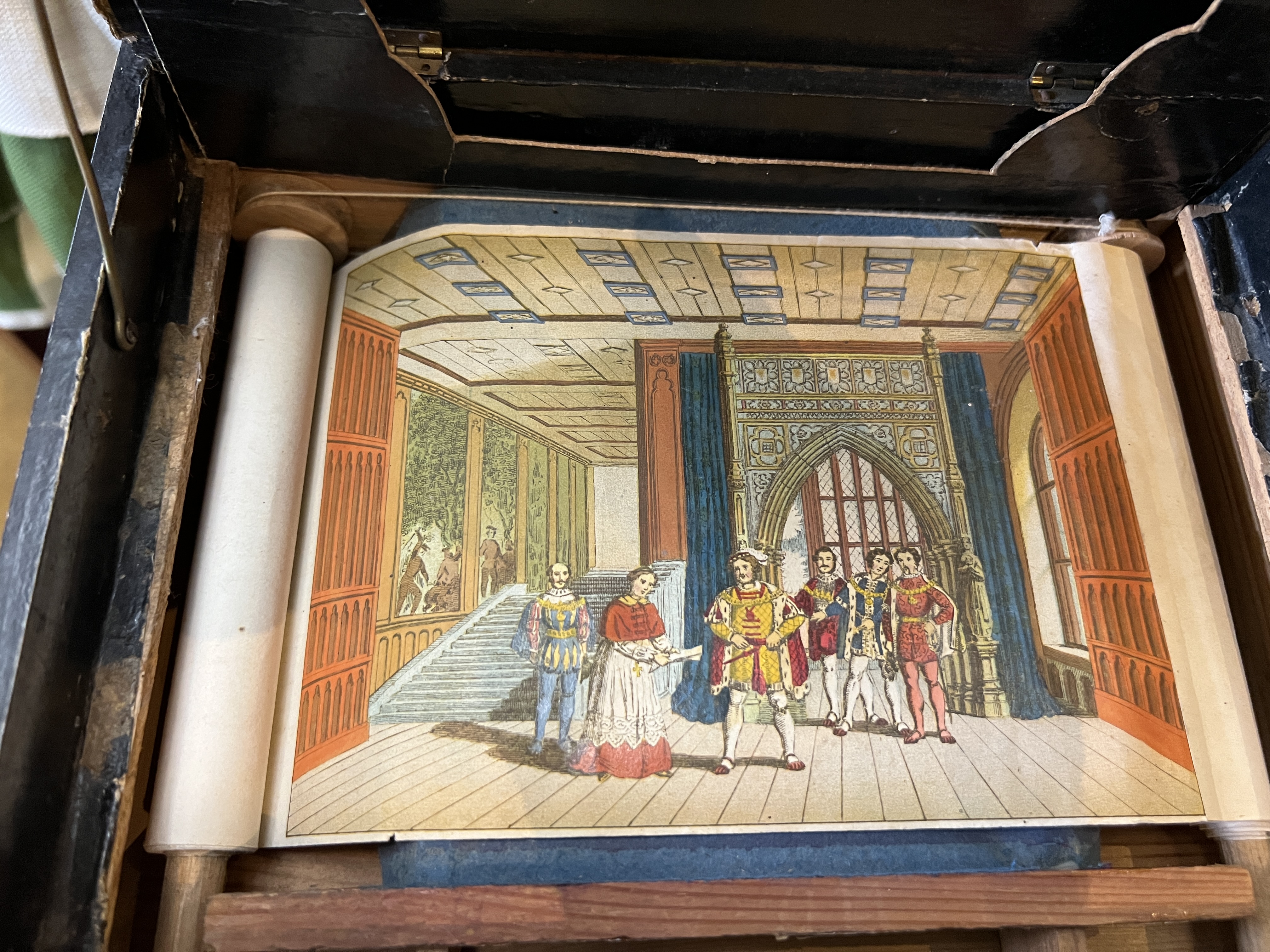 |
Figure 378.3 –Continuous Roll of Images |
The second coulisse has been removed for this photo. The string connecting the rollers allows them to be turned either direction at will.
Photo © Rod Bantjes. |
Endnotes:
[1] I would like to thank Amy Orr and especially Catherine Yvard for their generous assistance in the V&A archives..
[2] While the term "panorama" is often used for this form of continuous-roll scene change, the term is better reserved for wide-angle or 360-degree views of a given location..
[3] Hyde, Ralph, Paper Peepshows: The Jacqueline & Jonathan Gestetner Collection (Woodbridge: Acc Art Books, 2015)..