Rod Bantjes, “WN-GT11_Engelbrecht_Vertical.html,” created 10 August, 2025; last modified, 8 September, 2025 (https://people.stfx.ca/rbantjes/).
Vertical Kulissentheater
Werner Nekes Collection, Theatre Studies, University of Cologne[1] #WN-GT11[2]
German c.1740
Dimensions: H=62.2 cm, W=16.1 cm, D=16.2 cm
Lens: ⌀=4.2 cm, ƒ=27.9 cm
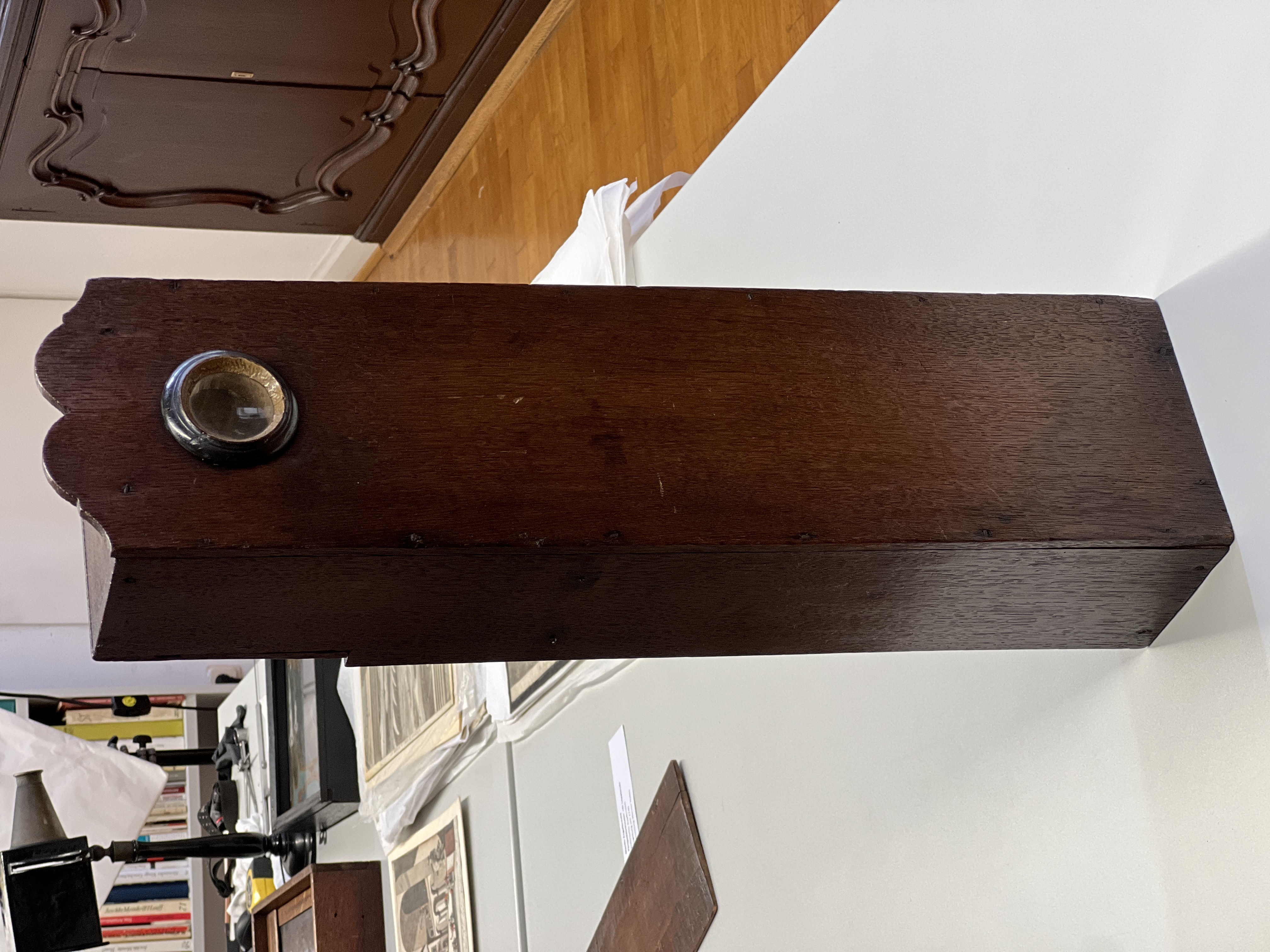 |
Figure GT49.1 –Vertical Kulissentheater |
| Front view showing the small lens. Photo © Rod Bantjes. |
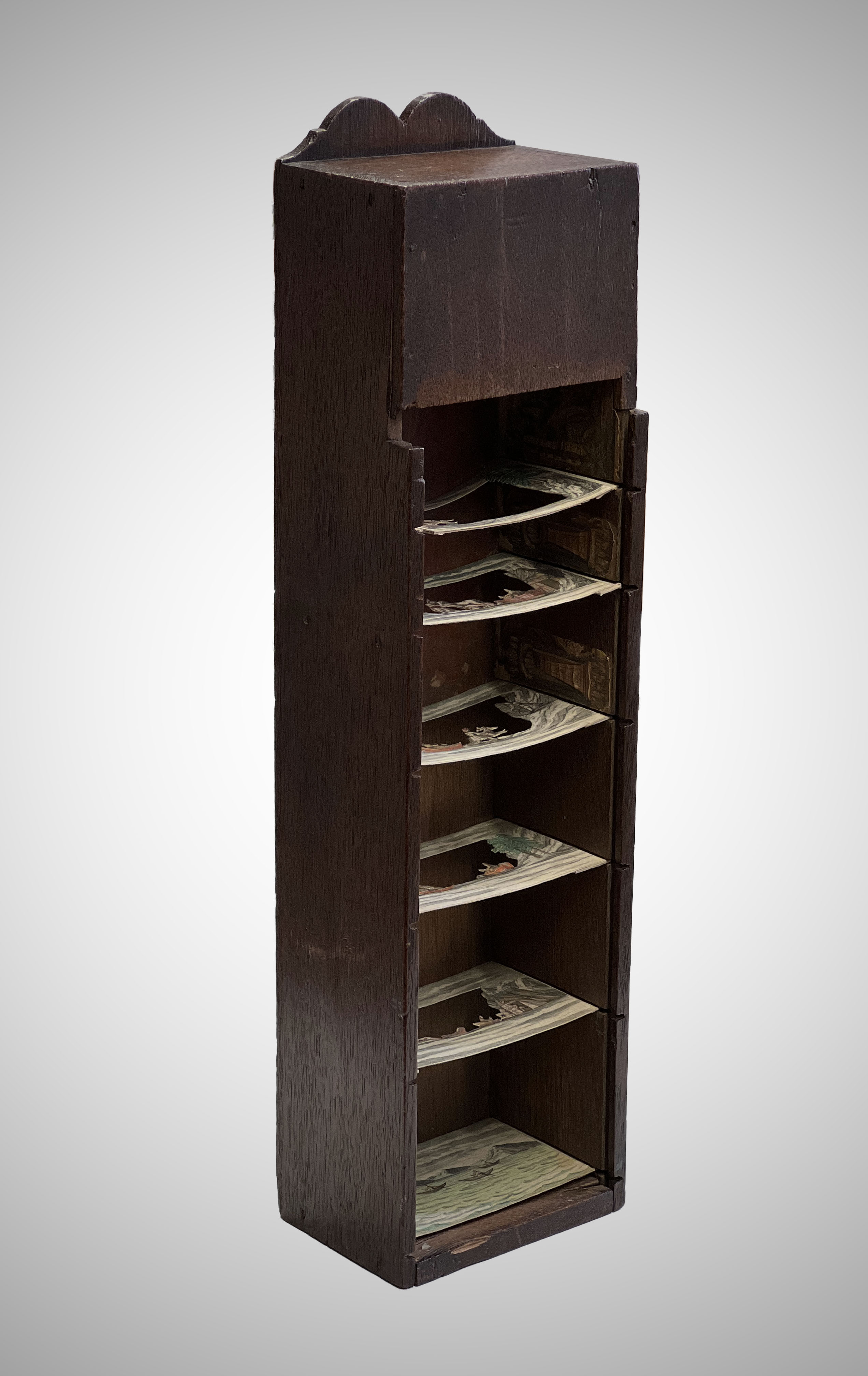 |
Figure GT49.2 –Vertical Kulissentheater |
| Back view showing the coulisses and backdrop. Photo © Rod Bantjes. |
This is a vertical small-lens viewer for 3D scenes composed of a series of 5 overlapping coulisse-frames and a backdrop. It is an example of an “optical machine ” and is included in the Optical Machine Taxonomy
Englebrecht Manufacture: Martin Englebrecht (1684-1756) of Augsburg was the developer of the kulissentheater. The inspiration for its distinctive feature, the ranked coulisses, was the scenography of the Baroque theatre, or perhaps its miniature form in the theatre maquette. Englebrecht’s workshop produced the boxes and copper-plate engravings for them in three sizes. The one depicted here uses small images (9.2 x 14 cm). The images for the larger version are 17 x 21.1 cm. He also produced a miniature version (7.3 x 9.0 cm).[3]
Boxes came in two different configurations: horizontal and vertical-with-diagonal-mirror like this one. Either the back or the top of the box (if horizontal) can be removed to allow natural light to illuminate the images.
Diagonal Mirror: The decision to use the mirror seems questionable at first since 18th-century mirrors were so bad: their rippled surfaces created what we would now consider to be an unacceptably wavy image. However, Joseph Harris in 1775 proposed that with the mirror the observer is less aware that the scene is confined to a small box:
| ...the representation will be more natural, and also more surprising, if the lens be fixed in the side, [or front as in Figure GT49.1]; a plane speculum or looking-glass ..., being fixed at half right-angles to the axis of the lens. For then the images of the pictures will appear in an horizontal plane; and prenotions of distance from the visible length or depth of the box being thus removed, the imagination has a greater scope in increasing the apparent distances of the images.[4] |
The Box: The box is very simply constructed from oak. Parts are lapped without mitres or dovetails. There are no brass fittings. The lens is secured by some form of white putty. The single double curve, top front, is the only external decoration. The inside of the mirror-case is papered with cutouts from engravings, possibly added by the user.
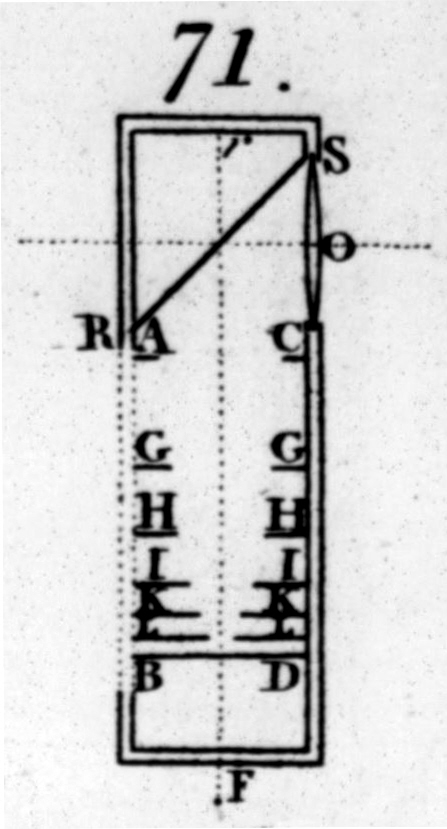 |
Figure GT49.3 –Harris’s Diagram |
“fig. 71. in which BD represents the picture at bottom, RS a reflecting plane; O the lens through which the picture is seen erect, and directly before the eye.” Source: Harris, Joseph. 1775. A Treatise on Optics London: B. White. |
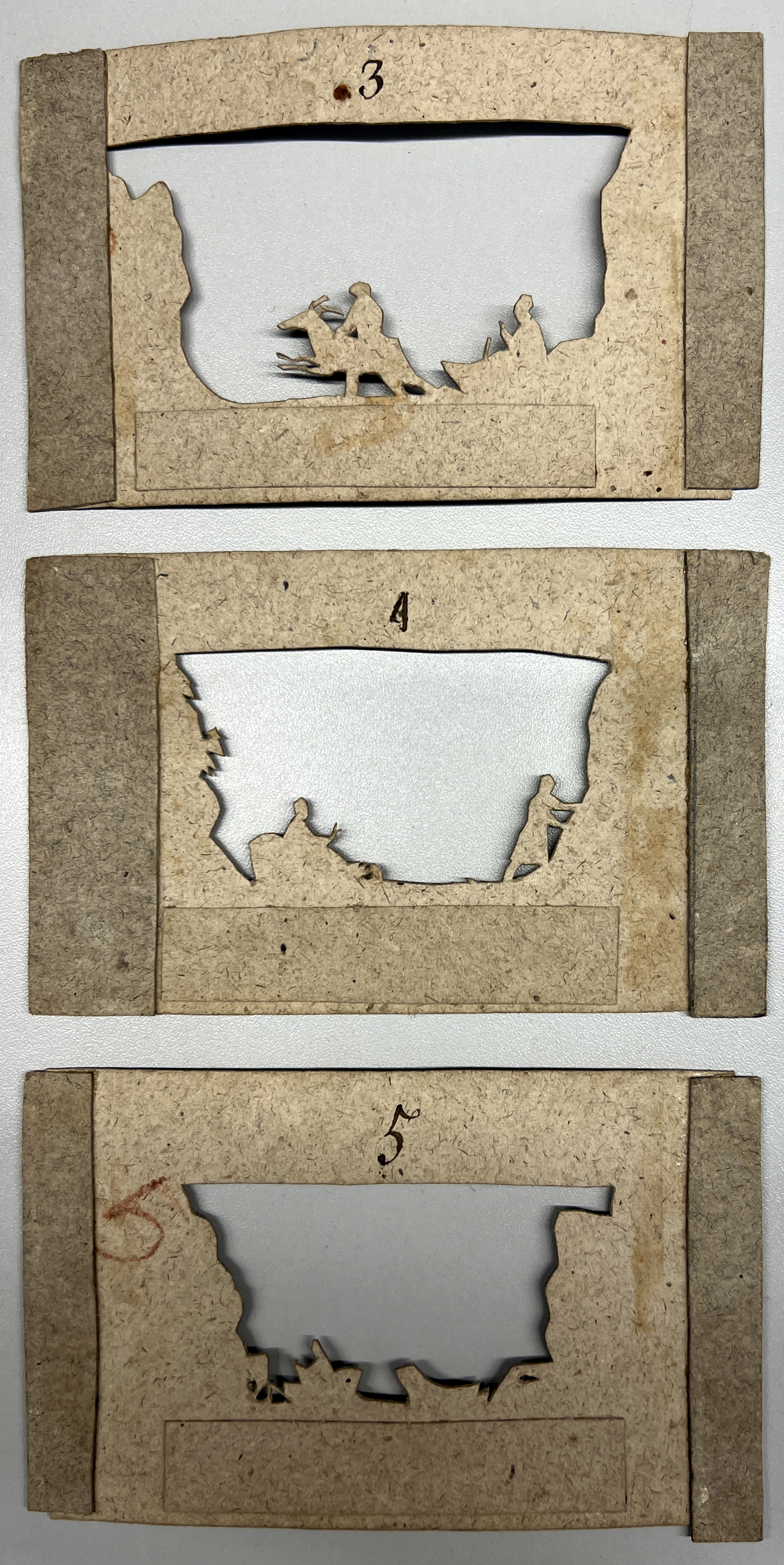 |
Figure GT49.4 –Coulisse Frames |
| Back sides of three of 5 coulisse frames. Note how the openings diminish slightly from front (3) to back (5). Photo © Rod Bantjes. |
Design and Function:
Coulisses were understood in the 18th century to affect the binocular convergence /divergence of the two eyes, motion parallax and the focus of the eyes.[5] These were the mechanisms by which coulisses were supposed to create a 3D effect within the depicted scene.
Small Lens: However, Englebrecht’s boxes are probably the first optical machines to use small lenses, too small see through with both eyes. In this way Englebrecht has excluded the principle of binocular convergence. This was understood to be one of our most powerful indexes of depth. In not using it, Englebrecht was either disregarding 18th-century optical theory or else unaware of it.
Focal Length: Harris, writing about a kulissentheater similar to Englebrecht’s (Figure GT49.3), recommends that the background image be placed at the focal length distance from the lens: “it will be better to place the [last] picture still nearer to the principal focus F...” he writes, because at this distance, “the refracted rays being nearly parallel, they affect the sight thus far as if they came from a remote object”.[6]
Harris’s advice conforms to the principle laid down by William Molyneux and Edmond Halley in 1692.[7] At the focal distance, the two eyes will fix on, and the single eye will focus on, each point on the picture surface as if it were at an infinite distance. Fixing attention on the closer coulisses will cause a greater convergence and a different focus consistent with closer objects. However this is not how Englebrecht has designed his box. His backdrop, representing the furthest distance should be at or a little closer than the focal length of his lens. Instead, the focus of his lens falls about half-way between the first coulisse and the backdrop as though he were unsure which part of the fragmented image it should correspond to. Here is more evidence that Englebrecht was likely ignorant of contemporary theories of vision.
Monocular Divergence: When there is only one eye viewing through the lens, as in Englebrecht’s box, that lens can only affect how the eye focuses through the principle of monocular divergence. The effect on the illusion of depth within a picture is weak – to my eye, imperceptible. Englebrecht applied it incorrectly. What then did he think the lens was supposed to do in his kulissentheater?
Camera Obscura Model of Focus:
Englebrecht’s Inspiration? I suspect Englebrecht’s understanding of focus was empirical rather than theoretical, obtained by observing how impossible it was to focus a complete image in an 18th-century camera obscura.
The camera obscura was a misleading model for how the eye worked, but it did reveal something true about our visual field that we are hardly ever aware of: much of it is out of focus. We are constantly scanning the scene before us with our eyes so the brain “fills in” the picture we experience with crisply-focused samples.
 |
Figure GT49.6 –Backdrop Detail |
This is the most distant part of the view and should, according to 18th-century theory, have been rendered in low resolution. Photo © Rod Bantjes. |
Narrow Depth-of-Field: The simple biconvex lenses of old camera obscuras had very short depth-of-field. When you focus on the foreground of a landscape, the distance is so blurry as to be unrecognizable . Under the influence of this device a few artists such as Vermeer struggled with whether and how to incorporate the blurry areas into their paintings.[8] This was the problem that I suspect Englebrecht’s kulissentheaters were meant to address.
Planes of Focus: As you move the lens in and out of an old camera obscura, distinct planes come crisply into focus one after another. I imagine Englebrecht observing this unfolding of the image and wondering what it would look like if he created a separate coulisse-frame for each focused plane and exhibited them one behind the other so that the eye would have to recapitulate the camera’s successive re-focusing.
Recapitulating Active Focus: His boxes do have the effect of recapitulating how the eye samples and reconstructs the fully-focused image of a scene in nature. Consider the animation of a scene from his large-scale box. The iPhone camera with which it was taken has focused on the first of six coulisses. The rest are all out of focus and the furthest are difficult even to make out. However, that is not how you experience the illusion. Rather, you see a single coherent scene where all the parts are clearly discernible. The iPhone can only take one focused sample; your eye takes many and your visive faculty deceives you with the notion that they are all right there in front of you, in focus simultaneously.
Role of the Lens? Suppose that I am right about Englebrecht’s thinking here. What about the lens; what role would it have, given this camera obscura logic? The optical box was sometimes understood as a camera obscura in reverse: a camera obscura takes a 3D world and delivers a 2D image of it into a box; an optical box takes a 2D image inside a box and delivers it out to an observer as a 3D illusion.[9] Some optical machines that I have called camera-optique hybrids, express this idea concretely, combining both functions in a single device. This figure of inversion gave people an intuitive sense that what the camera had, the optical box must have as well. Therefore the kulissentheater must have a lens, even if we are not sure exactly what it does.
Outlier? The monocular kulissentheater, despite its lens, operates on a different logic from other optical machines. Its 19th-century progeny, paper theatres that dispense with the perhaps superfluous small lens, are outliers.
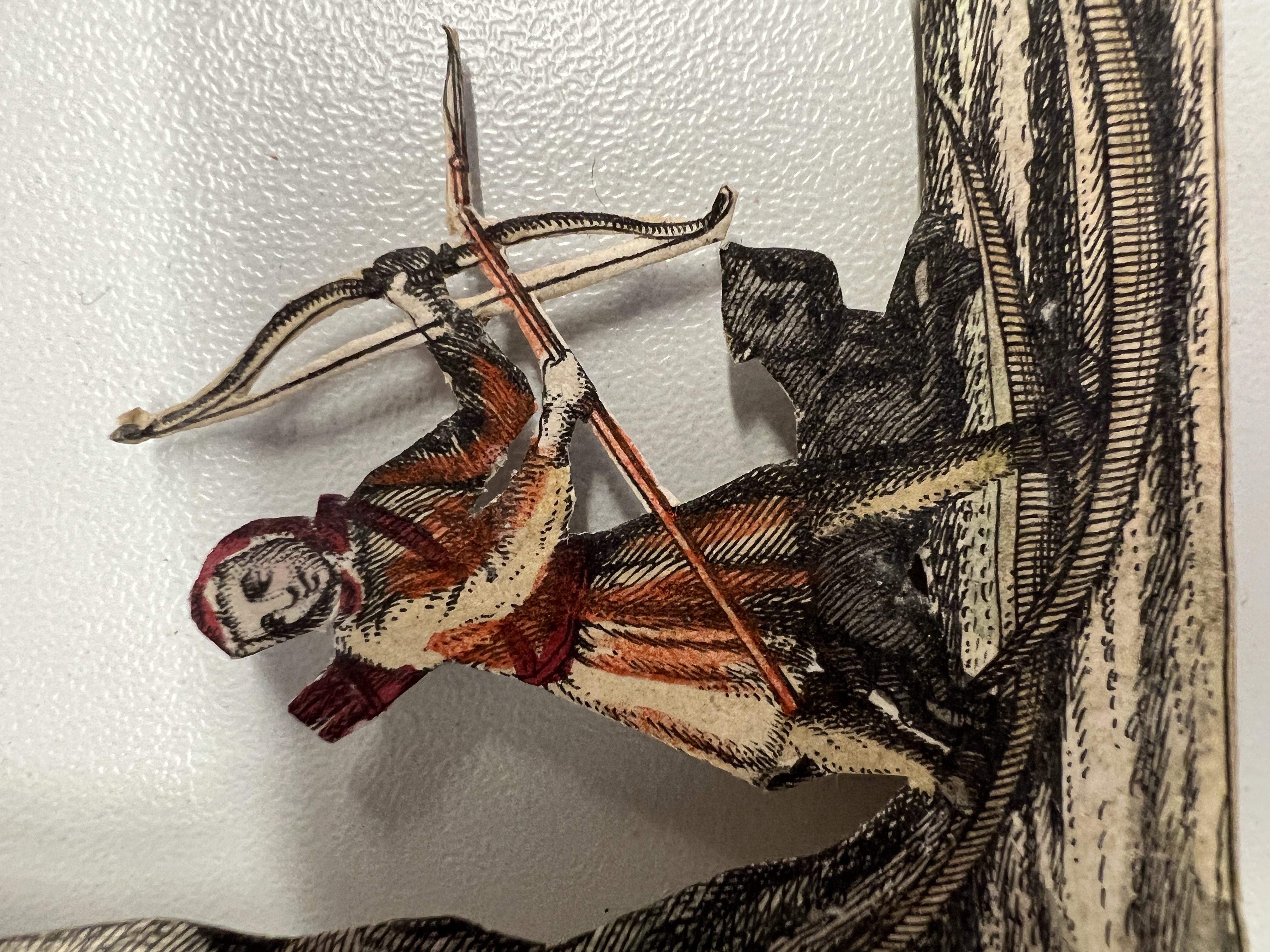 |
Figure GT49.6 –Coulisse Detail |
This arctic hunter has very fanciful snowshoes, or perhaps skis, and his dog has a perplexingly human face. Photo © Rod Bantjes. |
The Images:
Size and Variety: The scene that came with this box was of arctic hunters (Figures GT49.5 and .6). However, Englebrecht’s workshop produced a huge selection for the kulissentheater – around 200 subjects in 3 different formats. Format sizes were defined by the large folio sheets of paper used by engravers. Multiple images would be created in a single impress then cut: four parts for the quarto format (15.6 x 20.8 cm); eight for the octavio format (9.2 x 14.3 cm) and 12 for the duodecimo format (7.3 x 9.0 cm). Engelbrecht employed two artists, Jeremias Wachsmuth (1711-1771) and Johann David Nessenthaler (1717-1766), to help him produce this huge output. Fusslin et al. calculate that they were active between 1737 and 1770.[10]
Proprietary Images: Most optical machines of the 18th century used standard-sized vues d’optique supplied by numerous print-makers. Vues d’optique were printed on folio sheets approximately 36.8 x 46.6 cm, although the engraved copper plate and therefore the image was always smaller than this. The handmade, “laid” paper of the period was expensive and Englebrecht’s quarto, octavio and duodecimo sizes saved on costs. They also allowed him to produce smaller, cheaper boxes. In 1719 Englebrecht was granted a patent, or “imperial privilege,” for his distinctive images (renewed 1729 and 1739).[11] . This is probably the first example of a proprietary format for the optical machine. Later examples correspond to innovations in image-making: Henri Lefort’s paper dioramas and Carlo Ponti’s and Francis Frith’s special photographic formats. Optical box designs have often been shaped by image-making technologies.
The scope and enforceability of Englebrecht’s patent is unclear, however, vertical kulissentheatrers were later made by others. There is a French example, ca. 1885, with litho images in the Foticos Museum in Zaragoza, Spain.
Cutouts: The cut-out openings are very precise: you can see in Figure GT49.6 that the archer’s bowstring has been carefully separated from the bow. The slender tip of his spear has weakened but has remained miraculously unbroken for nearly 300 years. By contrast, the cutout silhouettes of later paper theatres only follow generalized outlines. Englebrecht likely contracted out this painstaking work to sweatshops where it could be done cheaply by women and children.[12]
Spacing: In some cases, including this one, the prints are unevenly spaced in the box: the closer parts of the image are close together and the further ones are progressively further apart. If camera obscura focus were the inspiration, this spacing would make sense as more changes of focus are necessary the closer things are to the camera. That is not to say that the camera obscura was used to draw these scenes. The fanciful details and remote setting of the arctic scene were certainly not taken from life in this way.
Endnotes:
[1] I would like to thank Dr. Peter W. Marx for permission to access the collection and Charlene Fündgens, Emma Gebbeken and Gerald Köhler for their generous assistance in the archive.
[2] Based on Neke’s numbering that will likely change once the Cologne Theatre Studies Department properly catalogues the collection.
[3] Füsslin, Georg, et al., Der Guckkasten : Einblick, Durchblick, Ausblick (Stuttgart: Füsslin, 1995), 49.
[4] Harris, Joseph, A Treatise on Optics (London: B. White, 1775), 230.
[5] See La Hire, Philippe de, Un Traite Des Differens Accidens De La Vue (Paris, 1685), 237; Porterfield, William, A Treatise on the Eye, the Manner and Phænomena of Vision (Edinburgh: G. Hamilton and J. Balfour 1759), 410.
[6] Harris, Treatise on Optics, 232.
[7] Molyneux, William, and Edmond Halley, Dioptrica Nova, a Treatise of Dioptricks(London: Printed for Benj. Tooke, 1692).
[8] Fink, Daniel A., "Vermeer’s Use of the Camera Obscura - a Comparative Study," The Art Bulletin 53, no. 4 (1971).
[9] Füsslin, Der Guckkasten, 13.
[10] Ibid., 49.
[11] Ibid., 49.
[12] Ibid., 52.