Rod Bantjes, “DFF-88-A-724 _Guckkasten.html,” created 9 August, 2025; last modified, 22 January, 2026 (https://people.stfx.ca/rbantjes/).
Viola Guckkasten
Deutsches Filminstitut & Filmmuseum (DFF)[1] #DFF-88-A-724
German c.1880
Dimensions: H=59.4 cm, W=33.8 cm, D=63.1 cm
Lens: ⌀=6.3 cm, ƒ=67.2 cm
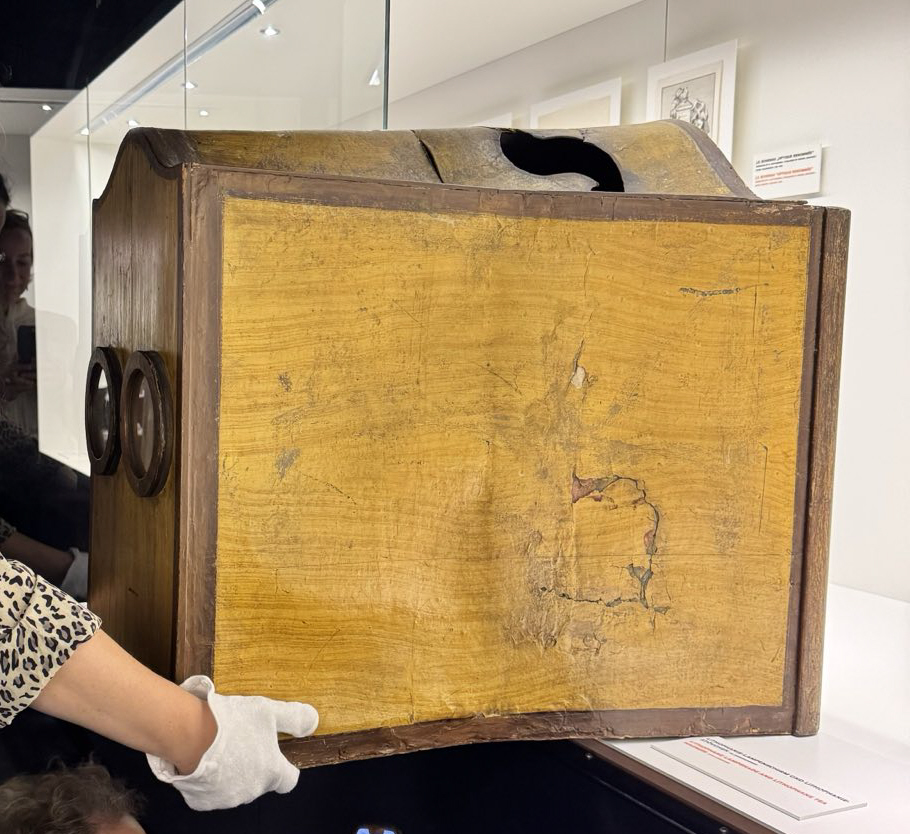 |
Figure 88-A-724.1 – Viola Guckkasten |
| Photo © Rod Bantjes. |
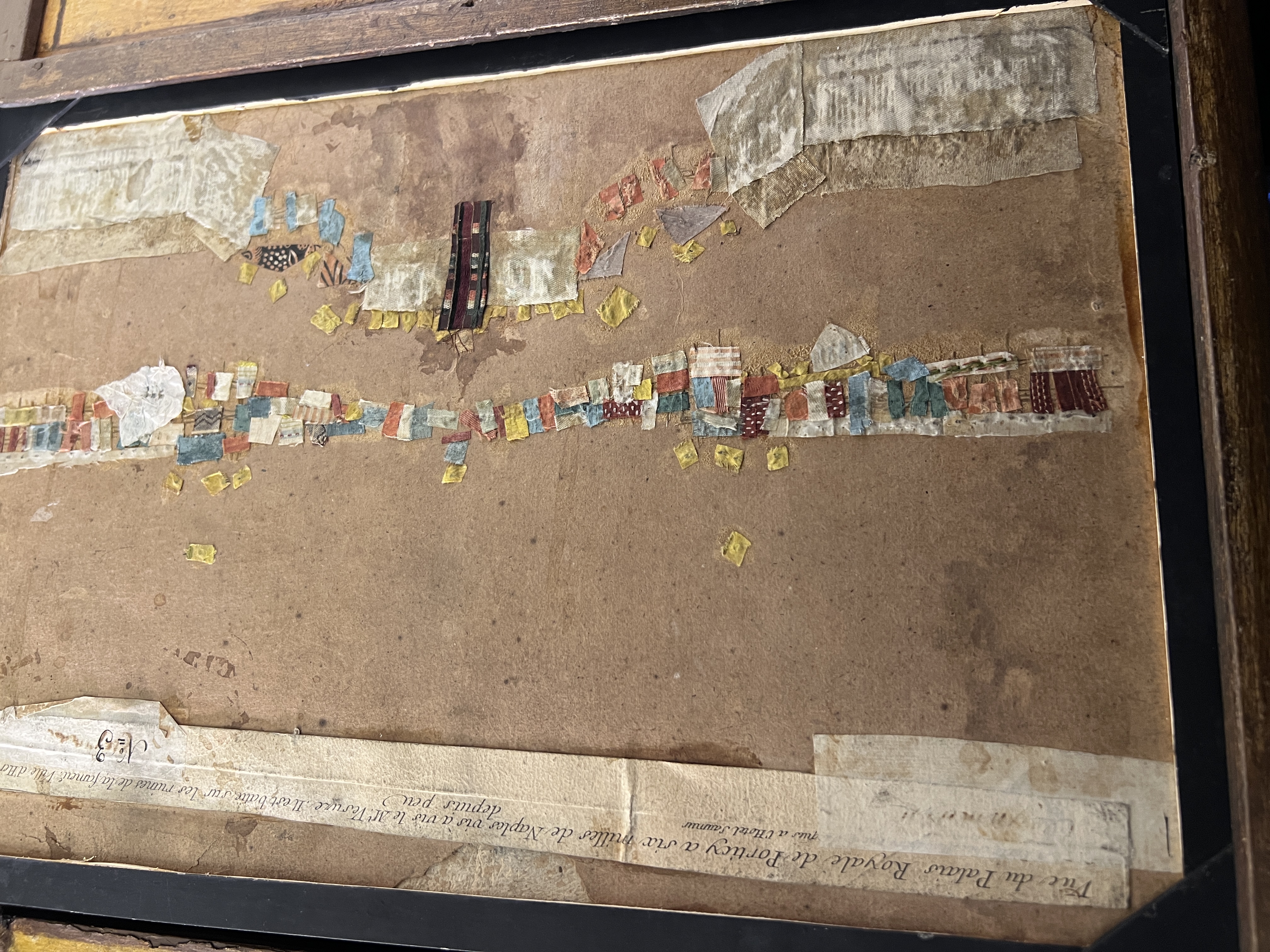 |
Figure 88-A-724.2 – Back of the vue d'optique |
| Photo © Rod Bantjes. |
This is a large, home-made, horizontal viewer for vues d'optique. It is an example of an "optical machine " and is included in the Optical Machine Taxonomy.
The styling is original and unique. To illuminate the front of the image, the maker has cut f-shaped holes in a curved top like the belly of a violin or viola. For this reason I call it the viola guckkasten. The sides curve outward to a wide front containing the two lenses. This flaring outward is typical of Italian mondo niovos. The curved top is made of pasteboard and the sides of wood veneer.
The lens-frames are crudely cut out rather than turned on a lathe. They are attached with unconcealed screws. These are marks of amateur construction. The viola guckkasten calls to mind another home-made box – The Crypt.
The view is framed by a black mask set halfway between the lenses and the image-plate. There are four slots that allow frames to be slid in from the top into the viewing area. How these were used is unclear since there is no flytower into which to lift them. Four images might have been stacked one in front of the other and lifted out and set aside in some sequence. In that case only the last view could be back-illuminated. It is also possible that coloured screens might have been used to alter the lighting.
The vue d'optique that is currently in the box – Vue du Palais Royale de Porticy a six milles de Naples vis à vis le Mt. Vesuve –is very inventively illuminated. It has numerous piercings, some very finely cut. Many vues d'optique have coloured paper glued to the piercings to produced coloured light; this one uses coloured cloth of different thicknesses and textures, possibly varnished in an effort to increase translucency.
There is no integrated support upon which to set the candles or lamp for back illumination such as one finds with mondo niovos. The box and light source were probably meant to sit on a table. This is further reason to think this was a home-made construction for home use, like the The Crypt.
Footnotes
[1] I would like to thank Stefanie Plappert for her assistance at the DFF – Deutsches Filminstitut & Filmmuseum..