Rod Bantjes, “DFF-91-A-102_35-mm_Viewer.html,” created 9 August, 2025; last modified, 26 January, 2026 (https://people.stfx.ca/rbantjes/).
Filmoscope
Deutsches Filminstitut & Filmmuseum (DFF)[1] #DFF-91-A-102
French c.1920
Dimensions: H=2.8 cm, W=4.1 cm, D=5.8 cm
Lens: ⌀=2 cm, ƒ=6.7 cm
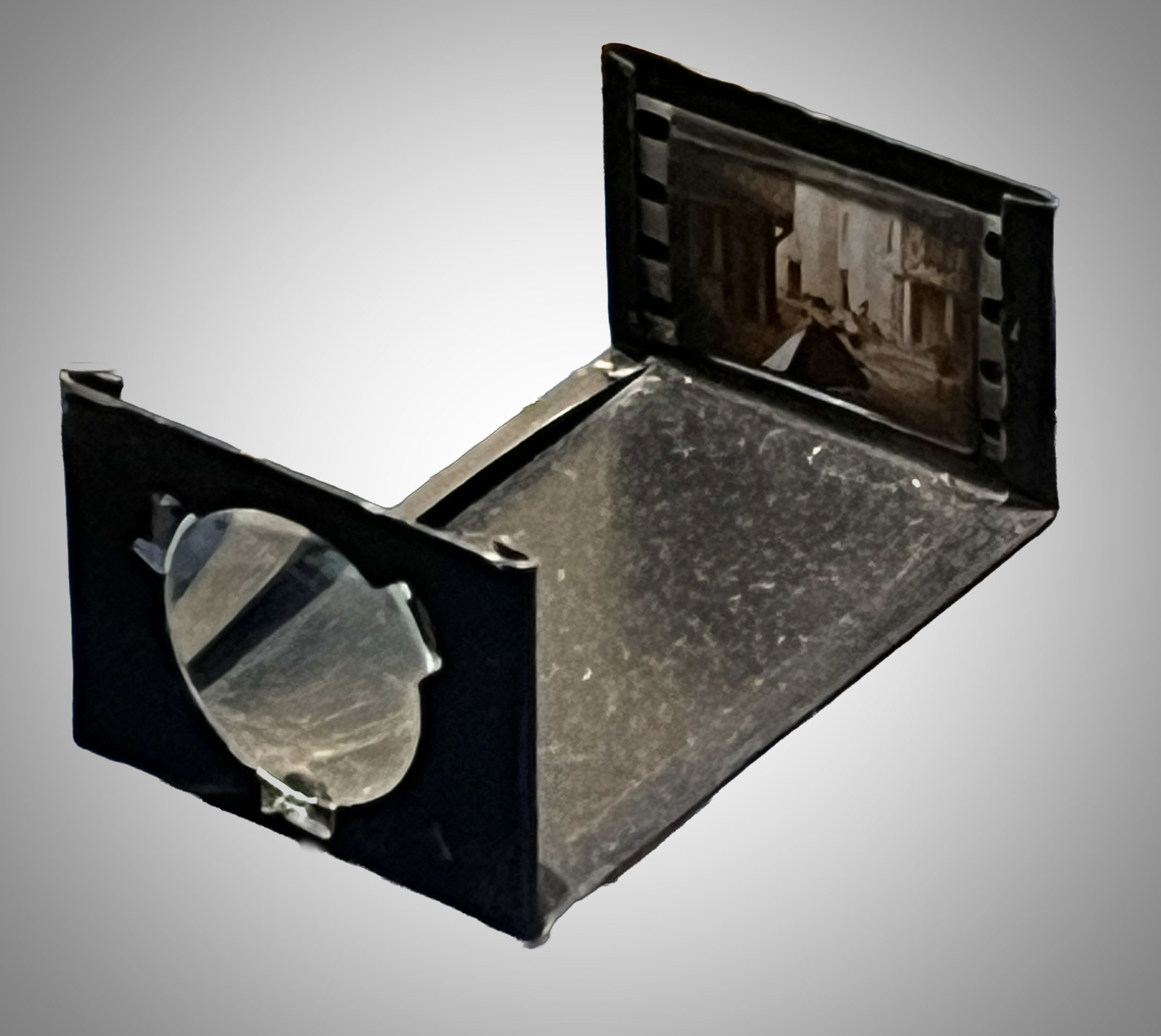 |
Figure 91-A-102.1 –35-mm Transparency Viewer |
| Photo © Rod Bantjes. |
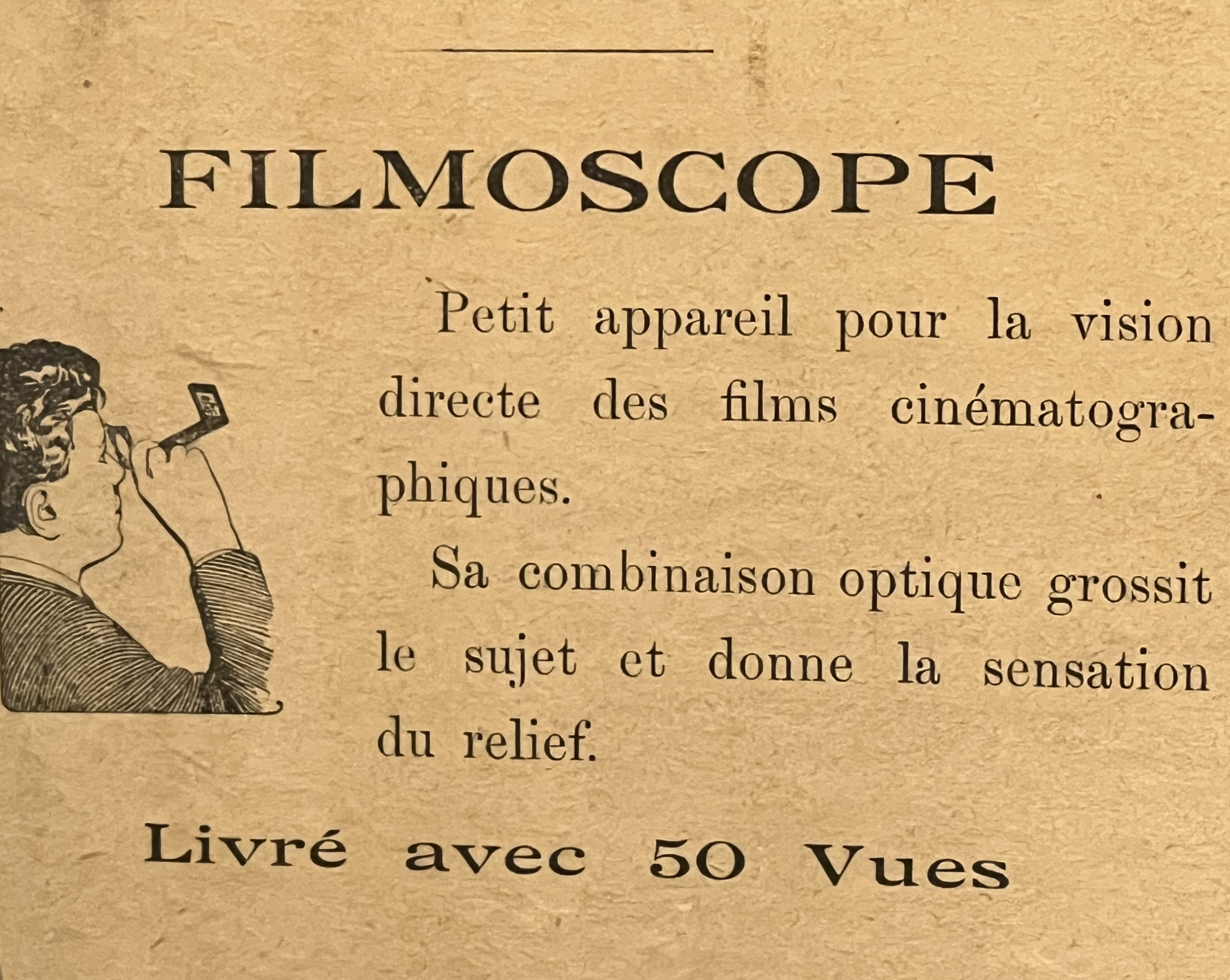 |
Figure 91-A-102.2 – Claim for 3D Effect |
| Photo © Rod Bantjes. |
This is a horizontal, small-lens viewer for 35 mm film transparencies. It is an example of an "optical machine " and is included in the Optical Machine Taxonomy.
Made of tin, it is the smallest and lightest of all the optical machines. The images it uses are smaller than those of the Peep Egg. For that device we decided that the biconvex lens no longer functions to provide a 3D effect, but is rather for magnifying the tiny images. However, in the case of the Filmoscope, the makers claimed that it gives a sensation of relief (see figure 91-A-102.2). I fail to see any 3D enhancement, but clearly some people were convinced of it (or at least hoped to convince others) as late as the 1920s.
The Filmoscope is an example of the optical machine's success in hybridizing with new technologies – in this case the celluloid film images of cinema. The transparent slides appear to be separate frames from film reels, perhaps editing off-cuts. Numerous similar devices were produced from this time onward: the Diavist, the Scoper, the Kino-Onik, the Rodo-Kino, the Ciné Mignon, the Rota-Film. Many of the names draw on the prestige of cinema to dignify the new miniature optical machine.
The Filmoscope comes in a box of scientific toys including a gyroscope, kaleidoscope and animation flip-book.
[1] I would like to thank Stefanie Plappert for her assistance at the DFF – Deutsches Filminstitut & Filmmuseum..