Rod Bantjes, “EXBD-69024_Zograscope_Part.html,” created 6 September, 2025; last modified, 10 February, 2026.(https://people.stfx.ca/rbantjes/).
Zograscope Part
Bill Douglas Cinema Museum[*] #EXBD-69024
English? ca. 1760
Dimensions: H= cm, W= cm, D= cm
Lens: ⌀=10 cm, ƒ=60.5 cm
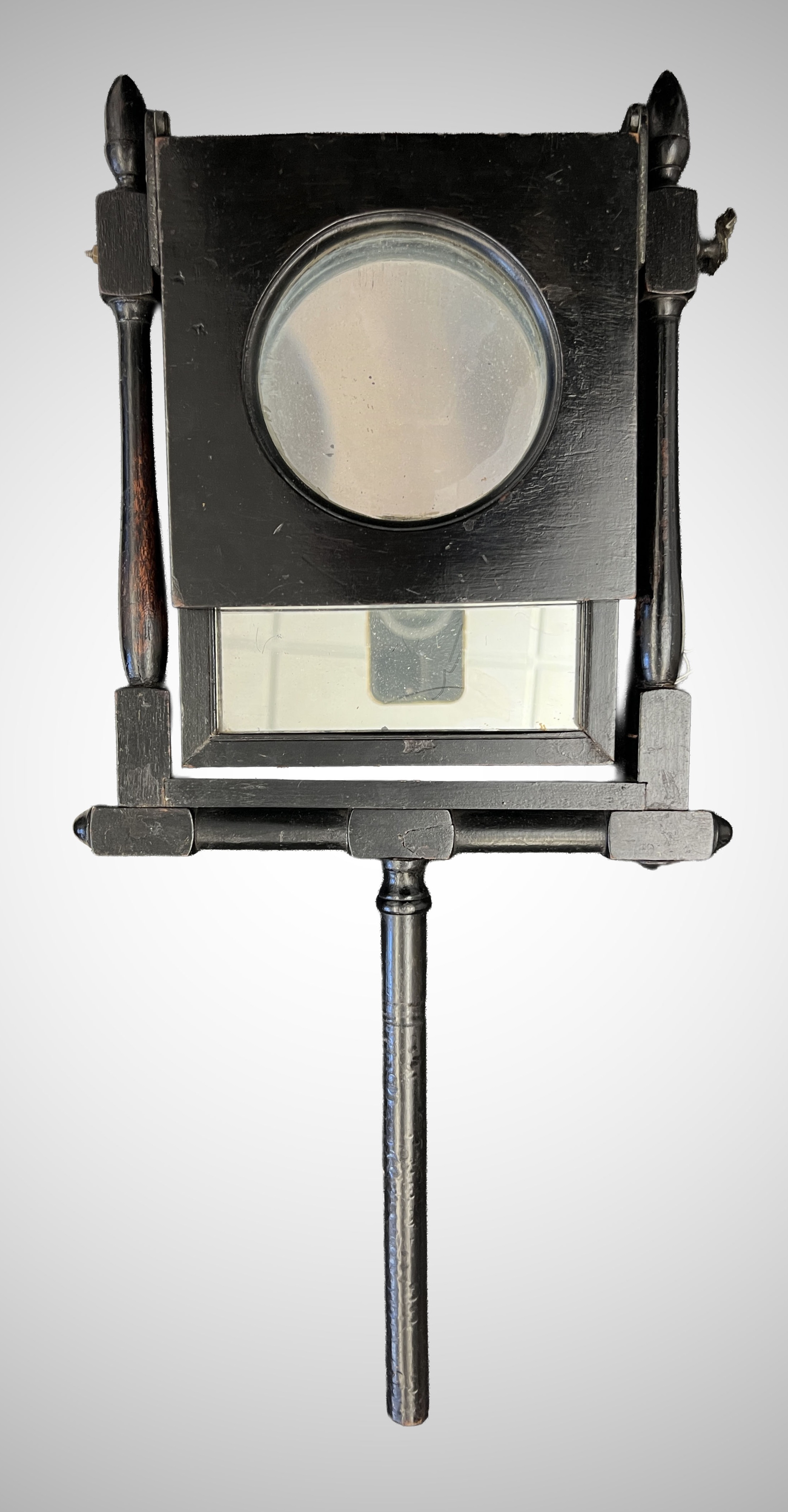 |
Figure EXBD-69024.1 –Zograscope Part |
| Photo © Rod Bantjes. |
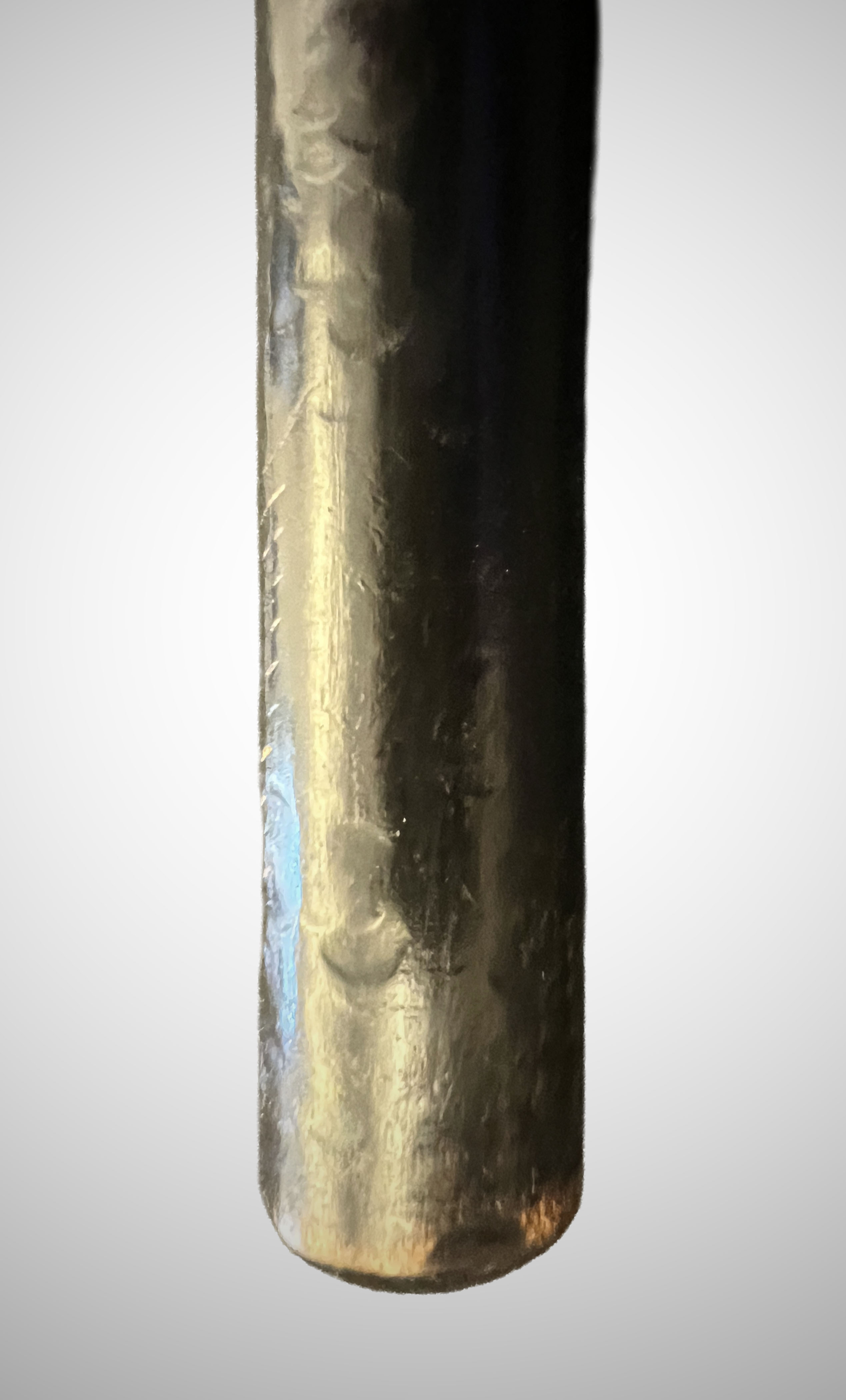 |
Figure EXBD-69024.1 – Sliding Inner Column |
| Note that the thumbscrew dents extend almost to the end of the stick indicating a long distance between lens/mirror assembly and the observed print. Photo © Rod Bantjes. |
This is the top section of a Zograscope – a biconvex-lens viewer for enhancing the 3D-effect of copper-plate engravings known as vues d'optique. It is an example of an "optical machine " and is included in the Optical Machine Taxonomy.
The mirror swings out and is held in place at a 45-degree angle by tightening two wooden thumbscrews. It reflects the print (set flat on a table) up through the lens.
This example is quite tall relative to other zograscopes – 24.8 cm from the T-bar to the top of the mirror frame. The lower shaft would have inserted into a wooden turned base and could be adjusted for height. This component too was unusually long – 20.2 cm. Different people or perhaps different sizes of prints demanded that the height (and distance between lens and print) be readjusted. Dents from the wooden thumbscrew indicate frequently adjustments and a wide variation (16.5 cm) in what was thought to be the right position.
The zograscope could also have been used without its base, as Joseph Harris explains: "A convex lens fixed in a frame to be held in the hand, and having before it a plane speculum inclined at the proper angle, or moveable upon a hinge so as to be readily set to this angle, will make a portable apparatus for the pockets,[xxx] and may be useful for viewing prints we casually meet with abroad".[xxx]
For more about zograscopes and their uses and meanings, follow this link.