Rod Bantjes, “EXBD-69120_Lorgnette.html” created 9 June, 2025; last modified, 10 October, 2025 (https://people.stfx.ca/rbantjes/).
Lorgnette Pittoresque
Bill Douglas Cinema Museum[*] #EXBD-69120
French c.1848
Box dimensions: H=8.4 cm; W=8.4 cm; D=13.4 cm
Lens: ⌀=4 cm, ƒ=8 cm
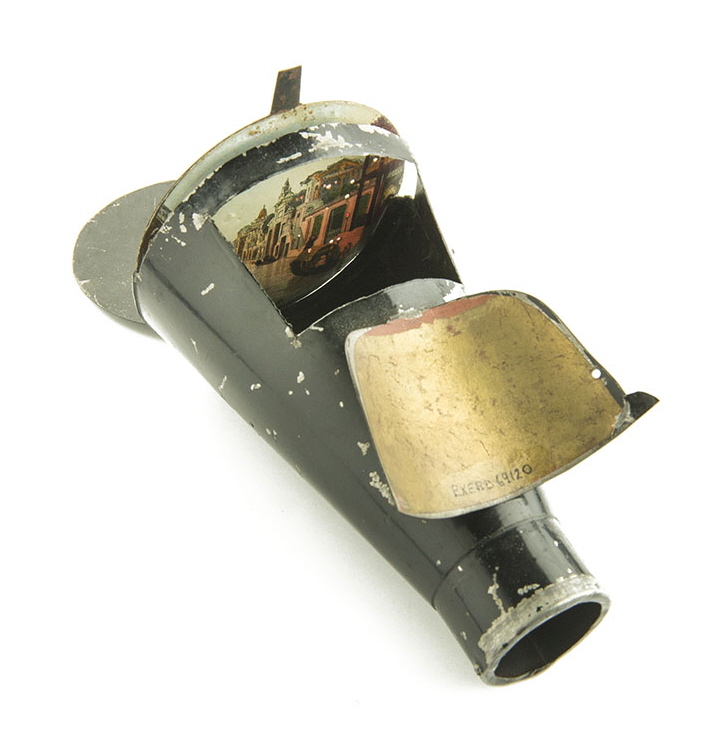 |
Figure 69120.1 –Lorgnette Pittoresque |
| The top flap swings over the opening to control front illumination.
Photo credit: Bill Douglas Cinema Museum. |
 |
Figure 69120.2 –View Transformation within the Lorgnette Pittoresque |
| As the front flap opens and the top flap closes a fire breaks out![1].
Gif image © Rod Bantjes. |
This is a small, portable, lensed viewer of paper diorama from the workshop of Henri Lefort (1804-1880). It is an example of an "optical machine " and is included in the Optical Machine Taxonomy
Structure and Use:
The French call it a lorgnette pittoresque. It is like a lorgnette, or opera-glass – handheld, portable, able to be brought to the eyes for a close-up, personal view of the theatrical scene. It holds small, circular tissue views – 8.1 cm in diameter, almost as small as the stereoscopic tissue-views (ca. 7 cm) that the French produced in great numbers in the 1860s.
The viewer is very lightweight – made of tin, painted with black enamel. It has a circular back-flap that can be opened for back-illumination. It is meant to be held with the little trap door at the top. This has a corner tab to lift and lower it and a gold-coloured reflective coating to direct light into the viewer to illuminate the front of the image (see figure 69120.1).
'Dioramic' Views:
The circular tissue-views are in little cardboard packages of about six each, labelled as 'series.' The maker promises that there are up to 90 different views available for purchase. Each disk consists of image-layers glued to a thin steel frame. The front layer is a coloured lithograph, pierced and hand-painted either on the back surface or on an intermediary layer to create effects that were common in 18th-century showboxes: a transition from a daylight to a night scene with a shimmering path of moonlight over water for example. The lighting mechanism is the same as in the old showboxes – opening a back flap to increase back-illumination and a top or front flap for front illumination. In this case the user herself controls the illumination – slowly closing the front flap while opening the back flap to transition the scene from day to night (see figure 69120.2).
 |
Figure 69120.3 –Dissolving View |
| When the front flap is completely closed the image of Eglise de Nicholai is extinguished and replaced by Statue de Pierre le Grande. [2]
Gif image © Rod Bantjes. |
Surprise Elements: Some of these disks have painted figures in the underlayer that emerge into the scene as the illumination shifts (e.g. additional figures running from the fire in figure 69120.2). This was a 19th-century innovation from as early as 1838. The Bill Douglas Museum has an example of a 'dioramic view' (catalogue #70212) of the coronation of Queen Victoria published in 1838. The young Queen and crowds of people, absent at first, fill Westminster Abbey when the image is back-illuminated.
Dissolving Views: A few of the circular disks have as an underlayer a second coloured lithograph of an entirely different scene. In one example an image of the Eglise de Nicholai dissolves into an image of a statue of Pierre le Grande rearing up on his horse (figure 69120.3). To achieve this effect the user must open the back flap and completely shut the front one to extinguish the first image. 'Dissolving views' of this kind can be dated to as early as 1840 with Spooner’s 'Protean View' No. 28 which transitions, when back-illuminated, from an image of the Thames Tunnel to one of the Coronation Procession (Brunel Museum, #LDBRU:2008.02(a)).
The Audience for the Lorgnette Pittoresque:
Lefort appears to have intended his dioramic viewers primarily for children. We know that the lorgnette pittoresque was used in the school for girls at the Ursuline convent in Quebec, Canada. It might have been seen as a way to enliven geography lessons. The lorgnette did provide illustrations of some of the great monuments of European cities – sometimes with purely fanciful embellishments like flames bursting from windows.
A notice of a society soireé in 1854 shows that adults too could take pleasure in these miniature dioramas. An 'incendie' like that in figure 69120.2 was met with 'cries of alarm.' The lorgnette pittoresque which 'M. Lefort [has] managed to make as small as a pair of opera glasses' was recommended to the assembled women as a secret, private pleasure in public: 'During the lengthy recitatives of our great opera singers, you can sneak away to Switzerland, Germany, or Saint-Petersburg, right in the middle of the Stemboch arcade, which is gaslit like every arcade in Paris.'[3]
Note on Dates:
The Cinémathèque française attributes the lorgnette pittoresque to Pierre Henri Amand Lefort and gives it a date sometime after 1849 when Lefort submitted his patent for the polyorama panoptique (Bill Douglas #EXBD-69055). However, as early as 1848, and probably as early as 1846, Lefort had been making 'dioramas of all dimensions' and 'lorgnettes-dioramas.'[4] The latter could well refer to the lorgnette pittoresque. The only new thing in the 1849 patent is the bellows that allowed for adjustments of the distance between lens and image that he used exclusively in the polyorama panoptique. By 1849 all of the other 'dioramic' features – front and back lighting by means of flaps; layered images including piercings; underlayers with hidden colours, shading, additional figures and alternate images – had already been developed by others.
Variants: There is a beautifully decorated lorgnette pittoresque with Chinese motifs in the François Binétruy collection. Construction details mark it as from the Lefort workshop. We might say that it is a colour variant of the same "species" of optical machine. This would also have been a more expensive variant perhaps carrying more prestige.
Footnotes:
[*] I would like to thank the Bill Douglas Museum for a stipend that supported my research there and the staff of the museum for their generous assistance..
[1] This GIF is based on a video of the actual device filmed through its rather dirty lens..
[2] This GIF is an animated simulation not done within the lorgnette pittoresque.
[3] Pellerin, Denis. 'Henri Lefort: The Ultimate Entertainer.' The Stereoscopy Blog. (2022). Accessed June 7, 2025. https://stereoscopy.blog/2022/06/21/exclusive-free-online-publication-henri-lefort-the-ultimate-entertainer/, 20..
[4] Lefort's dated letterhead reproduced in Pellerin, 'Henri Lefort.'.