Rod Bantjes, “EXBD-69139_Reflectoscope.html” created 9 June, 2025; last modified, 21 May, 2026 (https://people.stfx.ca/rbantjes/).
Reflectoscope
Bill Douglas Cinema Museum[*] #EXBD-69139
English ca.1920
Box dimensions:
Lens: ⌀=11.3 cm, ƒ=18.5 cm
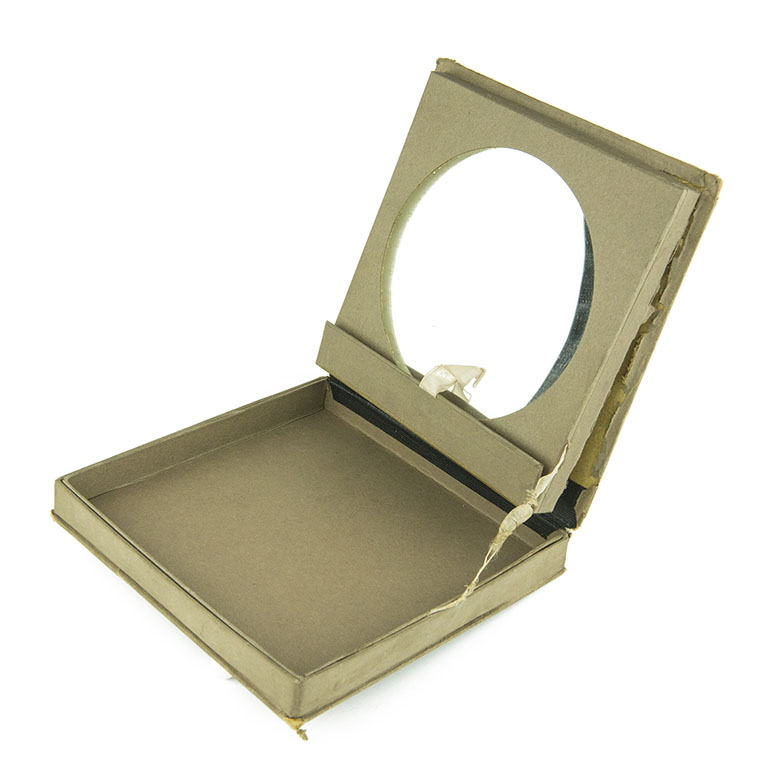 |
Figure 69139.1 –Reflectoscope |
Photo credit: Bill Douglas Cinema Museum. |
This is a pocket-sized concave-mirror viewer meant to enhance the depth effect of photographic snapshots or picture postcards. It is an example of an "optical machine" and is included in the Optical Machine Taxonomy.
The instructions are to ‘place the Picture Postcard in the groove facing the Mirror.’ The user was meant to look over the back of the image-card to its reflection in the mirror. Arther Judge writes in 1926 that ‘the “Reflectoscope,” now on the market, greatly improves the viewing of single photographs and gives a partial stereoscopic impression.’[xxx]
The device folds up into a little box of about 15 cm square. Two other viewers of this design were marketed in the early 20th century. The English-made Ensign Snapscope was advertised as giving ‘an enlarged view of your Snapshots and a striking stereoscopic effect.’[xxx] The American Shomescope, patented in 1913, was probably the most popular of the three variants judging from the number of them that show up at auction.[xxx] The Reflectoscope, constructed of cardboard, is the most ephemeral of the three and this may be partly why it is now the rarest. It was still in use in the 1930s.[xxx]
Concave mirror viewers are a variant of lensed viewing devices such as zograscopes and peepshows, examples of which are in the Bill Douglas Museum collection (e.g. EXBD-69075; EXBD-69027). Both the mirror and the lens change the angle of convergence of the two eyes in a way that in theory should make the depicted scene or object appear farther away, larger and more true to life.
These 20th-century snapshot viewers are descendants of 18th-century concave mirror devices. There are accounts of English versions for vues d'optique from 1749 to 1792.[xxx] A Dutch version for transparent glass coulisses known as a Perspectiefkast is recorded as early as 1714. The concave mirror viewer reappeared in the mid-19th century in the form of the Mirroscope.