Rod Bantjes, “WN-PA257_Perspectiefkast.html,” created 10 August, 2025; last modified, 18 October, 2025 (https://people.stfx.ca/rbantjes/).
Perspectiefkast [1]
Werner Nekes Collection, Theatre Studies, University of Cologne[2] #WN-PA257
Netherlands c.1750
Dimensions: H=37.2 cm, W=46.1 cm, D=9.6 cm
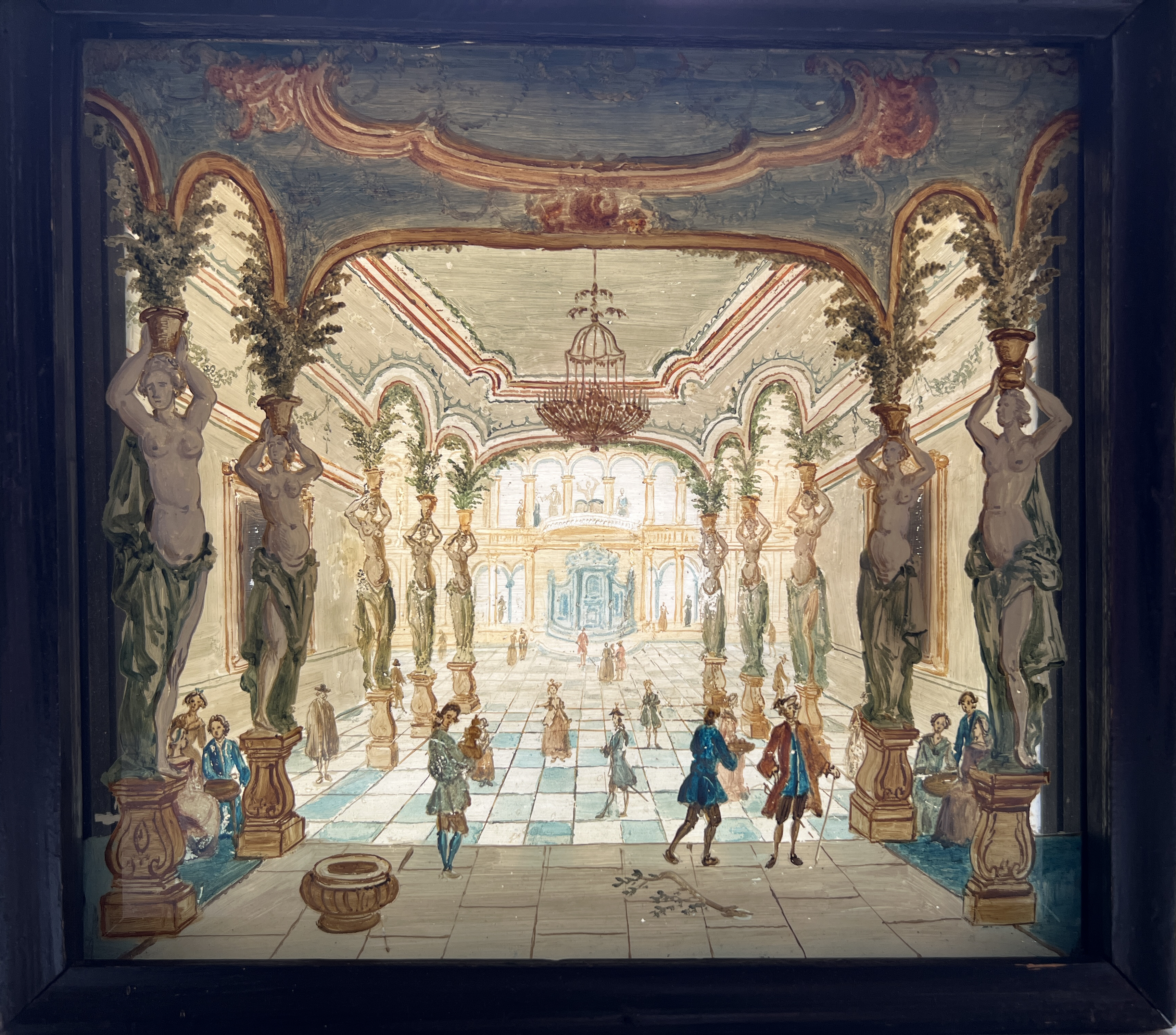 |
Figure PA257.1 – Perspectiefkast |
| Theatrical scene,[*] oil on glass, 34 x 43.8 cm. Photo © Rod Bantjes. |
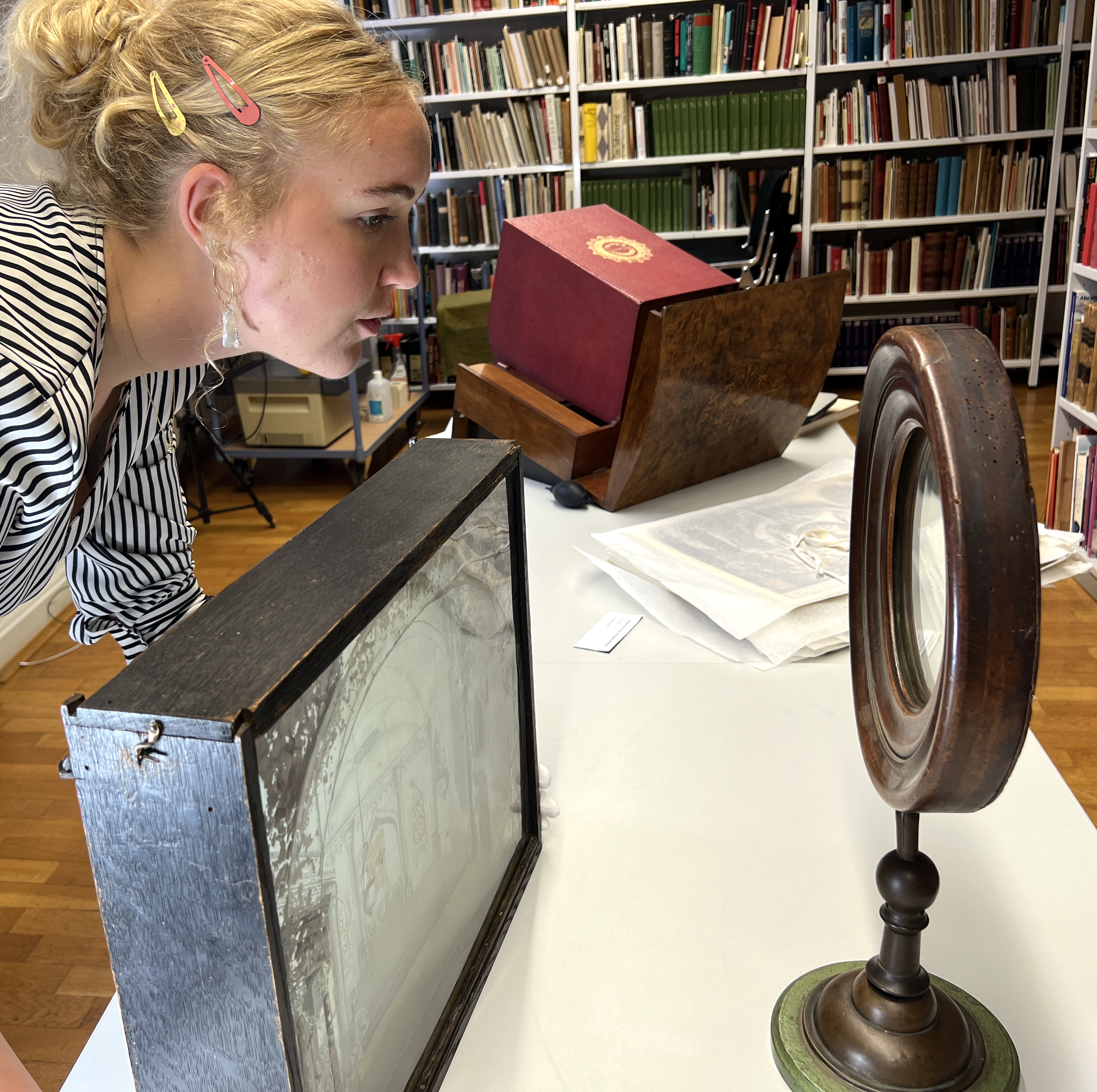 |
Figure PA257.2 – Viewing in the Concave Mirror |
| Photo © Rod Bantjes. |
This is a set of glass coulisse-frames meant to be viewed in a concave mirror. It is an impressive example of the 3D effect possible in an 18th-century "optical machine."
How to use it: Emma Gebbeken is demonstrating how to use the device (Figure PA257.3). She turns the glass theatre away from her towards the mirror and looks over the back of the case at the scene reflected in the mirror. To her right, out of view, is a spotlight illuminating the scene from behind.
Trying out the device for the first time in 2025, Emma started by making exploratory moments with her body and the glass case until she found the "sweet spot" where the 3D illusion was most powerful. Then she had to move her head up, down and side to side to take in the full extent of the room depicted in Figure PA257.2.
Luminous Glass: The perspectiefkast is one of very few optical machines to use glass coulisses. The painter Thomas Gainsborough's show-box is another.[3] Glass allows a much greater range of effects than paper. Like paper dioramas these coulisses use back-shading to create different intensities of illumination. While the light comes from behind, thinly applied paint appears bright, as though glowing from within, so that front illumination is not needed.
Little details like suspended lights or leaves can hover anywhere in transparent space. They do not have to be continuous with a coulisse frame as in Engelbrecht's cutout paper coulisses. Image-differences are painted on both sides of the glass so very fine parallax effects are possible. Glass renders space more persuasively than paper – it evokes a volume suffused with light, continuity and openness.
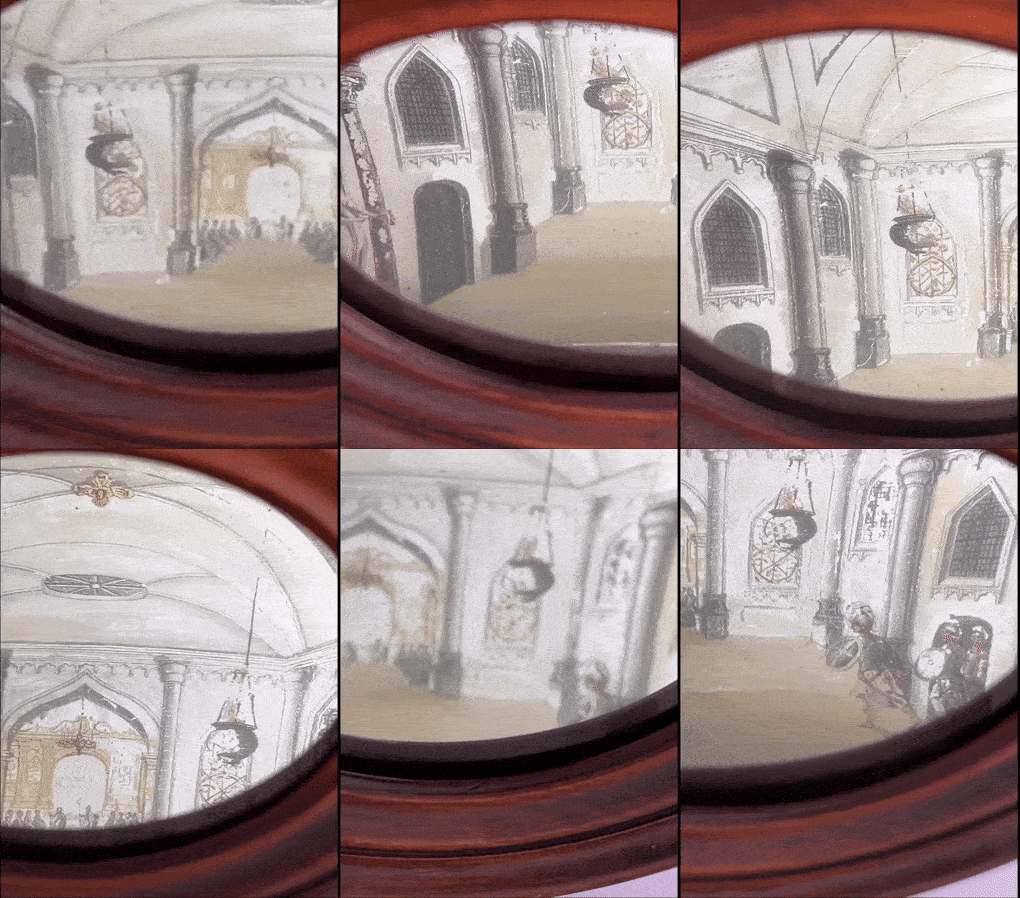 |
Figure PA257.3 – Perspectiefkast |
This gif offers a rough approximation of what it looks like surveying the scene through the mirror. Gif Image © Rod Bantjes. |
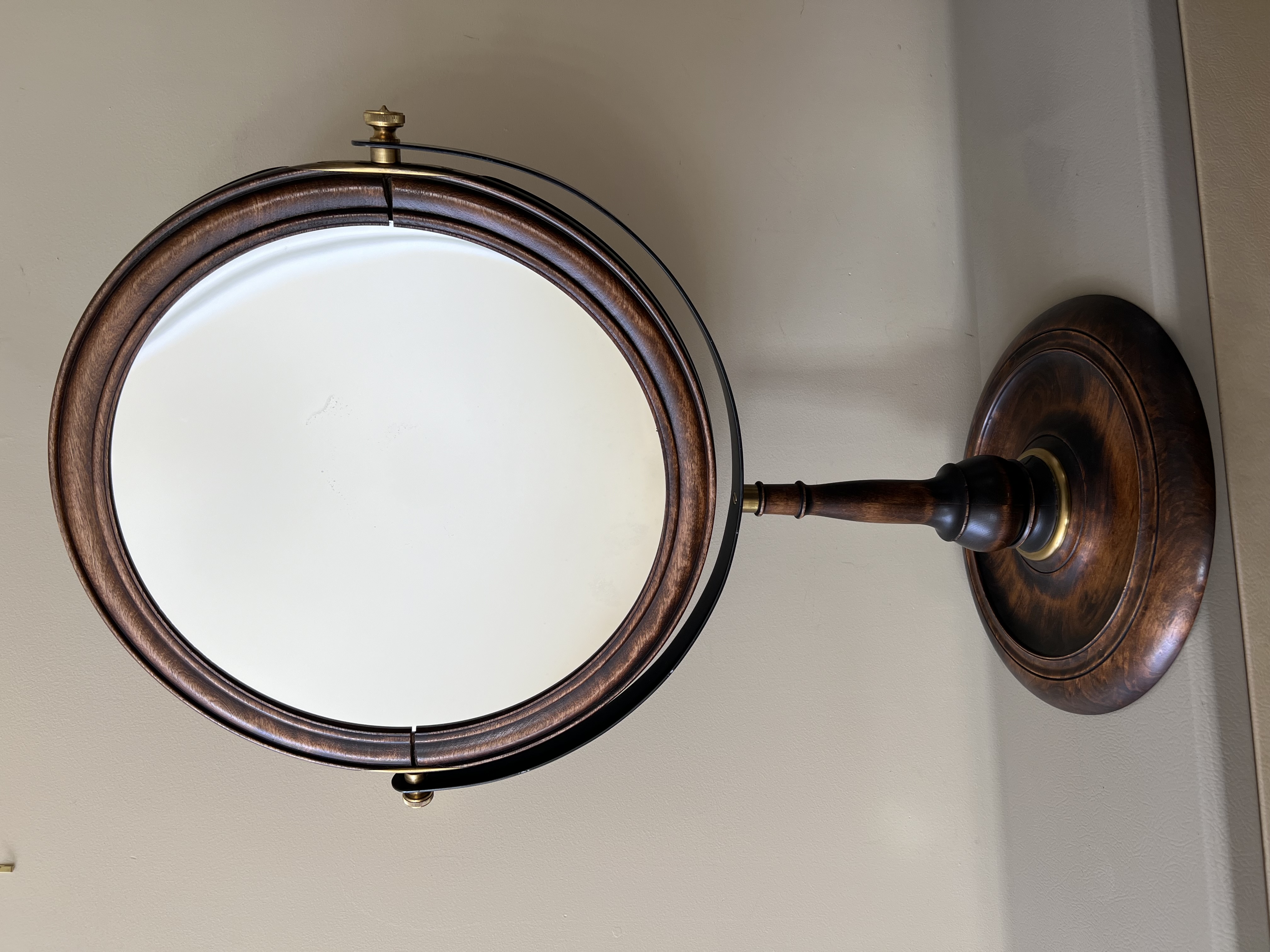 |
Figure PA257.2 – Concave Mirror |
This mirror, 40.5 cm in diameter and 63.5 cm focal length is close to the size that the Dutch would have used in the 18th century. Photo © Rod Bantjes. |
How it Works (The Mirror): The concave mirror has the same effect as a convex lens on the angle of convergence of the two eyes. It brings the eyes closer to parallel, as they would be when viewing something in the far distance.
We used a relatively small 19th-century mirror with a diameter of 16.7 cm and focal length of 51 cm – the only one available to us in the Werner Nekes collection. Early 18th-century mirrors were also relatively small and often made with burnished metal rather than glass. By 1735 mirrors of 46 cm were advertised in Dutch catalogues of optical devices.[4] After 1760 mirrors between 45 and 60 cm in diameter begin to appear in the Netherlands associated with the perspectiefkast.[5] I have yet to locate and examine one of these large mirrors, but I suspect that their focal length would be similar to the biconvex lenses used in optical machines – perhaps 60 to 90 cm.
How it Works (Parallax): The perspectiefkast has an open structure like a zograscope. There is no box into which one peers. Unlike the zograscope, and all of the lensed optical machines, there is not aperture that one looks through.[6] The viewer has a wide range of motion that she can use to enhance the parallax effect.
This range of motion is likely what allows the glass sheets to be placed close together: 1.6 to 2.6 cm apart. By contrast, the coulisses in Engelbrecht's boxes, where the view is constrained by small lenses, are 6 to 11 cm apart. Despite their close separation, the perspectiefkast glasses seen through the mirror seem to draw apart, elongating the space to three times its actual extent.
Concave Mirror Assemblage: Perspectiefkasts have survived in museums and private collections mostly without their concave mirrors. Collectors and archivists are sometimes unaware of this crucial accompaniment.[7] The mirrors or "burning glasses" were sold separately and could be used for scientific and "rational recreation" purposes other than enhancing 3D images.
Owners came from an educated elite who possessed a working knowledge of optics that has largely been forgotten. There was no doubt a degree of experimental freedom as to how they used these devices. In the same spirit, Emma Gebbeken speculated whether the mirror could have been used with other toy theatres. According to Wagenaar et al. she was right, paper theatres, much cheaper than glass, were frequently viewed through the concave mirror.[8]
The English Gentleman's Magazine advised in 1749 that "A concave mirrour shews perspectives, &c. to equal, if not greater advantage [than a biconvex lens], by reflexion, if they are placed in the focus, without any other apparatus: but those that are large enough for this purpose are sold at a high price." By "perspectives," here, the writer probably means simple vues d'optique.[9] The "&c." in this quote points to the open possibilities of the use of a concave mirror.
A further element of the perspectiefkast assemblage that is often missing is the lightbox containing candles or lamps and a reflective surface. The one depicted in Wagenaar et al. is quite large and sits on a table between the observer and the coulisse-case.[10]
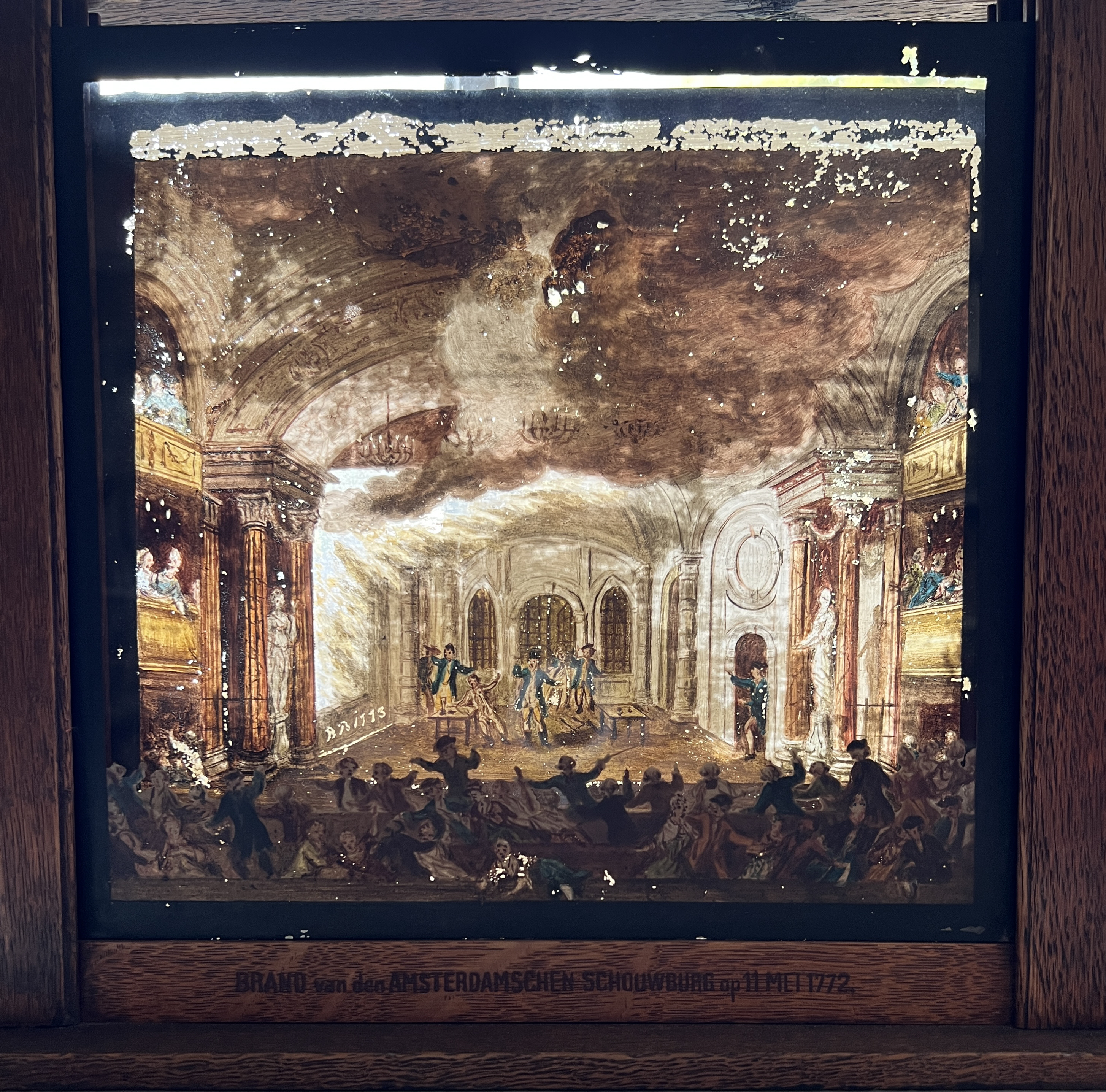 |
Figure PA257.4 – Fire in the Amsterdam Theatre, 1772. |
Photo © Rod Bantjes. |
18th-Century Context of Use
Owners: The device appears to have been exclusive to the Netherlands. Wälde's review of Dutch estate sales shows that owners were bourgeois professionals exclusively: government officials, physicians, professors. The perspectiefkast was typically one among many optical and scientific devices they owned.
The cases for the glass were, like Engelbrecht's boxes, made of oak, simply constructed and minimally adorned. However, the large mirrors were expensive and the hand-painted scenes were more like original works of art compared to Engelbrecht's engraved coulisses. Wälde is probably right that the perspectiefkast was more expensive than a magic lantern or peepshow (the Dutch version or rarekiek).[11] Unlike Engelbrecht's kulissentheater it was beyond the reach of the "middle classes" in the sense of petty-bourgeois tradespeople and shopkeepers.
Exhibition: An account from 1987 of private showings, perhaps in the early 20th century, describes how they were reserved for special occasions to impress assembled guests. The perspectiefkast was set up at the end of a long table in a darkened room and the guests were invited to file past, observing the 3D illusion change as they circled around the end of the table. They would "admire the striking effects of depth and distance as well as the curious distortions caused by the mirror."[12]
Most people would not have access to the device, so charging for public performances made sense. There is record of at least one public performance, in 1770, where the perspectiefkast was offered for view not as a travelling show-box but as an advertised indoor event.[13]
Dates: Wagenaar reports a set of glasses for the perspectiefkast as early as 1714.[15] Wälde concludes that by 1849 interest in the devices (as measured by auction prices) appears to have waned.[16] However, we know that they were still being used in the early 20th century.
Endnotes:
[*] A Werner Nekes exhibition catalogue describes it as a scene from the Joost van den Vondel play, Gijsbrecht van Amstel, however there is some doubt about that.
[1] "Perspectiefkast" is the preferred Dutch term for this Dutch device according to Dr. Mayke Groffen, Senior conservator of the Rotterdam Museum. In Dutch it means something vague like "perspective box," but in any other language it will refer only to this particular thing. The term "diaphanorama" which some use to denote the perspectiefkast, was invented in 1815 by Franz Niklaus König for his large-scale transparent views exhibited without a concave mirror. It is better reserved for König's device..
[2] I would like to thank Dr. Peter W. Marx for permission to access the collection and Charlene Fündgens, Emma Gebbeken and Gerald Köhler for their generous assistance in the archive..
[3] There is, in the Binétruy collection, a set of paintings on glass for an unknown optical machine.
[4] Wagenaar, Willem Albert, Annet Duller, and Margreet Wagenaar-Fischer, Dutch Perspectives: 350 Years of Visual Entertainment (Exeter: The Magic Lantern Society, 2014), 100.
[5] Wälde, Helmut, "The Dutch Diafanorama," The New Magic Lantern Journal 11, no. 9 (2014) 10.
[6] The perspectiefkast is not what Erkki Huhtamo would call a peep medium. See Huhtamo, Erkki, "The Pleasures of the Peephole: An Archaeological Exploration of Peep Media," in Book of Imaginary Media: Excavating the Dream of the Ultimate Communication Medium, ed. Eric Kluitenberg (London: Art Data, 2006).
[7] There is a probable perspectiefkast in the François Binétruy Collection for example.
[8] Wagenaar, Dutch Perspectives, 92.
[9] "Correspondence," The Gentleman's Magazine 19 (1749), 535.
[10] Wagenaar, Dutch Perspectives, 94.
[11] Wälde, "Diafanorama," 10.
[12] Wagenaar, Dutch Perspectives, 100-1. The quality of 18th-century mirrors was very poor which you can see from this example. This quote interestingly suggests that the distortions somehow add the illusion of a lively image.
[13] Wagenaar, Dutch Perspectives, 101.
[14] Ibid. 96.
[15] Wälde, "Diafanorama," 8.