Bantjes, Rod, “Kickham.html,” in Eigg Mountain Settlement History, last modified, 13 October, 2025 (http://people.stfx.ca/rbantjes/gis/txt/eigg/introduction.html).
John Kickham (1791 - ) (Eigg Mountain Settlement History)
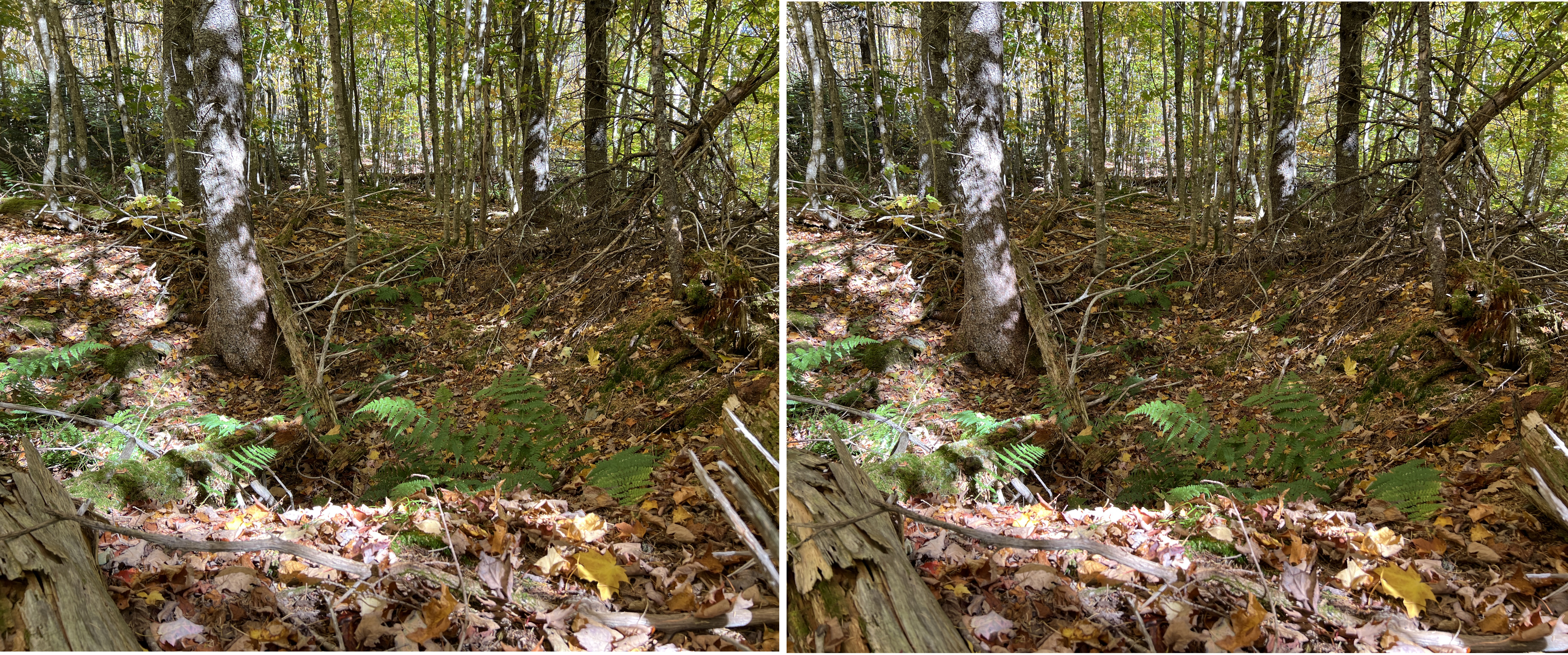 |
Figure 1 – Cellar of Kickham's House. |
| Looking east across the cellar. |
John Kickham emigrated from Ireland in the fall of 1821 with his friend Michael Murphy, both aged 30. In 1822 they petitioned for land on Eigg Mountain on the advice of Patrick Sullivan, who already had adjoining land surveyed for him (see petition and related petition). He is indicated as occupying his land (south of Andrew Mooney Jr. and including the peak of Eigg Mountain) in 1828 (see M_135) and in 1822 (see Dalton petition) prior to being granted it in 1829 (see O_24). This suggests that he had settled here by 1822, shortly before Ranald Fraser, the “first settler” in 1823.
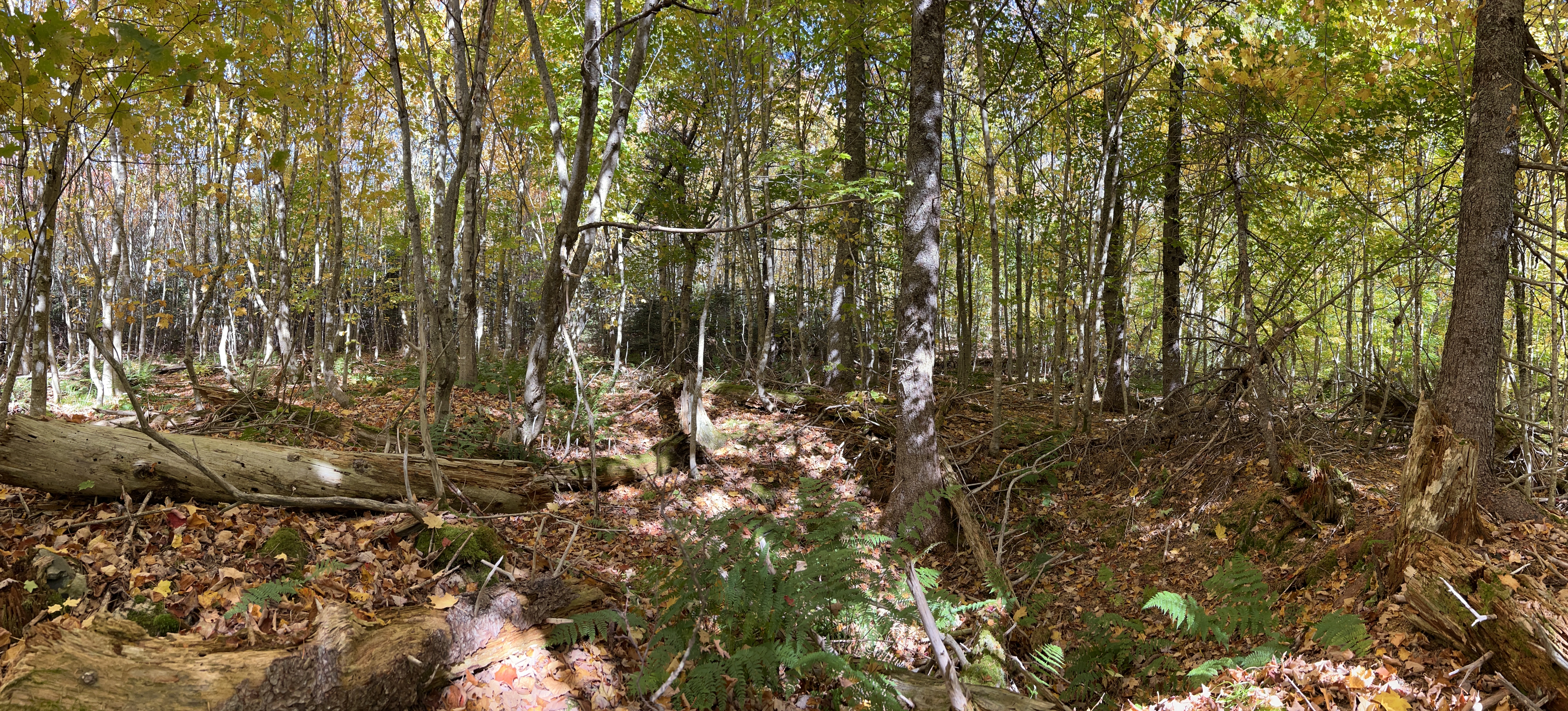
Charlie and Kenton had seen the cellar sometime before I met them. We searched for it more than once and couldn't find it until now (2025). I was using Lidar for the first time, but the site was not at any of the possibilities I had chosen from the Lidar elevations. The best guide was Charlie's recollection that it was right on the property line. I still do not know how he keeps track of property lines in the bush.
It must have been a pretty site when cleared – on a gentle south-facing slope towards a brook. The building was approximately 30 x 21 ft with the long side oriented 154° south. The cellar stairs may have entered from the north side close to the east corner. If so it would have been a two-chambered cellar with the chimney collapsed mostly into the north half. The south chamber is about 9 x 12 ft. It has been partly filled in and while some stone is visible, most has been buried.
Kenton tells me that the old people remembered Kickham's name but talked of this property as though it had been long abandoned. The building does not appear in this location on the 1893 Geological survey map, so it might even have collapsed by then. The field is currently growing up in small hardwoods – a sign of having been abandoned for more than a hundred years. The only other evidence of the Kickhams that Charlie and Kenton have come across is a gravestone in Havre Boucher for a woman who entered one of the Catholic religious orders. Perhaps Kickham stayed long enough to raise a family, and this might be his daughter.
This is the oldest house on Eigg Mountain. It is a long trek inland and up from the shore. Eigg Mountain was free of settlement in 1822, but John and his Irish friends chose this location instead. It is right up against Eigg Mountain proper (i.e. the peak), but is a much lower elevation than the high plateau. It is also south-facing. Both of these conditions are favourable for agriculture.
However, settlement on the high plateau lasted for three generation. While this settlement may not have lasted for more than one. The reason for that is unclear. One possibility may have been that they did not achieve the critical mass (settlers and their many children) needed for the common labour that sustained these early settlements.