Rod Bantjes, “GST-377_Smiths_Diagonal.html,” created 6 August, 2025; last modified, 19 October, 2025 (https://people.stfx.ca/rbantjes/).
Folding Diagonal Mirror (John Jay Smith)
Gestetner Collection (V&A)[1] #GST-377
English, 1740
Dimensions (open): H=69.5 cm, W=57.3 cm, D=38.8 cm. Dimensions (closed): H=13 cm, W=57.3 cm, D=38.8 cm.
Lens: ⌀=10.5 cm, ƒ=60 cm
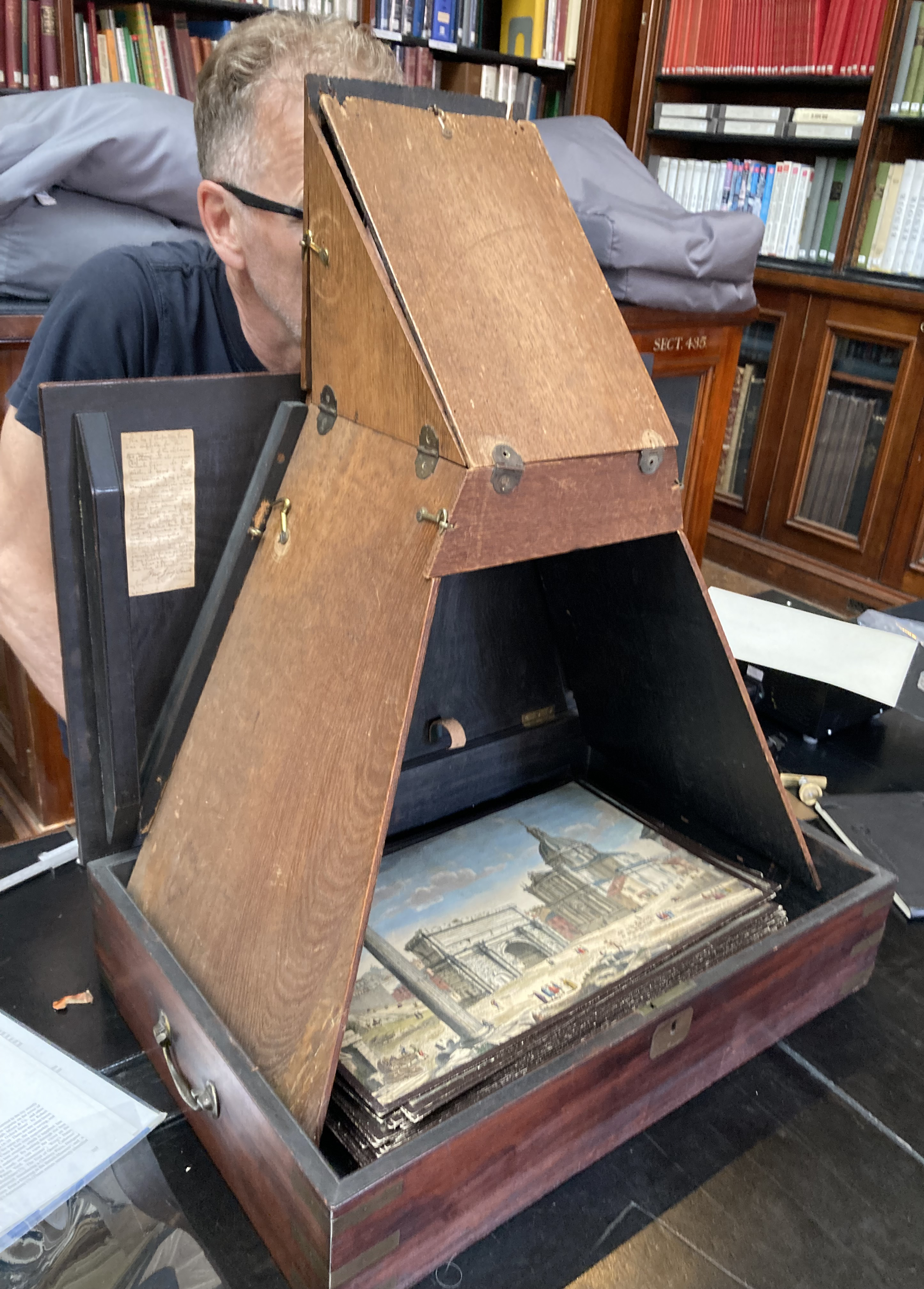 |
Figure 377.1 –Folding Diagonal Mirror |
I am looking through the lens at the reflection of the vue d'optique in the mirror.
Photo © Catherine Yvard. |
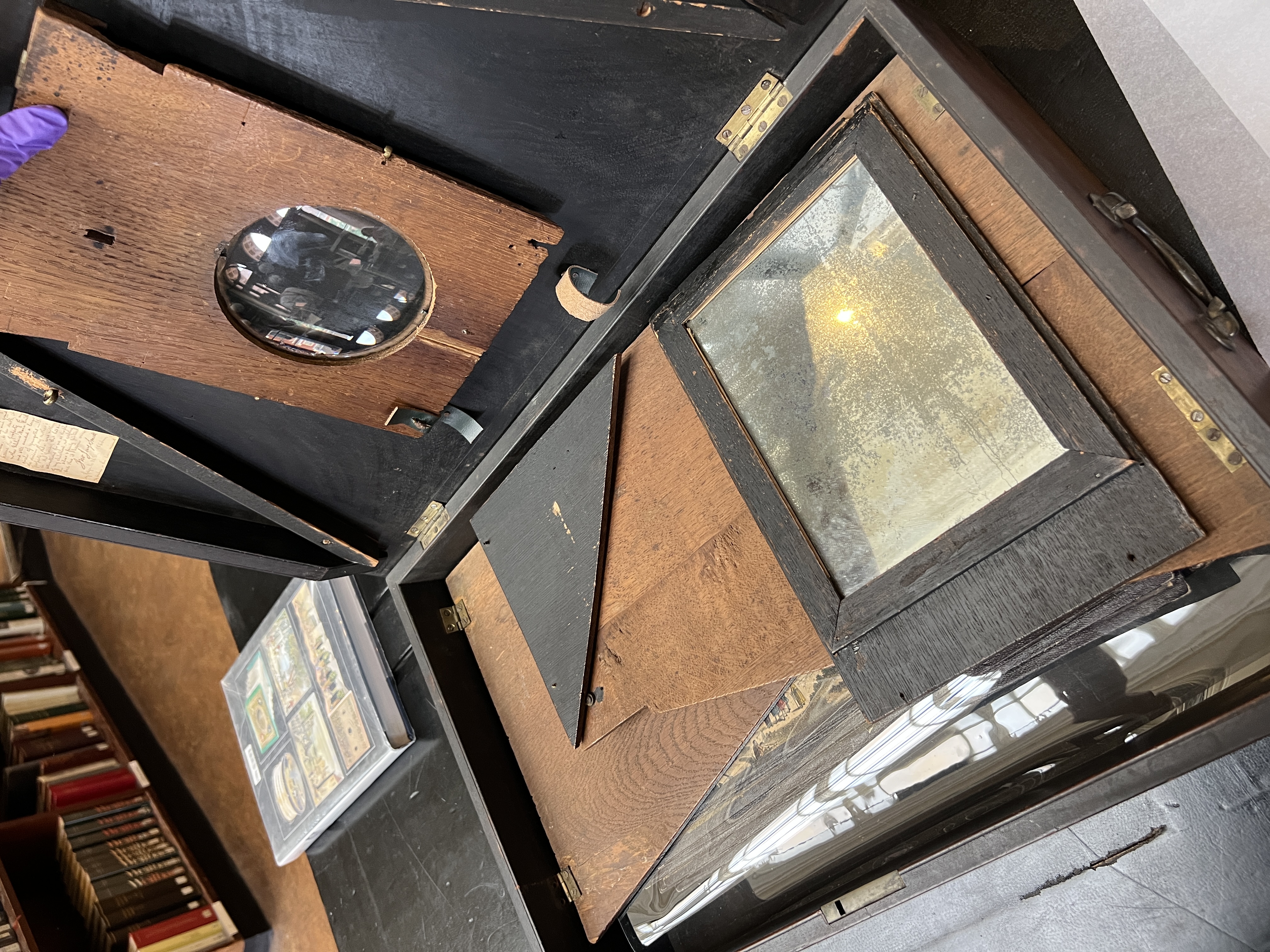 |
Figure 377.1 –Inner Components Folded |
Note the deteriorated quality of the mirror.
Photo © Rod Bantjes. |
This is an 18th-century folding diagonal mirror with a wide lens and long focal length designed for viewing full-sized vues d'optique to give them an enhanced 3D effect.[2] It is an example of an "optical machine " and is included in the Optical Machine Taxonomy.
This box was purchased in England in 1740 by an American, Hon. John Smith (a judge or some other public official), who brought it back as an amusement for his children. It was passed down within the family to eventually become the property of John Jay Smith (1798 - 1881), a librarian wealthy enough to live on a "personal estate" with formal gardens in Philadelphia. Perhaps conscious of its historic value, Smith (62 years of age at this time) pasted a note to the box describing its provenance and the delight that it had given to him and "a large circle of youngsters" in the last years of the 18th century: "In the division of my mother's property there was nothing in the house that had such attractions for me as this solace of my childhood, not excepting the silver & family pictures. And thus it became mine." He appears to have passed it on to a younger relative in 1872 so it must have continued to hold appeal amid the growing number of visual amusements available to a young person in a well-to-do American family.
The viewer is an example of good-quality cabinetry made for the private use of elite customers. The top of the closed box is made of a single piece of hardwood (possibly walnut) with a dark oil finish. In the centre of the cover there is an inset that may originally have been a maker's mark on brass. That has been filled with inlay and a new brass plate inset with an engraved list of the Smiths who owned the box. The walls of the box are probably mahogany and the inner leaves are made of oak. It is constructed with good-quality brass hardware (hinges, handles, hooks, screws rather than nails, etc., see Figure 377.3). Joins are made with precision. The brass brackets on the corners are perfectly inset and secured with brass rivets (see Figure 377.4). The box also has a brass lock, suggesting that the 64 vues d'optique it contained were considered quite precious.
Technical note: The lens clock measures 0.75 front and 0.75 back of the lens for a power of 1.5 and a calculated focal length of 66.7 cm.
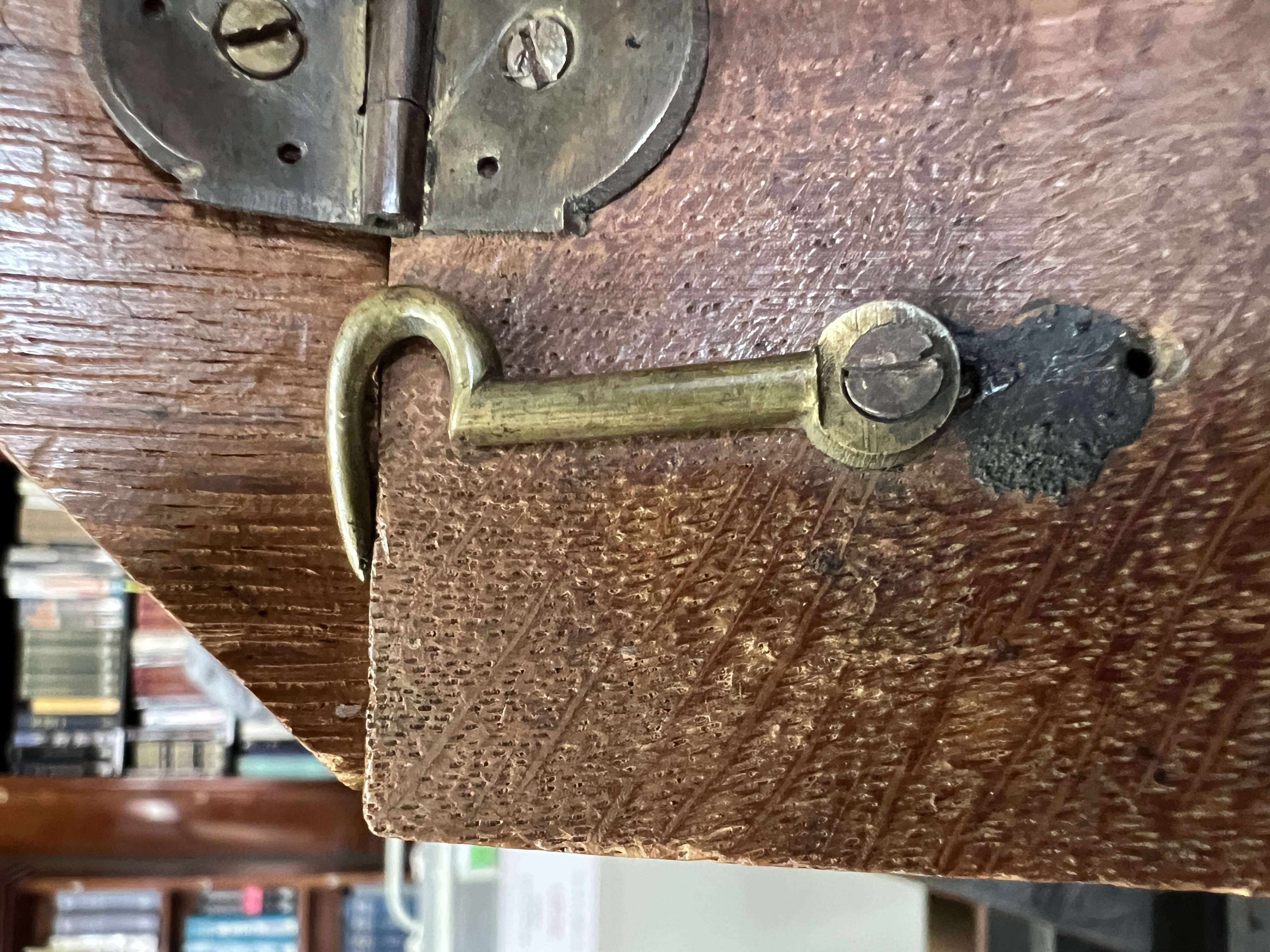 |
Figure 377.3–Quality Hardware |
| The panel is oak. Photo © Rod Bantjes. |
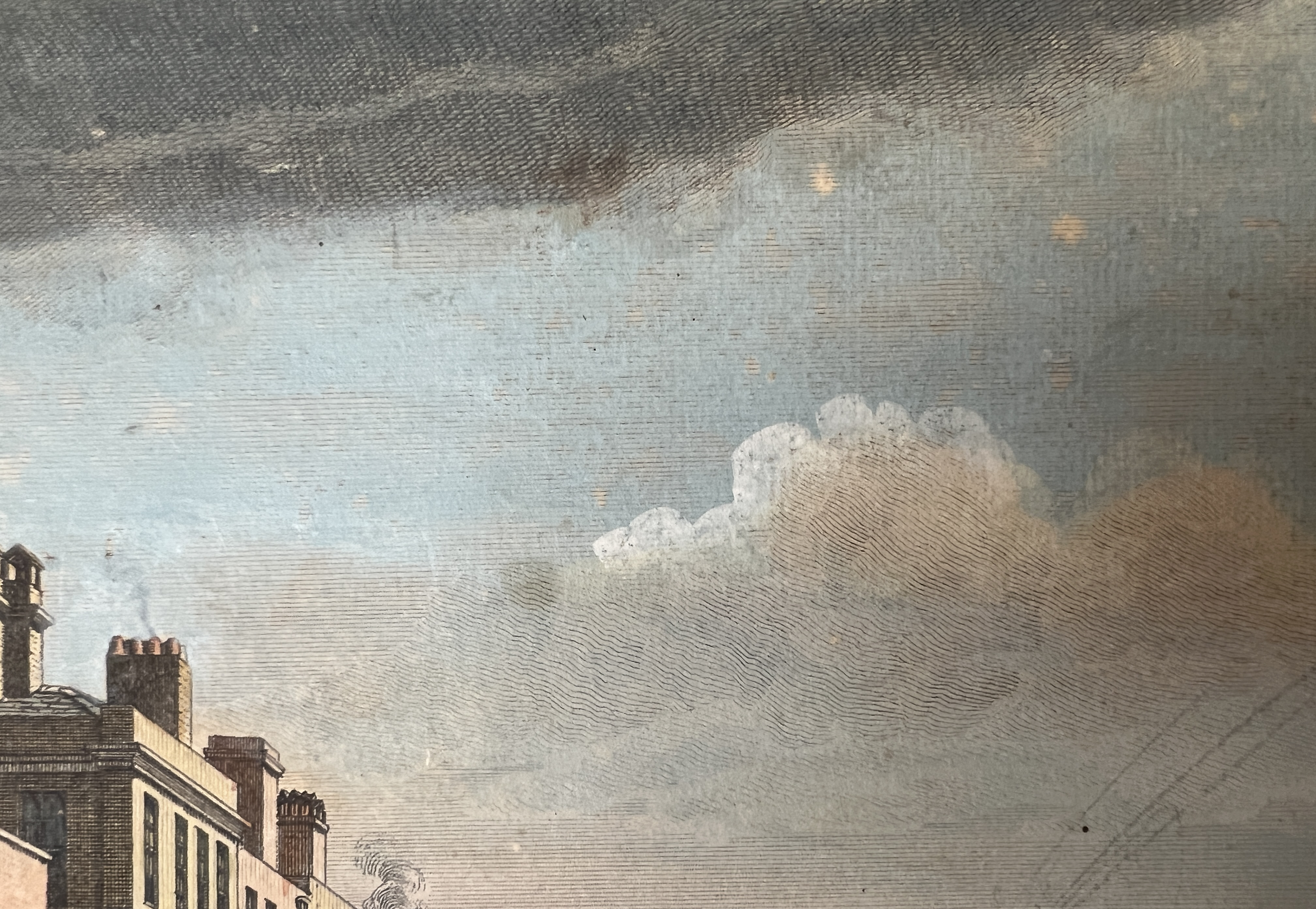 |
Figure 377.4 –Detail of a Vue d'Optique |
| Note the subtle application of colour. Photo © Rod Bantjes. |
The Views:
There are 64 vues d'optique stored within the box, all trimmed to the edges of the image, mounted on cardboard and labelled at the back. They are all copper-plate engravings on laid paper, roughly 26 by 43 cm in size. Ralph Hyde indicates that they were "all published by members of the Bowles family sometimes with Robert Sayer and Henry Overton. Those that are dated were published between 1741 and 1755". The majority of them (42) are "of landmarks in London and vicinity, one is in Bath, the remainder are of scenes in France, Italy, Holland and Russia."[3] The Smiths evidently collected them over time and carefully prepared each one for the box.
They are beautiful quality engravings with lovely lyrical details and expertly hand-tinted (see Figure 377.4). Many are of stately homes and gardens around London. One can imagine young John Jay Smith being captivated by these scenes and through them forming his ideals of landscape gardening that he later applied to the design of cemeteries and his own estate.[4]
Endnotes:
[1] I would like to thank Amy Orr and especially Catherine Yvard for their generous assistance in the V&A archives..
[2] See my explanation of the 3D effect.
[3] Hyde, Ralph, Paper Peepshows: The Jacqueline & Jonathan Gestetner Collection (Woodbridge: Acc Art Books, 2015)..
[4] The Cultural Landscape Foundation. "John Jay Smith". https://www.tclf.org/pioneer/john-jay-smith. Accessed August 6, 2025..