Rod Bantjes, “FB-BO-30_Tirettes.html,” created 6 April, 2026; last modified, 6 April, 2026. (https://people.stfx.ca/rbantjes/).
Boît à Tirettes
François Binétruy Collection,[xxx] #FB-BO-30
French, ca. 1820
Dimensions: H=43.2 cm, W=43.5 cm, D=37.3
⌀=8.7 cm, ƒ=30.3 cm
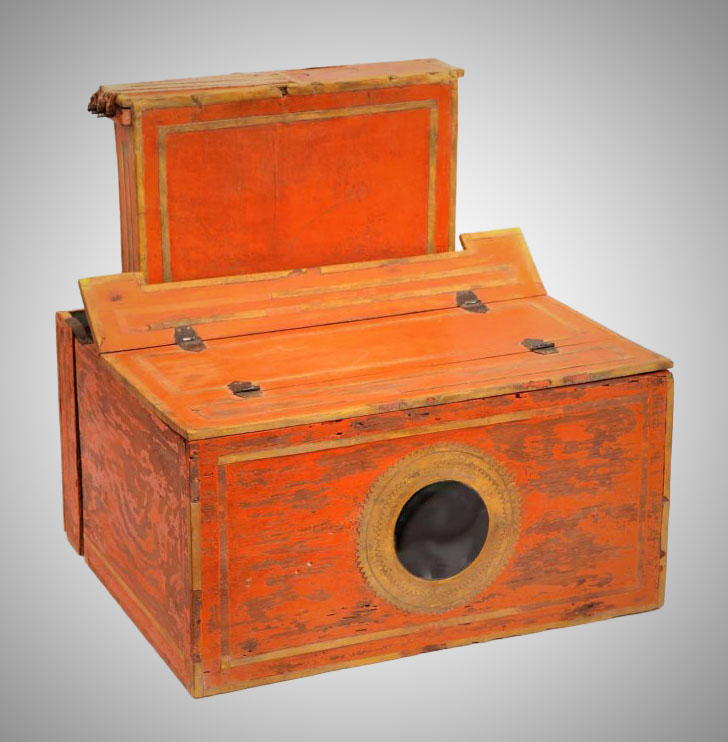 |
Figure FB-BO-30.1 –Boîte à Tirettes |
| Photo © François Binétruy. |
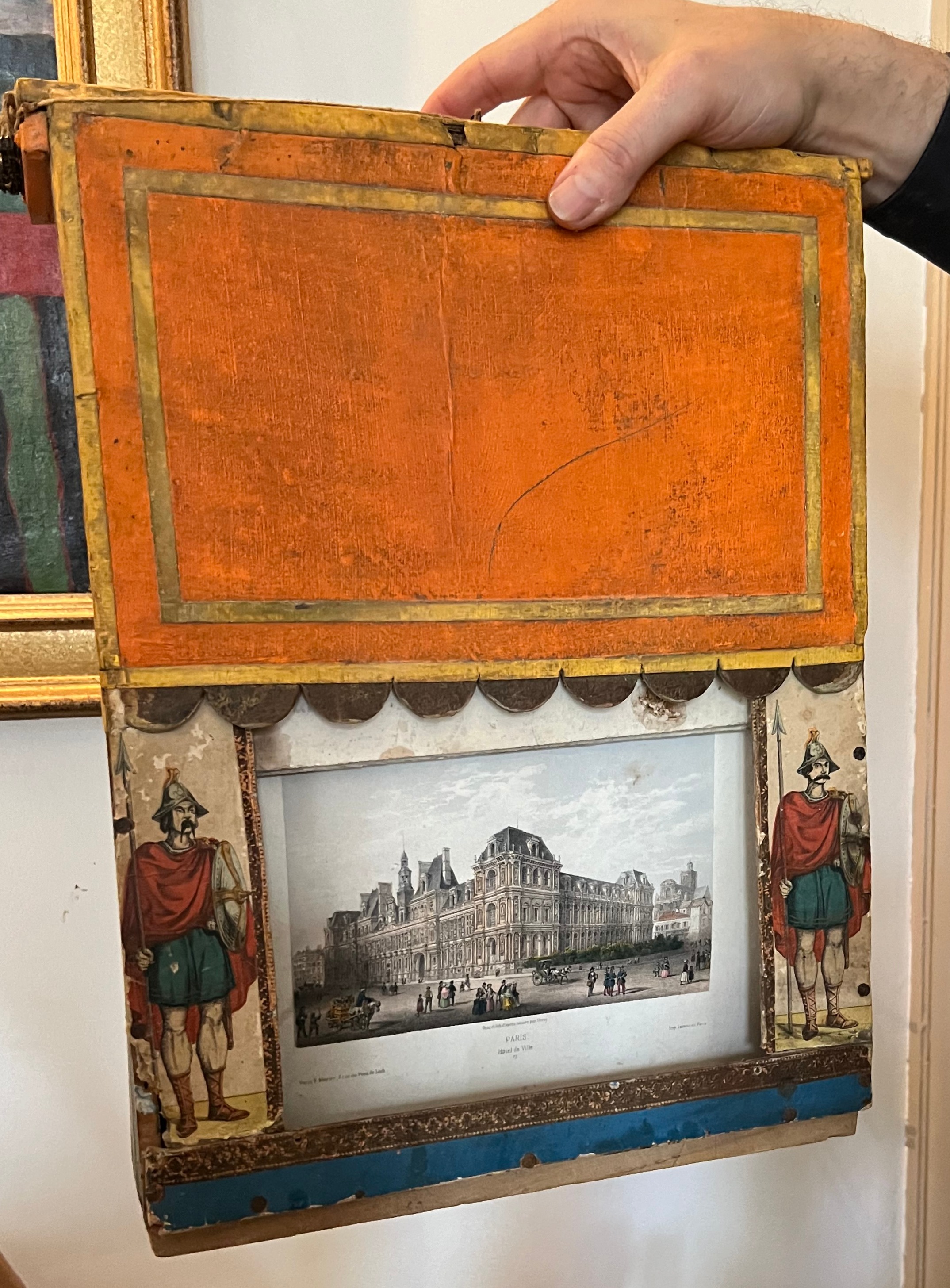 |
Figure FB-BO-30.2 – Flytower Removed from the Box |
| Photo © Ana Mendes. |
This is a toy showbox complete with a flytower for changing scenes. Its single biconvex lens is meant to enhance the 3D effect of the small lithographic images it contains. It is an example of an "optical machine " and is included in the Optical Machine Taxonomy.
Construction: Its orange (sang-de-boeuf) color with gold accents and the appliqué lens-frame with stellated pattern are typical of the Sang-de-Boeuf workshop. It is made of lightweight, cheap materials. Boxes from this workshop were made-to-pattern in large numbers. This design is rare, so it is perhaps an example of small-batch production.
The Lens: The lens is 8.7 cm in diameter, so it is large enough to see through with both eyes. Its focal length (30 cm) is approximately the distance between it and the images. It therefore meets the 18th-century specifications for the best 3D effect.
Image-Format: The two images we saw were small lithographs, about 18 cm in width (there should be 16 in total). The proscenium frame is wider – 20.7 cm. A former user had extended one of the lithographs with hand-drawn margins to fully fit the opening. There is a third "introductory image" of a line of soldiers in Eastern European, perhaps Tartar, dress. When the image is pulled up out of the "stage," the four central soldiers ascend and two are left "on guard" on either side. Why exotic soldiers are needed to guard this little world-stage is left up to the imagination.
The Flytower: The flytower is removable (Figure FB-BO-30.2). It has a uniquely-designed pull-string mechanism for raising and lowering the images. Instead of the strings exiting the side of the tower (typically the left side facing forward), they exit the top-middle and run to the left edge where they are secured by metal rings over metal pins. This arrangement does away with the usual stringer-bar (see for example mondo niovo Figure M01032.2 ). There are 16 strings, presumably for 16 images. The flytower is not deep front-to-back (perhaps 5-6 cm). How 16 images slide up and down freely in the small space is a question that would need to be determined by further examination.
Illumination: The box is not designed for pierced or translucent images and there is no back-illumination. Nor is there any internal artificial lighting, just narrow top-flaps to let in natural light.
Endnotes:
[xxx] We are grateful to M. Binétruy for allowing us access to his superb private collection of optical devices.