Rod Bantjes, “MNC-M01032_Mondo_Niovo_3-Lens.html,” created 3 March, 2026; last modified, 3 March, 2026 (https://people.stfx.ca/rbantjes/).
Mondo Niovo[xxx] 3-Lens
Museo del Cinema Collection, Torino, Italy[*] #MNC-M01032
Italy, ca.1760-1960
Dimensions: H=63.8 cm, W=70.2 cm, D=82.3
Lens: ⌀=5.7 cm, ƒ=0 cm
The Mondo Niovo in General
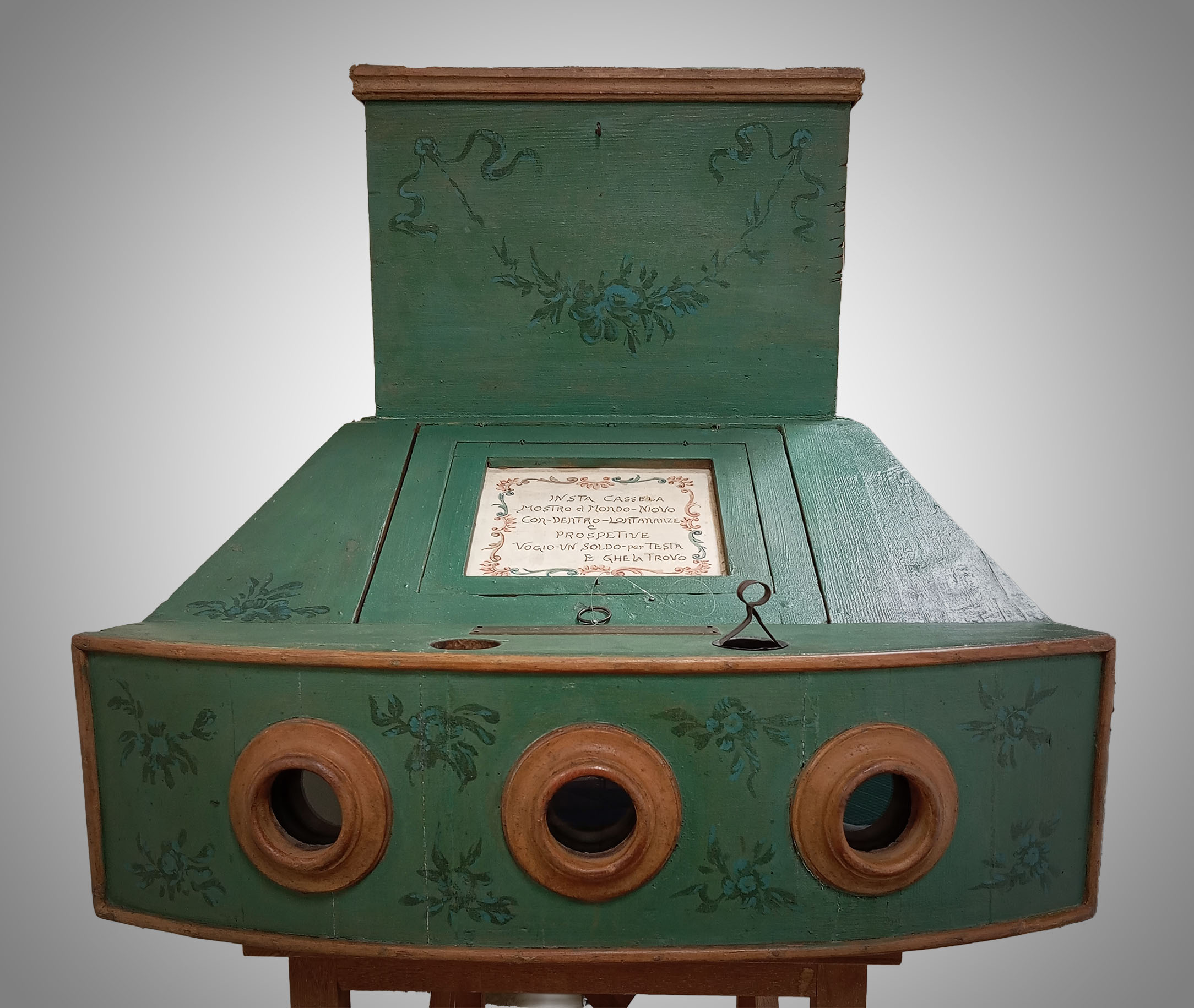 |
Figure M01032.1 – Mondo Niovo 3-Lens |
| Photo © Ana Mendes. |
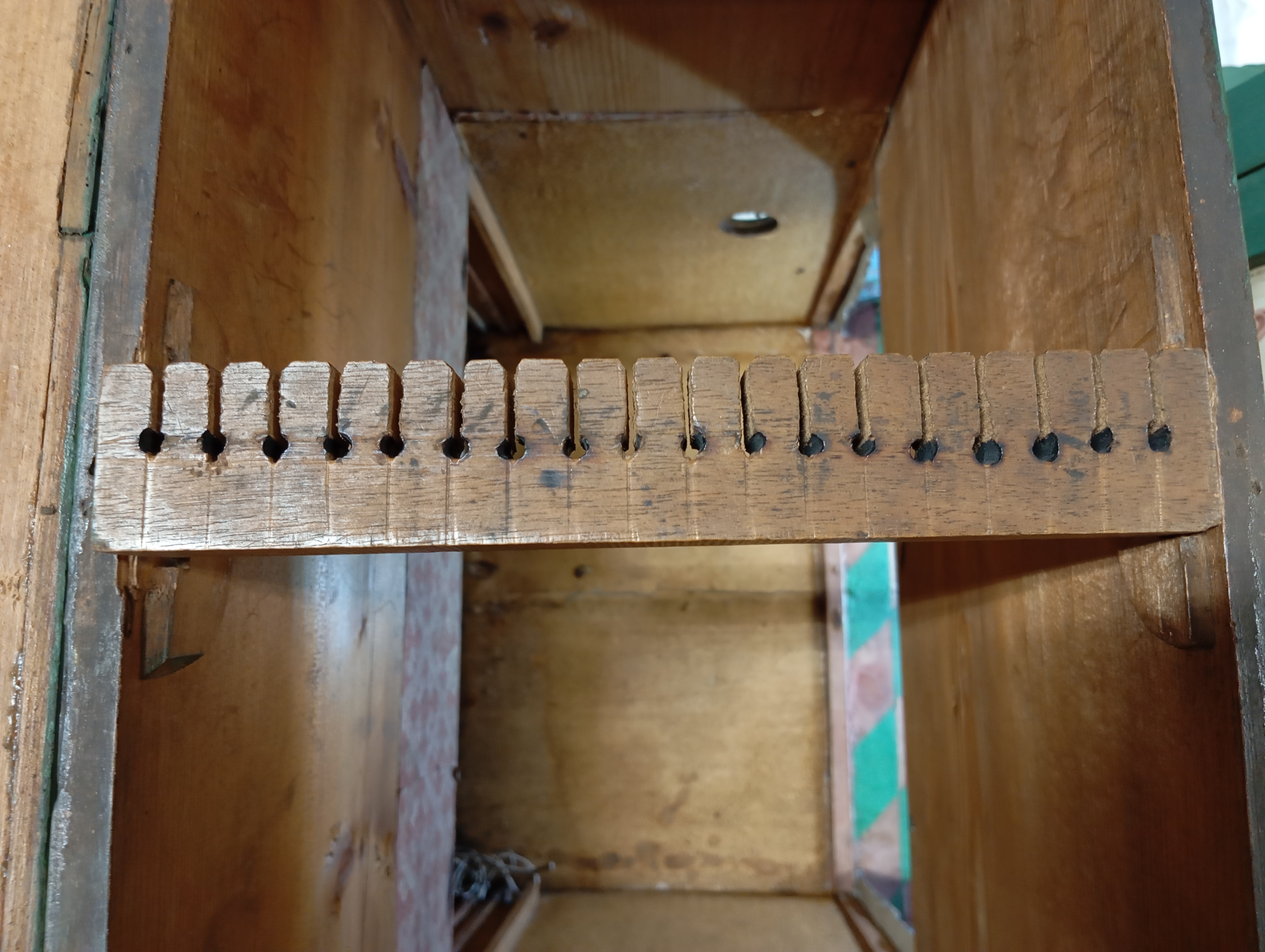 |
Figure M01032.2 – The Flytower |
We are looking down into the flytower. The removable stringer should be rotated 180° because the lines are pulled through it from the left which is the top of this photo. Photo © Ana Mendes. |
This is a Venetian-style multi-lens show-box for exhibiting pierced and illuminated vues d'optique. It is an example of an "optical machine" and is included in a genus "Mondo Niovo" in the Optical Machine Taxonomy.
The Mondo Niovo was the Italian version of the European Raree Show – a travelling spectacle popular in markets and fairs in the 18th century. Mondo Niovos always have three related features that are rarely seen together in the raree show:
| • a flytower above the central "stage" area; | |||
| • a front-section that fans out like the seating in a theatre toward a curved lens-array where the audience assembles to look inside; | |||
| • and a rear extension that has a flap and holds candles for back-illumination of the translucent images. |
The front-section's top-surface is downward-sloping and contains a top-flap for front illumination. The forward tilt helps to direct light back on to the front of the vue d'optique which falls like a back-drop on the stage.
For further discussion of the general features of these devices see the Mondo Niovo genus.
Description of this Box
Lenses: The three "lenses" of this box are not lenses, but flat pieces of glass. Each opening is just under 6 cm in diameter – too small to comfortably look through with both eyes. So there is no 3D effect with this box, either binocular or monocular. The rounds of glass are not properly inset into the lens-frames, but rather secured with four small brackets at the back. I take this as evidence that originally there were proper lenses that have been replaced.
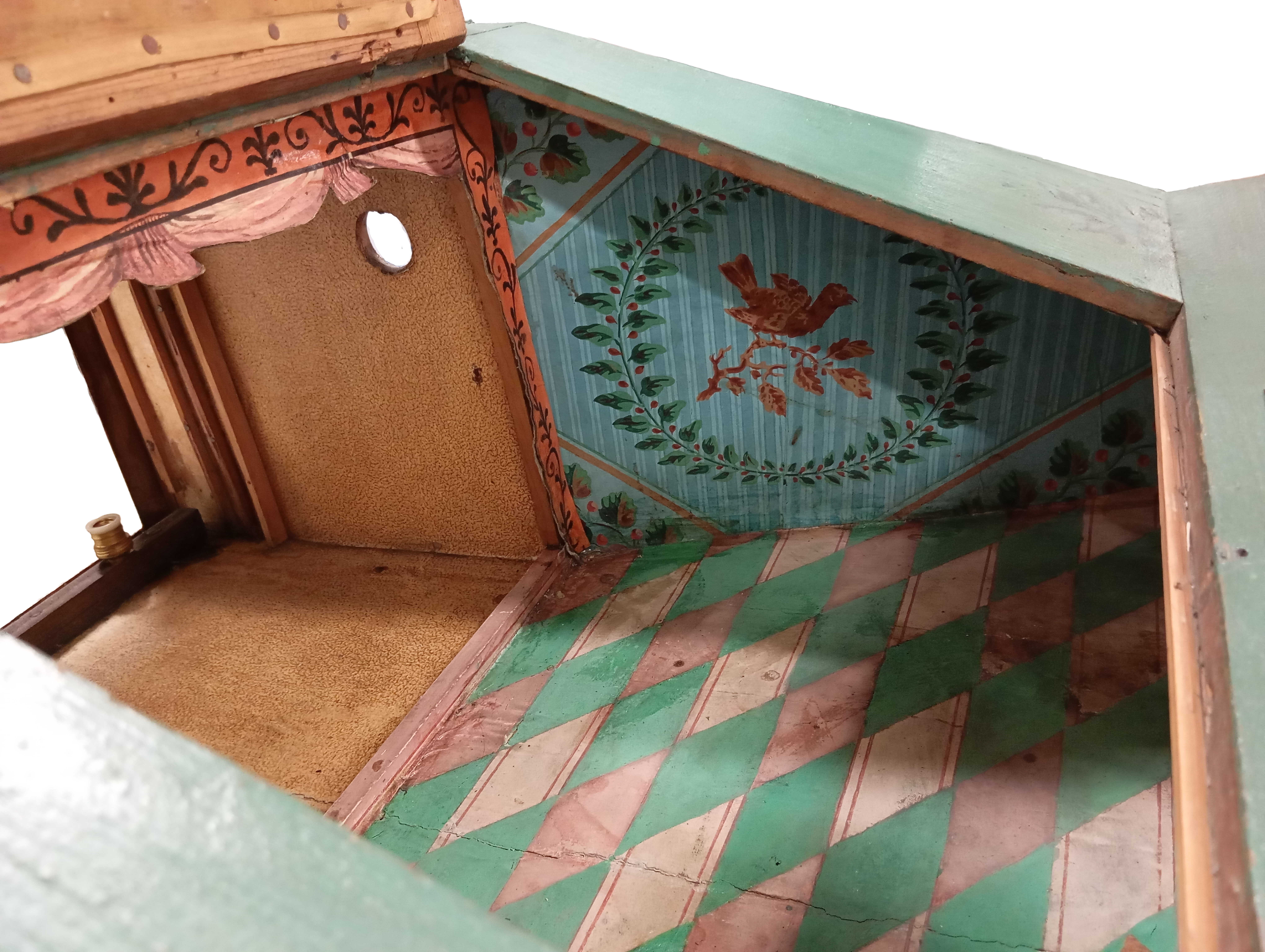 |
Figure M01032.3 – The Stage |
| Photo © Ana Mendes. |
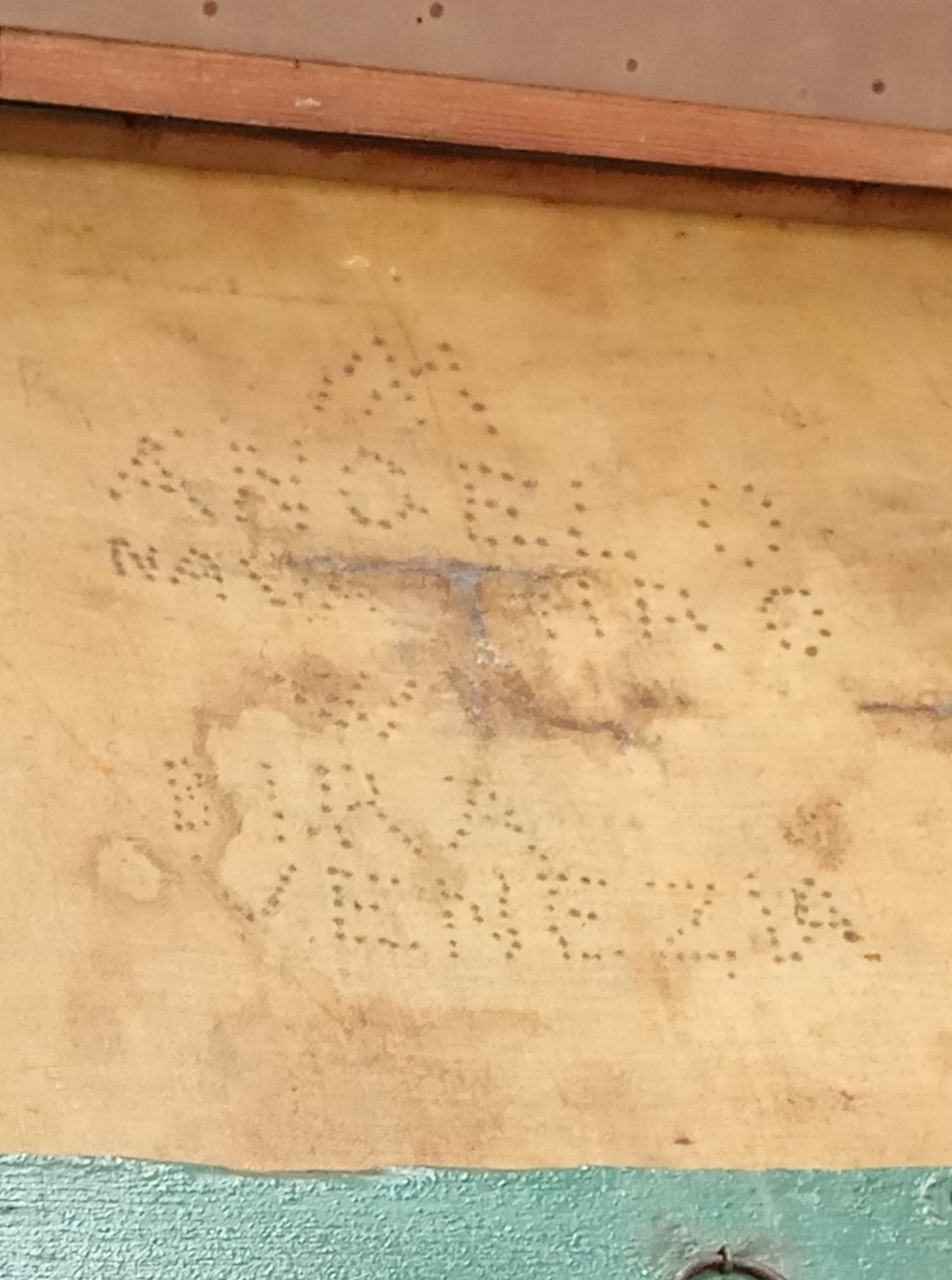 |
Figure M01032.4 – The Secret Inscription |
| Photo © Ana Mendes. |
Flytower: The flytower has a stringer with 18 keyhole-style guides which also serve as pulleys for the pull-strings (Figure M01032.2). Uncharacteristically, it has no guide-channels down the sides of the flytower. It does have an inspection-hole on the upper left side (facing forward); the same side as the external pull-string array, and the side that the operator would stand. The purpose of the hole was no doubt so that the operator could check to see whether the descended images were tilted or askew – particularly important when they had no guide-channels to keep them straight.
External Illumination: The box has the standard front and back flaps for illumination with natural or external light. The front flap can be operated by a pull-string that runs through a cup-hook at the top of the flytower. There are notches at the corner of the flytower that may have served as guides for the pull-string as it ran toward the operator's position at the side of the box – a further eyelet and cleat would seem to have been a better solution. The back flap has no pull-string, but is furnished with a clip to hold it open. The hinges of this flap consist of an eyelet and a twisted wire – evidence of simple, do-it-yourself construction.
Internal Illumination: There are two candle-holders behind the lens array. They have keyhole-shaped chimneys which can be easily grasped to rotate them. The inner sleeves are in the form of tubes with one side cut out. Turning the cutout side toward the stage illuminates the image hanging there. The candle-holders in the rear light-box have been removed and replaced by three electric light-sockets.
Portability: The box weighs 13 kg which is light enough to be carried on the back; however there is no evidence of shoulder straps having been mounted under the box.
Decoration: The exterior is decorated in green paint with darker green floral patterns and edges highlighted in natural wood. Inside, it has a charmingly decorated stage (Figure M01032.3). There is a hand-painted proscenium arch and grand drape. The "audience space" is papered to invoke a tiled floor and walls with floral designs.
Inscription: There is an inscription that you can see on the front flap (Figure M01032.1). It reads, "insta cassela monstro el mondo niovo con-dentro-lontananze e prospetive vogio-un soldo-per testa e ghela trovo," which translates roughly as "In this box I show the New World inside with depth and perspective; I want a penny per person; and I will get it." The same words appear on an 18th-century print depicting an Italian show-box. We can imagine it as a somewhat boastful cry of an 18th-century Italian showman: "I have something rare and special and you won't be able to resist it!".
Secret Inscription: There is a little flap within the flap and when you lift it another, secret inscription is revealed below the public inscription. It's letters are pricked out of burlap in the same way that a vue d'optique has pinholes or piercings meant to shine when back-illuminated. So, in the dark, with candles lit inside the box, the message glows. Not all the words are clear, and their meaning is cryptic. The inverted W means "down" and is followed by someone's name: "Angelo Nava[...?]ro." So, perhaps "down with Anglo ..." The next part is "W Bira Venizia". There was a Venetian beer-maker called "Birra Venizia" in 1913.[xxx] Could this have been a joke? An advertisement? Who was it meant for? It remains a mystery.
Period of Use: The box was probably late 18th-century in origin, but it may have seen close to two centuries of use. If the "Bira Venizia" refers to the beer-maker, that puts it in use in 1913. The electric lights are wired with some cloth-covered wire and some plastic-covered. The electrification of the box may have happened in the 1950s. It could have been in use until the early '60s before it was donated to the Museo del Cinema by Pina Castellino in 1966.
Endnotes:
[*] We would like to thank Raffaella Isoardi and Valentina Malvicino for making our research possible and assisting us in every way, as well as Antoine ... for assistance in the archives.
[xxx] The name means "new world" in Italian, perhaps because it introduced people to new worlds, including the distant Americas. The spelling with an "i" is Venetian and we use it (as opposed to Mondo nuovo or mondo novo) because this style seems to be uniquely Venetian.
[xxx] The correct spelling is with two "r"s. My Venetian informant, Luca Vascon, says "The way that inscription is made shows a low literacy level, as well as someone not used to writing or drawing (insecure writing, and all over the place, even if done with "points")."