Rod Bantjes, “GST-369_Gothic.html,” created 4 August, 2025; last modified, 4 August, 2025 (https://people.stfx.ca/rbantjes/).
Folding Diagonal Mirror (Gothic Window)
Gestetner Collection (V&A)[*] #GST-369
French ca.1845
Dimensions (open): H=48 cm, W=41 cm, D=48 cm. Dimensions (closed): H=3 cm, W=41 cm, D=47 cm
Lens: ⌀=6 cm, ƒ=53.5 cm
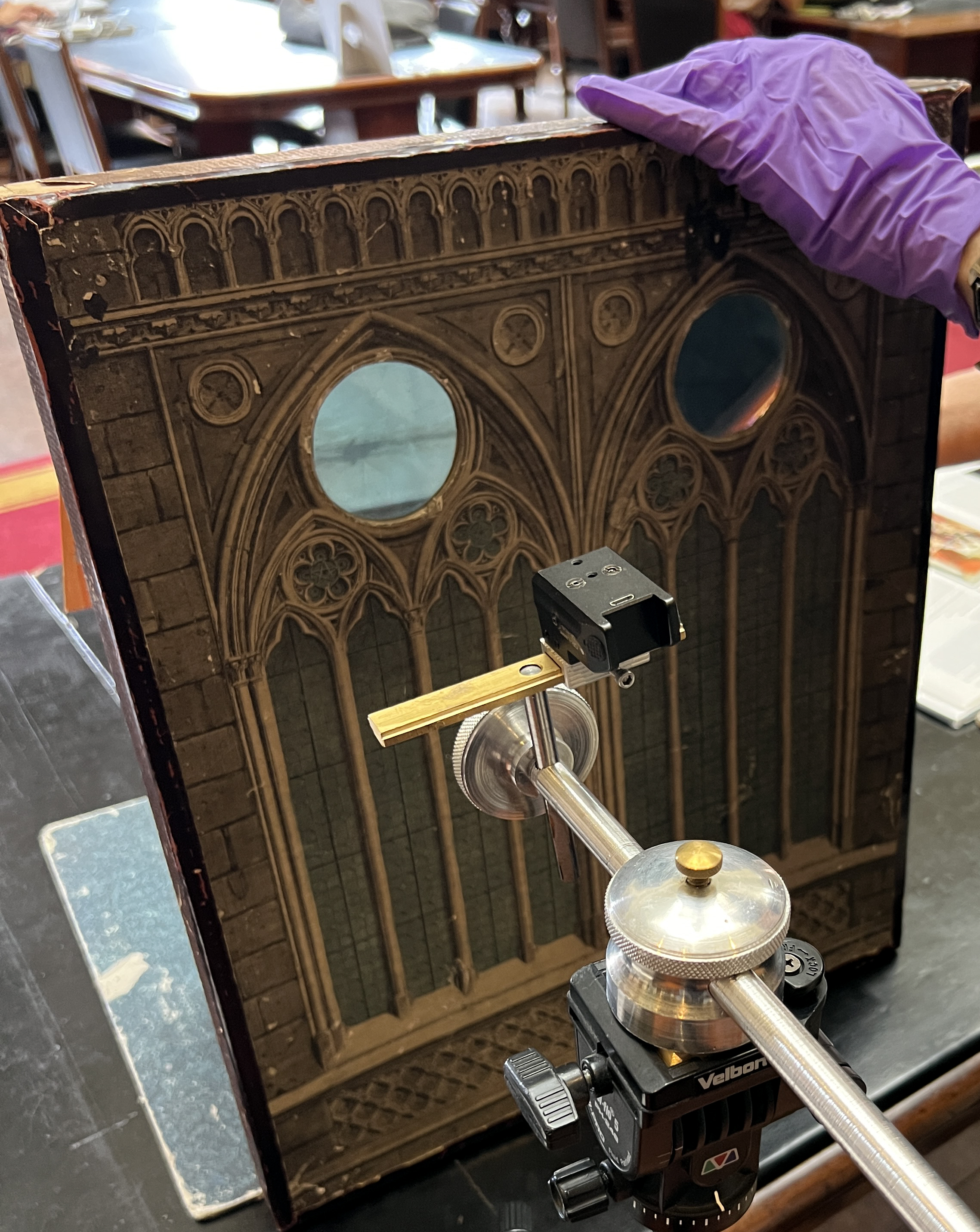 |
Figure 369.1 –Folding Diagonal Mirror |
| The box is having its lenses measured in this image. Photo © Rod Bantjes. |
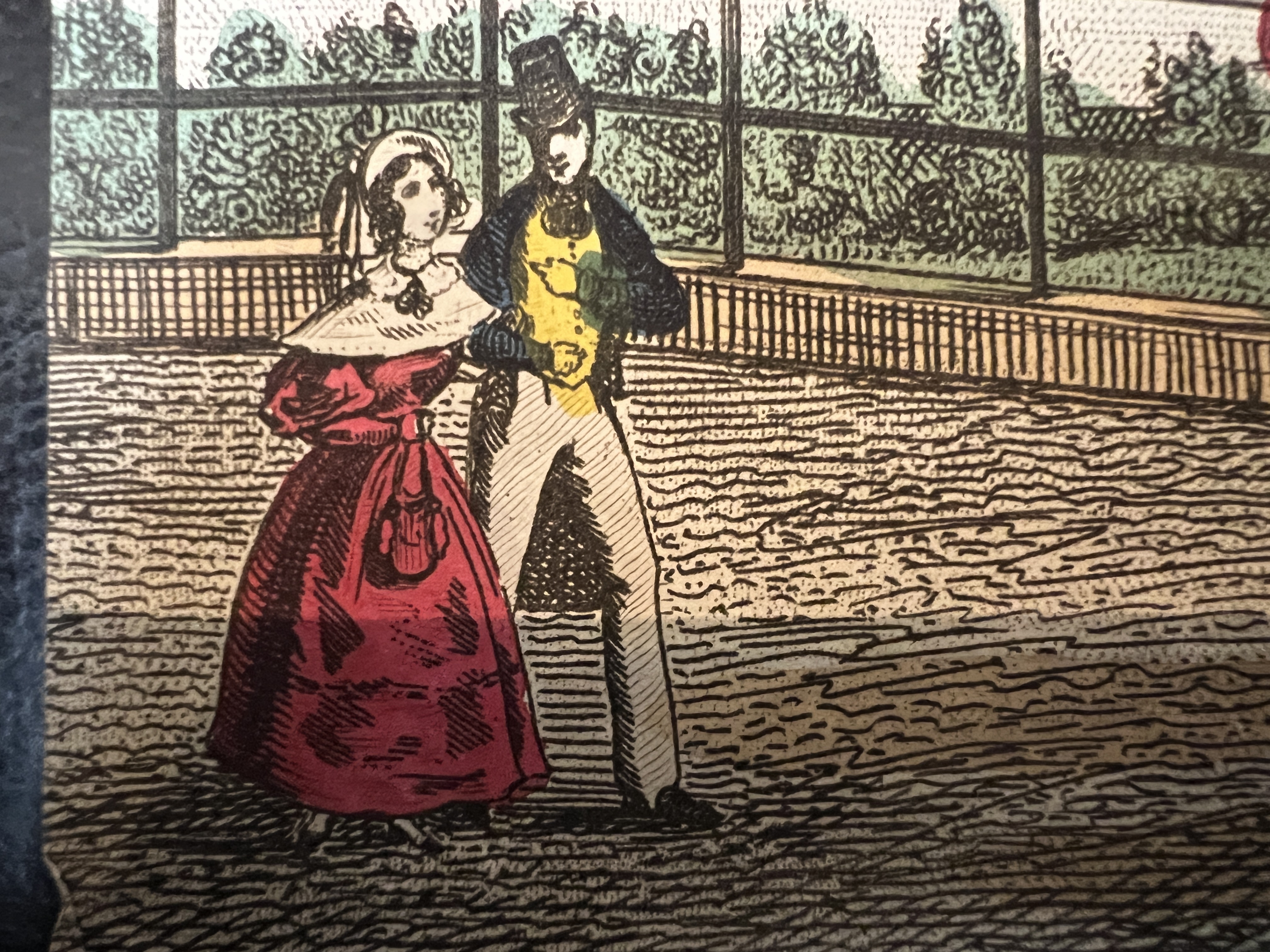 |
Figure 369.2 –Detail of Print |
| Photo © Rod Bantjes. |
This is a folding viewer for small vues d'optique. Two people can look side-by-side through the lenses at images reflected in a diagonal mirror. It is an example of an "optical machine " and is included in the Optical Machine Taxonomy.
The viewer is made from lightweight paper-covered wooden panels. Its fold-out design is a simplification of earlier forms of folding diagonal mirrors such as #GST-377 or the popular folding "books" such as #WN-2396. A flap supporting the mirror is supported by two fold-out side flaps. There are neither hooks to secure them nor metal hinges. Why the front is made to look like a Gothic window is uncertain – we seem to be looking into a cathedral at scenes of a mostly secular world.
The images are in the style of 18th-century vues d'optique and have similar subject matter. Some are clearly copies of vues d'optique. However, instead of copper-plate engravings on laid paper, they are possibly wood engravings on wove paper – both more common in the 19th century.
La Cinémathèque française gives a date for this viewer of around 1830. On the evidence of the content of two of the images Ralph Hyde suggests ca. 1845 instead: "The Place de la Concorde shows the two Fontaines de la Concorde, erected 1840; the Pont Notre Dame shows the bridge as it was before 1853."[1]
The device is factory-made. An identical one in the Cinémathèque française attests to the standardization of manufacture. It also has a label that reads: "Galerie Vivienne No. 6, Guillard, large children's toy factory on the first floor, Paris." In 1846, Henri Lefort began making optical boxes of a similar lightweight construction and portability (see for example EXBD-69056). These were horizontal boxes with small, short-focus lenses that allowed for back-illumination and the dramatic lighting effects of the recently popular dioramas. This Galerie Vivienne viewer hearkens back to the 18th century, with large views, lenses wide enough for both eyes, long focal lengths and image-plate about focal-length distance from the lenses, just as 18th-century theory demanded.[2] Within these size constraints it nonetheless folds down to a light and slender package.
The views associated with the viewer are as follows:
- La Bourse, Paris
- Place de la Concorde, Paris
- Fontaine des Innocents, Paris
- Château des Tuileries, Paris
- Pont Notre Dame, Paris
- Amiens Cathedral
- Château de Compiègne
- Anvers de l'Escaut, Belgium
- the Belvedere, Rome
- St Paul's Cathedral, London
Endnotes:
[*] I would like to thank Amy Orr and especially Catherine Yvard for their generous assistance in the V&A archives..
[1] Hyde, Ralph, Paper Peepshows: The Jacqueline & Jonathan Gestetner Collection (Woodbridge: Acc Art Books, 2015)..
[2] Harris, Joseph, A Treatise on Optics (London: B. White, 1775). See also my discussion of the theory.