Rod Bantjes, “Genus_Trapez-Guckkasten.html,” created 15 December, 2025; last modified, 23 October, 2025 (https://people.stfx.ca/rbantjes/).
Trapez-Guckkasten Genus (1730-1820)
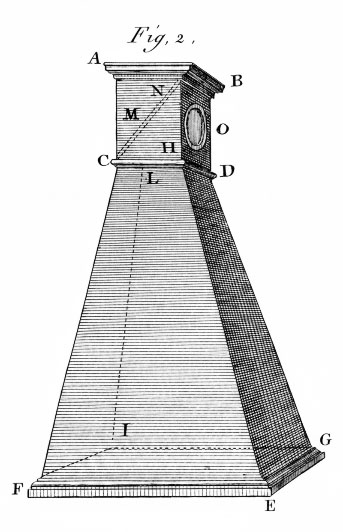 |
Figure TG.1 –Trapez-guckkasten |
| Source: Guyot, Edme-Gilles, and Guillaume-Germain Guyot. Nouvelles Recr&eactue;ations Physiques et Mathematiques. Vol. II, Paris,: Gueffier, 1786. |
The Trapez-Guckkasten is so-named because its base takes the form of a trapezoid.[xxx] It was a popular form of 18th-century optical machine, perhaps second only to the Zograscope. It can be thought of as a zograscope with two added features: 1) an integrated image-plate which forms the base of the trapezoid; and 2) masking to isolate the image from visual distractions. It is as though the bundle of rays reflected from the rectangular print up through to the lens has been both isolated and outlined by the sides of the box. This way that form echoes the path of light is what defines the genus.
The optics are enclosed in a small square turret – no larger than it needs to be to house a diagonal mirror of sufficient size to reflect the image below. The back of the trapezoid is always fully or partly open to admit light onto the image – typically a vue d'optique.
Masking gives a more immersive experience of the intended view, which is an improvement if immersion is your aim. What the Trapez-Guckkasten sacrifices is the zograscope's light weight, collapsibility and adjustability between lens and image-plate.
List of Species:
| Single-Lens: | 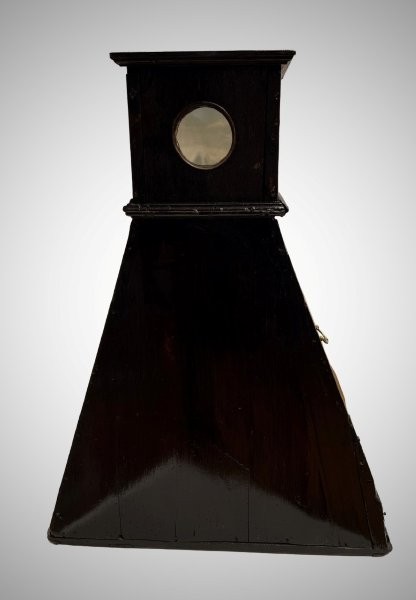 |
| WN-RB01 |
This is the classic morphology and styling.
| Double-Lens: | 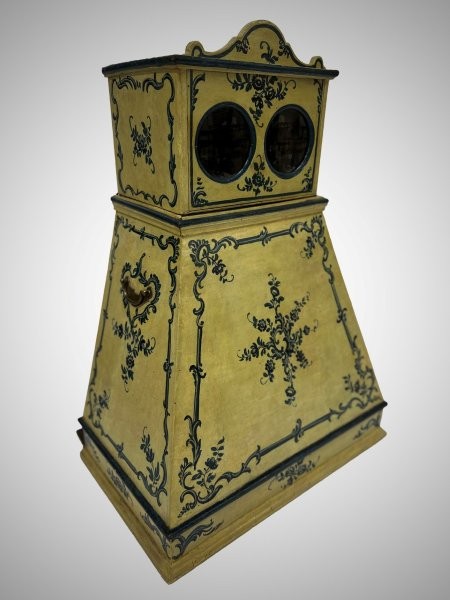 |
| MNC-M01027 |
Same as the previous with a second lens for viewing by two people.
| Triple-Lens: | 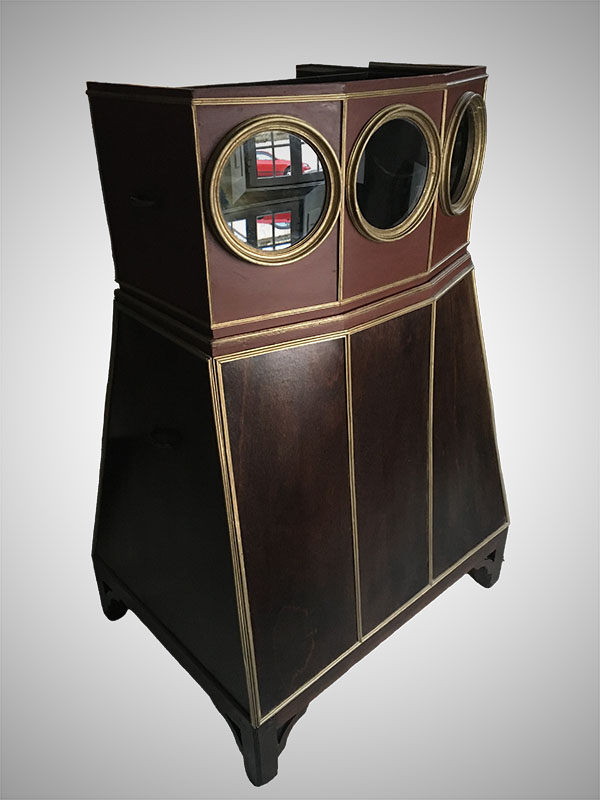 |
| CC-01 |
Here a third lens has been added and the lens-array given a slight curve to keep the three viewers from having to squeeze too tightly together.
| Colporter: | 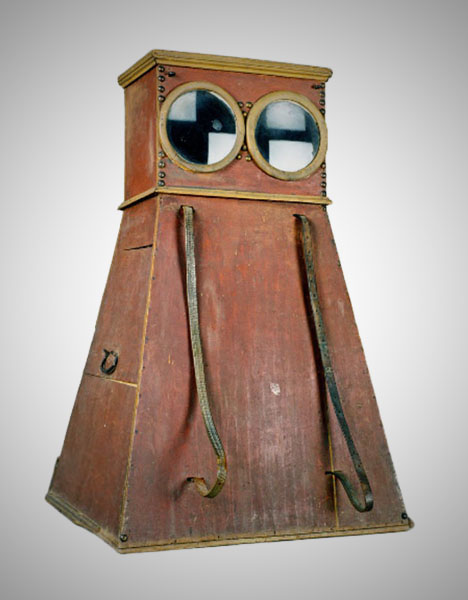 |
| AP-95-1615 |
A travelling show-person has added shoulder straps to a two-lens box for ease of carry, transforming it into a new species.
Endnotes:
[xxx] I am adopting the German term because it is unique to this device and descriptive of it.