Rod Bantjes, “Family_Zograscope.html,” created 1 August, 2026; last modified, 1 August, 2026 (https://people.stfx.ca/rbantjes/).
Zograscope Family (1740 - 1871)
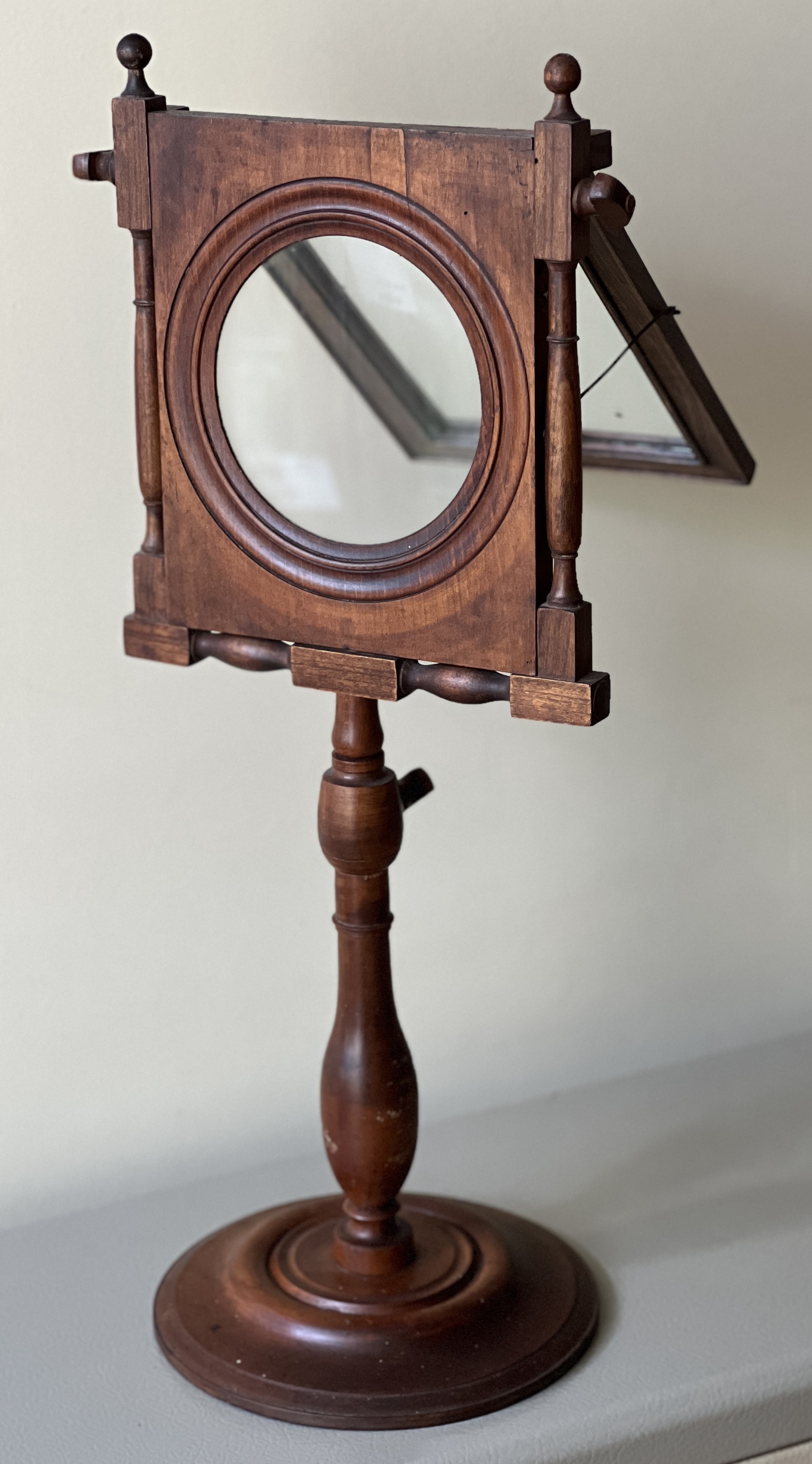 |
Figure RB-01.1 –Zograscope |
| Photo © Rod Bantjes, 2025. |
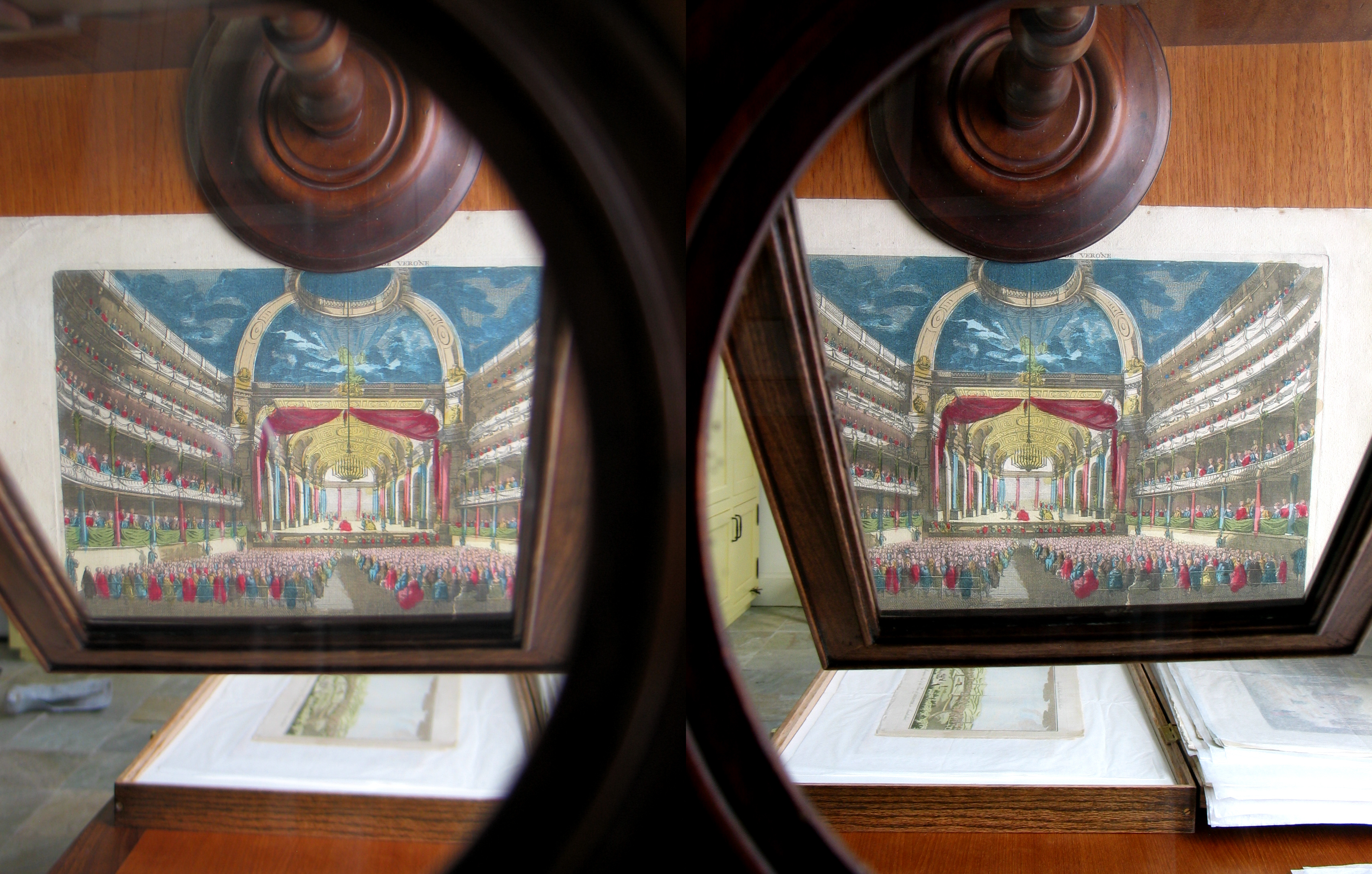 |
Figure RB-01.2 –View through the zograscope |
| This is a stereo image that you can free-view cross-eyed to get a feeling for the 3D effect. The image is a vue d'optique from the late 18th century. Photo © Rod Bantjes, 2025. |
A Zograscope is a biconvex lens viewer for enhancing the 3D-effect of copper-plate engravings known as vues d'optique.
Definition: Zograscopes are distinguished from other diagonal-mirror viewers in the Optical Machine Taxonomy by the fact that they have no enclosing box or image-holder and so rely on a surface such as a table to support the image.
Nomenclature: The zograscope has been known by various names including optical diagonal machine (1750-1810) optical diagonal mirror (1871)[1] and optical pillar machine (1829)[2]. “Zograscope” is the oldest and most enduring. Unlike so many terms for optical machines, it is exclusive to this device. It derives from the term “zographie” used by astronomer and mathematician John Dee in 1570 to describe the “Mechanicall” rules and techniques for drawing in perspective. A zograscope then would be a machine for viewing perspective to the best advantage.
How to Use It: To appreciate the 3D effect you must look through the lens with both eyes at the image of a print reflected in the mirror (see Figure RB-01.2). You position the print upside-down at the base of the zograscope. Since the mirror reverses the print left-to right, vues d'optique often had titles printed in reverse so that they could be read when seen through the device.
This style of viewer was the most common for private use in well-to-do households (Figure ZG.1). It had more prestige than the itinerant show-boxes or raree shows, but was paradoxically thought to give an inferior effect.
The 3D Effect
Eighteenth-century writers recommend that the distance between the print should and the lens should be approximately the focal length of the lens. At that distance the lens will make the direction of the two eyes parallel when looking at the surface of the print, just as they would be when looking at a distant horizon. This is supposed to make depicted landscapes appear to be at a great distance, and the illusion of a great space to open up before the viewer.
Masking /Immersion
One of the explanations that people sometimes give for the supposedly “immersive” spatial effect of optical machines is that the device masks out all visual distractions so that the eyes take in only the image and the mind can be absorbed into its imagined space. That explanation clearly does not apply to the zograscope as you can see from Figure RB-01.2.
If you move further back from the lens so that the edges of the print are not visible (about 18cm) then the image occupies only a small portion of your visual field. You see the zograscope mechanism all the way down to its base and far more of the room beyond than of the vue d'optique world in which you are supposed to be immersed.
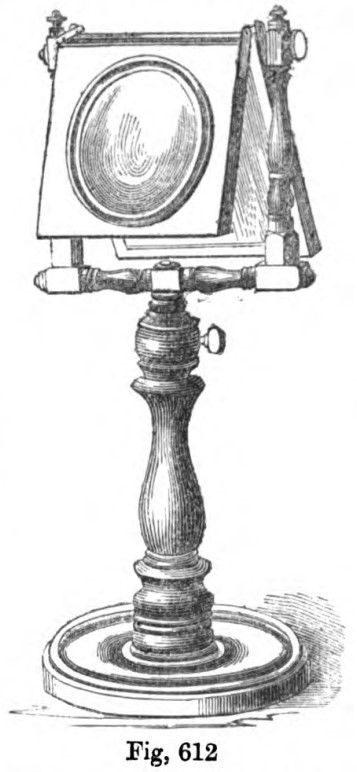 |
Figure RB-01.3 – Zograscope, 1871 |
| Source: Casella, C. F. 1871. An Illustrated and Descriptive Catalogue of Philosophical, Meteorological, Mathematical, Surveying, Optical and Photographic Instruments. London: P. Lane.. |
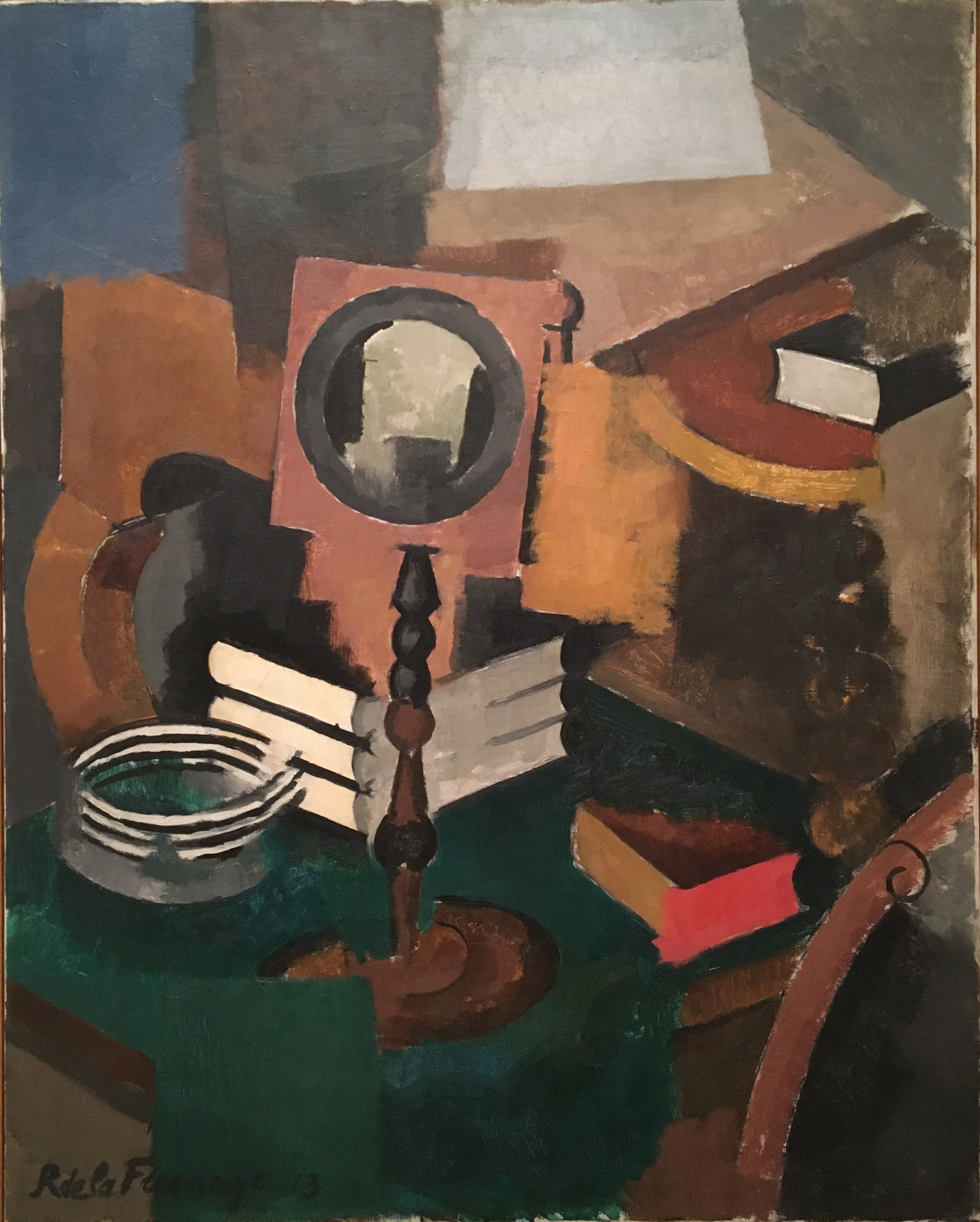 |
Figure RB-01.4 – Zograscope and Cubism |
| Source: Roger de la Fresnaye, 1913, Still Life [with Zograscope], 92.5 x 73.5 cm, Oil on canvas, Statens Museum for Kunst, Copenhagen. |
Exposed Mechanism /Rational Recreation
The zograscope was popular in bourgeois households where curiosity and self-discovery of scientific principles were encouraged as part of children’s education. “Philosophical toys” like the optical machine were meant to part of this education and to instruct, but also to amuse and delight. It was important that children both enjoyed the illusion that the device created, but perhaps more important that they thought about how the illusion worked.
The open structure, that brings into view the machine's lenses and mirrors, was better suited to this sort of “rational recreation.” The zograscope was perhaps not intended to be immersive, but rather to always encourage a critical remove on the part of the user.
Material evidence for this claim is the reverse printing of the descriptive information about each vue d'optique. That design choice assumes that people will be reading while looking into the machine in a way that invites rational rather than immersive engagement.
Long History of the Zograscope
The zograscope was not only one of the most popular of the optical machines, but also, in the form that you see it here (Figure RB-01.3), one of the most long-lived – from the mid-18th century until at least 1871.
C. S. Casella was still selling them in 1871 when so many more 3D visual amusements were then available. His offering shares with my zograscope (Figure RB-01.1) many of the classic design features. It has a turned base and stand with a central column-like element. At the top of the column is a spool-like form with a wooden thumbscrew that secures the lens-mirror assembly and allows it to be adjusted up or down. The lens-case and mirror are rectangular and the frame that holds the lens-mirror assembly is turned with end-blocks joined by column-like forms. The verticals are topped by finials.
This enduring standard of design makes individual zograscopes difficult to date with accuracy.
The cubist painter, Roger de la Fresnaye, included a zograscope in a still-life that he painted in 1913 (Figure RB-01.4). Apparently it still could be found in some households in the early 20th century. The cubists were interested in the constructed character of our spatial perception. I like to think that de la Fresnaye saw in the zograscope, as I do, a device that helped to lay bare the mechanisms by which our visual faculty constructs space.[3]
List of Genuses
Each row in the following table represents a different genus:
| Turned Pillar - Single: | 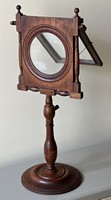 |
| Genus |
This species has the standard design and styling. They are mostly of hardwood construction including the thumbscrew for securing the vertical pillar. The base and column are hand-turned. The lens frame is composed of turned elements terminating in square blocks at joints, crowned by two finials.
There are many minor variations in turned profiles and the particulars of hardware. They were undoubtedly produced to a standard but by many different manufacturers over a long span of time.
| Turned Pillar - Double: | 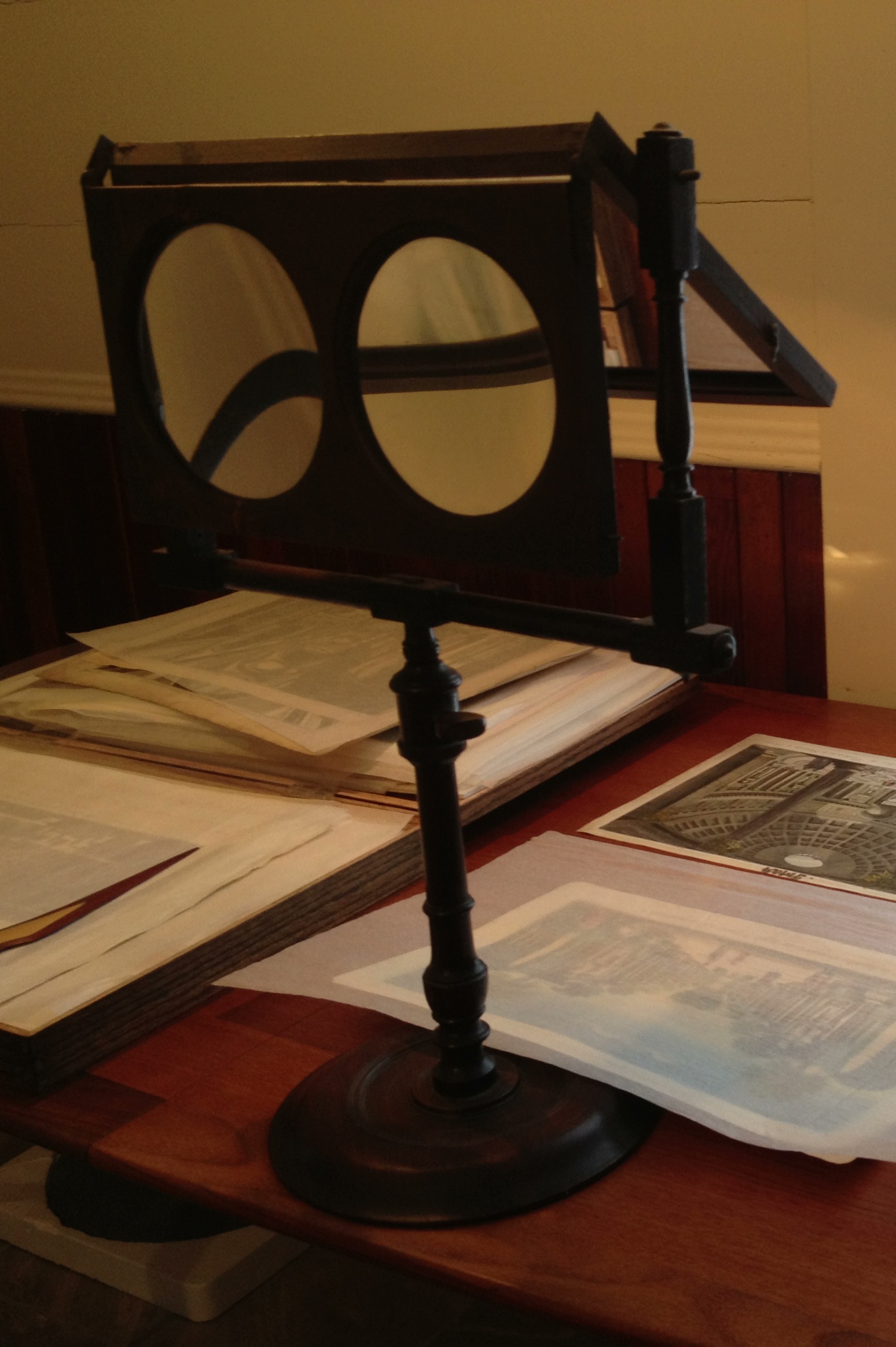 |
| RB-02 |
Zograscope-viewing was often a collective activity as Figure ZG.1 illustrates. This model would allow two to view side-by-side.
| Tripod: | 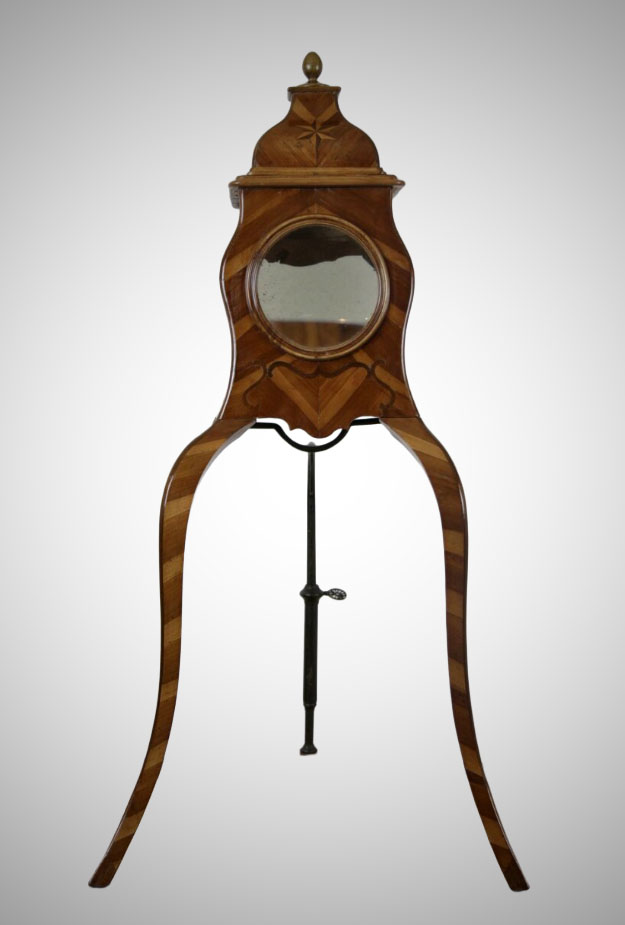 |
| PM-34001813 |
This type is supported by three legs. There is only one known species.
| Suspended: | 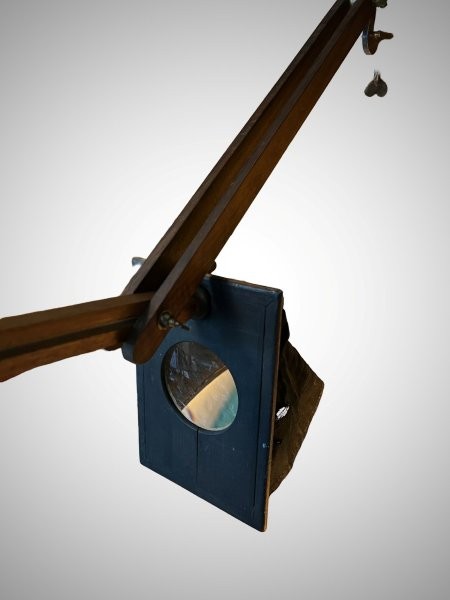 |
| RB-25-07 |
This type attaches to some overhead support. There is only one known species.
Endnotes:
[1] Chaldecott, J. A. "The Zograscope or Optical Diagonal Machine." Annals of Science 9, no. 4 (1953): 315-22.
[2] Arnott, Neil. Elements of Physics. 1 vols. London: Longman, Rees, Orme, Brown and Green, 1829.
[3] Bantjes, Rod. 2021. “The Optical Machine’s Asynchronic Progress.” Technology and Culture 62(4):1119-42.