Rod Bantjes, “RHCL-26-01_CDV_Monoscope.html,” created 5 October, 2026; last modified, 5 October, 2026. (https://people.stfx.ca/rbantjes/).
CDV Monoscope Billon
Regout family Archive, Regional Historical Centre Limburg in Maastricht #RHCL-26-01
France, ca. 1869
Dimensions: H= cm, W= cm, D= cm
Lens: ⌀= cm, ƒ= cm
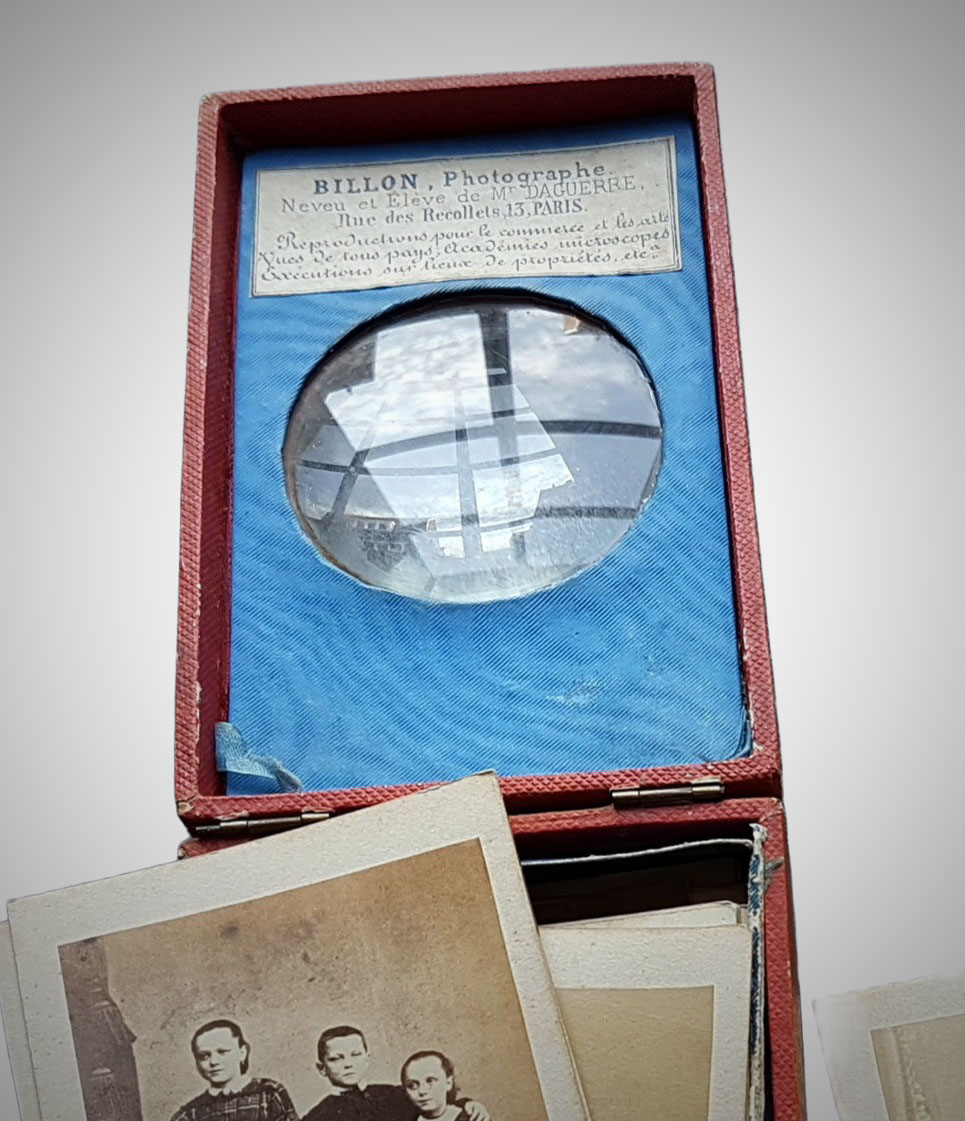 |
Figure RHCL-26-01.1 –Billon CDV Monoscope |
| Photo © Regout family archive at the Regional Historical Centre Limburg in Maastricht. |
This is a viewer exclusively for cartes de visite (CDV) sold by French photographer Armand(?) Billon, student and nephew of Louis Daguerre. It is an example of an “optical machine ” and is included in the Optical Machine Taxonomy as a member of the genus CDV-Mono-Graphoscope in the family CDV Graphoscope.
Lens: The lens is narrower than a CDV, so less than 6 cm. While larger than other CDV Graphoscopelenses, it is like them too small to see through with both eyes. It therefore relies on the weak monocular principle of 3D enhancement. Judging from its curvature, evident in the photo, the lens has a short focal length (perhaps equivalent to the length of the box).
The Box: The box is cheaply constructed with paper-covered softwood. This makes it lightweight and portable. It functions both as a storage case and base for the erected lens and image. Like the Cloth Neomonoscope and Reflectoscope, the image-card probably slots in between an inner cardboard layer and outer edge of the box. Unlike most Genus_Mono-Graphoscope.html Mono-Graphoscopes, which it resembles, the image-plate’s height and distance from the lens is therefore not adjustable.