Rod Bantjes, “Family_CDV_Graphoscope.html,” created 19 August, 2026; last modified, 19 August, 2026 (https://people.stfx.ca/rbantjes/).
CDV Graphoscope Family (ca. 1860-1890)
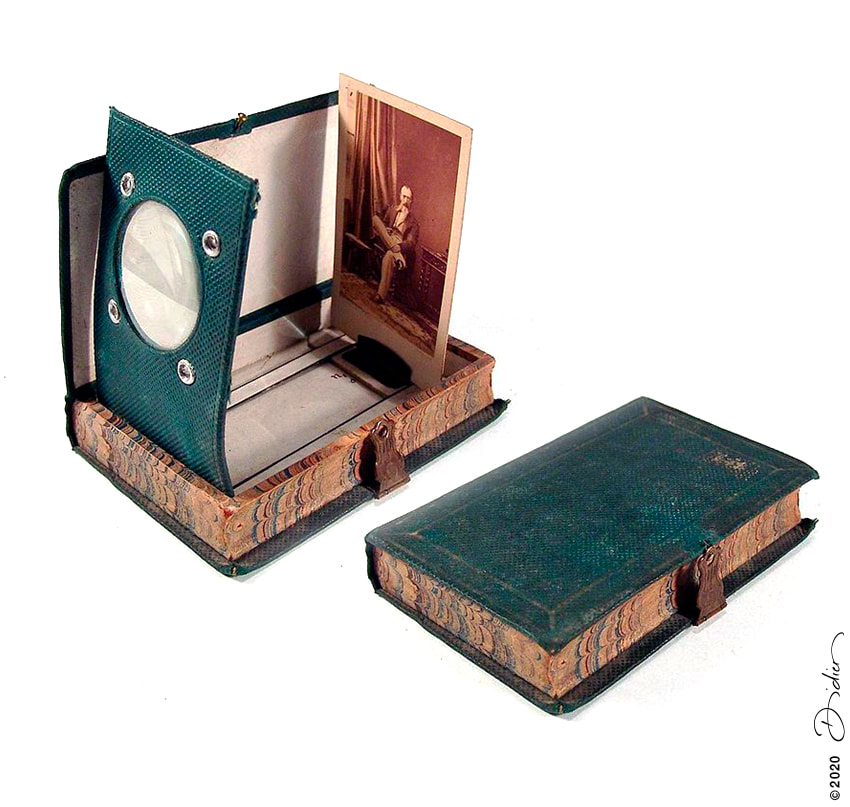 |
Figure CF.1 –CDV Graphoscope |
| Photo © Didier Mahler. |
These are all biconvex lens viewers, or optical machines, for cartes de visite. These viewers all fold up as cases in which to store a selection of images. Since cartes de visite do not exceed 6.3 cm in width, the cases are small and the lenses on the lids are also small – less than 6 cm and too small to view through with both eyes. So they all must rely on the weak monocular principle of 3D enhancement.
Monocular Lens: With small, monocular lenses and short focal-lengths (probably less than the box, or about 10 cm), they are unlike most graphoscopes. Their morphology and use for photographs make them similar enough to the graphoscope that they are included in the Order Graphoscope as a separate family.
Card Holder: The small, lightweight, rigid CDV was an affordance that allowed for a pared-down image-holder – no more than a slot without a back or upper frame. This simple design also appears in a graphoscope designed for cabinet cards and, in the early 20th century, in concave mirror viewers for snapshots.
Miniaturization /Portability: Shaped by the carte de visite image-format, all of these viewers appeal to the 19th-century love of miniaturization and portability. They fold down into pocket-sized boxes that function as carrying cases for a selection of views.
List of Genuses
Each row in the following table represents a different genus; entries within the row are for different species:
| CDV-Mono-Graphoscope: | 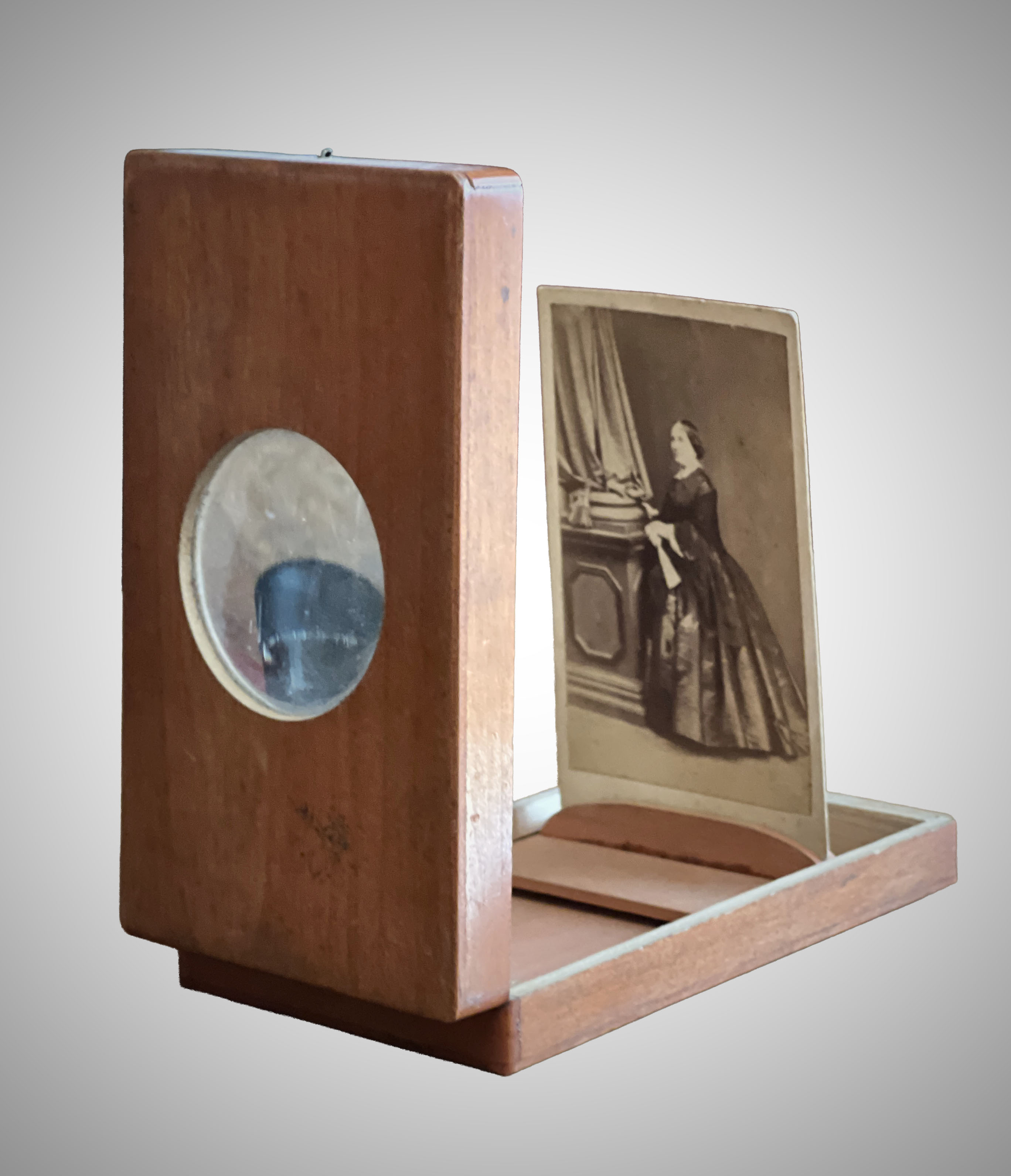 |
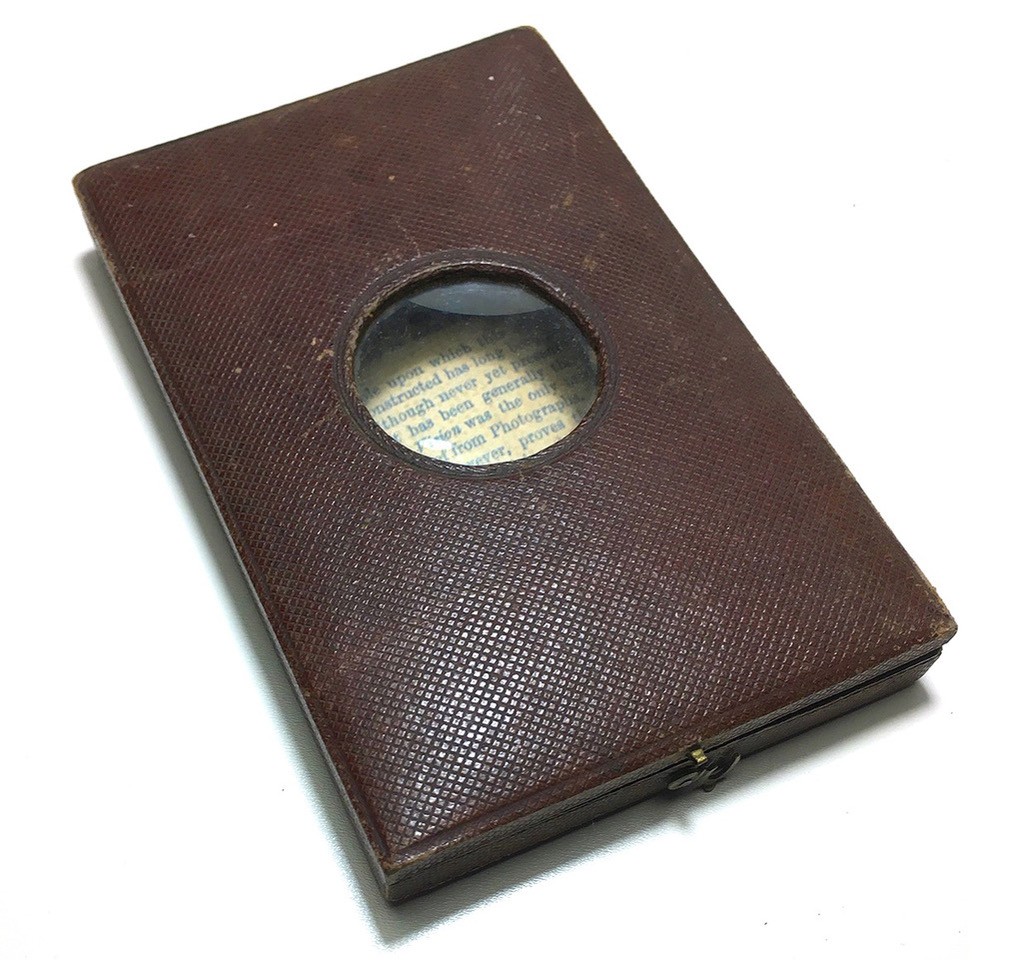 |
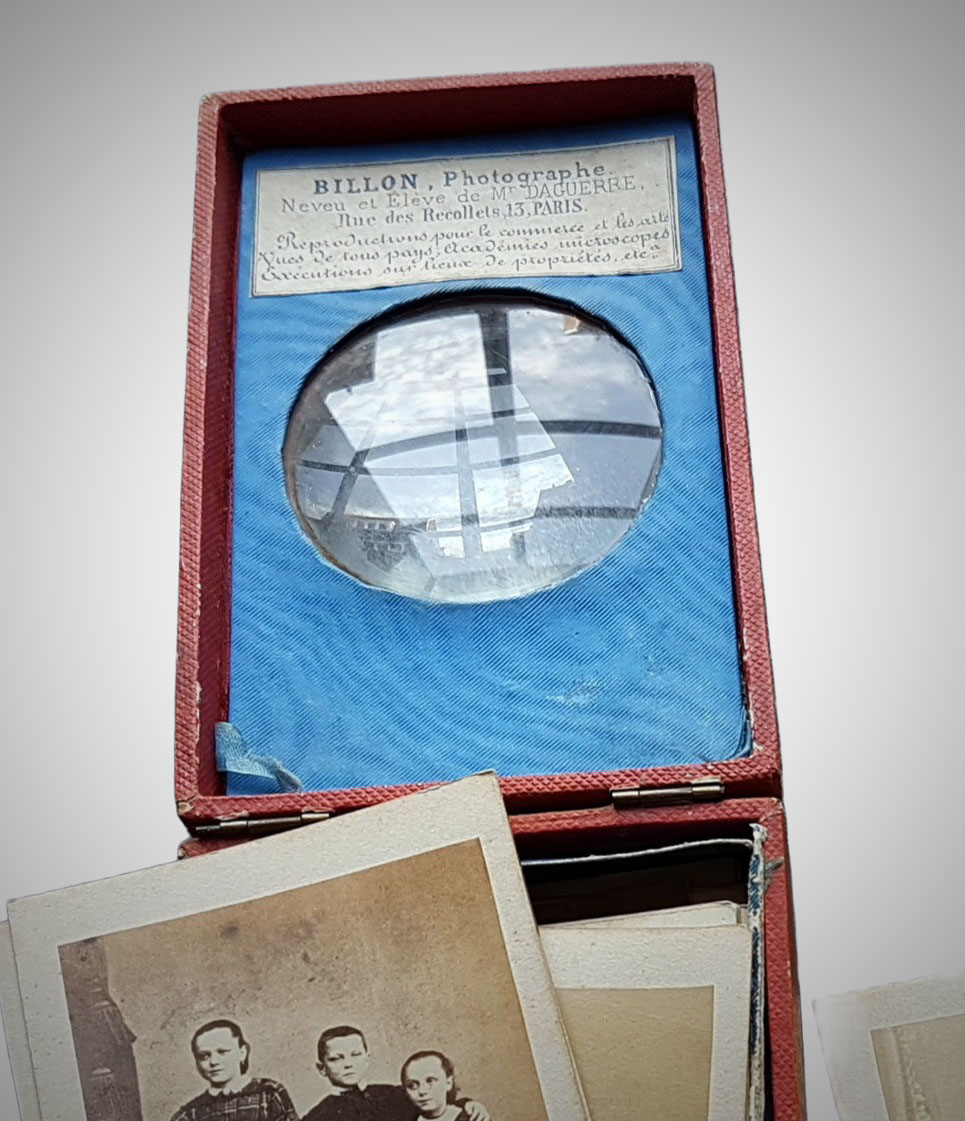 |
| Mini-Mono-Graphoscope | Cloth Neomonoscope | Billon |
This genus is characterized by a single fold-up lid that is hinged to a base of the same width and depth. The lid doubles as a lens-plate. It is similar in form, but not scale to the Mono-Graphoscope. This CDV version may have been the original form and inspiration for the Mono-Graphoscope
| Book-CDV-Monoscope: | 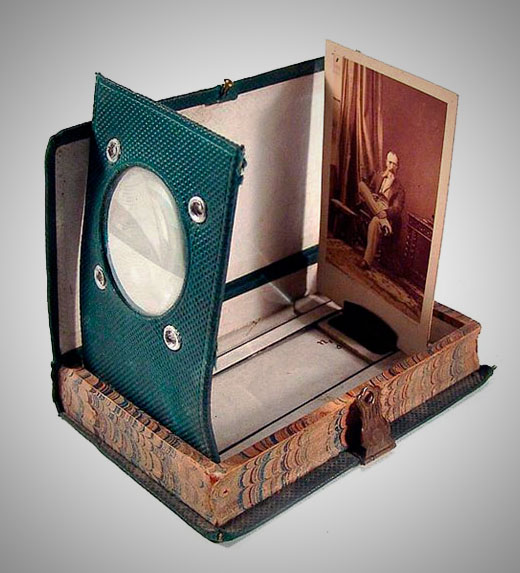 |
| Genus |
This genus is characterized by its fake book-form. It has two hinged components: the front “book cover” and a separate image-plate.