Rod Bantjes, “Image_Card_Photos.html,” created 4 October, 2026; last modified, 4 October, 2026 (https://people.stfx.ca/rbantjes/).
Card-Photos
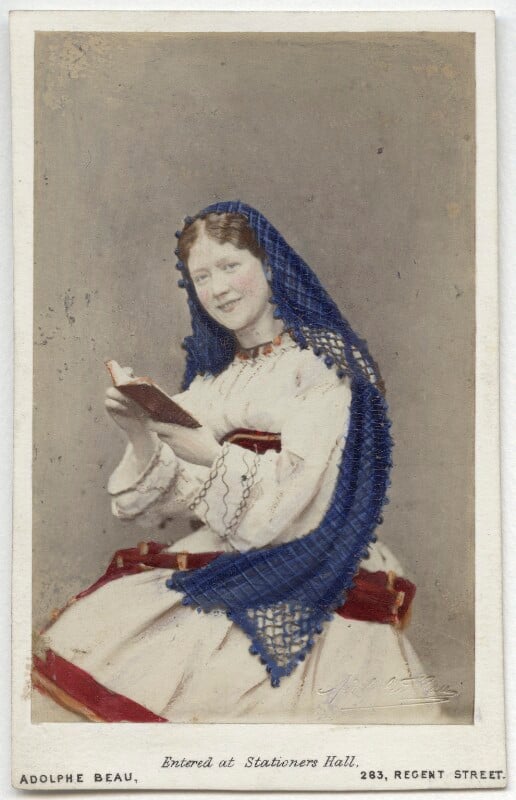 |
Figure CP.1 – Carte de Visite |
Adolphe Paul Auguste Beau, 1863, Kate Terry as Blanche de Nevers in 'The Duke’s Motto', hand-coloured albumen carte-de-visite, 8.8 x 5.6 cm (image size), © National Portrait Gallery, London. Creative Commons license 3.0
This is an example of the kind of image Beau designed his viewer for. |
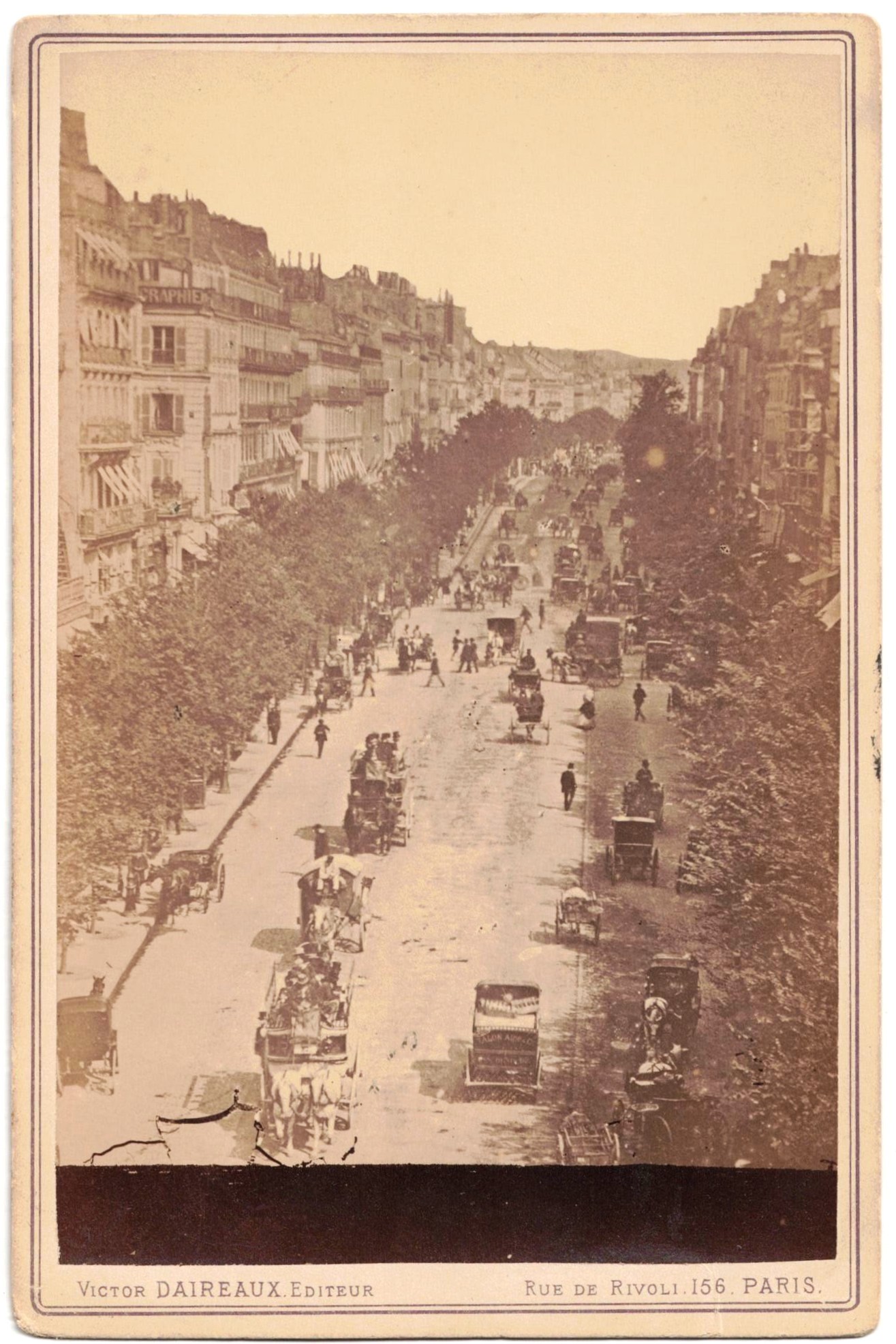 |
Figure CP.2 – Cabinet Card |
Victor Daireaux, ca. 1880, Les Boulevards, albumen cabinet card, 15 x 9.7 cm (image size), 16.6 x 10.8 (card size), Collection of Rod Bantjes. |
So far we know of two formats of card-backed photos that optical machines adapted to: the small carte de visite (Figure CP.1) and the much larger cabinet card (Figure CP.2). (For other photo-formats, in the form of transparencies, see photographic Paper Dioramas.)
Carte de Visite: The carte de visite (CDV) was developed in 1855 by André-Adolphe-Eugène Disdéri and became widely popular in the 1860s. Optical machines typically interbred with new devices or formats only once these became popular, so the CDV-Graphoscope was likely an innovation of the 1860s. Paul Adolphe Auguste Beau applied for his patent for a CDV viewer, the neo-monoscope, in 1860.
The carte de visite size was modelled on existing calling cards (9 x 6 cm). Using a multi-lens camera, Disdéri developed a method of printing 4 to 8 negatives of this size on a single glass plate and reproducing batches of prints as contact sheets. The small scale and efficiency of reproduction dramatically reduced the cost per image, and made the carte de visite affordable to a wider public. A new industrial model for marketing images opened a new channel of adaptation to the ancient optical machine.
Cabinet Card: Cabinet cards, nearly twice the size of cartes de visite (ca. 16.5 x 10.8 cm), were introduced in the 1860s. They were widely used in the 1880s and in decline in the 1890s.[xxx] The Souvenir de Paris was a mono-Graphoscope designed specifically for cabinet cards. It relies on a simple slot to hold the image – a feature that can be seen in the example in the Bill Douglas Cinema Museum Collection.
Endnotes:
[xxx] https://en.wikipedia.org/wiki/Carte_de_visite
[xxx] https://en.wikipedia.org/wiki/Cabinet_card