Rod Bantjes, “WN-SN529_Engelbrecht_Vertical.html,” created 10 August, 2025; last modified, 10 August, 2025 (https://people.stfx.ca/rbantjes/).
Large Vertical Kulissentheater
Werner Nekes Collection, Theatre Studies, University of Cologne[1] #WN-SN529[2]
German c.1840
Dimensions: H=142.6 cm, W=28.3 cm, D=25.6 cm
Lens: ⌀=10.2 cm, ƒ=57 cm
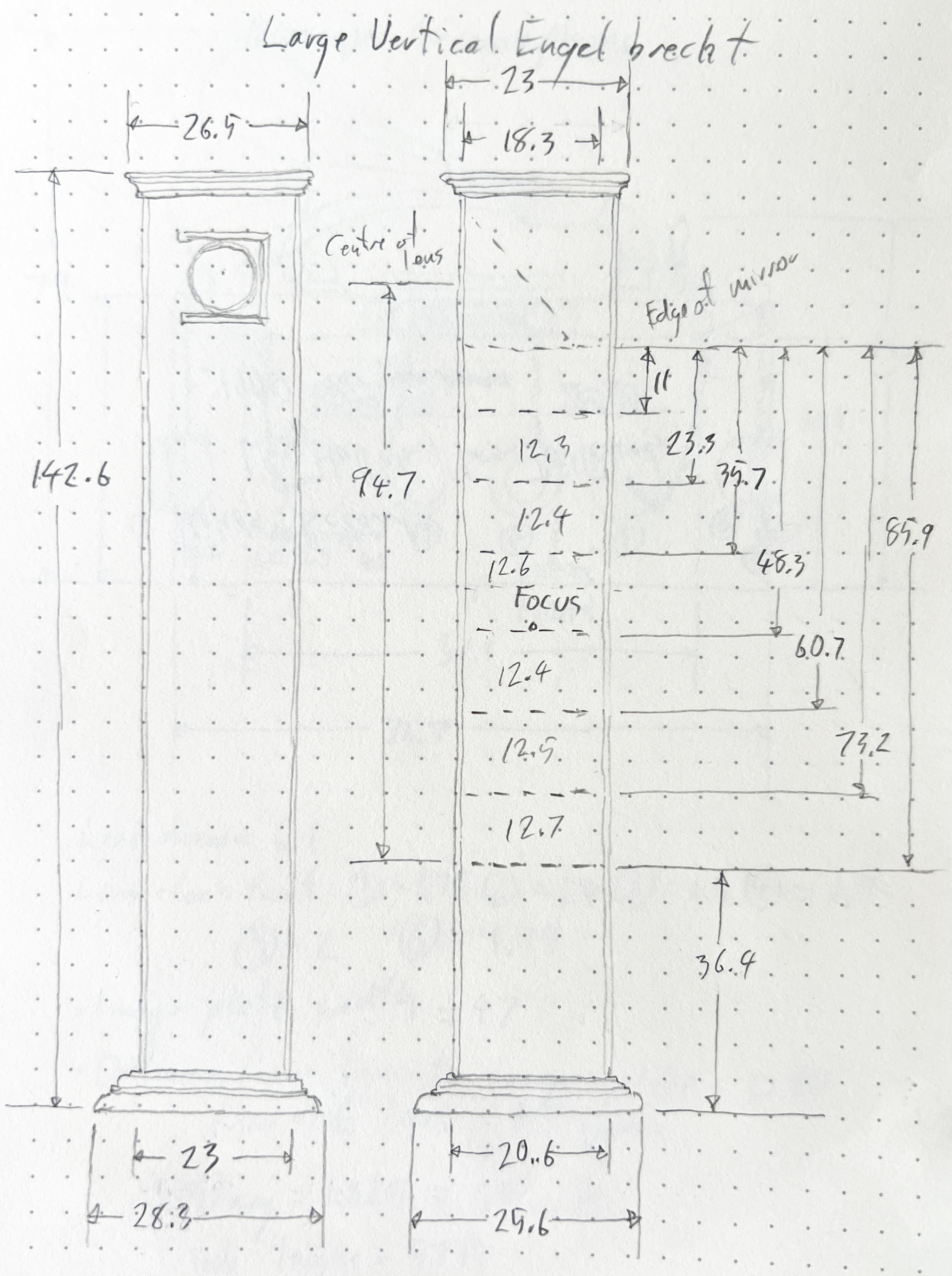 |
Figure SN529.1 –Large Vertical Kulissentheater |
| Diagram taken from "field notes." |
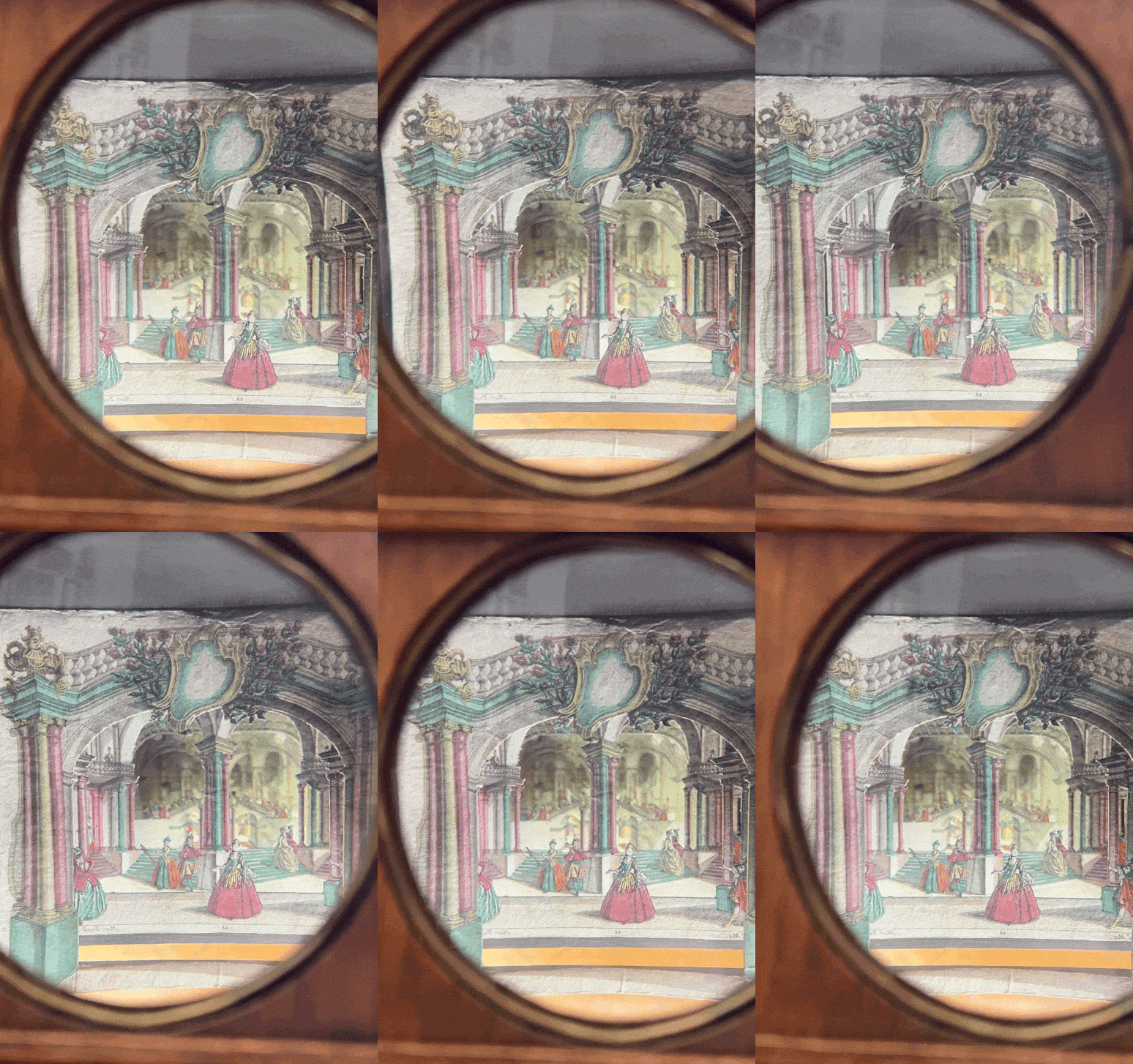 |
Figure SN529.2 –Parallax Effect |
The camera has focused on the first coulisse. Note how the remaining 5 are successively more out of focus until you can barely make them out. GIF image © Rod Bantjes. |
This is a large-format viewer for scenes consisting of a series of hand-painted engravings: six cut out as coulisse-frames and a solid backdrop. It is an example of an "optical machine " and is included in the Optical Machine Taxonomy
This is the largest and most expensive of the viewers that was produced by Martin Engelbrecht's workshop in Augsburg between 1737 and 1770.[3] The coulisse-frames are copper-plate engravings printed on quarto format paper (15.6 x 20.8 cm). Quarto is one quarter of a "folio" sheet which was what standard vues d'optique were printed on. So, in terms of the viewing area this box is a quarter the size of most optical machines in the 18th century. However, its depth, measured from the lens to the last image-plate, is close to a metre, similar to the Dutch Rarekiek. That gives the planes of the image more separation and a more exaggerated parallax-effect when viewed through the lens (see Figure SN529.2).
The GIF animation in figure SN529.2 does not give an accurate impression of the wonderful depth of the image when you look through the lens. The iPhone with which it was taken has focused only on the first coulisse. However, if you are lucky enough to try out the actual box, your eyes will be constantly scanning and refocusing so you can also make out the further depths of the scene clearly. Your brain does a sleight-of-hand to convince you that the whole scene is in focus at once. Engelbrecht may have been aware of the difference between the camera image and the actively-scanned image and designed his kulissentheaters to exploit the way that focus works in natural vision.
The Focus of the lens is about midway between the first coulisse-frame and the backdrop, consistent with my argument that he probably was not aware of how the lens is supposed to affect monocular and binocular convergence. However, the lens in this box is a pristine plano-convex (i.e. flat on one side). I am not sure that plano-convex lenses were used in the 18th century so I suspect that it might be a later replacement.
Notes on Construction:
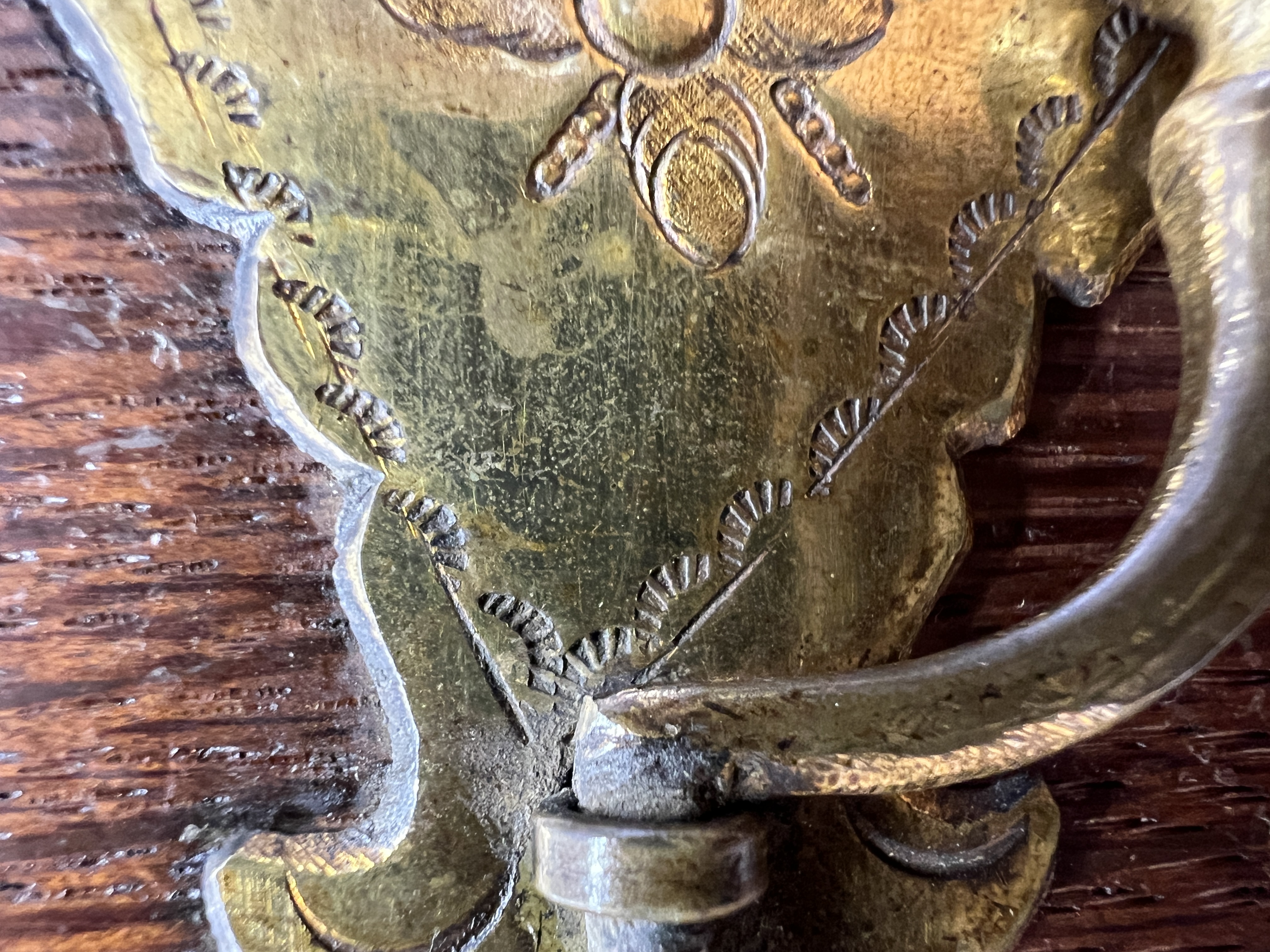 |
Figure SN529.3 –Brass Handle |
| Photo © Rod Bantjes. |
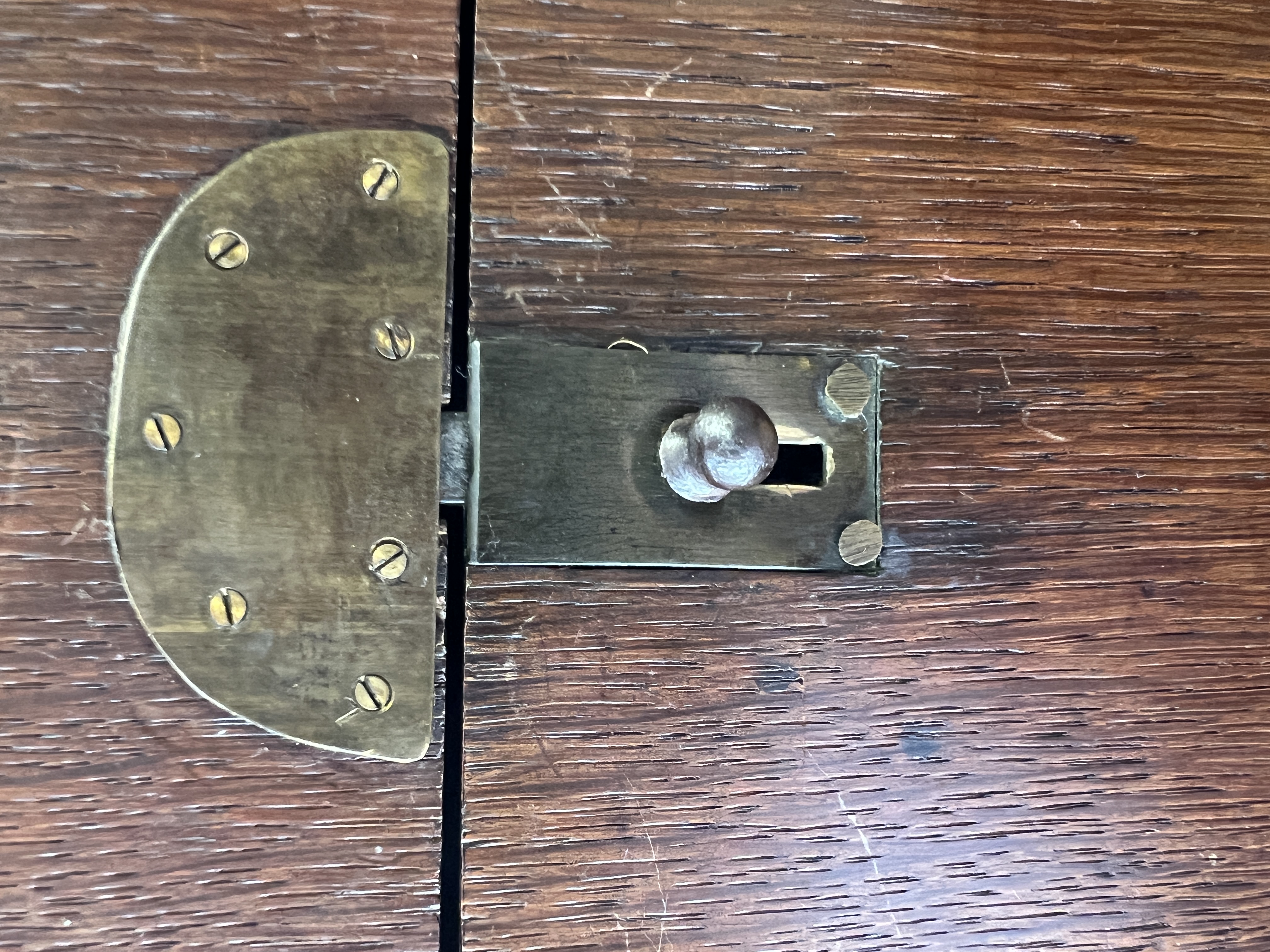 |
Figure SN529.4 –Latch |
Photo © Rod Bantjes. |
Engelbrecht's boxes are generally very plain – simple oak construction without colour, decoration or fancy detailing. They have an austere "Protestant" feel to them. This one is a slight exception. It is accented with cornice and beading and has a few brass fixtures. There are handles to assist in moving it and a latch and brass hinges for the back which can be opened to admit light onto the coulisse-frames.
The patterns in the brass handle appear to be hand-hammered rather then machine-stamped or formed in a mould (Figure SN529.3). The latch shape and the spacing of the screws are done by eye and are a little irregular (SN529.4). So, while Engelbrecht's boxes were of standardized design, the actual manufacture had not reached the level of machine-regularity and efficiency more typical of the 19th century.
Endnotes:
[1] I would like to thank Dr. Peter W. Marx for permission to access the collection and Charlene Fündgens, Emma Gebbeken and Gerald Köhler for their generous assistance in the archive..
[2] Based on Neke's numbering that will likely change once the Cologne Theatre Studies Department properly catalogues the collection..
[3] Füsslin, Georg, et al., Der Guckkasten : Einblick, Durchblick, Ausblick (Stuttgart: Füsslin, 1995), 49..