Rod Bantjes, “GST-372_Church_Tower.html,” created 5 August, 2025; last modified, 19 October, 2025 (https://people.stfx.ca/rbantjes/).
Vertical Box in the form of a Church Tower
Gestetner Collection (V&A)[*] #GST-372
English, ca.1812
Dimensions: H=50 cm, W=20.5 cm, D=18 cm
Lens: ⌀=3 cm
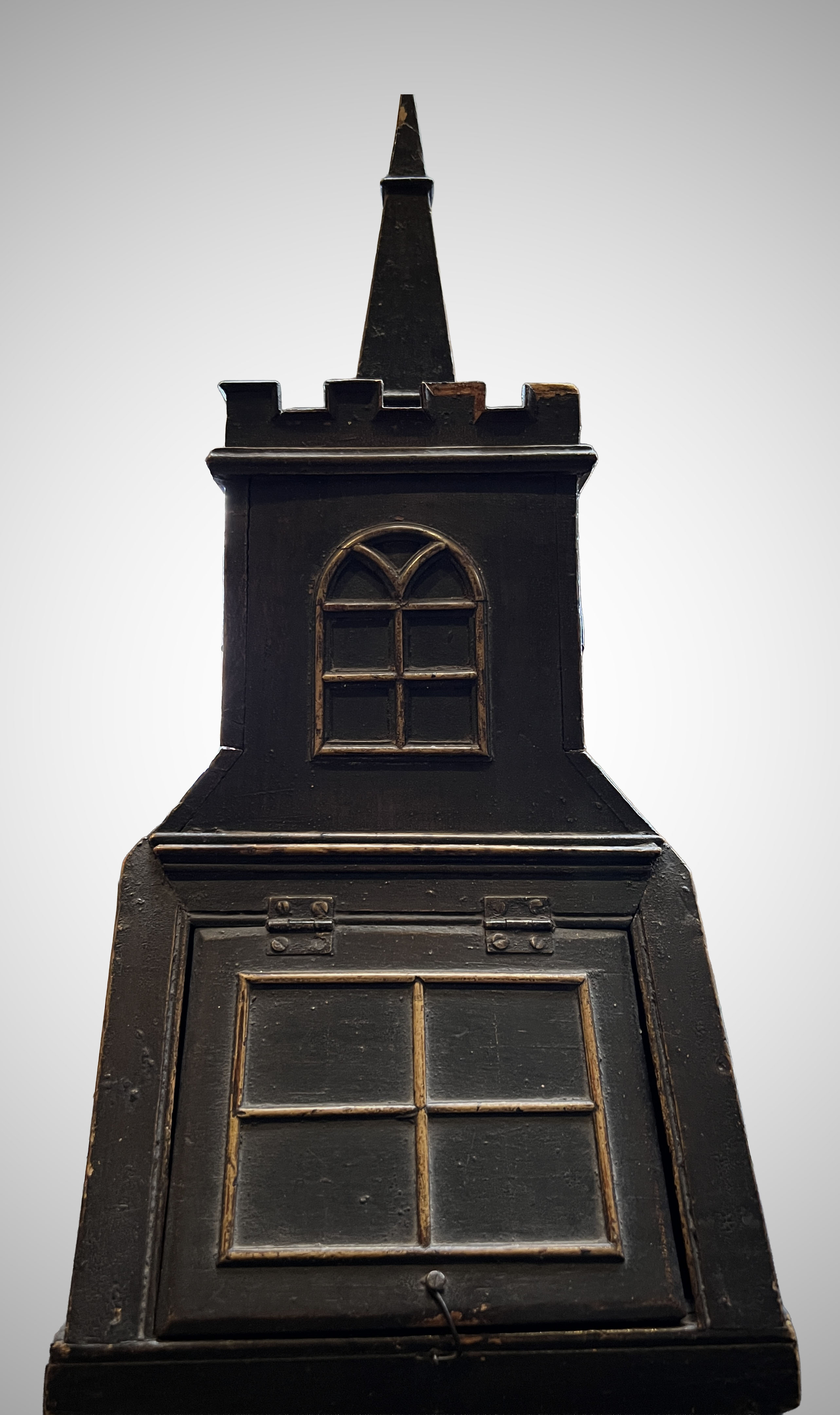 |
Figure 372.1 –Vertical Box |
| Shown from the back. Photo © Rod Bantjes. |
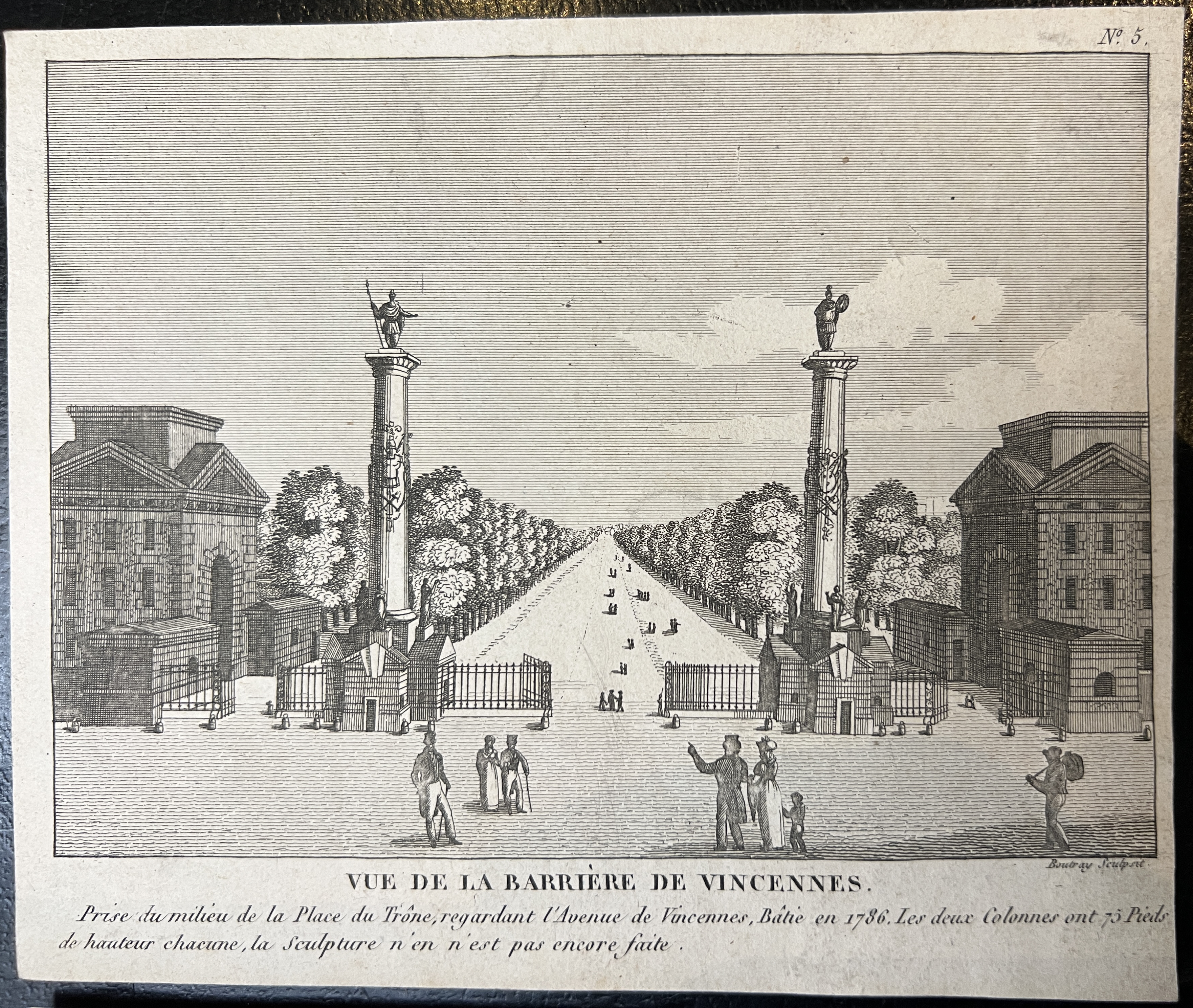 |
Figure 372.2 –Vue d'Optique |
| Photo © Rod Bantjes. |
This is a diagonal mirror viewer with a monocular lens (i.e. smaller than 6 cm diameter) and small views (14 x 17.5 cm). It is an example of an “optical machine ” and is included in the Optical Machine Taxonomy.
It is an early example of a monocular viewer, departing from 18th-century prescription that the lens be large enough to look through with both eyes.[1] The lens is missing, but the empty hole has residual glue suggesting that it did once house a lens.
The viewer is supplied with five miniature copper-plate engravings on laid paper, in black ink with no colouring. These are numbered in a way that suggests that they are a selection from at least 20 available images. They are all in vue d'optique style with exaggerated central, single-point perspective (see Figure 372.2). One or two of the women depicted in them are wearing dresses with high “empire waists” typical of the first two decades of the 19th century (see Figure 372.4).
The box is simply constructed of painted and lacquered wood. It is not an example of fine cabinetry, but the elaborate shape, raised mouldings and beading would have made it more expensive than many later boxes designed as children's toys. On the inside walls of the box, someone has pasted a bricolage of decorative paper and imagery, perhaps from period wallpaper (see Figure 372.3). This is more often a feature of home-made boxes, but may have been added later by one of its users.
Ralph Hyde suggests that the box may be German in manufacture. This style – where the exterior of the box masquerades as one thing and the lens reveals another, and distant world within – can be found in German-speaking countries in the early 19th century. There is also a French diagonal mirror viewer (GST-369) in the form of a pair of cathedral windows, but it is lighter and collapsible unlike the Austrian examples. Hyde offers other evidence that this one (i.e. GST-372) may be English rather than German: “On the underside of the trap-door is a cartouche. Within the cartouche appears the word 'BEHOLD'. Beneath it appear the words 'MULTEM IN PARVO [= 'Much in little'] 1812'. The letter 'W' appears on the left and the letter 'L' on the right. On the bottom are painted the words '[...] Longfield Skerton 1812' (someone called Longfield who lived in Skerton, Lancs.?).” [2]
The fact that it is in the form of a church is curious but not unusual. Hyde writes: “Large boîtes d'optique in the shape of church towers were carried and performed in public by itinerant showmen. See, for instance, Bowles & Carver's 'Youthful Entertainment' (late 18th century) and Thomas Rowlandson's 'The Showman' (1806).” [2] We can imagine children with this little version, acting the role of travelling showman for their playmates – shouting for their attention and narrating the amazing scenes within.
The question remains: why a church? The French cathedral is yet another example. Perhaps, like me, people considered the cathedral to be the precedent and model for both the theatre and these little show-boxes. It was a portal into another and distant world – a space larger than its container, represented by architecture, narration and visual imagery (the first and most sophisticated imagery that most Europeans would have known).
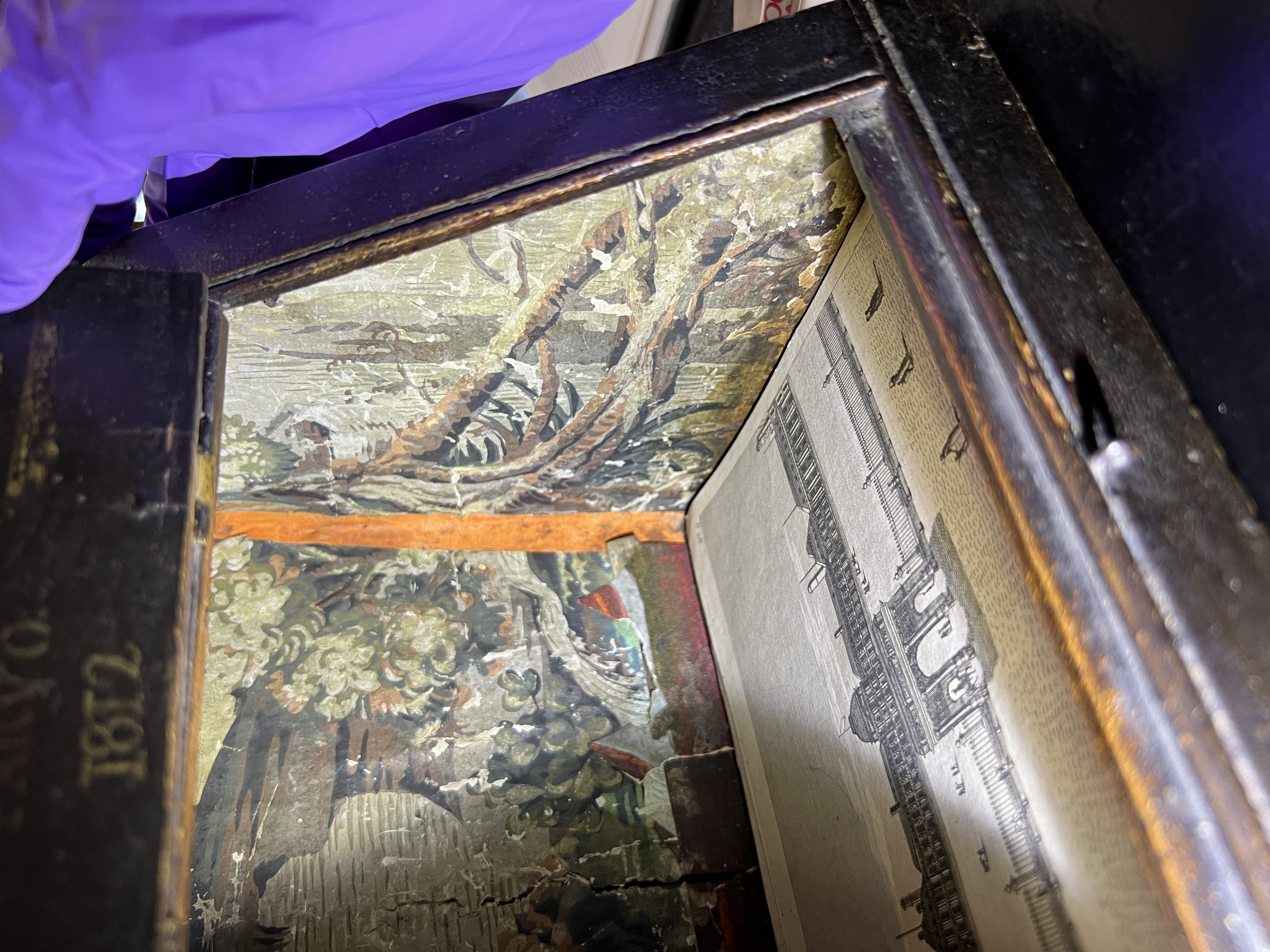 |
Figure 372.3 –Papered Inner Walls |
| Looking in through the back. Photo © Rod Bantjes. |
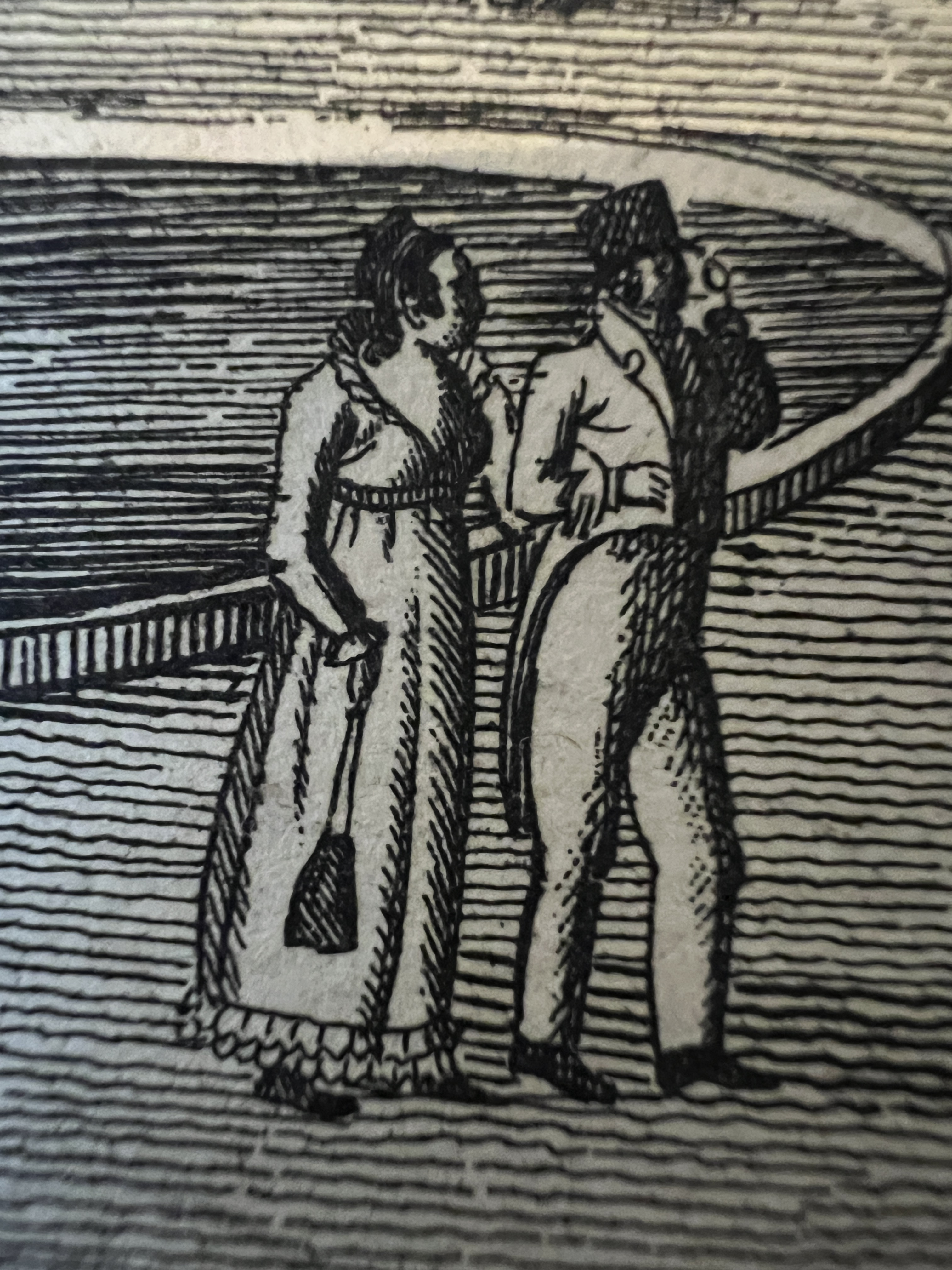 |
Figure 372.4 –Detail Vue d'Optique |
| Note the woman's dress exemplifying the “empire waist” Photo © Rod Bantjes. |
List of views:
- Vue de la Barrière de Vincennes (No. 5)
- Vue du Palais des Tuileries, du Côté de la Cour (No. 9)
- Vue du Panthéon ou Saint Geneviève (No. 11)
- Vue du Jardin et des Galleries du Palais Royal (No. 12)
- Val de Grâce (No. 20)
Endnotes:
[*] I would like to thank Amy Orr and especially Catherine Yvard for their generous assistance in the V&A archives..
[1] Harris, Joseph, A Treatise on Optics (London: B. White, 1775). See also my discussion of the theory.
[2] Hyde, Ralph, Paper Peepshows: The Jacqueline & Jonathan Gestetner Collection (Woodbridge: Acc Art Books, 2015)..