Rod Bantjes, “GST-375_Vivandiere.html,” created 4 August, 2025; last modified, 19 October, 2025 (https://people.stfx.ca/rbantjes/).
Diagonal-Mirror Box: the Vivandière
Gestetner Collection (V&A)[1] #GST-375
Austrian c.1855
Dimensions: H=42 cm, W=19 cm, D=14 cm
Peephole: ⌀=3 cm, missing lens
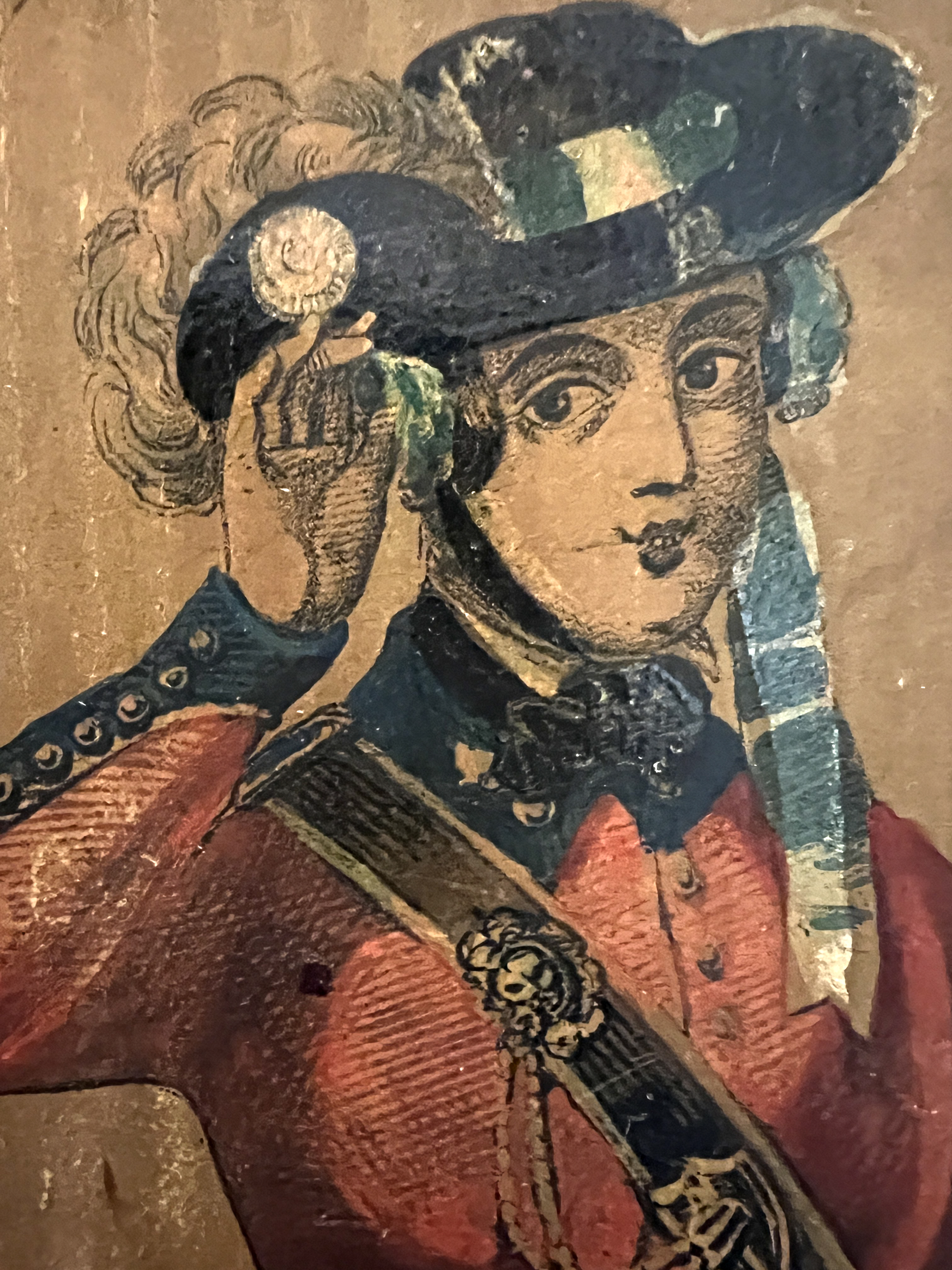 |
Figure 375.1 –The Vivandière |
| Detail from the image on the front face of the box. Photo © Rod Bantjes. |
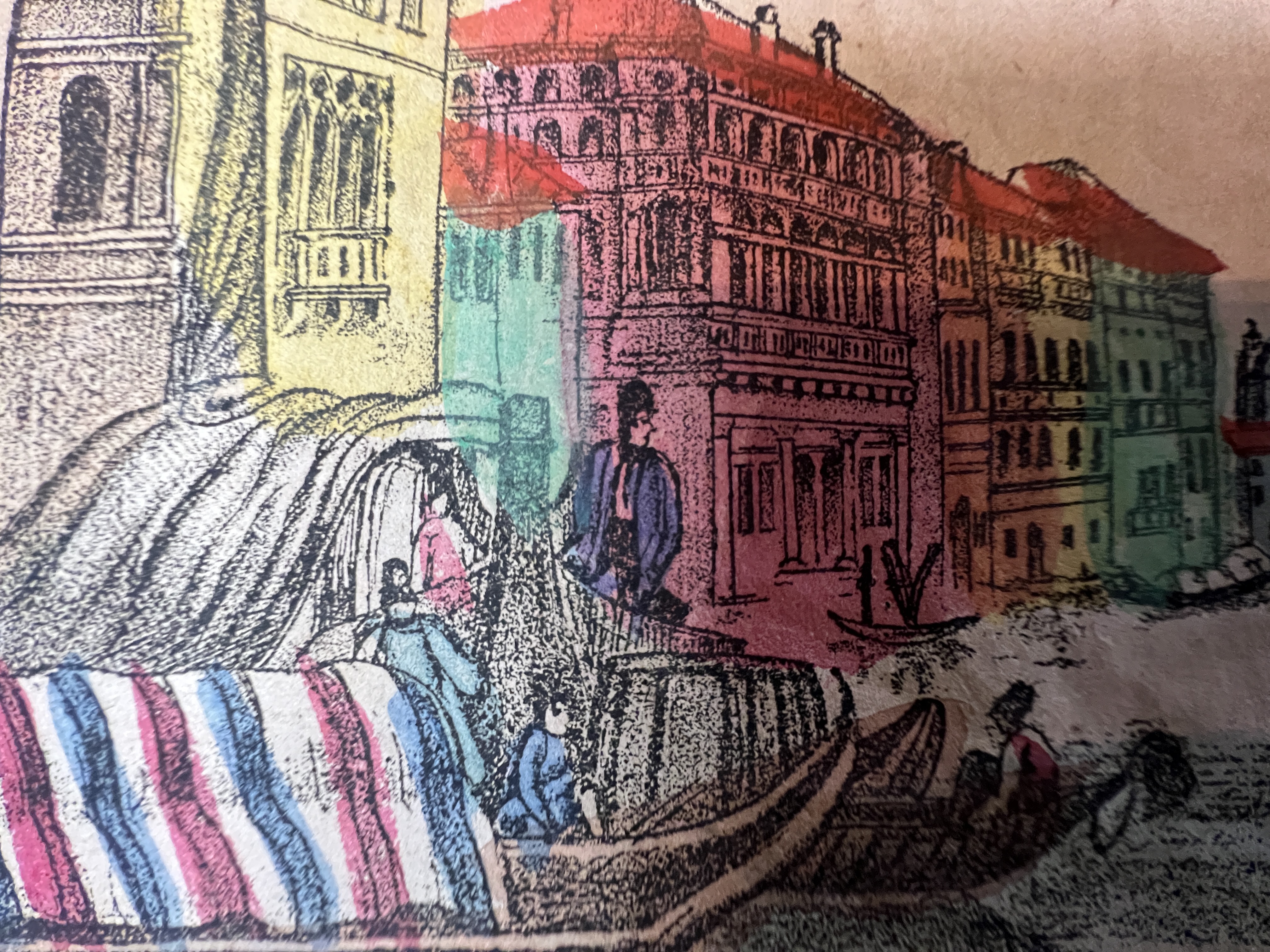 |
Figure 375.2 –Detail of Canal in Vendig |
| Detail showing the hurried application of colour. Photo © Rod Bantjes. |
This is a diagonal-mirror box for viewing small litho-prints. It is an example of an "optical machine " and is included in the Optical Machine Taxonomy.
Its style of construction, single internal coulisse and images are the same as other boxes, all probably from the same Austrian workshop: GST-373, GST-374, and EXBD-69331. The coulisse in this box has the same image as the one in GST-374, only slightly smaller. Given the diversity of designs, these boxes were probably made in small batches (see below), unlike the Lefort boxes. The only part mass produced would be the views. These would typically be hand-coloured by women or children for little or (if they were family members) no money. You can see (Figure 375.2) how rushed they must have been to complete their work-quotas.
Figure 375.4 shows the backs of this box (top) and GST-374 (bottom) showing the coulisses and the sliding shutter. These shutters offered a more limited lighting control than Lefort's popular "dioramic" boxes of this period (see EXBD-69055 and EXBD-69056). Opening the shutter halfway illuminated the view; opening it further illuminated the coulisse as well.
Ralph Hyde gives a vivid account of the image on the face of the box: it "...has been heightened with gum arabic. At the top of the design are the flags of Britain and France, and the emblem of Turkey between. Within this grouping is the peep-hole, crudely cut. Beneath the peep-hole is the figure of a lady in military attire, carrying a keg, who salutes us. She is a vivandière, a camp-follower in the Crimean War, and the uniform she wears would have been adapted from that of the regiment to which she was attached. The background consists of tents; canons protrude from the one on the right." [2]
Contemporary prints and paintings of travelling showboxes often represent the showman as a disabled soldier. Such men would have been unfit for better employment, but would have enjoyed one of the few opportunities that working-class people had of seeing the world. Returned soldiers would have had many stories to tell to enliven a peepshow performance. This young vivandière too has found a way to travel with the army. Perhaps through her, little girls could imagine themselves seeing the world as they gazed at the virtual spaces offered through their little viewing-box.
The lens of this box has fallen out or been removed for some other use. It was held in a cupped depression in the wood and secured by glue and a layer of paper around its circumference edge.
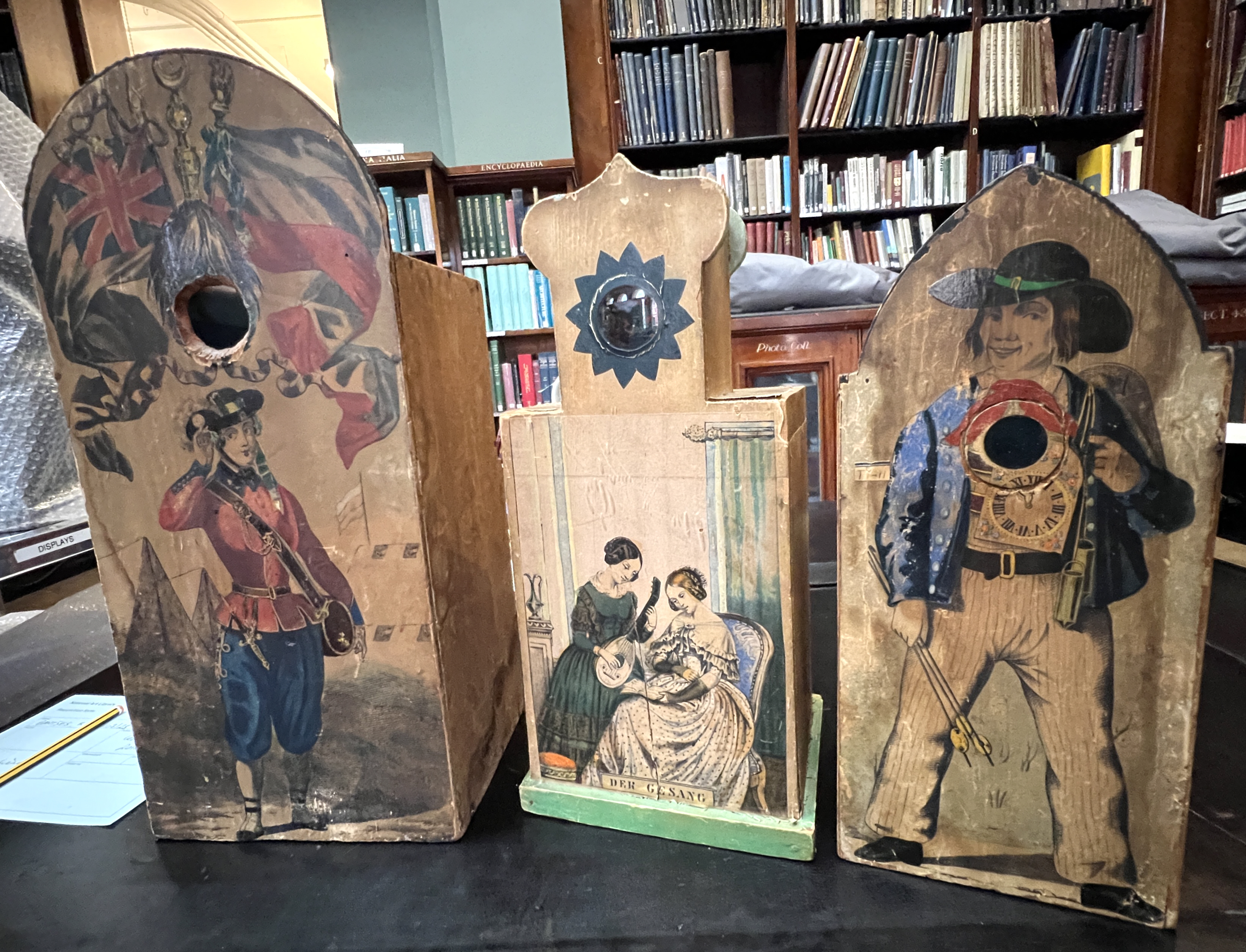 |
Figure 375.3 –Three Related Boxes |
| From left to right: GST-375, GST-373, GST-374. Photo © Rod Bantjes. |
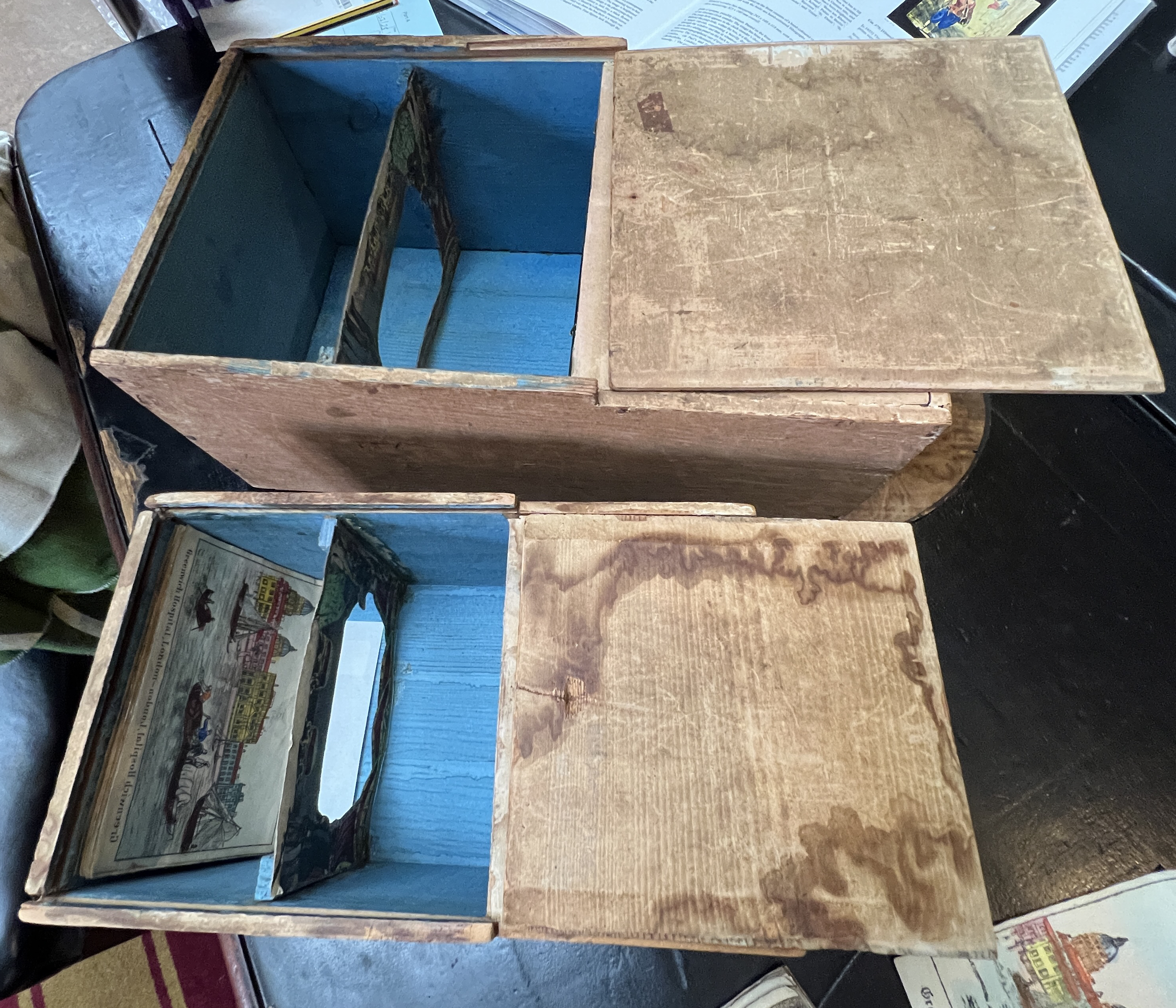 |
Figure 375.4 –Backs of Boxes |
| Top: GST-374; bottom: GST-374. Photo © Rod Bantjes. |
List of Views:
- Brücke in London (St Paul's and Blackfriars Bridge). The same view accompanies box GST-374.
- Rotherhith in England (Rotherhithe, London). The same view accompanies box GST-374.
- Bollhouse in London (Custom House)
- Tower zu London
- Adolph's Terasse in England (Adelphi Terrace, London)
- Greenwich Hospital in London
- St Paulskirche in London (St Paul's, London)
- Elbebrüche in Dresden
- Canal in Venedig (Canal in Venice)
- Palais Foscari zu Venedig (Venice)
- Rialto Brücke in Venedig (Rialto Bridge in Venice)
- St Trienta Brücke in Florenz (St Trienta Bridge in Florence)
Endnotes:
[1] I would like to thank Amy Orr and especially Catherine Yvard for their generous assistance in the V&A archives..
[2] Hyde, Ralph, Paper Peepshows: The Jacqueline & Jonathan Gestetner Collection (Woodbridge: Acc Art Books, 2015).