Rod Bantjes, “RB-04_Stereo-Graphoscope.html,” created 24 April, 2026; last modified, 24 April, 2026 (https://people.stfx.ca/rbantjes/).
Stereo-Graphoscope
Rod Bantjes Collection, #RB-04
French ca. 1895
Dimensions (open): H=41 cm, W=17.1 cm, D=35.3 (closed): H=9.5 cm, W=17.1 cm, D=26.6
Lens: ⌀=12.5 cm, ƒ=31.6 cm
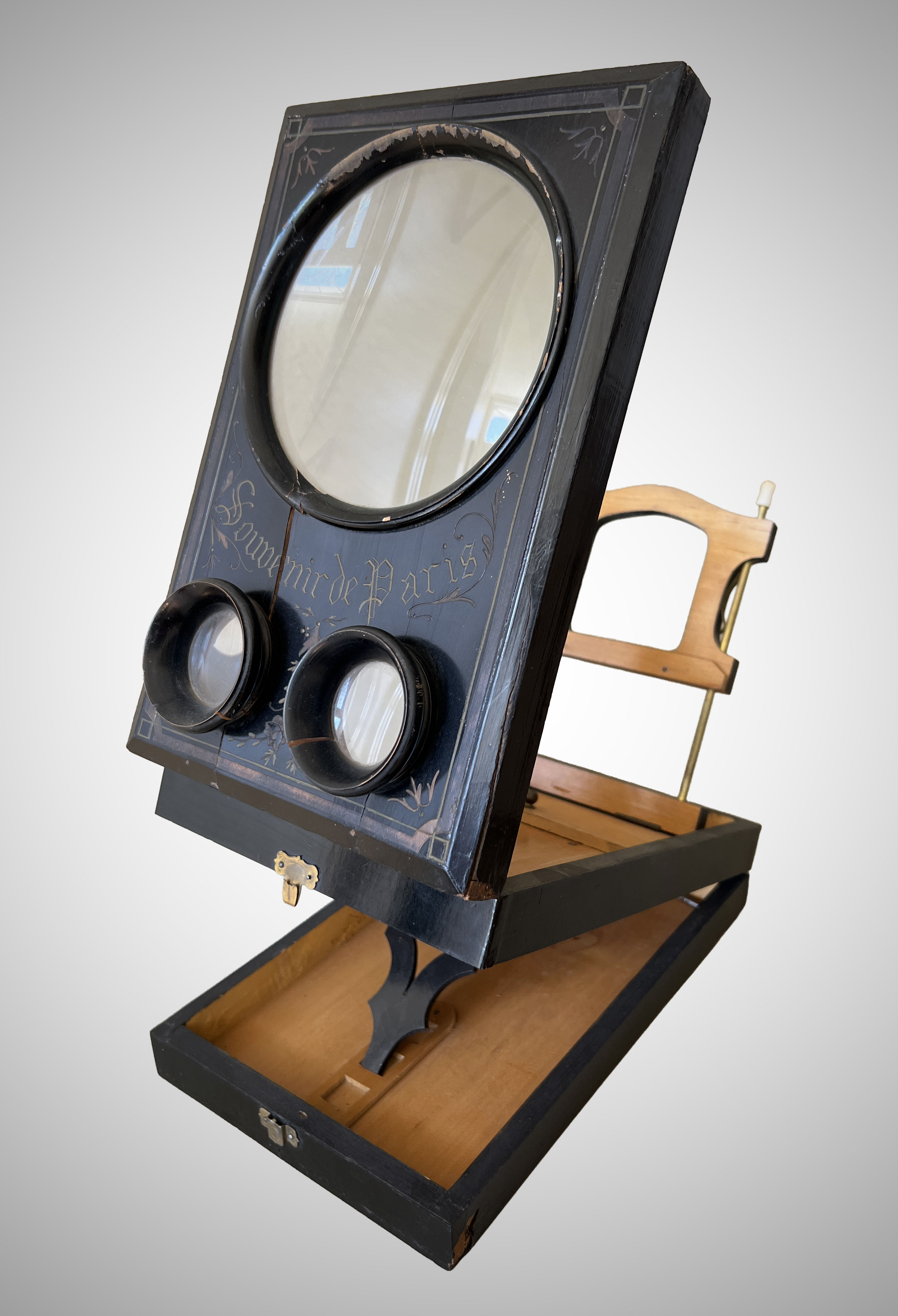 |
Figure RB-04.1 –Stereo-Graphoscope |
| Photo © Rod Bantjes. |
This is a biconvex lens viewer for late 19th-century photographic formats. It is an example of an "optical machine" and is included in the Optical Machine Taxonomy where it is a member of the genus "Mono-Stereo-Graphoscope" and the family Stereo-Graphoscope.
18th-Century Tech:The Stereo-Graphoscope was an 18th-century 3D technology applied to photographic prints. John Rowsell's choice to patent this instrument in 1861 is curious since the far superior 3D technology of the stereoscope had recently been invented. Click here for more discussion on how the Stereo-Graphoscope fits within the context of other media devices.
Features:This example is one of the cheapest versions of the Stereo-Graphoscope. It is made with a light hardwood, perhaps boxwood, with a black laquered finish. The hardware is made from thin stamped metal, in some cases affixed with nails (a mark of cheap construction in the 19th century).
Endnotes:
[1] "A Combination Stereo-Graphoscope," The British Journal of Photography XXII, no. 768 (1875), 37.
[2] "The Stereo-Graphoscope," Camera Craft 14 (1907).
[3] "A Combination Stereo-Graphoscope," 37.