Rod Bantjes, “RBS-01_Brewster_Stereoscope.html,” created 2 September, 2025; last modified, 2 September, 2025 (https://people.stfx.ca/rbantjes/).
Brewster Stereoscope
Rod Bantjes Collection #RBS-01
English(?) c.1855
Dimensions: H= cm, W= cm, D= cm
Lens: ⌀= cm, ƒ= cm
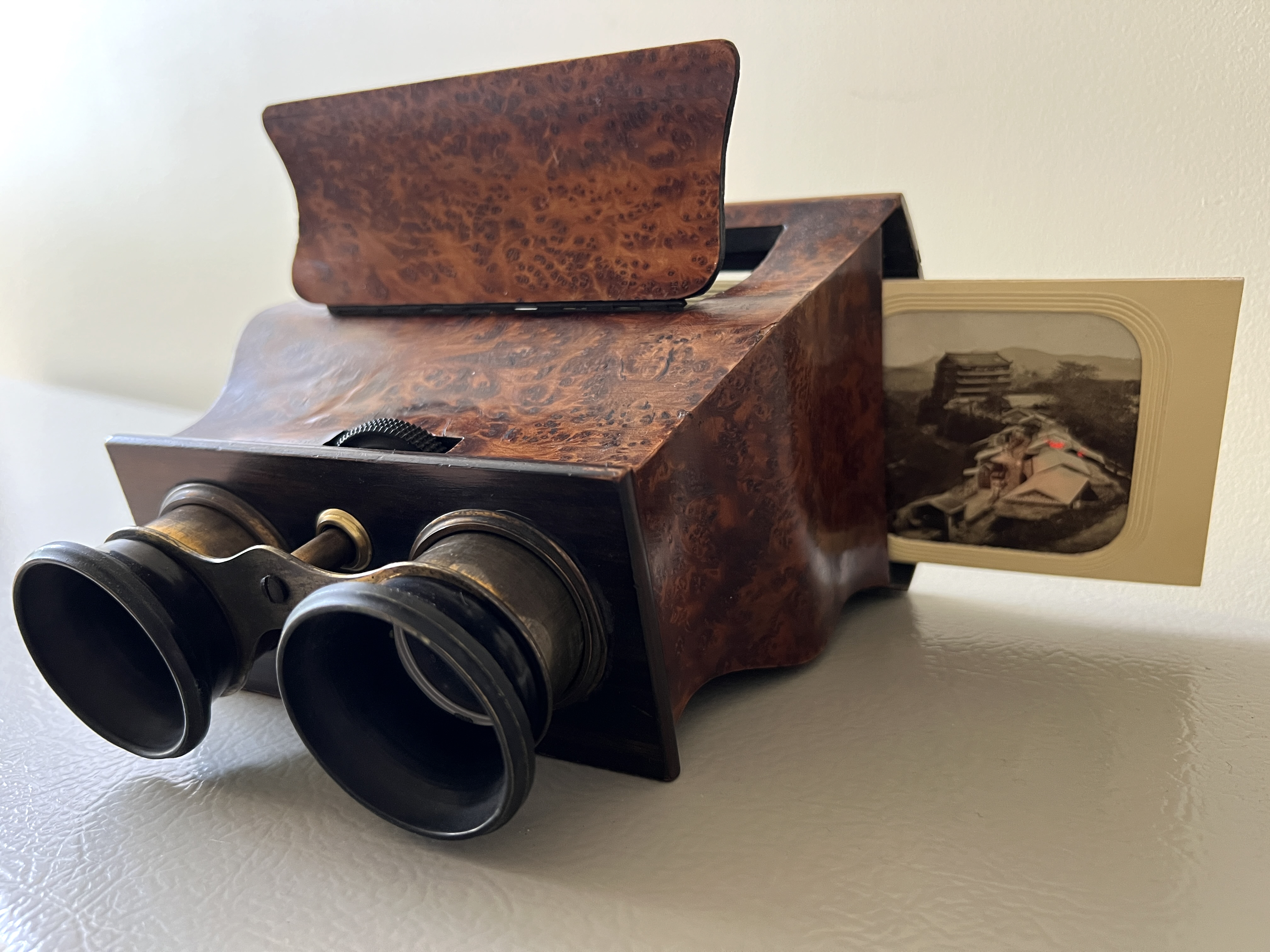 |
Figure RBS.1 – Brewster Stereoscope |
| Photo © Rod Bantjes. |
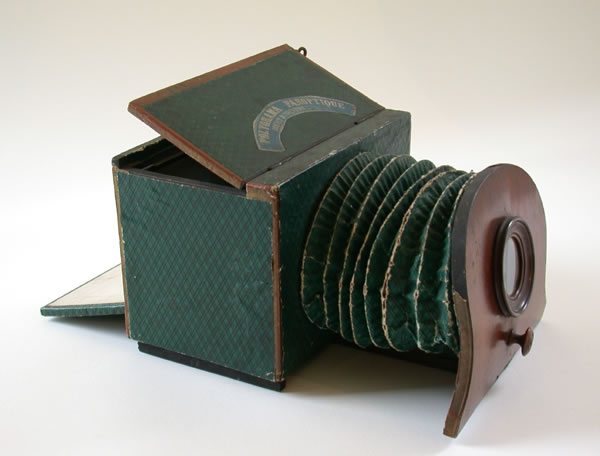 |
Figure RBS.2 – Polyorama Panoptique |
Photo credit: Bill Douglas Cinema Museum. |
This is viewer for stereoscopic images.
How it Works: The stereoscope was designed around the principle of binocular disparity – the idea that in natural vision the images on the left and right retinas are always slightly different. Our minds use that difference to assess and deliver to our awareness an experience of volume and depth. Stereoscopic images, taken from some distance apart (often greater than that between the two eyes), reproduce this binocular disparity. In this way they mimic our actual 3D vision better than all media that had preceded them.
Lenticular Version: David Brewster designed this version of the stereoscope to be more compact than inventor Charles Wheatstone's original instrument. Brewster's is called a "lenticular" stereoscope because it directs each eye to a different image using lenses rather than mirrors which were used in Wheatstone's device.
Together with a pair of well-constructed stereo-images, the stereoscope plays upon our visual system using both the principles of binocular disparity and binocular convergence to produce its striking 3D effect. It is far superior to the older 3D-technology of the optical machine, with its simple convex lens. It is not an optical machine but some people, such as Giorgio Sommer (Figure RBS.3) used it as though it was one. For this reason, Brewster's lenticular stereoscope is included in the Optical Machine Taxonomy as an instructive outlier.
Hybrid with the Optical Machine: Brewster's stereoscope was designed on the inspiration both of Wheatstone's device but also of the small optical machines for paper dioramas of the 1840s. It was a kind of "inter-media hybrid." It looks a little bit like Lefort's Polyorama Panoptique designed in the same year, 1849 (Figure RBS.2). They both have an adjustable lens-plate at the front. They are both enclosed boxes into which you slide an image. They are meant to accept transparent images and therefore have means to control the light revealing the front of the image versus that illuminating the transparency from the back. They both use a mirrored flap for the front. Brewster has used a frosted glass for the back and has dispensed with the flap.
The Brewster box is an example of the stereoscope trying to look like an optical machine. Soon the some optical machines would try to look like stereoscopes – The Brewster-like graphoscope (FOCO-11930), the Neumann Graphoscope (FOCO-3127), The Unis Panoramic (FOCO-31345) – or else incorporate stereoscope elements into their bodies – the Graphoscope-Stereoscope and its variants.
In Figure RBS.1 you can see a half-inserted sterescopic image that was made by Henri Lefort. It is a "tissue view" made with the same technique and producing the same day-night effects as the paper dioramas that Lefort made for his Polyorama Panoptique. This is one crossover between optical machine and stereoscope.
Non-Stereoscopic Images for the Stereoscope
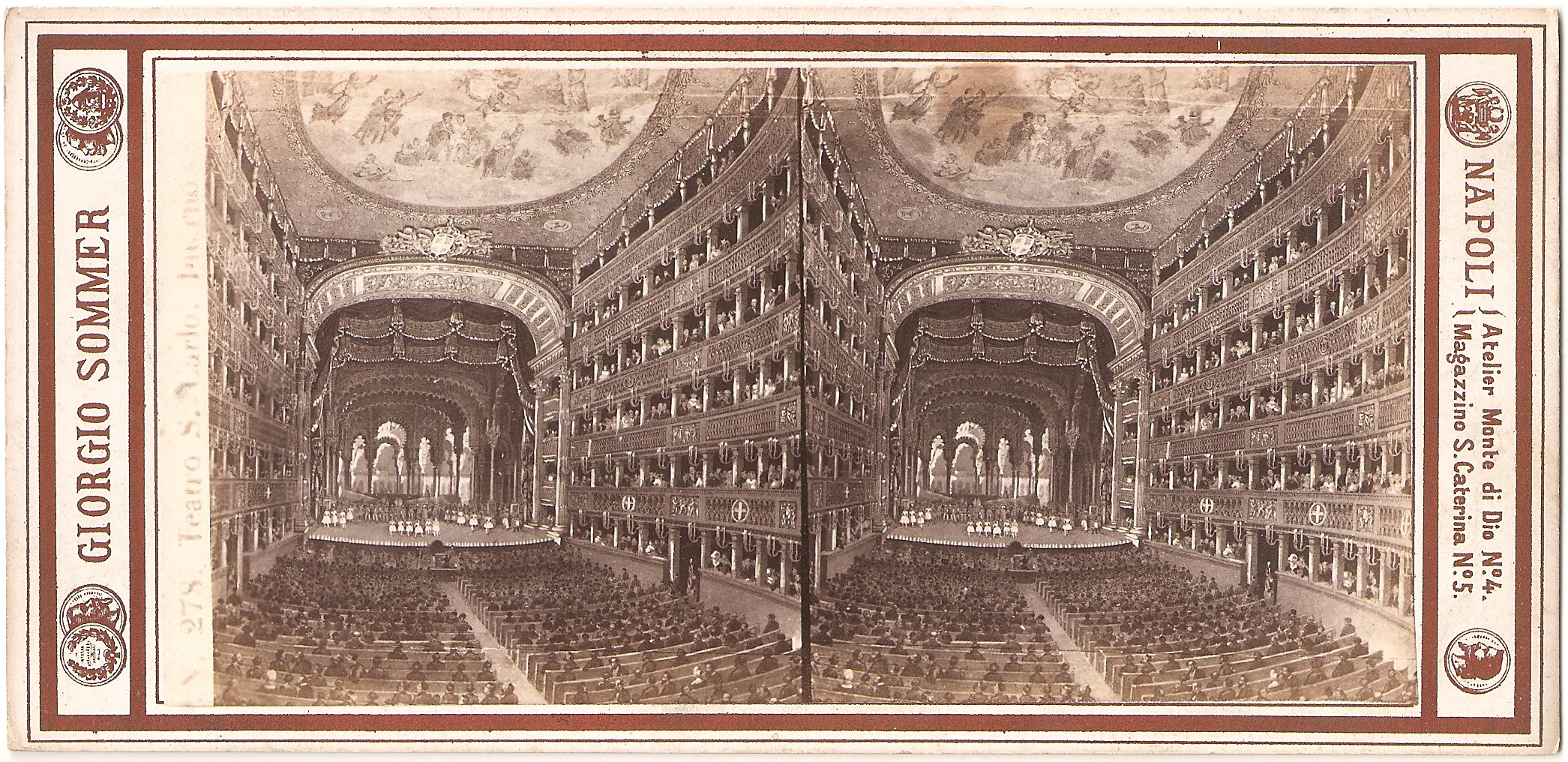 |
Figure RBS.3 – Non-Disparity Images |
| Source: Giorgio Sommer, c. 1870, Teatro della Scala Milano, albumen on paper, 8.5 cm x 17.6 cm, collection of the author. |
Hybrid Projection: The stereogram[1] image that you see on the left is another cross-over from the 18th-century optical machine to the stereoscope. It is in the form of a vue d'optique and is rendered in a distinctive wide-angle perspective known as "hybrid projection". It is also hand-drawn. Hand-drawn images can be stereoscopic, with the depicted objects being in slightly different orientations and their shapes therefore slightly dissimilar. However, not in this case. These paired images are non-disparity and therefore non-stereoscopic. What are they doing in the stereoscope?
Giorgio Sommer could have photographed the interior of this opera house. Exposure times were getting shorter in the 1870s, however, they were still too long to capture the audience and actors on stage without motion-blur. Also, the expanse of the hall could not have been captured with the lenses Sommer had available to him. The camera could not look up at the ornate ceiling and down over the heads of the crowd simultaneously. Early photography reproduced the perceived deficiencies of linear perspective – the restrictive angle of view chiefly – and exposed new ones such as the upward convergence of parallel vertical lines evident when the camera was tilted up.[2] Just as painters had, since the 17th century, struggled with these deficiencies, so did photographers in the 19th. Hybrid projection solved these problems and those who worked with optical devices would have been very familiar with it. It appears that, for many, the 18th-century vue d'optique, hand-drawn in hybrid projection, was in this way superior to the photograph.
There are many examples of hand-drawn stereograms in hybrid projection. They appear in other photographic media as well: the Graphoscope and the Megalethoscope. Carlo Ponti, or possibly Carlo Naya photographed the same drawing used in Sommer's Teatro della Scala Milano (Figure RBS.3), and mounted it as a paper diorama for the Megalethoscope.
The 19th-century homage to the 18th-century optical machine is clear in both the subject, a baroque theatre (also considered to be a form of optical machine), and the rendering of a surround of space in hybrid projection. This is true of examples from the Graphoscope, Megalethoscope and the Polyorama Panoptique.
The Stereoscope as Optical Machine: The strangest thing about this intercourse between the stereoscope and the optical machine is that the non-stereoscopic images when placed in the stereoscope do, surprisingly, have an enhanced 3D effect. It is weaker than a true stereoscopic affect, but similar to what you would experience looking through the lens of an optical machine. True, you are also looking through lenses in the lenticular stereoscope, but these lenses have the reverse effect on the angle of convergence of the eyes to that of the optical machine lenses. The 3D illusion of non-disparity stereograms presents a conundrum that I discuss in "The Optical Machine’s Asynchronic Progress".
It is likely that to many, like Sommer, it made sense to place non-disparity images in the stereoscope because they experienced the weak 3D enhancement effect. In this way the stereoscope became for them a variant of the optical machine.
Endnotes:
[1] This is a case where it is useful to distinguish between the stereogram, the physical card with two images on it, and the stereoview, the 3D scene that one experiences when looking at a properly stereoscopic stereogram in the stereoscope..
[2] Bantjes, Rod, "Vertical Perspective Does Not Exist:" The Scandal of Converging Verticals and the Final Crisis of Perspectiva Artificialis," Journal of the History of Ideas 75, no. 2 (2014).