Rod Bantjes, “BA-24_Cosmorama.html,” created 9 August, 2026; last modified, 9 August, 2026. (https://people.stfx.ca/rbantjes/).
St. James Street Cosmorama
#BA-24
England, 1820
Dimensions: H=490 cm, W=1000 cm, D=1000 cm[xxx]
Lens: H=24 cm, W=16 cm, ƒ= 229cm[xxx]
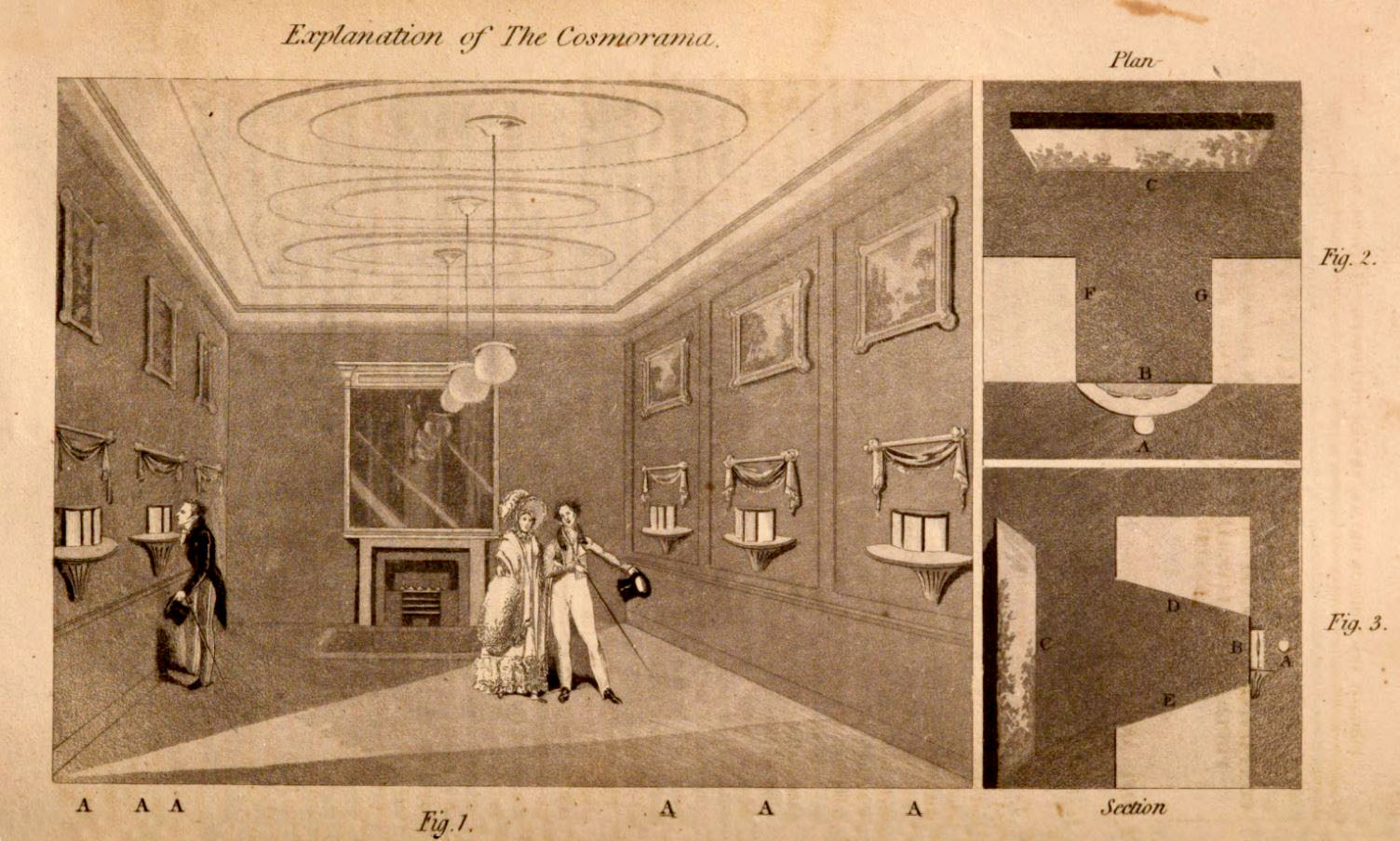 |
Figure BA-24.1 –Cosmorama, St. James's Street, London |
| Source: Blunt, C. “Popular Description of the Cosmorama.” La Belle Assemblée 24, no. 155 (1821): 233. |
The St. James Street Cosmorama was a public picture gallery with lensed viewing stations that enhanced the spatial illusion of paintings erected behind them. It is an example of an “optical machine ” and is included in the Optical Machine Taxonomy as a member of the genus of Indoor Cosmoramas in the cosmorama family.
Thanks to Charles Blunt‘s detailed description, we know more about the technical details of this than any other cosomorama except the Girona Cosmorama which has survived intact. There was a huge variety of cosmoramas in the 19th century, all of them now lost, and we should be cautious about assuming that the St. James Street cosmorams was typical.
The Room: The entire room is purpose-built for this display. The hidden apparatus depicted in Blunt’s figs. 2 and 3, extended at least 2 metres beyond the inner walls. Yet you can see that the corniced ceiling was fitted to those walls. Blunt describes it as a “handsome room, having the air of a small picture-gallery,” with “a commendable air of elegance and comfort.”
Size, Distance and Focal Length of Lenses: Blunt says that the paintings are between 6 and 9 feet from the lens. The lenses are wide enough to view through with both eyes, probably around 16 cm wide and 25 high, Consistent with Joseph Harris's advice in 1775,[xxx] Blunt tells us that the focal length of the lenses is a bit longer than the distance to the image. That ensures that the eyes converge on the painting at a minuscule angle – close to parallel and similar to what they might when viewing an actual, as opposed to a depicted horizon.
Size of the Paintings: Blunt does not give us the measured size of the paintings. But he indicates how to calculate it. The distance between lens and painting is “regulated by the dimensions of the picture, following the established limitation of the best angle of vision, which must be certainly within 60 degrees.” Assuming that the painter observed the standard 60° angle of view when painting the scene, the point of sight for viewing her painting will be the 60° vertex of a triangle whose base is the width of the painting. Using a bit of trigonometry we can calculate that if the painting is 6 feet away, it will be just under 7 feet (two metres) wide. If it were 9 feet from the lens it would be 3.2 metres wide. If the angle of view of the painting were 90°, as some of Sattler's appear to have been, then at 6 feet it would be 3.7 meters wide. Looking at the depiction of the room, it seems likely that 3.7 metre paintings would be bumping up against one another behind their partition. It would also be more than three times the width of all other known cosmorama paintings.
The Triple Lens: At each viewing station there are three lenses arranged in a semi-circle. The lenses are rectangular, each probably cut from a huge lens of around 26 cm diameter. The rationale for having three is unclear. If it were to allow viewers to move their position left and right for a wider perspective on the painting a single lens 16 cm wide would be more than adequate. The only evidence we have of other cosmoramas are the Girona Cosmorama which has only one lens per station, and an engraving of the P.T. Barnum cosmorama, which has two lenses per station, laid flat against the wall and spaced wide enough that two people could view simultaneously. Other curved-front optical machines like the Triple-Lens Trapez-Guckkasten or the Mondo Niovo are meant to accommodate multiple viewers at the same time. The curve of the lens-array gives space to the clustered viewers.
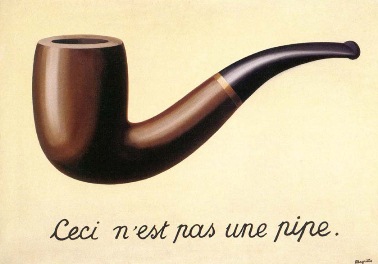 |
Figure BA-24.2 – The Treachery of Images |
| René Magritte, 1929, La Trahison des images, oil on canvas, 60.3 cm × 81.1 cm, Los Angeles County Museum of Art. |
Masking: In his figures 2 and 3, Blunt has depicted the masks whose purpose is to hide all but the painted scene from view. The overhead view in figure 2 is probably mis-drawn – the mask should flare out as it does in the side-on view in figure 3. That is the style in the Girona Cosmorama and in the Trapez-Guckkasten. While an often-touted feature of the cosmorama, masking was hardly original. The mask eliminates distractions and allows the viewer to enter into the imagined world of the painting. By eliminating familiar objects in the room to reference against, it also makes it difficult to estimate the size of the painting. It could be large and distant or small and close at hand.
Size and Illusion or the Illusion of Size: When assessing claims about the apparent size of cosmorama views, it is important to keep in mind René Magritte’s lesson about the treachery of images (Figure BA-24.2). A pipe is about 14 cm long, but what we see is not a pipe but rather dried, pigmented oil on canvas, or in our case, pixels on a screen. How big is the depiction of the pipe? Were we to see it hanging in a gallery, we could assess it relative to the size of the wall, the size of other people in the gallery, its approximate distance from us. If we place the painting in the cosmorama which eliminates all these cues, it becomes impossible to judge its size, just as it is impossible from just looking at it on your screen.
Suppose Magritte painted the pipe from life, placing it a meter away from him and narrowing his angle of view to about 20°. If we place it in the cosmorama with its mask, but without its lenses, then, at a meter away from the lens, the painting will be 35.3 cm wide and the pipe will appear the same size as it did to Magritte – “life-size.” We can place ...cm painting 2 meters away, or a ...cm version 50 cm away and the apparent size of the pipe will not change (or at least it will project identically-sized images onto the retina).
Adding the lenses complicates matters. Following optical machine theory, the lens for the close painting should have a focal length of ca. 52 cm, the lens for the more distant painting should have a focal length of around 2.2 meters. The longer the focal length, the weaker the magnification. A lens of 2-meter focal length has almost no curvature and minimal, but just perceptible, magnification. The closer painted pipe will project a slightly larger image on the retina than the further one. We could interpret that as an abnormally large pipe; or we could read it as a pipe that is closer to us than it was to Magritte when he painted it. We tend to assume that it is a life-sized pipe closer to us because we already know what size pipes are. That is true of any recognizable depicted thing, whether still-life, landscape or portrait. Without contradictory clues we read it as life-size at some proportionate distance from us. When people in the 19th century say that an image, in the cosmorama, stereoscope or panorama, appears life-size, that is more an indicator of their willingness to “make believe” that the depicted scene is real than of the technical character of the apparatus. They, and modern commentators who accept what they say uncritically, are mislead by the old paradigm of geometric optics according to which optical devices can somehow force us to perceive images in determinate ways.[xxx]
The Effect of Scale: Does the scale of the cosmorama paintings make a difference? The near version of the painting viewed through a shorter-focal-length lens will magnify the painted surface more than the large-scale, more distant painting with long-focus lens. This is a function both of distance and magnification. In the large version you can see the image just as clearly, but not the painted substrate. That helps the willing viewer to make believe that the image comes from things in the world rather than pigmented oil on canvas
Endnotes:
[xxx] These are estimates based on Blunt’s drawing. Width is calculated to include the mechanisms behind the walls.
[xxx] Blunt says that the distance from lens to painting is 6 to 9 feet (I have taken the average here) and that the focus of the lens is somewhat more than that.
[xxx] Harris, Joseph. A Treatise on Optics London: B. White, 1775, Bk-II/Sect-IV/Prop-XXVII/No-316/Sckol-2/p-230.
[xxx] See Bantjes, Rod. 2021. “The Optical Machine’s Asynchronic Progress.” Technology and Culture 62(4):1119-42.