Rod Bantjes, “Family_Cosmorama.html,” created 19 August, 2026; last modified, 19 August, 2026 (https://people.stfx.ca/rbantjes/).
Cosmorama Family (1820-1890)
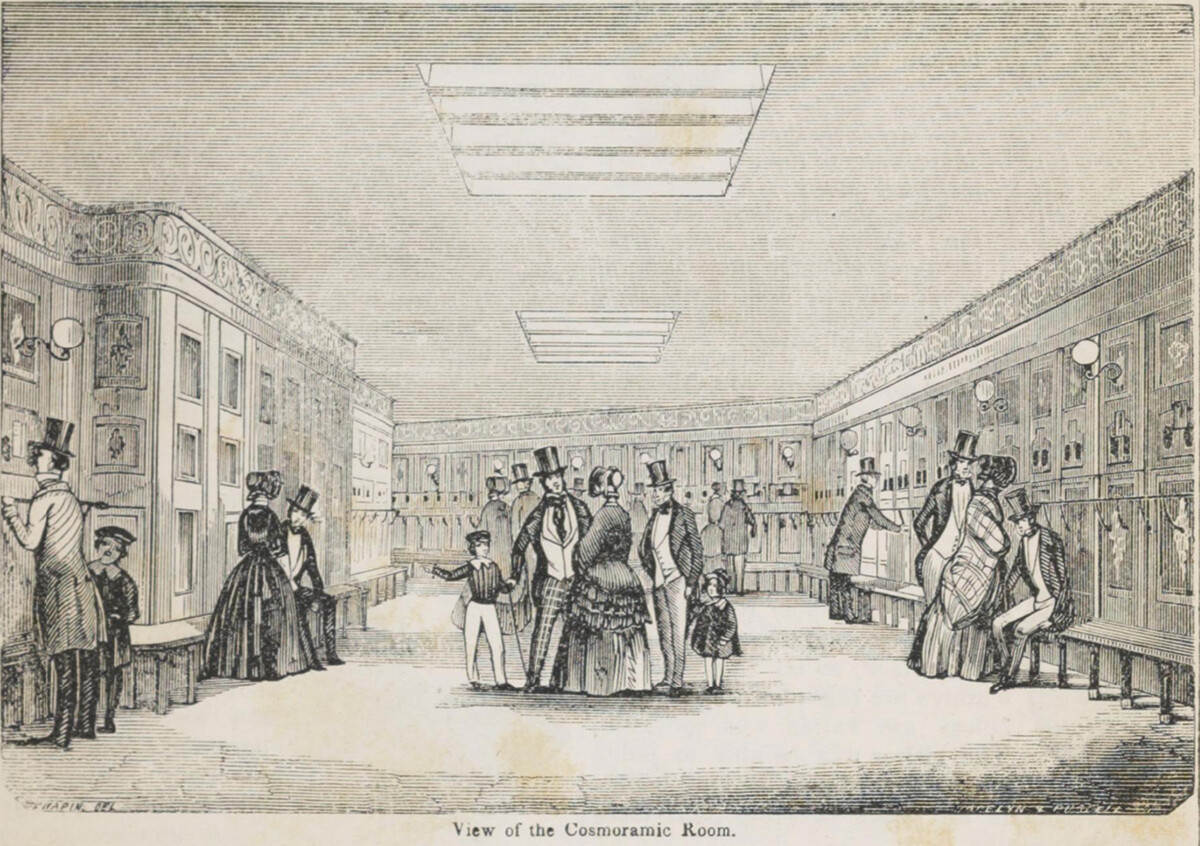 |
Figure CF.1 –Cosmorama |
| Source: Guidebook to P.T. Barnum’s American Museum, New York, cited in Flores, Victor. 2026. “Imperial Visions on Tour: Cosmoramas, Neoramas, and Eurocentrism in Andorfer’s Grand Optical Gallery.” Early Popular Visual Culture, February, 1–27. doi:10.1080/17460654.2025.2605312. |
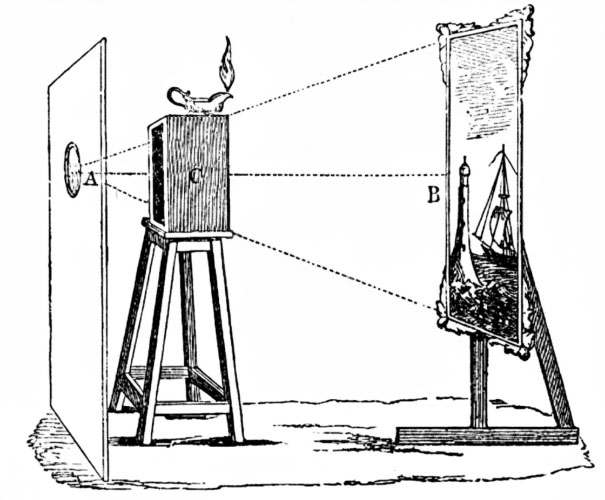 |
Figure CF.2 –Cosmorama Mechanism[xxx] |
| Source: Clarke, William. The Boy's Own Book; a Complete Encyclopædia of All the Diversions ... Of Boyhood and Youth. London: W. Kent & Company, 1859. |
1.0 Definition
The Cosmorama is an exhibition where the pictures are viewed through convex lenses in order to enhance their 3D effect. It is characterized by numerous separate lenses (or clusters of lenses) looking onto separate images. It is an example of an “optical machine” and is included in the Optical Machine Taxonomy.
1.1 Genteel Peepshow: John Timbs in 1867 described the cosmorama as “but an enlargement of the street peep-show; the difference not being in the construction of the apparatus, but in the quality of the pictures exhibited.”[xxx] True, all the components of the mechanism illustrated in Figure CF.2 – the image within an enclosure, the lens, the masking frame – were features that could be found in Raree Shows and other optical machines in 1820. However, at least initially, the setting was different – the old mechanisms were housed in elegant salons in fashionable neighbourhoods.
1.2 Paintings vs Prints: Timbs elaborated on what he meant by the “quality of the pictures”, writing, “in the common shows, coarsely-coloured prints are sufficiently good; in the Cosmorama a moderately good oil-painting is employed.” Paintings held greater prestige than prints, which carried the stigma of mechanical reproduction.[xxx] However, the trouble with defining the cosmorama by this feature is that, as John Plunkett has shown, many ordinary Raree Shows began using paintings rather than prints in the 19th century[xxx] and would therefore have to be called cosmoramas, and many cosmoramas later began using prints: chromolithographs in the case of the Grand Cosmorama and Neorama in Portugal (1857)[xxx] and vues d'optique in the case of the Girona cosmorama. The shift from paintings back to prints is one indication of the declining prestige of the cosmorama over time.
2.0 List of Genuses
Each row in the following table represents a different genus of the cosmorama family:
| Indoor Cosmorama: | 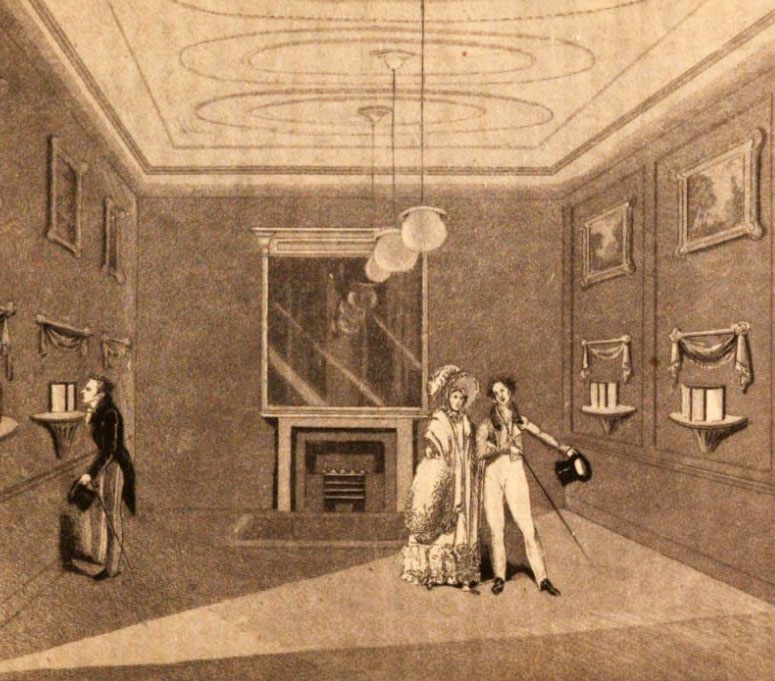 |
| Indoor Cosmorama |
This was the original style: a multiple-station peepshow within a gallery setting. The images are not back-illuminated.
| Cosmo-Diorama: | 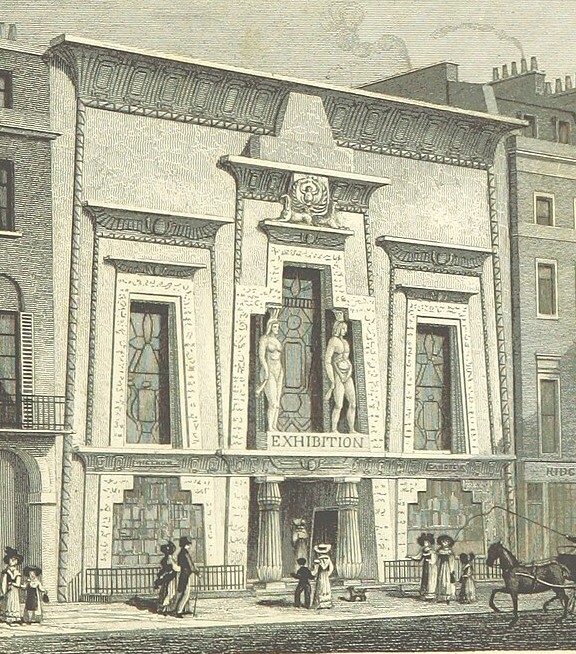 |
| Genus Link |
This was an indoor cosmorama with images that could be back-illuminated for atmospheric effects. It is an inter-media hybrid between cosmorama and diorama (of 1821). The “Pœcilorama,” a promoter's name for a particular Cosmo-Diorama, opened in London in the Egyptian Hall in 1826. A reviewer for The Times pronounced that, “ In mere pictorial excellence all the views are infinitely superior to the Cosmorama.”[xxx]
| Cosmo-Panorama: | 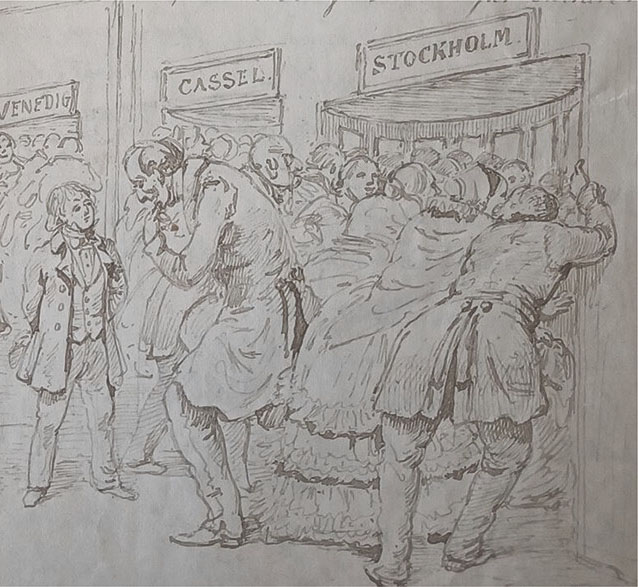 |
| Cosmo-Panorama |
This was an indoor cosmorama with panoramic images displayed on curved surfaces and viewed through lenses. The Enslen cosmo-panorama, depicted here, was a touring exhibit that had 180° painted panoramas, three meters long, displayed behind separate stations with concave curved lens arrays.[xxx]
| Outdoor Cosmorama: | 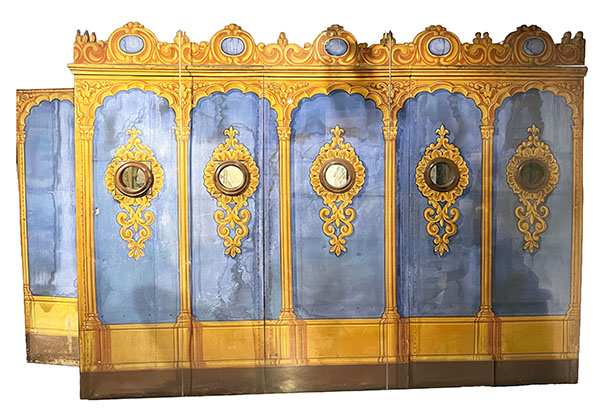 |
| Outdoor Cosmorama |
These cosmoramas were set up outdoors in markets and fairs.
| Cosmo-Raree: | 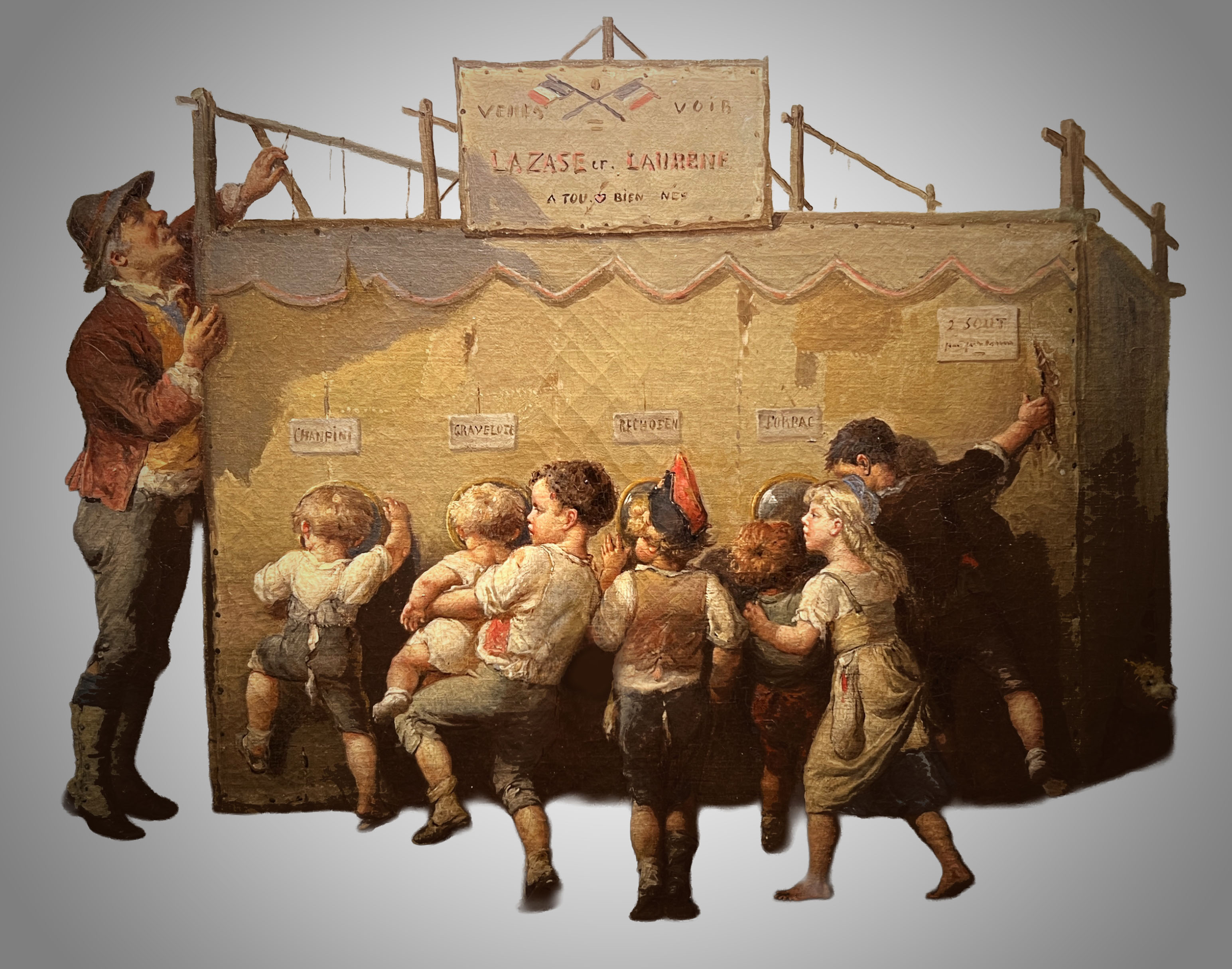 |
| Cosmo-Raree |
This was an outdoor cosmorama that incorporated a pull-string mechanism for changing views, like a Raree Show.
| Cosmo-Zogroscope: |  |
| No Image available |
This was late 19th-century indoor cosmorama, an inter-media hybrid between a cosmorama and a zogroscope. It was described in 1890 as consisting of “eight or ten coloured drawings executed in body colours laid horizontally round a semicircular table, and reflected in mirrors placed diagonally opposite to them. The spectator looks at them through convex lenses placed immediately in front of each mirror. The exhibition takes place by lamplight only, and the lamps are so placed as not to be reflected in the fields of the mirror.”[xxx]
| Photo-Cosmorama: | |
| No Image available |
A photo-cosmorama was a cosmorama that used photographs as images.[xxx] Their relation to the cosmorama is similar to the relationship of the Graphoscope to tabletop optical machines like the Boîtes Dioramique.
3.0 Optics
All descriptions of Cosmorama optics indicate large (binocular) lenses. Arnott, a contemporary authority referenced by commentators on the cosmorama and likely consulted by makers of cosmoramas,
4.0 The Cultural Prestige of the Optical Machine
4.1 Mechanical Perception /Representation: What initially drew my interest to the optical machine was the way in which it challenged a persistent paradigm of perception. It exploited the unconscious physiology of binocular vision to produce a visual effect. An older paradigm had encouraged the assumption that seeing was fully available to the theatre of consciousness. Its defining metaphor was the camera obscura in which, just like in the eye, there is a perfect picture or “representation” of the external world which we apprehend immediately. Problems for this idea were present from the start. In the early 17th century, for example, René Descartes was well aware that pictures as we understand them could not travel through the optic nerve to the brain.[xxx] George Berkeley showed that we can't judge distances by eye without unconsciously importing prior tactile experience.[xxx] Slowly, a counter-paradigm emerged which recognized that visual perception involved processing by a kind of hidden machinery within the organism.
The emergent paradigm was not attractive to many because it was materialist and its mechanisms obscure. The ideas and new imaging devices that embodied those ideas met with resistance. The raree-show for example came to represent a benchmark for the lowest, most “deceptive” form of visual display against which others could be measured.[xxx] All of the optical machines suffered to some degree from the disrepute of the “mechanical.” The cosmorama was designed to overcome that stigma. The failure of that attempt is what I find interesting.
4.2 Mechanickal Art: The leading Romantic writers and critics of the early 19th century opposed the materialism of Enlightenment philosophy. They also recoiled from the machinic and commercial elements of popular culture in their own era, including the great machinery of illusion: the panorama, diorama, cosmorama, and even the theatre.[xxx] These were all objects of their disdain. Their critique hinged on an older binary opposition between “mechanickal” and “liberal” arts. Mechanickal arts were merely technical, produced for money by people without critical thinking for people without discernment, whereas “liberal” arts were produced freely by geniuses for those of discerning taste:
| Mechanickal | Liberal | |
| Type of action | Bodily, manual, material | Mental, conceptual, ideal |
| Decision-making | Conventional, rule-following | Creative, genius |
| Motivation | Private financial gain (market) | Free and for public benefit (polis) |
| Prestige | Low, associated with servility | High, associated with ruling |
4.3 Realism as Deception: For these critics, the very success of new media in creating an experience of immersion, of being lost within the world of the image, undermined their status as fine art. The role of the artist, as they saw it, was not to “imitate“ nature or “deceive“ the eye of the spectator. While art critic William Hazlett recognizes that in some sense painting is a deception in which “We discover distance in a glazed surface,“[xxx] I think the deeper anxiety was about new media that played on the perceptual apparatus of the viewer in ways that they were unconscious of. The viewer of an Optical machines, for example, experiences a spatial effect by means unknown to them. Their reception of the illusion is bodily and involves no particular cultural understanding or discernment. The artist was meant instead to communicate mind-to-mind, spirit-to-spirit. Technical proficiency in representation was important (and rather difficult to distinguish from manual arts and imitation), but the power of his or her ideas – historical, emotional or spiritual – had to predominate. The viewer demonstrated her discernment and cultural distinction through her understanding of and feeling for the high ideals expressed.
Romantic ideas were based on doubtful philosophical distinctions between mind and matter as well as ideological conceptions of class distinction. Its proponents had to deny the materiality of conventional perspective painting[xxx] and overplay the mechanical character of new media. More to the point, they gave no compelling argument for why it was impossible to create conceptual art in a mechanical medium. Nonetheless the stigma against mechanical media was tremendously powerful, in part because it rested on unquestioned cultural assumptions built into the mechanical-liberal binary. Contemporary artist Thomas Gainsborough, who loved the new media and created work for his own show-box, was reluctant to make that work public for fear of damaging his reputation as a serious artist.
The Prestige of Location and Architecture:
The cosmorama was an early and not entirely successful attempt to elevate the optical machine from its lowly status as a “mechanical” art by placing it in an exhibition context reserved for high art.
institutional permanence of a dedicated building...
Showmen and Narration:
Declining Prestige of the Cosmorama:
It was an appeal to the supposedly sophisticated tastes of aristocratic and genteel publics as well as those aspiring bourgeois classes who sought to emulate them. But it was also an attempt – alongside the panorama and diorama – to shape public taste and gain acceptance for apparatus-mediated art.
Endnotes:
[xxx] Strictly speaking, the cosmorama depicted in Figure CF.2 is not a cosmorama by our definition since it lacks multiple viewing stations. it does have an easel for mounting the image which we know was a feature of the Girona Cosmorama. The scale of the cosmorama and the flexibility needed for mounting exhibitions might have necessitated such a feature. While the easel is a feature that does not appear in any other optical machine, the evidence is too scarce to make it one of the defining features of this device.
[xxx] Timbs
[xxx] Cited in Plunkett, John. 2026. “Cosmoramas, Immersive Viewing and the Evolution of Peep Practice.” Early Popular Visual Culture, August, 1–26. doi:10.1080/17460654.2026.2700727.
[xxx] Wood, Gillen D'Arcy. The Shock of the Real: Romanticism and Visual Culture, 1760-1860. New York: Palgrave, 2001, 7, 69; Hazlitt, William. Sketches of the Principal Picture-Galleries in England. London: Taylor and Hessey, 1824, 5.
[xxx] Plunkett, John, “Peepshows for All: Performing Words and the Travelling Showman,” Zeitschrift für Anglistik und Amerikanistik 63, no. 1 (2015), 22.
[xxx] Victor Flores and Susana S. Martins, eds., Cosmorama: The Forgotten Medium, Lisbon: CICANT, 2025.
2.0 List of Genuses:
[xxx] Moens, Bart G. “Itinerant Cosmorama Practices and Exhibition Networks in Northwestern Europe: Carl Georg Enslen’s Travelling ’Room Journeys‘ (1810s–1860s).” Early Popular Visual Culture (2026): 1-24.
[xxx] Moens. “Itinerant Cosmorama Practices”
3.1 Mechanical Perception /Representation Endnotes:
[xxx] William Hazlett for example, describes a proper art gallery by assuring the reader that it ”is not a bazaar, a raree-show of art, a Noah's ark of all the Schools, marching out in endless procession ; but a sanctuary, a holy of holies, collected by taste, sacred to fame, enriched by the rarest products of genius.” (Hazlitt, William. Sketches of the Principal Picture-Galleries in England. With a Criticism on "Marriage a-La-Mode". London: Taylor and Hessey, 1824, 3.)
[xxx] Descartes, René. “Discourse and Essays: Optics.” Translated by John. Cottingham, Robert. Stoothoff and Dugald. Murdoch. In The Philosophical Writings of Descartes., edited by John Cottingham, Robert Stoothoff and Dugald Murdoch. Cambridge: Cambridge University Press, 1984, 105, 165, 167.
3.2 Romantic Disdain Endnotes:
[xxx] Concerning the 18th-century conception of the theatre as a machine, see “ Theatre Maquette.”
3.3 Realism as Deception Endnotes:
[xxx] The full quote is: “The world of art is an enchanting deception. We discover distance in a glazed surface ; a province is contained in a foot of canvass; a thin evanescent tint gives the form and pressure of rocks and trees ; an inert shape has life and motion in it. Time stands still, and the dead re-appear, by means of this ‘so potent art!’”(Hazlitt, Sketches, 30.)
[xxx] For a media archaeology demonstration of the materiality of perspective painting see “The van der Heyden Device: Perspective Painting as a Peep-Show”.